
Open-Source AI vs Closed AI: Which Path Wins?
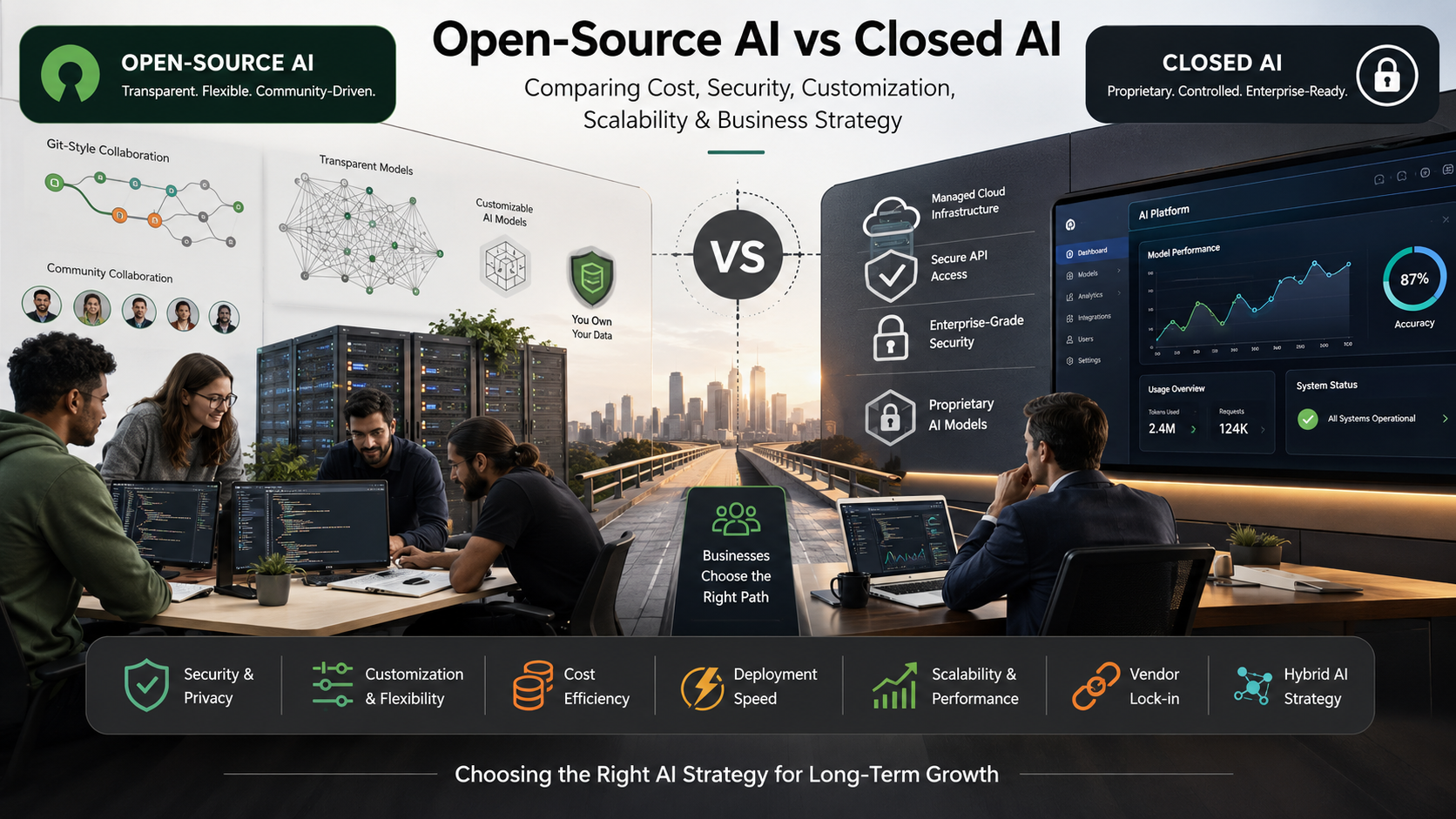
The debate around open-source AI vs closed AI is reshaping how businesses approach artificial intelligence. Companies adopting AI must decide between transparent, community-driven models and proprietary systems controlled by private providers.
Open-source platforms, such as Hugging Face AI models and resources, have shown how collaboration can accelerate innovation. These platforms allow developers to access, modify, and deploy AI models with greater flexibility. They also provide a growing ecosystem where researchers and businesses can explore different AI solutions.
Closed AI platforms offer another advantage: simplicity. They provide ready-to-use tools, managed infrastructure, and fast deployment without requiring companies to maintain complex AI systems.
Choosing the right approach depends on several factors, including budget, technical expertise, security requirements, and long-term business goals. This guide explores the key differences between open and closed AI, including cost, customization, privacy, scalability, and vendor dependency.
Understanding the Foundations of the AI Divide
The difference between open-source AI and closed AI begins with one fundamental factor: ownership and access. AI systems are built using several important components, including training data, model weights, algorithms, architecture, and source code. The level of access a company receives determines how much control it has over the technology and how easily it can adapt the system for future needs.
In open-source AI models, developers and organizations can examine how the technology works internally. They can review the model structure, analyze performance, modify components, and create solutions designed for specific industries. As a result, open-source AI encourages collaboration, transparency, and continuous improvement among researchers and developers worldwide.
On the other hand, closed AI operates under a proprietary model. Companies keep their source code, model weights, and development processes private. Instead of accessing the internal system, users interact with the technology through applications, platforms, or APIs. Therefore, businesses gain convenience and faster implementation but have limited control over how the AI model functions behind the scenes.
Ultimately, the difference between these two approaches represents a broader technology decision: control versus convenience. Open-source AI gives organizations greater independence and customization, while closed AI provides simplicity and managed performance. Before choosing an AI strategy, businesses should evaluate their technical resources, security requirements, and long-term goals to determine which approach best supports their future growth.
What Is Open-Source AI?
Open-source artificial intelligence refers to AI models where important components are publicly available. These may include source code, model weights, documentation, and development tools.
This approach allows developers and organizations to download, modify, and host AI systems independently. They can adjust models for specific industries, improve performance, and create customized applications.
The main advantages of open-source AI include:
- Greater transparency into model operations
- More control over data and infrastructure
- Freedom from complete dependence on one provider
- Ability to customize models for specialized tasks
Open-source AI also encourages global collaboration. Researchers and developers can review, improve, and build upon existing technology.
However, open models require technical knowledge. Companies must manage hosting, security updates, hardware requirements, and ongoing maintenance.
What Is Closed AI?
Closed AI, also known as proprietary AI, is developed and controlled by a private organization. Users typically access these systems through APIs or software platforms.
The underlying model architecture, training process, and weights remain private. Companies cannot directly modify the core technology.
Closed AI platforms focus on convenience and speed. Providers manage:
- Infrastructure maintenance
- Model updates
- Security improvements
- Performance optimization
This makes proprietary AI attractive for businesses that want fast implementation without building an internal AI team.
The main limitation is reduced control. Organizations depend on the provider’s pricing, policies, availability, and development decisions.
For many businesses, closed AI provides the fastest path from idea to working product.
Open-Source AI vs Closed AI: Key Differences
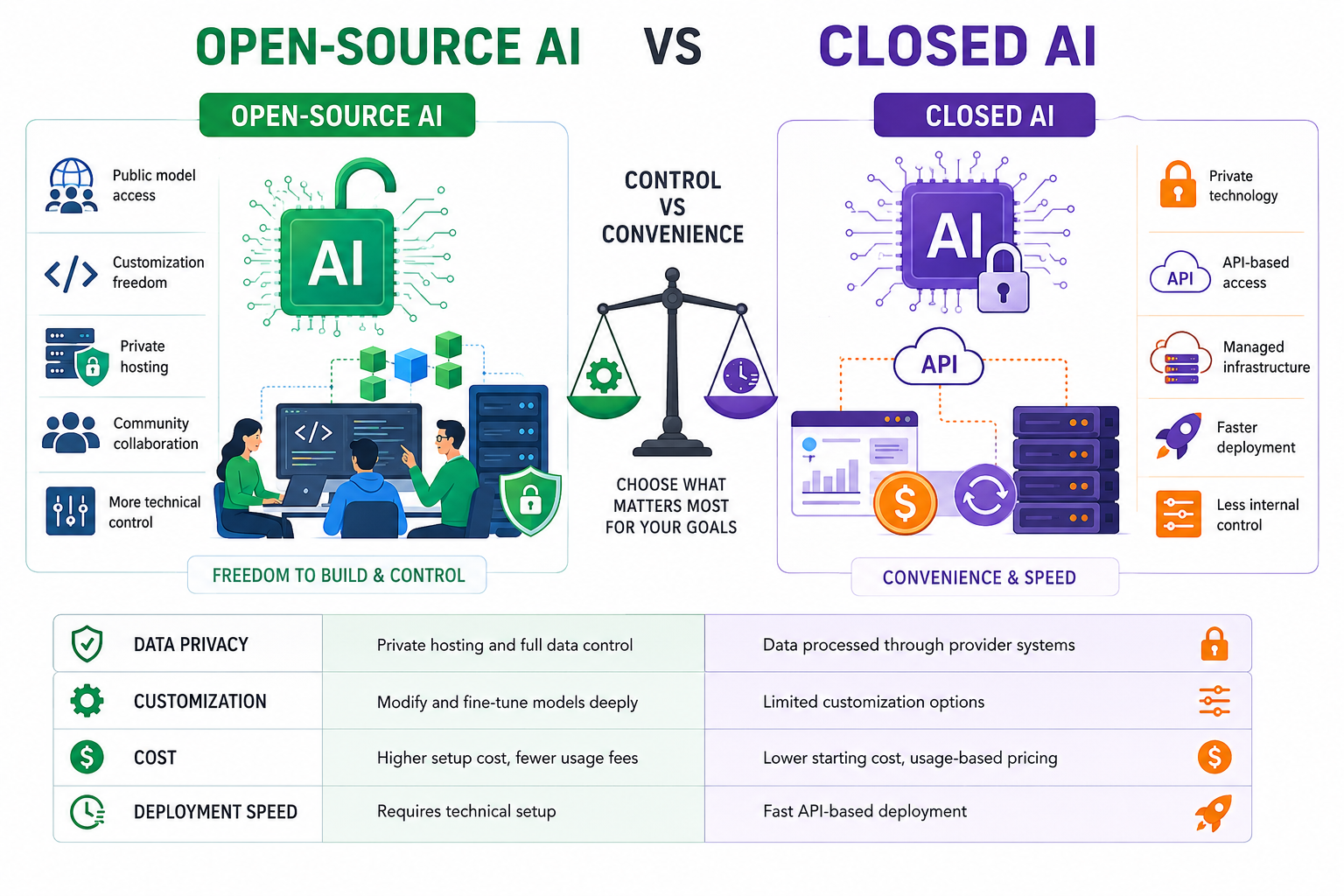
Both AI approaches offer unique benefits. The better option depends on business goals, technical resources, and compliance needs.
| Feature | Open-Source AI | Closed AI |
|---|---|---|
| Data Privacy | Full control through private hosting | Data processed through provider systems |
| Customization | Deep model modification available | Limited customization options |
| Cost | Higher setup costs but fewer usage fees | Lower starting cost with usage-based pricing |
| Deployment Speed | Requires technical setup | Quick access through APIs |
Data Security and Privacy Control
Data protection is one of the biggest reasons organizations consider open-source AI. When companies host AI models internally, sensitive information remains within their own infrastructure.
This is especially important for industries such as healthcare, finance, and legal services. These sectors often handle confidential information and must follow strict compliance requirements.
Closed AI providers usually offer strong security systems and compliance features. However, businesses still share data with external platforms when using cloud-based AI services.
For organizations with strict data sovereignty requirements, open-source AI can provide greater control. Companies can decide where data is stored, how models operate, and who can access information.
Security depends on implementation, though. Poorly managed open-source systems can create risks if companies fail to maintain updates and protection measures.
Customization and Technical Flexibility
Customization is another major difference between open-source and closed AI systems.
Closed AI platforms usually provide limited customization through tools such as prompt engineering and fine-tuning. These options can help businesses create brand-specific responses or improve task performance.
However, users cannot change the fundamental architecture of proprietary models.
Open-source AI offers deeper flexibility. Developers can modify model components, adjust performance settings, and train systems for specific industries.
This makes open models valuable for organizations building unique AI products. Businesses can create specialized solutions that match their exact requirements.
The trade-off is complexity. Custom AI development requires skilled engineers, computing resources, and ongoing technical management.
Cost Considerations and Infrastructure Requirements
The cost difference between open-source and closed AI is not always simple.
Closed AI platforms usually have lower entry costs. Businesses can begin using AI immediately without purchasing expensive hardware or hiring specialized teams.
Most providers charge based on usage, making costs predictable for smaller projects.
Open-source AI can become more affordable at large scale. Companies avoid repeated API fees and gain complete control over deployment.
However, they must invest in infrastructure, including:
- GPU computing resources
- Cloud hosting expenses
- AI engineering expertise
- System maintenance
The best financial choice depends on usage volume. Small businesses often benefit from closed platforms, while large organizations may gain advantages from open systems.
Choosing the Best AI Strategy for Your Business
There is no single winner in the open-source AI vs closed AI debate. Instead, the right choice depends on your company’s goals, technical resources, budget, and long-term technology strategy.
Before selecting an AI approach, businesses should evaluate several important factors. The decision should not be based only on popularity or current trends. Instead, companies should consider how AI will support their operations in the future.
Key factors include:
- Required level of customization: Determine whether your business needs simple AI features or highly specialized models.
- Data privacy requirements: Evaluate whether sensitive information must remain within your own infrastructure.
- Available engineering resources: Consider whether your team can manage AI development and maintenance.
- Expected AI usage scale: Estimate whether your AI demand will remain small or grow significantly.
- Long-term technology plans: Review how the AI solution fits into your future business goals.
Additionally, many organizations are adopting a hybrid AI strategy. This approach combines the advantages of both models. Companies may use closed AI tools for rapid testing and open-source AI systems for important internal applications.
As a result, businesses gain faster development while maintaining greater control over critical AI processes. A hybrid approach can provide flexibility, reduce risk, and support long-term innovation.
When to Choose Closed AI
Closed AI is often the better option for companies that need fast implementation and minimal technical complexity. Because providers manage the infrastructure, businesses can start using advanced AI capabilities without building their own systems from the beginning.
For startups and smaller companies, this approach can be especially valuable. They can focus on improving products, serving customers, and testing new ideas instead of managing servers, security updates, and AI maintenance.
Furthermore, closed AI platforms provide access to powerful models through simple APIs and user-friendly tools. This makes them suitable for teams with limited machine learning experience.
Closed AI is useful when:
- Speed is more important than customization
- Internal AI expertise is limited
- The project is still being tested
- Professional support and managed services are valuable
However, businesses should also consider potential limitations. The biggest concern is vendor lock-in. When a company depends heavily on one AI provider, changes in pricing, policies, or available features can create challenges.
Therefore, closed AI works best for organizations that value convenience, quick deployment, and reduced operational responsibility.
When to Choose Open-Source AI
Open-source AI is a strong choice for organizations that prioritize control, flexibility, and long-term independence. Unlike closed systems, open models allow businesses to access and modify important parts of the technology.
For companies with experienced engineering teams, open-source AI provides opportunities to create highly customized solutions. Organizations can adjust models, improve performance, and build AI systems that match their specific business requirements.
Open-source AI works well when:
- Data privacy is a top priority
- Deep customization is required
- Long-term independence matters
- AI provides a major competitive advantage
Although open-source AI often requires a larger initial investment, it can provide significant benefits over time. Companies gain more control over their technology and reduce dependence on external providers.
Moreover, organizations can avoid some risks associated with proprietary platforms, such as unexpected pricing changes or limited access to features.
Ultimately, open-source AI is most suitable for businesses that view artificial intelligence as a core strategic asset and have the resources to manage their own AI infrastructure.
Frequently Asked Questions About Open-Source AI vs Closed AI
Which is more secure: open-source AI or closed AI?
When comparing security, open-source AI and closed AI follow different approaches. Open-source AI provides stronger control over data because organizations can host models on their own private servers or secure cloud environments. As a result, sensitive information can remain within the company’s infrastructure instead of being transferred to external providers.
However, closed AI platforms also provide strong security advantages. Major AI providers invest heavily in cybersecurity, encryption, monitoring systems, and compliance standards. Therefore, businesses that use proprietary AI can benefit from professionally managed security without maintaining everything internally.
At the same time, open-source AI gives organizations greater transparency. Companies can review the model, control access, and customize security measures according to their requirements. For this reason, industries with strict regulations, such as healthcare and finance, often consider open-source solutions.
Ultimately, the more secure option depends on the organization’s technical skills, compliance needs, and ability to manage infrastructure. In other words, open-source AI offers more control, while closed AI offers more convenience.
Is open-source AI always cheaper?
Although open-source AI is often considered a low-cost option, it is not always cheaper in every situation. The total cost depends on factors such as project size, usage volume, infrastructure needs, and technical requirements.
On one hand, open-source AI can reduce long-term expenses because companies avoid repeated API fees. For example, large organizations running millions of AI requests may save money by hosting models themselves.
On the other hand, open-source systems require additional investments. Companies may need powerful GPUs, cloud resources, AI engineers, and maintenance teams. Therefore, the initial setup cost can be higher compared with ready-to-use AI services.
Meanwhile, closed AI platforms often provide lower entry costs. Businesses can access advanced models quickly without purchasing hardware or hiring specialized teams. As a result, smaller companies and startups may find proprietary AI more affordable.
In conclusion, open-source AI can become more cost-effective at scale, whereas closed AI is often better for smaller projects with limited resources.
Can closed AI models be customized?
Yes, closed AI models can be customized; however, their flexibility is usually limited compared with open-source alternatives. Most proprietary platforms provide customization through APIs, prompt engineering, workflow settings, and fine-tuning options.
For instance, businesses can adjust AI responses to match their brand voice, improve customer service interactions, or create specialized workflows. Additionally, these tools allow companies to improve performance without managing complex technical systems.
Nevertheless, closed AI platforms usually prevent users from modifying the core model architecture. Because of this limitation, organizations cannot fully change how the system processes information or optimize every internal component.
In contrast, open-source AI provides deeper customization opportunities. Developers can modify model weights, retrain systems, and adapt AI solutions for highly specific tasks.
Therefore, closed AI is a practical choice for businesses that need useful customization quickly. However, companies requiring complete control and advanced modifications may benefit more from open-source AI.
What is vendor lock-in in AI?
Vendor lock-in happens when a company becomes highly dependent on one AI provider’s technology, pricing structure, or services. As a result, switching to another platform can become difficult, expensive, and time-consuming.
For example, a business may build its applications around a specific proprietary AI API. Later, if the provider changes pricing, updates its terms, or removes features, the company may face challenges when moving elsewhere.
Furthermore, migration often requires software changes, employee training, and workflow adjustments. Therefore, businesses should consider long-term flexibility before choosing a single AI provider.
In comparison, open-source AI reduces vendor dependency because organizations control the model and infrastructure. Consequently, companies can move systems between different environments and adjust technology according to their needs.
However, open-source solutions also require responsibility. Organizations must manage updates, security, and maintenance themselves. Ultimately, the best choice depends on whether a company values independence or managed convenience.
Which AI approach is faster?
Generally, closed AI provides faster deployment because providers manage infrastructure, updates, and optimization. Businesses can connect to AI services through APIs and start building applications immediately.
Because of this simplicity, startups and smaller teams can launch AI features without investing in complex hardware or machine learning expertise. Additionally, providers handle performance improvements behind the scenes.
However, open-source AI requires more preparation. Organizations must select suitable models, configure hosting environments, optimize performance, and maintain the system over time.
Despite these challenges, open-source AI can deliver excellent results when managed properly. For example, experienced engineering teams can customize models and improve efficiency for specific business needs.
Ultimately, closed AI is usually faster for immediate deployment, while open-source AI provides greater flexibility for organizations willing to invest more time and resources. Therefore, the right choice depends on project goals, technical ability, and long-term strategy.
Conclusion: Open-Source AI vs Closed AI
The choice between open-source AI vs closed AI will influence how businesses manage technology, costs, and innovation.
Closed AI offers speed, simplicity, and reliable performance. It helps teams launch AI solutions without managing complex infrastructure.
On the other hand, open-source AI provides greater control, customization, and independence. It allows organizations to protect sensitive data, reduce vendor restrictions, and build AI systems tailored to their specific needs. Businesses interested in understanding the fundamentals of open AI models can explore this detailed open-source AI guide for additional insights.
Many businesses are moving toward a hybrid approach. They combine proprietary tools for quick development with open-source models for strategic applications.
The best choice depends on your goals, resources, and future plans. Evaluate your security needs, budget, technical capabilities, and growth strategy before selecting an AI path.