
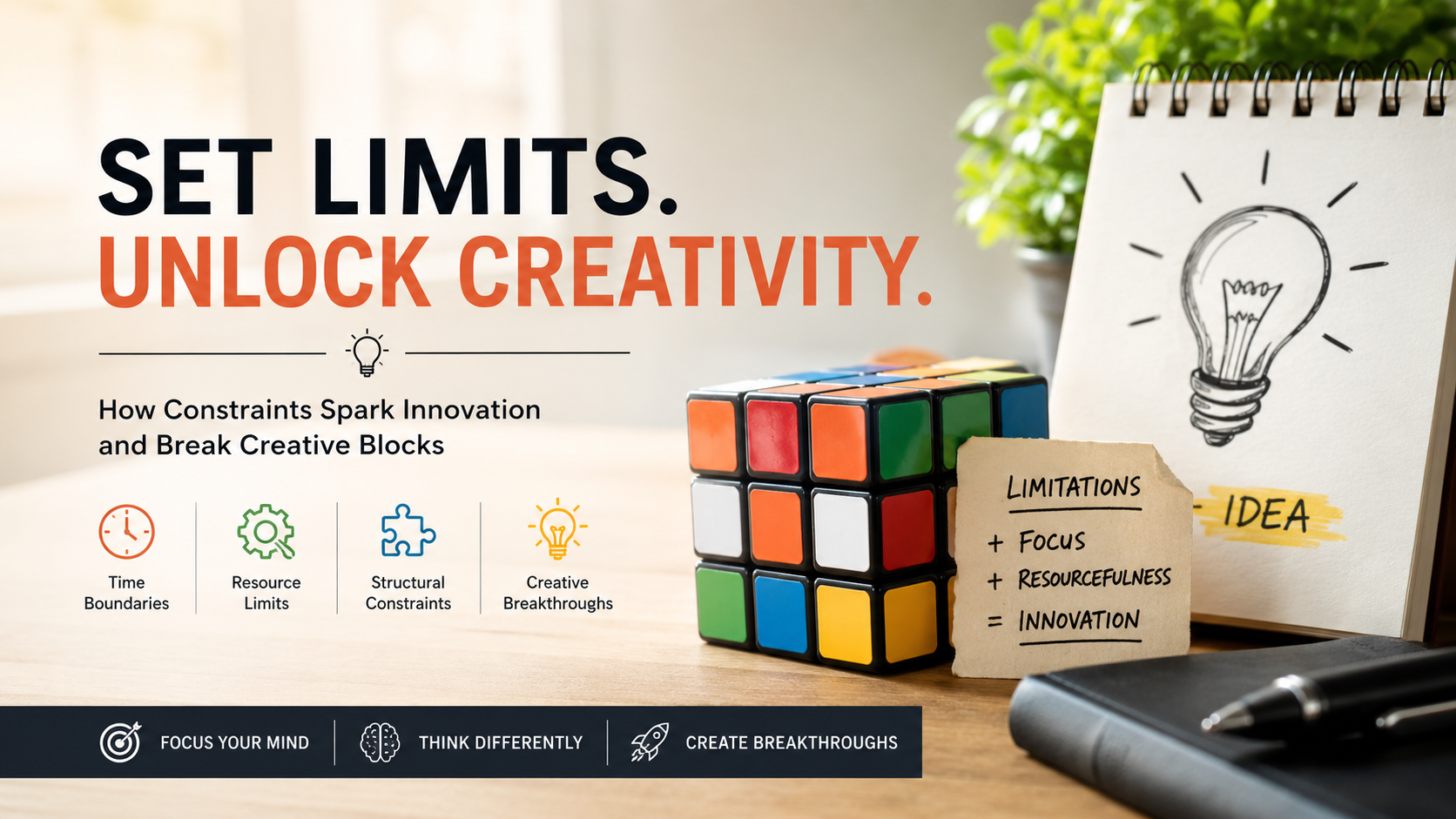
Setting Up Constraints to Inspire Creative Thinking
When we think of creativity, we often picture absolute, unbridled freedom. We imagine a blank canvas with infinite possibilities, zero rules, and a completely open horizon to explore. However, having endless options frequently leads to creative paralysis rather than groundbreaking innovation. By intentionally setting up constraints, you can break through mental blocks. This strategy forces your brain to find unique, unexpected solutions. Boundaries do not stifle your passion. Instead, they give your mind a specific problem to solve, which channels your mental energy much more efficiently.
Boundaries act as a vital catalyst for deeper cognitive processing and problem-solving. According to psychological insights shared on the Harvard Business Review, people often achieve their most innovative breakthroughs when they operate under strict, uncompromising limitations. When resource or design limits force us out of our comfort zone, we abandon obvious answers. We start to look at problems from entirely new angles. This article will explore the fascinating science behind restrictive innovation. We will look at why a lack of options can supercharge your focus. We will also learn how to design structured limitations for your own projects. Whether you are an artist, a software developer, or a business strategist, mastering this mindset will transform how you approach your daily work.
The Paradox of Total Creative Freedom
Most people assume that more resources, more time, and more choices naturally lead to better outcomes. However, psychologists often refer to the burden of unlimited choice as the “tyranny of freedom.” When you can do absolutely anything, deciding where to start becomes an exhausting chore. This choice paralysis drains your mental energy before you even begin. Your brain wastes critical time sorting through infinite paths instead of executing a single, focused idea. This choice overload often causes creators to procrastinate or give up entirely out of sheer exhaustion.
By setting up constraints, you can eliminate this analysis paralysis. Narrowing your field of vision down to a manageable scope allows you to focus entirely on execution. You no longer suffer from the anxiety of infinite choices. Instead of wondering what to build from a million possibilities, you focus your intellect on how to build something extraordinary within a strict set of rules. This mental shift turns a vague, overwhelming goal into a structured puzzle that your brain can actively solve.
How Mental Boundaries Fuel Innovation
When faced with a rigid limitation, your brain cannot rely on its default settings or past habits. You cannot use the same tools, budgets, or processes you always use to get by. Consequently, this friction forces your mind to find clever, unconventional workarounds. You will quickly discover options that you never would have considered otherwise. Necessity truly becomes the mother of invention when you strip away the luxury of standard options. Many of the world’s most iconic designs and stories were born directly out of severe limitations.
Consider some famous historical examples of creative limitations that changed culture:
-
Dr. Seuss: Written using a list of only 50 distinct words, Green Eggs and Ham became a massive global hit. The constraint forced incredible rhythm and simplicity.
-
Twitter/X: The original 140-character limit forced users to be concise, witty, and punchy. This strict limitation completely reshaped digital communication and how we consume information.
-
Apollo 13: Engineers famously saved the astronauts by building a carbon dioxide filter using only the random items available on the spacecraft. This historical event proved that scarcity drives ultimate resourcefulness.
Designing Strategic Limitations for Your Projects

To use this approach effectively, you must learn how to design the right types of boundaries for your specific workflow. If a constraint is too loose, it will not trigger your resourcefulness. It will fail to push you past your standard habits. Conversely, if it is too tight, it will paralyze your progress and cause unnecessary frustration. Finding the sweet spot is an art form that requires experimentation and self-awareness.
1. Time-Based Boundaries
Giving yourself too much time to complete a project usually invites intense procrastination and toxic perfectionism. When deadlines are far away, we spend days tweaking minor details that do not actually matter. Try implementing strict time limits, such as the Pomodoro technique or tight, self-imposed project deadlines. When you only have two hours to finish a complete draft, you stop overthinking every single syllable. You simply start producing raw, authentic work. This urgency forces your brain to prioritize momentum over perfection, leading to cleaner and faster output.
2. Resource and Budget Restrictions
A massive budget can sometimes lead to lazy decision-making and bloated projects. When you limit your budget, software tools, or raw materials, you must become highly resourceful to achieve your goals. For example, building a website using only native HTML and CSS forces you to focus heavily on clean layout design. It also forces you to prioritize fast loading speeds and beautiful typography. You cannot hide a weak design behind heavy animations or complex plugins. Scarcity forces you to master the core fundamentals of your craft, ensuring the final product is built on a solid foundation.
3. Structural and Format Restraints
Imposing a strict format can completely change your creative output and reveal hidden talents. If you are a writer, try telling a complete, emotionally resonant story in exactly 100 words. If you are a graphic designer, try building an entire user interface using only two corporate colors. These structural guardrails force you to maximize the value of every single element you choose to include. You quickly learn to cut out the fluff. You focus purely on what delivers the most impact to your audience, resulting in highly potent work.
Embracing the Art of Restrictive Innovation
Shifting your mindset to view limitations as a gift rather than a curse takes consistent practice. Instead of complaining about what you lack, start celebrating the clear boundaries you have in front of you. These parameters give you a specific framework to play within. This shift makes the creative process highly engaging, structured, and predictable. When you know the exact rules of the game, you can play it with much more confidence and precision.
Moreover, working within a structured framework makes it much easier to measure your overall success. You know exactly what the rules are. This clarity allows you to judge your final product against those specific criteria objectively. Ultimately, boundaries do not cage your creativity; they give it a steady, reliable ladder to climb. By welcoming limitations into your daily routine, you unlock a sustainable way to create high-quality work. Best of all, you no longer have to rely on the fickle nature of random inspiration.
FAQ SECTION
Why does setting up constraints actually help creative thinking?
Setting up constraints helps because it eliminates analysis paralysis and reduces cognitive load. When you have too many choices, your brain feels completely overwhelmed and struggles to make a definitive final decision. By introducing clear boundaries, you reduce the number of paths available to you, which focuses your attention. This structure forces your mind to dive deeply into a single problem, pushing you to abandon obvious, superficial answers. Consequently, you discover highly innovative solutions that you otherwise would have ignored in a sea of endless possibilities. Limitations turn a vague goal into a concrete puzzle, making the creative process far more productive and less stressful for your mind.
What are some common examples of creative boundaries?
Common boundaries include strict time limits, tight budgets, or deliberately limited toolsets. For example, a photographer might challenge themselves to shoot an entire photo series using only a single fixed prime lens. This limitation forces them to move physically to find unique angles. A writer might attempt to draft an informative article using simple vocabulary without any industry jargon to ensure maximum accessibility. Setting up constraints like these forces software developers to build applications using a minimal amount of code to optimize performance. These structured limitations break routine habits and force creators to look at their chosen medium from an entirely fresh, resourceful perspective that yields unexpected artistic breakthroughs.
Can a constraint ever be too restrictive?
Yes, boundaries can absolutely become too restrictive if they are not balanced correctly. If a limitation completely starves you of the vital tools, essential information, or reasonable time required to finish a task, it causes intense frustration rather than creative inspiration. The goal of this framework is to create healthy friction that sparks resourcefulness, not an impenetrable brick wall that causes a dead end. If you find yourself completely stuck, stressed out, and unable to make any meaningful progress on your project, you should simply loosen the rules slightly until you find a productive balance that challenges you without crushing your spirits.
How do businesses use limitations to build better products?
Businesses use limitations to foster lean innovation, reduce waste, and speed up their development cycles significantly. By working under tight deadlines or minimal budgets, product development teams are forced to focus purely on core features rather than unnecessary, complicated fluff. Setting up constraints during the design phase often leads to a highly effective minimal viable product (MVP) that solves a specific user problem cleanly and efficiently. Stripping away excess resources prevents teams from over-engineering solutions, ensuring that the company delivers value to the market quickly while conserving capital and adapting rapidly to real-world customer feedback.
How can I apply this concept to my daily writing routine?
You can easily apply this by setting a strict word count limit or a tight timer for your daily writing sessions. For instance, try writing a comprehensive summary of a complex topic in fewer than 150 words, which forces you to choose every sentence with absolute precision. Alternatively, give yourself exactly twenty minutes to write a messy first draft without stopping to edit or fix typos. Setting up constraints in this manner prevents your hyper-critical inner editor from stalling your creative flow early on, allowing you to generate momentum and produce a high volume of raw material that you can refine later.
CONCLUSION
True innovation rarely happens in a vacuum of absolute, unbridled freedom. Instead, human ingenuity thrives when we encounter friction, strict limits, and difficult obstacles. By deliberately setting up constraints in your daily work, you give your mind the solid structure it needs to excel and innovate. Rather than viewing a tight budget, a short deadline, or a strict format as a frustrating roadblock, you should learn to embrace it as a powerful creative tool that sharpens your focus. Managing your time or selecting the right tools can be incredibly streamlined when utilizing the best productivity apps for Windows 11, which provide excellent frameworks to lock down your focus.
Boundaries strip away the paralyzing noise of infinite choices, allowing you to focus deeply on what truly matters to your project. They force you to stretch your resources, rethink your typical processes, and discover clever solutions that you never would have seen on a completely blank canvas. The next time you find yourself staring blankly at a screen or a project board, stop waiting for random inspiration to strike you. Instead, intentionally build a tight box around your ideas by setting up constraints and see how quickly your mind finds a brilliant, unexpected way to break out.