
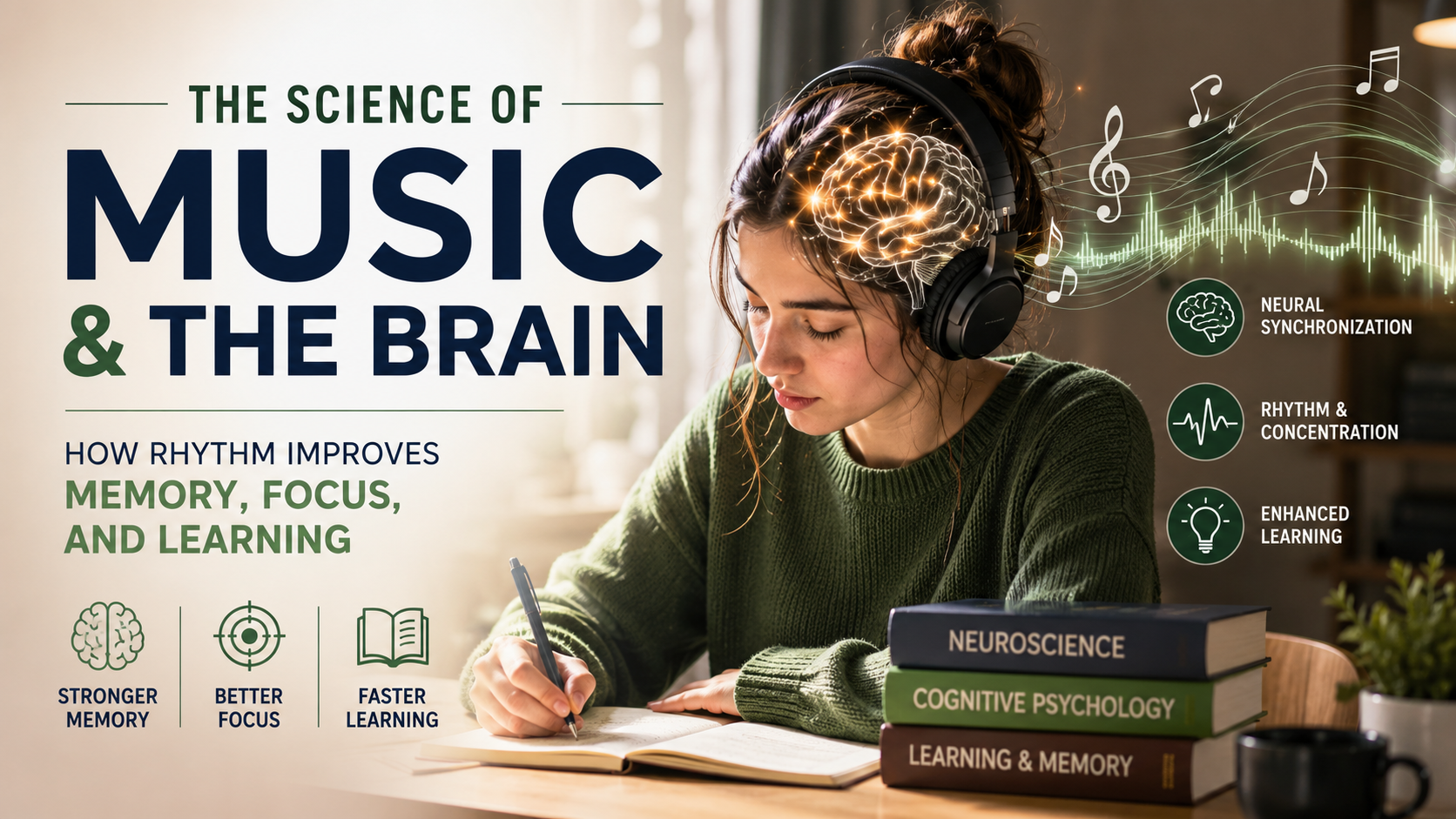
The Science of Music and the Brain: How Rhythm Improves Memory, Focus, and Learning
Have you ever wondered why a familiar song brings back vivid memories? The relationship between music and the brain is a fascinating area of modern neuroscience. When you listen to a beat, your neural pathways light up instantly. Sound waves travel through your ears as electrical signals. These signals activate multiple brain regions at the same time. Researchers at the National Institutes of Health study how auditory stimuli reshape cognitive functions. Their findings prove that sound is much more than simple entertainment.
Rhythm acts as a powerful workout for your mind. It engages areas responsible for auditory processing and motor control. It also stimulates emotional regulation and deep memory recall. Because rhythm creates predictable patterns, it helps structure how you process information. The connection between music and the brain becomes especially useful during intense learning. Whether you are studying for an exam or learning a new skill, rhythmic cues elevate your performance.
Understanding this mental process allows you to use sound strategically. In this guide, we will explore how sound affects your mind. We will examine how specific rhythms sharpen concentration. Finally, you will learn practical ways to use music for memory improvement.
How Music and the Brain Process Auditory Rhythms
Your mind is an expert pattern recognition machine. When sound vibrations enter your ears, the auditory cortex translates timing and pitch. Rhythms act as timing anchors in your mental environment. They provide a predictable structure for your neural networks. This allows your mind to anticipate incoming information easily.
This acoustic processing involves several connected neural structures. The auditory cortex decodes pitch, tone, and volume. Meanwhile, the cerebellum tracks timing and physically aligns with the beat. Furthermore, the hippocampus links musical patterns directly to long-term memory. The prefrontal cortex manages decision-making and concentration.
When you listen to a steady tempo, your brainwaves align with the beat. Neuroscientists call this process neural entrainment. Through neural entrainment, music and the brain synchronize effectively. Your mind moves out of a sluggish state and enters an optimal frequency. This synchronization improves neural communication efficiency and reduces mental fatigue during long study sessions.
HOW NEURAL ENTRAINMENT WORKS
Auditory Input
│
▼
Cerebellum / Auditory Cortex
│
▼
Neural Synchronization ◄──────── Rhythm / Pattern Recognition
│
▼
Enhanced Cognitive State
│
▼
High Memory & Deep Concentration
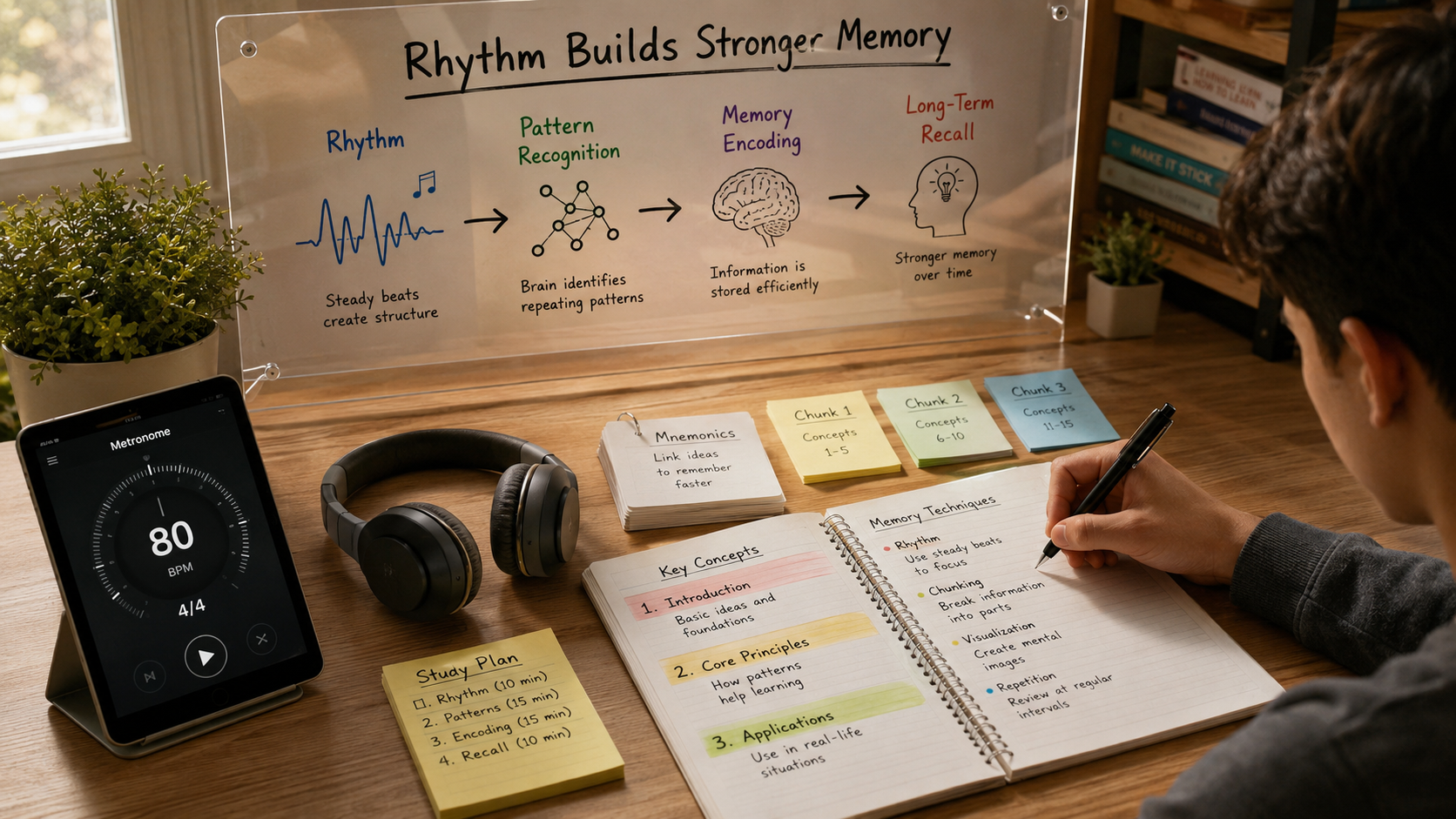
How Brain and Sound Waves Enhance Memory Retention
Rhythm creates a structural frame for memory retention and recall. Think about how children learn the alphabet. They do not memorize twenty-six isolated letters. Instead, they sing a rhythmic song. The underlying beat binds the letters together. This turns separate data into a cohesive memory structure. As a result, the mind retrieves the information effortlessly.
In the hippocampus, auditory cues stimulate synaptic plasticity. This process strengthens the connections between communicating neurons. When you study while listening to repetitive acoustic patterns, you create dual-coding memory pathways. You store textual information alongside the rhythmic framework. Consequently, retrieving that stored knowledge becomes much easier over time.
Musicians break complex compositions into smaller phrases to master difficult passages. You can apply this exact chunking strategy to academic learning. Dividing dense information into rhythmic units prevents working memory overload. By organizing data with consistent rhythms, you consolidate long-term memories more effectively. This improves recall speed during exams or public presentations.
| Memory Technique | Cognitive Benefit |
|---|---|
| Rhythmic Mnemonics | Improves rapid recall of list items |
| Neural Synchronization | Strengthens long-term memory consolidation |
| Dual-Coding Processing | Creates multiple neural retrieval paths |
Sound Synchronization, the Brain, and Concentration
Not all auditory inputs affect your mind in the same way. Fast or erratic music can trigger subtle stress responses. These unwanted sounds elevate cortisol and fragment your focus. Conversely, steady rhythms encourage sustained concentration by dampening internal distractions. To maximize deep focus, instrumental tracks without lyrics are essential.
Language-based songs compete directly for processing space in language centers. Listening to vocal tracks while reading causes cognitive interference. Your mind tries to process two speech streams at once. In contrast, instrumental soundscapes with a steady tempo foster alpha brainwaves (8–12 Hz).
Alpha brainwaves reflect a state of relaxed alertness and effortless learning. By stabilizing your neural oscillations, ambient music minimizes mental wandering. This lowers task-switching fatigue significantly. Understanding how music and the brain interact helps you build an optimal study environment. You can immerse yourself in challenging work for extended periods without feeling drained.
| Brainwave Type | Frequency (Hz) | Associated Cognitive State |
|---|---|---|
| Theta | 4–7 Hz | Creative Flow & Intuition |
| Alpha | 8–12 Hz | Relaxed Focus & Deep Learning |
| Beta | 13–30 Hz | Alert Problem Solving |
Practical Strategies for Neural Music Processing
To turn neuroscientific insights into daily productivity habits, build a deliberate auditory workspace. Simply playing random background songs will not yield optimal results. Instead, select specific sound styles tailored to your exact task. Matching audio characteristics to your workload optimizes mental energy and focus throughout the day.
For tasks requiring logical reasoning or reading, choose instrumental tracks at 60 to 80 beats per minute. Classical music and ambient soundscapes work best here. For repetitive administrative tasks, slightly faster tempos around 100 to 120 beats per minute work well. They increase alertness and working speed without overloading your mental capacity.
Additionally, lo-fi beats and binaural beats serve as exceptional study tools. Lo-fi music uses repetitive rhythmic loops that anchor attention while filtering out noise. Binaural beats present slightly different frequencies to each ear through headphones. This technique encourages target brainwave states like alpha or theta waves. Pairing these methods with structured study intervals ensures sustained performance.
FAQ SECTION
How does music and the brain interaction improve study habits?
The interaction between music and the brain improves study habits by activating both brain hemispheres simultaneously. This dual engagement strengthens neural communication pathways. Consequently, your mind processes, organizes, and retains incoming information much more efficiently. Rhythmic sound patterns provide a predictable temporal framework that reduces cognitive load. This prevents working memory burnout during intense learning sessions.
Furthermore, listening to steady instrumental music encourages the production of alpha brainwaves. Alpha waves promote a state of calm alertness ideal for deep focus. This mental state lowers stress and cortisol levels during difficult tasks. Additionally, background acoustic soundscapes effectively mask unpredictable environmental noises. They block out sudden conversations or street traffic that would otherwise interrupt your concentration. By creating a consistent environment, music establishes a reliable psychological trigger for daily study routines.
What type of music works best for deep concentration?
Instrumental music with a steady tempo of 60 to 80 beats per minute works best for deep concentration. Genres like classical compositions, ambient soundscapes, video game soundtracks, and lo-fi beats are particularly effective. These genres lack vocal lyrics, which is crucial for focus. Lyrics compete directly for processing bandwidth in the language centers of your mind. They diminish your reading comprehension and writing performance significantly.
By removing linguistic elements, non-vocal music allows your brain to dedicate its full working memory to complex tasks. Furthermore, video game soundtracks are specifically composed to encourage focus without causing distraction. Maintaining a constant sound environment stabilizes your neural rhythms in the alpha wave spectrum. This steady state ensures that you can enter and sustain deep work without feeling mentally exhausted.
Can listening to rhythm boost long-term memory recall?
Yes, listening to structured rhythm can significantly boost long-term memory recall. Rhythm creates strong structural anchors within the hippocampus and related memory networks. When you learn information alongside consistent acoustic patterns, your brain forms dual-coding memory pathways. Your mind stores factual information together with the rhythmic auditory structure, creating multiple retrieval routes in your neural network.
When you recall that information later, triggering the same rhythmic framework helps extract the stored data faster. Neuroscientists have demonstrated that rhythmic synchronization enhances synaptic plasticity. This physically strengthens the connections between neurons involved in memory consolidation. The connection between music and the brain proves that integrating rhythm into learning preserves information long-term and improves retrieval speed during exams.
Are binaural beats genuinely effective for focus?
Binaural beats can be genuinely effective for enhancing focus when used correctly with stereo headphones. This phenomenon occurs through neural entrainment. During entrainment, the brain synchronizes its internal electrical oscillations with an external auditory stimulus. When you play two slightly different frequencies into each ear, your auditory cortex reconciles the difference. It produces an internal perception of a third frequency beat.
When this frequency difference falls within the alpha wave range (8 to 12 Hz), it encourages relaxed focus. It also reduces anxiety and enhances cognitive absorption. Psychological and neuroscientific studies indicate that binaural beats can help reduce task-switching behavior. They improve sustained attention during demanding study sessions. While individual responsiveness varies, binaural beats offer an evidence-based method to optimize brain states for learning.
Does fast-paced music hinder cognitive performance?
Fast-paced or emotionally intense music can hinder cognitive performance during tasks that require complex logical reasoning. High-tempo music—typically exceeding 120 beats per minute—stimulates the sympathetic nervous system. It elevates heart rate, blood pressure, and central nervous system arousal. While this physiological boost benefits physical exercise, it often generates excessive mental noise during demanding intellectual work.
This over-arousal taxes your prefrontal cortex and working memory. It leaves fewer neural resources available for processing new concepts. Furthermore, abrupt rhythmic changes or sudden volume spikes frequently trigger the brain’s involuntary orienting response. This breaks your focus and forces your mind to readjust to the environment. To protect your cognitive bandwidth during intense study sessions, avoid fast-paced, dramatic tracks. Opt instead for calm, steady, and predictable acoustic structures.
Is it better to study in total silence or with background sound?
Whether it is better to study in total silence or with background sound depends on your personality and task complexity. Total silence provides a pristine cognitive space with zero auditory interference. This can be highly advantageous for difficult mathematical problem-solving or dense analysis. However, absolute silence is rarely attainable in real-world settings. Minor, unpredictable noises like a distant chair moving become jarring and disruptive.
Conversely, ambient background sound or steady rhythmic music creates a consistent auditory mask. This mask smooths out unpredictable noise spikes, making your environment far less distracting overall. Studies demonstrate that moderate ambient sound can stimulate abstract thinking and creative problem-solving. If you find absolute silence unnerving, using low-volume background rhythms offers the perfect compromise for maintaining deep concentration.
CONCLUSION
The connection between music and the brain offers a powerful blueprint for optimizing cognitive function and daily focus. Far beyond simple entertainment, auditory rhythms directly influence neural timing and stimulate synaptic plasticity. Early exposure to structured sound can even influence long-term neural growth, which is why music lessons support healthy child development and lay a strong foundation for lifelong learning. By organizing incoming information into predictable structures, steady beats reduce cognitive fatigue and help build resilient memory pathways throughout your lifetime.
Integrating sound intentionally into your daily work routine requires minimal effort yet yields immediate productivity results. Choose the right tempo and stick strictly to lyric-free instrumental arrangements. Using auditory entrainment techniques like lo-fi or binaural beats can completely transform your learning environment. These evidence-based adjustments mask disruptive background noises and stabilize your attention span. Understanding how music and the brain interact turns demanding study sessions into productive experiences.
Ultimately, your mind is biologically wired to respond to sound and rhythm in profound ways. When you design an acoustic workspace that aligns with your natural rhythms, you unlock higher levels of concentration and clarity. Experiment with various instrumental genres today. Identify the specific tempos that best support your focus, and harness the remarkable power of sound to sharpen your intellect.