The Ultimate Creative Guide: Best AI Tools for Image Generation 2026
The landscape of digital creation has shifted dramatically, and finding the best ai tools for image generation 2026 is now a priority for designers, marketers, and developers alike. In early 2026, the launch of highly efficient architectures like Google’s Nano Banana 2 (Gemini 3.1 Flash Image) completely changed expectations around speed and quality. Navigating this rapidly evolving space requires a clear understanding of which models excel at photorealism, typography, and commercial safety. According to the Google Search Central documentation, high-quality, helpful content must always prioritize user intent and technical transparency, especially as AI-generated imagery becomes a core component of the modern web ecosystem.
Understanding these tools matters because selecting the wrong engine can lead to distorted anatomical features, garbled text layouts, or compliance issues. This comprehensive review breaks down the top platforms dominating the creative industry right now. We will evaluate real-world performance, unique rendering strengths, and specialized features like vector exports and conversational canvas editing to help you select the ideal tool for your specific workflow.
THE TOP AI IMAGE GENERATION LANDSCAPE IN 2026
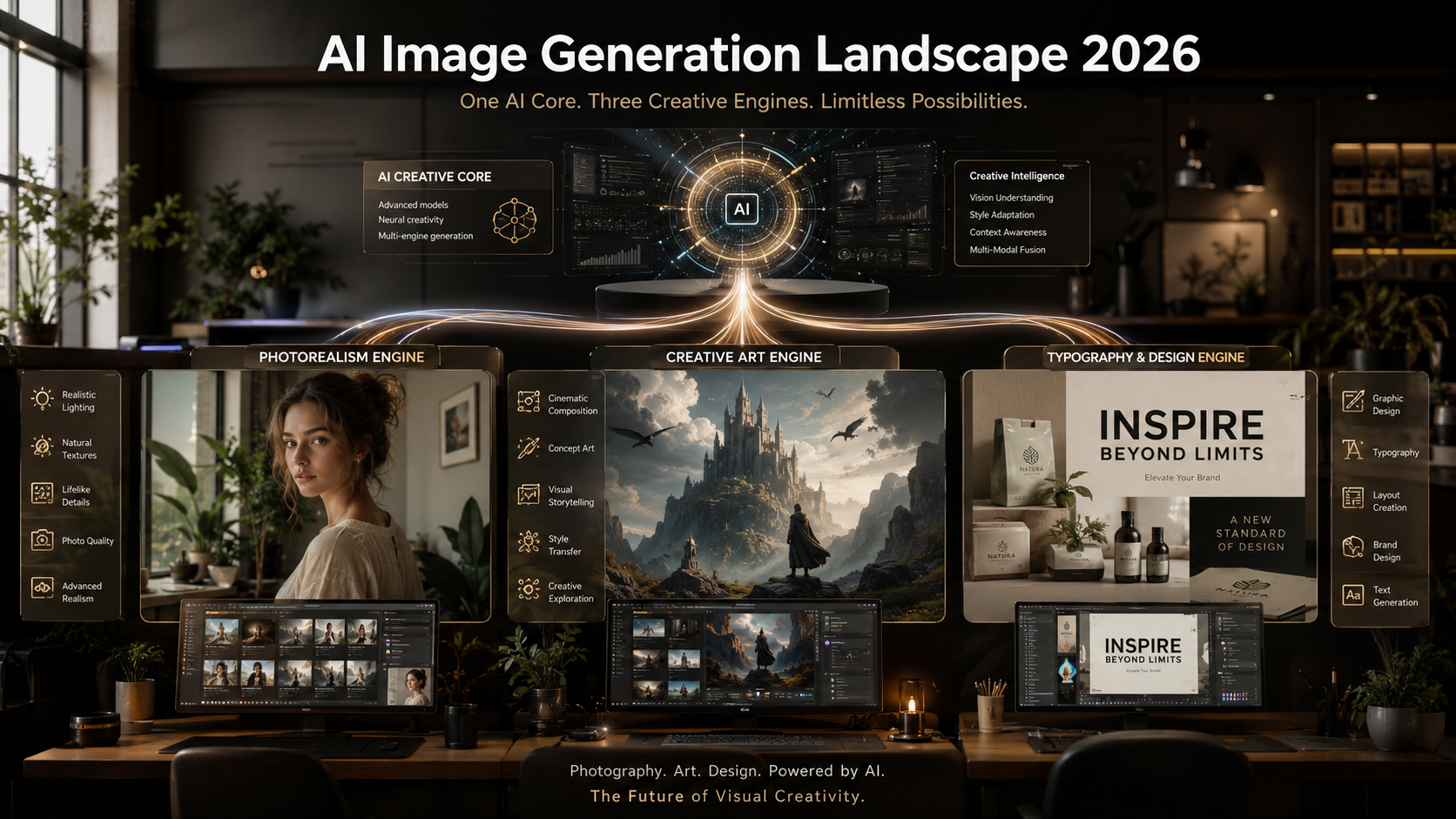
The generative space is no longer a one-size-fits-all market. Visual engines have bifurcated into specialized pipelines optimized for distinct production demands. Whether you need an API to handle millions of programmatic product renders or an intuitive interface for artistic asset design, the market offers a tailored solution.
Flux 1.1 Pro and Flux.2: The New Standard for Photorealism
Developed by Black Forest Labs, the Flux ecosystem has emerged as the preferred choice for production-grade photorealism. Flux 1.1 Pro offers an unparalleled understanding of natural lighting, executing complex multi-light environments and soft bounced shadows with precision.
Beyond lighting, its architectural framework significantly reduces common artifacts in complex spatial regions like fingers, eyes, and textured fabrics. If your workflow requires rendering human subjects in highly believable lifestyle settings without the cost of physical photoshoots, Flux stands out as an elite contender.
Midjourney v7: The Artistic Powerhouse
For pure creative expression, cinematic textures, and atmospheric depth, Midjourney v7 remains the reigning industry benchmark. Moving away from its historical constraint of operating solely inside Discord, Midjourney now offers a robust web platform alongside an integrated animation pipeline.
Midjourney v7 excels at interpreting abstract aesthetic prompts, making it incredibly popular among concept artists, cinematic designers, and editorial illustrators. It naturally applies a polished, gallery-ready look to images that other tools often fail to capture on the first draft.
Ideogram v2 and GPT Image 2: Leaders in Typography
Historically, rendering crisp, legible text within an image was a major roadblock for diffusion models. Ideogram v2 completely dismantled this barrier by prioritizing typographic layout control. It achieves near-flawless accuracy when embedding long-form text, labels, or complex signages inside a graphic.
Similarly, OpenAI’s GPT Image 2 has vastly improved its conversational editing flow inside ChatGPT. It allows creators to systematically alter text elements, shift palettes, or adjust asset placement by simply talking to the model.
COMPARING THE BEST AI TOOLS FOR IMAGE GENERATION 2026
To help you decide which tool fits your budget and production scale, the table below outlines the core metrics, cost structures, and standout capabilities of the premier engines available today.
| Tool / Model | Cost Structure | Best For | Output Strengths |
| Flux 1.1 Pro | ~$0.03 per Megapixel | Commercial Photorealism | Flawless anatomy, lifelike directional lighting |
| Midjourney v7 | Starts at $30/month | Cinematic & Fine Art | Deep textures, creative atmosphere, upscaling |
| Google Nano Banana 2 | Free (App) / Tiered API | High-Speed Iteration | Rapid generation, 4K texture micro-details |
| Ideogram v2 | ~$20/month | Typography & Logos | Graphic design layouts, sharp embedded text |
| Recraft V4 | $0.04 to $0.08 per image | Vector Graphics | Native SVG generation, strict brand consistency |
| Adobe Firefly (2026) | Included in Creative Cloud | Enterprise Compliance | Indemnified commercial safety, licensed data |
DESIGN-SPECIFIC AND ENTERPRISE ENGINES
For creators working under strict brand guidelines or complex legal requirements, standard consumer models can introduce unwanted risks. The following tools address specialized creative needs.
-
Recraft V4: This tool has carved out a massive niche for brand designers because it is currently the only major visual engine capable of generating native vector graphics (SVG). This allows illustrations, logos, and iconography to scale infinitely without pixelation.
-
Adobe Firefly: Trained exclusively on licensed stock imagery and public domain content, Firefly provides enterprise teams with absolute peace of mind. It integrates directly into Photoshop and Illustrator, focusing heavily on professional workflows like generative fill and background replacement.
-
Leonardo.ai Phoenix: This platform provides custom fine-tuning environments where game developers and concept designers can upload a small dataset of artwork to train a bespoke style model, ensuring perfect asset continuity across large projects.
FAQ SECTION
Which AI is best for image generation 2026?
Which is the best AI for 2026?
Choosing the best AI in 2026 depends on what you need it to do. There is no single tool that leads in every category. However, for multimodal abilities, two of the strongest choices are Google’s Gemini and OpenAI’s ChatGPT. Both combine text understanding, advanced reasoning, and image capabilities in one platform.
For example, Gemini stands out because of its speed and strong visual generation features. It is designed to create highly detailed images with realistic lighting and sharp quality. In addition, its integration with Google’s ecosystem makes it useful for many daily tasks.
On the other hand, ChatGPT focuses on flexibility and conversation-based editing. Users can refine images through simple instructions instead of rewriting complicated prompts. As a result, creating and improving visuals feels more natural.
Ultimately, the best AI depends on your workflow. If you want fast image creation and broad integration, Gemini may be the better choice. However, if you need creative control, editing, and interactive assistance, ChatGPT is a powerful option. Therefore, both platforms are among the leading AI tools for 2026.
Which AI is best for image generation right now?
The best AI image generator depends on your specific goals. Different tools are designed for different types of creative work. Therefore, there is no single winner for every user.
For fast and simple image creation, Google’s Gemini is a strong choice. It offers an easy workflow and works well for everyday visuals. In addition, it can produce detailed images with realistic textures, sharp product designs, and quick revisions. This makes it useful for creators who want quality results without learning complicated prompt techniques.
However, for professional businesses and brands, Adobe’s Adobe Firefly is often the better option. It focuses on commercial-friendly image creation and is built with licensed training data. As a result, companies can use it more confidently for marketing materials, advertisements, and branded content.
Meanwhile, other AI tools may be better for specific styles. Some specialize in artistic images, while others focus on realism or design work. Ultimately, the right choice depends on your project. For quick personal creations, Gemini is a great option.
Is Grok 3 really the best AI?
xAI’s Grok is a strong AI tool, but whether it is the best depends on your goals. It stands out because of its focus on creativity, speed, and real-time awareness. For creators who want bold and experimental visuals, Grok can be an exciting option.
One of its biggest advantages is its connection with X. This allows it to stay connected with current trends and online conversations. As a result, it can be useful for creating timely content, social media visuals, and modern digital artwork.
However, Grok is not always the ideal choice for every professional use case. For example, businesses that need strict brand controls, predictable results, and commercial-focused workflows may prefer tools like Adobe Firefly. Meanwhile, creators who prioritize artistic freedom may find Grok more appealing.
Overall, Grok is one of the strongest AI options available, especially for creative experimentation and fast content creation. However, it is not automatically the best AI for everyone. The best choice depends on whether you value creativity, safety, editing control, or business reliability
CONCLUSION
The best ai tools for image generation 2026 represent a mature, highly specialized ecosystem far removed from the unpredictable artifacts of early generative models. Choosing the right tool comes down to mapping your specific project requirements to the strengths of each model architecture. If your priority is absolute photorealism and believable lighting, integrating Flux 1.1 Pro into your pipeline will deliver the highest return. For designers crafting logos, marketing banners, or brand mascots, combining the typographic mastery of Ideogram v2 with the scalable vector exports of Recraft V4 provides an elite production workflow.
As these technologies continue to integrate deeper into professional suites and creative pipelines, the competitive edge belongs to those who understand how to leverage each engine’s distinct advantages. Start by identifying whether your project requires the commercial indemnity of Adobe Firefly, the conversational flexibility of ChatGPT, or the pure artistic power of Midjourney v7. By choosing the right tool for the job, you can unlock unprecedented creative efficiency while maintaining pristine asset quality.
For creators exploring more AI-powered tools and automation solutions, check out our guide on AI Voice Generator Without Subscription to discover flexible voice creation options without recurring costs.