

Why Students Are Afraid to Ask Questions in School and Beyond
Classrooms should buzz with curiosity, yet silence often fills the room when teachers invite open discussion. Many educators assume silence means students understand the lesson. In reality, students may stay quiet because they feel confused, anxious, or embarrassed. Understanding why students are afraid to ask questions can help educators, parents, and learners create safer learning environments.
When students hide confusion, learning gaps can grow quickly. Fear of public failure is one common reason students avoid speaking. Raising a hand can expose a learner to peer judgment, criticism, or unwanted attention. Research information from the American Psychological Association highlights the importance of emotional safety in children’s learning and participation.
This article explores why students hold back in class and everyday situations. It also examines signs of academic distress and practical ways to encourage questions. Finally, it explains how negative teacher behavior can discourage inquiry and weaken student confidence.

Why are some students afraid to ask questions in class?
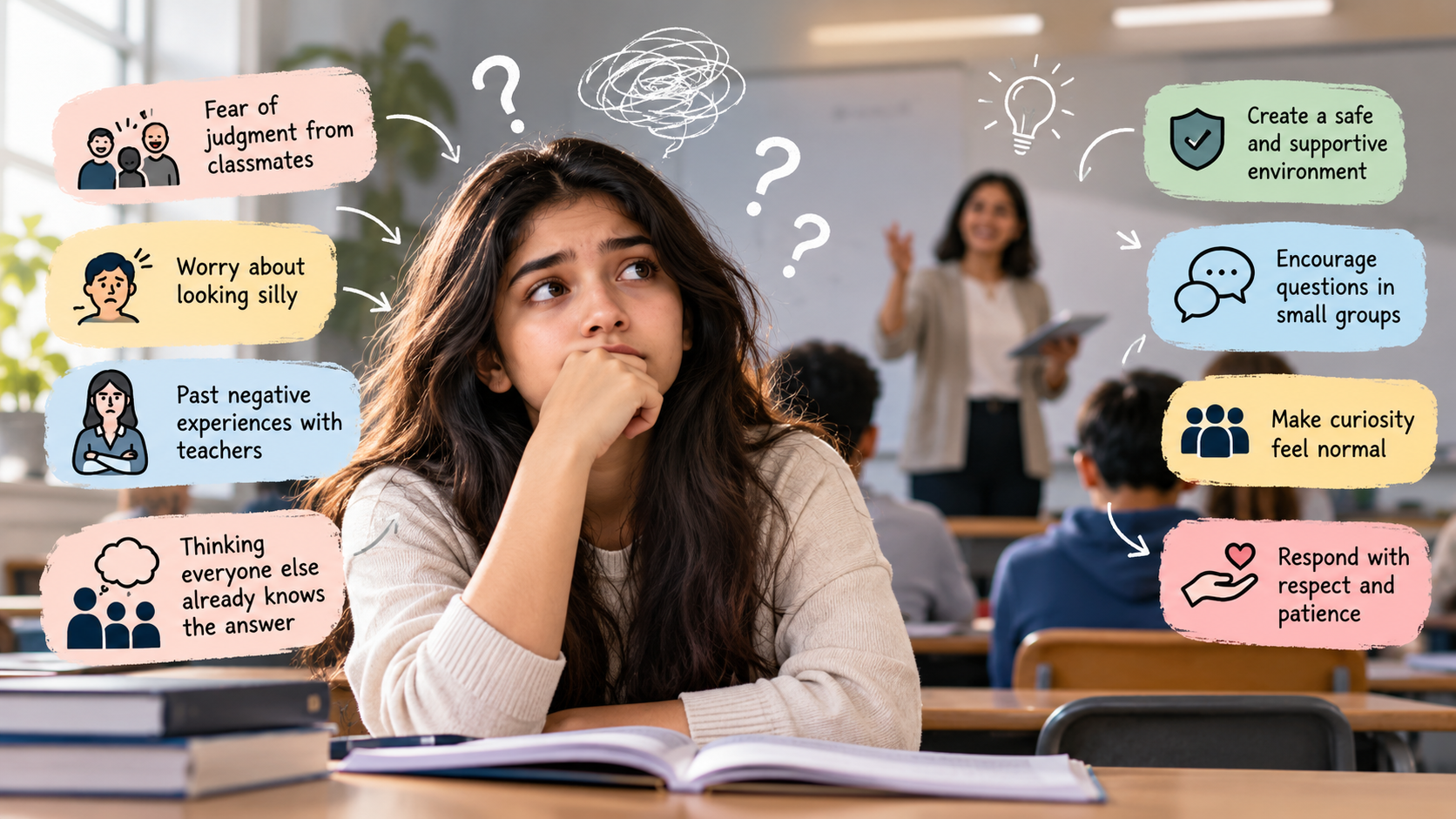
Many students avoid questions because they fear embarrassment in front of their classmates. A classroom can create strong social pressure, especially when students believe everyone else understands the lesson. This assumption can make a learner feel that their question is unnecessary or foolish.
Past experiences can make this fear stronger. A student may remember being laughed at after giving an incorrect answer. They may also have experienced impatience or criticism from a teacher. These experiences can teach students that speaking up creates risk.
Students may also worry about attracting attention. Raising a hand makes their uncertainty visible to the entire class. Some learners would rather remain confused than become the center of attention.
Understanding why students are afraid to ask questions requires looking beyond academic ability. Fear can come from social judgment, previous experiences, low confidence, or classroom culture. When students expect negative reactions, silence becomes a form of self-protection.
The Impact of Social Evaluation on Participation
Adolescents often place significant emotional value on peer approval and social acceptance. Because of this, classroom participation can feel like a social risk rather than a simple learning activity. Students may worry that classmates will judge their intelligence based on the questions they ask.
This pressure becomes stronger during adolescence. Students are becoming more aware of how others perceive them. A question that seems simple to a teacher may feel highly personal to a teenager.
Some students may also compare themselves with classmates who answer quickly. Seeing confident students participate can create the impression that everyone else already understands the topic. A confused learner may then assume they are the only person struggling.
Fear of social evaluation can affect both questions and answers. Students may avoid volunteering, joining discussions, or requesting clarification. Over time, this behavior can reduce their classroom participation and confidence.
Teachers can reduce this pressure by creating routines where questions are expected. Anonymous questions, small-group discussions, and private check-ins can help students participate with less social exposure. These approaches make curiosity feel normal rather than embarrassing.
Why are people afraid to ask questions?
People often avoid questions because asking reveals uncertainty. This can feel uncomfortable because many social environments reward confidence and independence. Someone who admits they do not understand may worry that others will view them as less capable.
This fear can appear at school, work, or home. Employees may hesitate to ask for clarification during meetings because they fear appearing inexperienced. Adults may avoid asking for help because they believe they should already know the answer. Learning how to ask for feedback at work can also make workplace communication feel more manageable.
Social expectations can make the problem worse. People sometimes associate knowledge gaps with incompetence. As a result, they may pretend to understand instead of requesting clarification.
Previous experiences also influence this behavior. Someone who was mocked for asking questions may become more cautious later. Over time, avoiding questions can become an automatic response.
Understanding why students are afraid to ask questions also helps explain similar behavior in adults. Confidence with questions develops through experience. Supportive environments make uncertainty easier to admit. When people know questions will receive respectful answers, they are more likely to seek clarification and learn effectively.
The Psychological Fear of Looking Incompetent
Most people want others to see them as capable and confident. Admitting a knowledge gap can therefore feel like exposing a personal weakness. This concern can prevent people from asking important questions, even when clarification would improve their performance.
The fear is especially strong when the topic involves unfamiliar skills. A person may worry that a basic question will make others assume they lack ability. Instead of speaking, they may remain quiet and try to understand the information alone.
This behavior can create unnecessary problems. Misunderstandings may continue because the person never confirms what they heard. In school, that can lead to incorrect assignments or weaker test performance. At work, it can result in mistakes that could have been prevented.
The solution begins with changing how questions are viewed. Asking for clarification does not automatically indicate incompetence. It can show that someone wants to understand information accurately.
Teachers, managers, and peers can help by responding calmly to questions. When clarification receives respect, people become less concerned about appearing uninformed. This reflects the importance of psychological safety at work, where people can communicate concerns without unnecessary fear of negative judgment.
What are the signs of a struggling student?
Identifying an overwhelmed learner requires careful observation. Academic distress does not always appear as obvious misbehavior. A struggling student may instead become unusually quiet, withdrawn, or inconsistent with schoolwork.
Changes in academic performance can provide an important warning. These may include incomplete homework, declining test scores, missed deadlines, or difficulty completing familiar tasks. However, one poor result does not automatically indicate serious academic difficulty.
Classroom behavior can also provide clues. A student may avoid eye contact, stop volunteering, stare blankly during instruction, or hesitate when asked to explain an answer. They may also avoid subjects that previously seemed manageable.
Social and emotional changes deserve attention as well. Students may withdraw from classmates, become unusually frustrated, or show less interest in activities they previously enjoyed.
These signs do not prove that a student is struggling academically. Different factors can affect classroom behavior. However, noticeable and persistent changes deserve a supportive conversation.
Teachers and parents should avoid immediately assuming laziness. Asking open questions can reveal whether confusion, anxiety, workload, or another barrier is affecting the learner.
Why do students hesitate to ask questions in class?
Hesitation often develops when students need more time to process information. A teacher may move through complex material quickly, leaving little time for learners to identify what they do not understand. By the time a student forms a question, the lesson may have already moved forward.
Students may also worry about interrupting the teacher. They can assume that classmates understand the topic and want the lesson to continue. This creates pressure to remain quiet, even when clarification is necessary.
Another factor is uncertainty about the question itself. Students may know that something feels confusing without knowing exactly what they need to ask. This can make speaking up feel even more difficult.
Time pressure can strengthen these concerns. A student may decide to figure out the answer later instead of stopping the lesson. Unfortunately, that strategy can allow confusion to accumulate.
Understanding why students are afraid to ask questions therefore requires attention to classroom pacing and communication. Giving students processing time, written prompts, and multiple ways to ask questions can reduce hesitation. Small adjustments can make participation feel more manageable.
How to encourage students to ask questions?
Teachers can encourage questions by making curiosity a normal part of classroom learning. Students should understand that confusion is not a failure. It is often a natural part of learning something unfamiliar. Building this environment can also support student confidence in the classroom.
Instead of asking only, “Any questions?” teachers can use more specific prompts. Questions such as “Which part was hardest?” or “What would you like me to explain again?” give students a clearer starting point.
Anonymous options can also help. Digital forms, message boards, and question cards allow students to seek clarification without public attention. This can be particularly useful for students who are shy or anxious.
Think-pair-share activities provide another useful approach. Students first consider an idea alone, then discuss it with a partner before sharing with the class. This reduces the pressure of speaking without preparation.
Teachers should also respond carefully to incorrect questions or answers. A respectful response shows students that mistakes are acceptable and can become part of effective teacher reflection after lessons.
Over time, these practices can create a classroom where asking questions feels routine. Students become more willing to admit uncertainty, seek clarification, and participate actively. These habits can also help build confidence in students as they become more comfortable expressing their ideas.
Normalizing Curiosity Through Guided Inquiries
Teachers can make questioning easier by treating curiosity as a normal part of every lesson. Students are more likely to participate when questions are expected rather than treated as interruptions. Encouraging this mindset can help students understand why curiosity matters and how to grow it.
One simple approach is to build questioning into the lesson structure. For example, students can write two questions after learning a new concept. They can then compare their questions with a partner before sharing selected examples.
This method reduces individual pressure. A student does not have to create a question publicly without preparation. They first have time to think and discuss their ideas.
Teachers can also use sentence starters. Prompts such as “I understand ___, but I am confused about ___” give students language for expressing uncertainty.
Another useful strategy is to praise thoughtful questions. The focus should remain on curiosity and learning rather than whether the question is sophisticated.
These routines help students see questions as part of successful learning. They also give quieter students structured opportunities to participate.
When questioning becomes a regular classroom expectation, students may feel less concerned about being singled out. The goal is to make inquiry ordinary, accessible, and safe.
How to spot a toxic teacher?
A harmful classroom environment can make students afraid to ask questions. Teachers should be able to correct mistakes and maintain standards without humiliating learners. Problems arise when criticism becomes personal, unpredictable, or repeatedly discouraging.
Possible warning signs include sarcastic comments about students, public humiliation, dismissive responses to genuine questions, or repeated embarrassment after incorrect answers. A teacher may also consistently ignore students who need additional support.
One incident does not automatically establish a harmful pattern. Teachers can have difficult days, and classroom management can sometimes involve firm correction. The concern becomes more serious when negative behavior is frequent and affects a student’s willingness to participate.
Students may respond by avoiding questions, withdrawing from discussions, or refusing to seek help. Over time, this can weaken their confidence and increase academic frustration.
Parents and school leaders should focus on patterns rather than isolated interactions. Students should have safe ways to report concerns and request support, including through one-on-one meetings with principals when appropriate.
A respectful classroom does not require unlimited agreement from students. It requires clear expectations, fair treatment, constructive feedback, and reasonable opportunities to seek clarification. When these conditions exist, students are more likely to participate without fearing humiliation.
Conclusion
Creating supportive learning spaces requires addressing why students are afraid to ask questions at every level of education. When students keep silent, the breakdown is rarely a lack of interest; instead, it indicates unaddressed fear of social embarrassment, rapid pacing, or intimidating learning atmospheres. Classroom silence often conceals profound academic vulnerability that demands thoughtful educator awareness.
Teachers and educational leaders hold the power to dismantle these barriers by modeling patience, utilizing anonymous communication channels, and celebrating thoughtful questions. Similarly, recognizing warning signs of toxic instructional dynamics protects young learners from long-term academic burnout. Transforming curiosity from a perceived risk into an intellectual asset helps students reclaim their voice. As schools adopt supportive instructional habits, classrooms become thriving, collaborative communities where every student feels secure enough to explore, question, and excel.