

Why Qualified People Struggle to Get Interviews
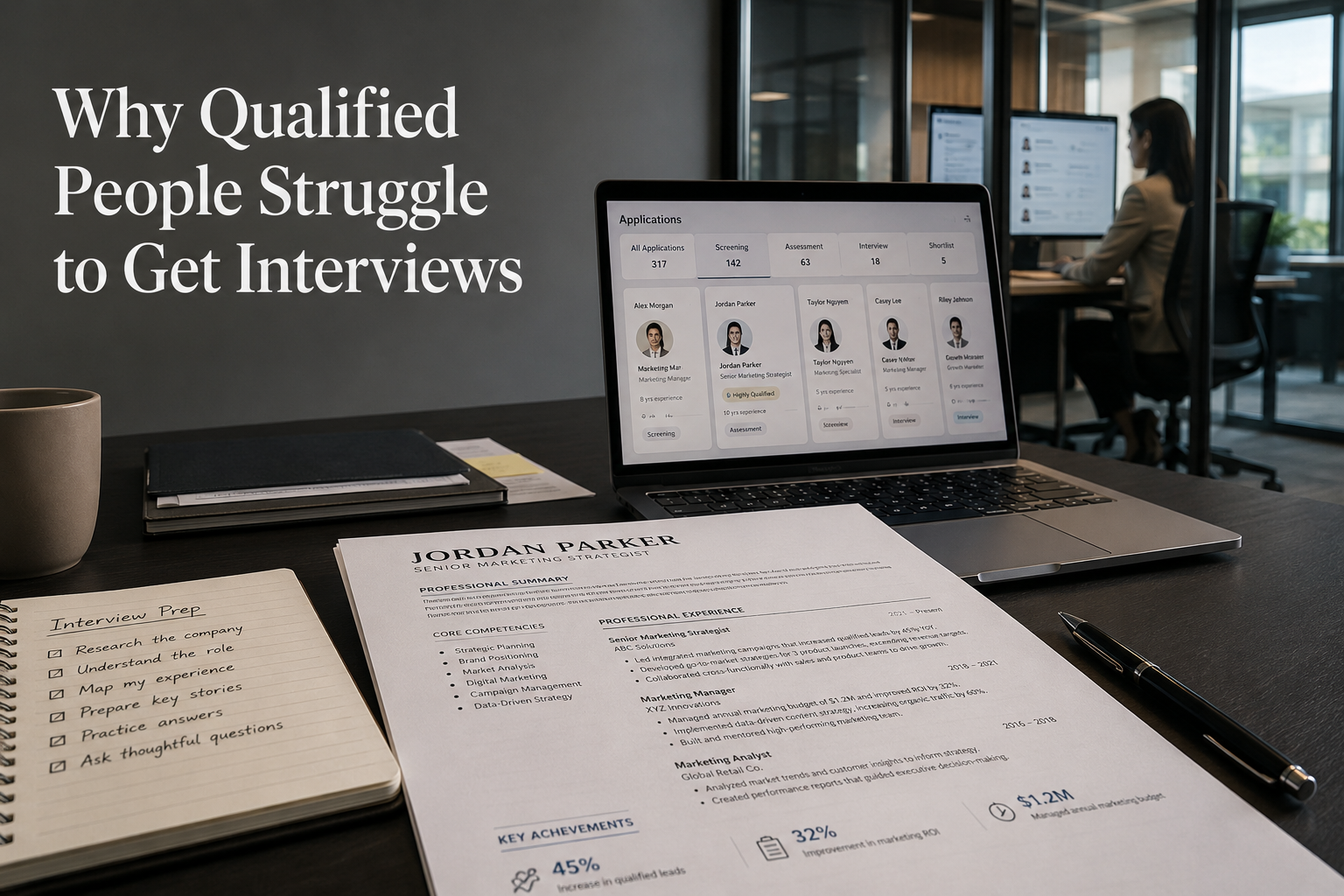
Sending out dozens of tailored resumes without getting a callback is exhausting. You may match the job description closely, yet hiring teams still overlook your application. Understanding why qualified people struggle to get interviews helps you identify what is blocking your search.
Competitive openings can attract large applicant pools. U.S. Bureau of Labor Statistics provides labor-market data showing how employment conditions and competition vary across occupations and periods. In modern hiring, technical qualifications are only one part of the decision. Applicant volume, screening systems, referrals, recruiter priorities, and hiring timelines can all affect visibility.
Recruiters also look for evidence of business value. A resume that lists duties without outcomes can make strong experience appear ordinary. Your application must quickly show how you solve problems, improve results, reduce risk, or support growth.
This guide explains the most common reasons qualified candidates struggle. It also covers interview rejection, interviewer interest, networking, and seasonal hiring patterns.
Why can’t I get interviews for jobs I’m qualified for?
When you meet the requirements but receive no interviews, the problem may be how your experience is presented. Recruiters often scan for relevant achievements, skills, scope, and outcomes rather than matching job titles alone. A strong technical background can still be overlooked if its value is unclear.
Your resume should connect your experience to the employer’s needs. Listing responsibilities such as “managed projects” or “handled client accounts” provides limited evidence of performance. Specific results create a stronger case.
Applicant Tracking Systems can also influence visibility. Many systems help employers organize and search applications using job-related information. However, passing an ATS does not guarantee an interview. Human review, competition, timing, and role requirements still matter.
This presentation gap is a common part of why qualified people struggle to get interviews. Position your experience around problems solved and outcomes achieved. Make important qualifications easy to find, then support them with credible evidence.
Tailor Your Impact Over General Duties
Replace broad task descriptions with concise accomplishment statements. Your goal is to show what you changed, improved, delivered, or achieved. This gives hiring managers evidence of capability instead of asking them to infer your impact.
For example, “managed a sales team” describes responsibility but says little about performance. “Led an eight-person sales team that generated $1.2 million in annual revenue” adds scope and a measurable outcome. Use numbers when they are accurate and relevant.
Strengthen these statements by adding context. Explain the challenge, your action, and the result without turning each bullet into a long story. Metrics might include revenue, savings, conversion rates, productivity, retention, delivery time, or customer growth.
Place your strongest achievements near the top of each relevant role. Match them to the employer’s priorities without copying the job description. This makes your resume easier to scan and helps recruiters understand your value quickly.
Why do I keep getting rejected from jobs I am qualified for?
Repeated rejection does not always mean you lack the required skills. Qualified candidates can lose roles because of stronger competition, internal candidates, referrals, timing, compensation concerns, or differences in experience.
Some companies advertise positions while already considering internal employees or referrals. A public posting therefore does not guarantee equal visibility for every applicant. Hiring teams may also prioritize candidates whose experience closely matches immediate needs.
Overqualification can create another concern. An employer may wonder whether the position will provide enough challenge or whether you will expect compensation beyond the role’s range. These concerns can affect hiring decisions.
Cultural and strategic alignment can matter as well. Employers may choose someone whose working style, motivation, or experience better fits the team’s needs.
When examining why qualified people struggle to get interviews, look beyond basic qualifications. Compare your positioning, seniority, motivation, and evidence of fit with the specific role.
Overcoming the Overqualification Dilemma
If your background appears significantly more senior than the position, address the concern before the employer fills in the gaps. Explain why the role genuinely fits your goals.
Use your cover letter, application responses, or interview discussion to connect your experience with the position’s responsibilities. Explain why you want this scope and what attracts you to the company. Avoid vague statements about simply “wanting a change,” and avoid the common cover letter mistakes that can weaken an otherwise strong application.
Emphasize the value your experience brings. Show that you can contribute quickly, understand complex problems, and support the team without suggesting that the role is temporary.
Be realistic about compensation and career progression when the topic arises. If the position represents a deliberate shift, explain the reason clearly and consistently.
The strongest message is simple: your experience is an asset, and your interest is credible. That reduces uncertainty around retention and expectations. It also helps recruiters see fit rather than assuming you will leave quickly.
Why am I having a hard time getting an interview?
A difficult interview search may reflect an overreliance on cold online applications. Public job boards can expose your resume to large applicant pools, making it harder to stand out.
Warm introductions can add context that a resume cannot provide. Referrals, professional communities, former colleagues, recruiters, and industry contacts can help your application reach the right person. Networking also gives you information about teams and roles before you apply.
Your online presence matters too. Recruiters may review your LinkedIn profile during hiring. If your profile conflicts with your resume, lacks recent experience, or provides little evidence of expertise, it can weaken your application.
A focused search combines applications with relationship-building. Target companies where your experience solves a clear problem. Then contact relevant people with a concise message about your background.
This broader approach addresses why qualified people struggle to get interviews when online applications alone produce little traction.
Leverage Direct Networking and Referrals
Do not rely entirely on automated job portals. Build relationships with people connected to the teams you want to join.
Before contacting someone, understand the role and identify why your background is relevant. A short message works better when it focuses on shared professional context or a clear business problem. Avoid generic messages that immediately ask for a job.
Employee referrals can improve visibility, although they do not guarantee an interview. A referral is most useful when the employee understands your qualifications and can credibly explain your fit.
Strengthen this strategy by staying in touch with contacts before opportunities appear. Share useful industry insights and ask informed questions without making every interaction transactional.
Keep applying directly when appropriate. Networking should complement your application strategy, not replace it. The goal is to create more paths to consideration while making your qualifications easier to understand.
What are some reasons why I might not get selected in an interview?
Not being selected after an interview does not necessarily mean you lacked technical ability. Decisions can reflect communication, preparation, role fit, examples, compensation, competing candidates, and performance. If rejection happens, understanding how to deal with rejection after an interview can help you evaluate what happened without assuming you were unqualified.
A common weakness is answering questions by repeating the resume. Interviews let you explain how you think, make decisions, and deliver results. Your answers should connect your experience to the employer’s current challenges.
Unstructured answers can also weaken an otherwise strong candidacy. If examples lack a clear situation, action, and outcome, interviewers may struggle to understand your contribution. The STAR method can provide structure for behavioral interview questions and answers.
Low energy, poor listening, weak preparation, or generic questions can create concerns. So can answers that avoid responsibility or provide little evidence of learning. If nerves are affecting your preparation or delivery, learning how to overcome interview anxiety can help you present your qualifications more clearly.
When considering why qualified people struggle to get interviews and offers, separate skill from presentation. You may be capable of doing the job but fail to demonstrate that capability clearly.
Structure Every Answer with Tangible Results
Use the STAR framework to keep behavioral interview answers focused. Start with the Situation and briefly explain the context. Define the Task so the interviewer understands your responsibility. Then spend most of your time explaining the Action you personally took.
Finish with the Result. Whenever possible, quantify the outcome using accurate measures such as revenue, savings, delivery time, customer growth, quality, productivity, or risk reduction. If a result cannot be measured, explain the concrete change that followed.
Do not spend two minutes describing a project’s background. Give enough context to establish the problem, then explain your decisions and actions. Close by showing what happened and what you learned.
This structure makes answers easier to follow and assess.
Prepare several examples before the interview. Choose stories that demonstrate leadership, problem-solving, collaboration, and measurable results. Practice them enough to stay structured without sounding memorized, especially when preparing for top behavioral interview questions.
How to identify if an interviewer is interested or rejecting you?
You can look for signals during an interview, but no single behavior proves that an interviewer will advance you. People have different communication styles, and interviewers may remain neutral even when interested. Treat signals as clues rather than guarantees.
Potentially positive signs include detailed follow-up questions, practical discussion of your experience, explanations of team priorities, or clear information about the next stage.
Less encouraging signs can include a meeting that ends unusually early, limited engagement with your answers, or vague information about what happens next. However, these signals can also result from scheduling pressure or a standardized process.
The most useful indicator is concrete follow-up. If the interviewer explains the next step, identifies who you will meet, or provides a realistic timeline, you have clearer evidence of continued consideration.
Avoid reading body language too literally. Focus on the quality of the conversation and whether the employer gives you actionable information.
Watch for Future-Oriented Language
Listen for language that shows the interviewer is discussing your potential contribution beyond the interview. These comments can indicate that they are imagining how you might fit. However, they are not promises of an offer.
An interviewer who says you would work with a particular team may simply be describing the role. Treat that as context rather than proof of selection. Stronger evidence comes from specific next steps, such as another interview, a case exercise, reference checks, or a stated decision timeline.
Vague phrases such as “we will be in touch” provide little information. They may reflect a standard closing statement rather than rejection.
If the process remains unclear, ask a direct question before the meeting ends. Ask what the next stage involves and when candidates should expect an update.
This approach is more reliable than decoding every gesture or phrase. It keeps your attention on measurable signals.
What is the hardest month to get hired?
There is no single month that is universally the hardest time to get hired across every industry. Hiring patterns vary by sector, company, role, location, budgets, and economic conditions. However, December is often slower because many organizations face holiday absences, year-end planning, budget decisions, and reduced interview availability.
Hiring can slow when decision-makers are unavailable. Panel interviews become harder to coordinate, approvals may take longer, and some companies postpone non-urgent hiring until the new year.
January can bring renewed activity as teams receive new budgets and return from holiday schedules.
Rather than treating one month as a universal hiring rule, use seasonal patterns as planning information. Continue applying when relevant opportunities appear, especially for roles with urgent business needs.
Understanding timing can help explain why qualified people struggle to get interviews even when applications are strong. A delayed response may reflect the employer’s process rather than your qualifications.
Use Slow Hiring Months for Strategic Preparation
A slower hiring period is a reason to adjust your strategy, not abandon your search. Use quieter weeks to improve the materials and relationships that support your next applications.
Start with your resume. Remove weak bullets and strengthen measurable achievements. Then review LinkedIn for consistency.
Use the same period to build a focused target-company list. Identify organizations where your background matches current business needs. Research their teams and likely decision-makers before reaching out.
Networking can be useful when fewer active applications are competing for attention. Contact former colleagues or industry connections with genuine questions and useful context. These conversations can uncover opportunities before they become highly competitive.
Keep monitoring job postings during slower months. Some employers still hire because business needs do not follow seasonal patterns.
The goal is to enter busier hiring periods prepared. A stronger resume, clearer positioning, and warmer network can improve your odds.
Frequently Asked Questions
How many jobs should I apply for before expecting an interview?
Most job seekers submit between 20 to 50 targeted applications before landing a formal interview. In highly competitive fields, that number can rise significantly. To improve your odds, focus on submitting fewer, highly tailored applications backed by employee referrals rather than blasting hundreds of generic resumes across automated job boards.
Can an ATS reject my resume automatically without a human seeing it?
Yes, an Applicant Tracking System can filter out your resume if it lacks essential keywords, uses unreadable formatting, or fails basic knock-out questions. Recruiters set parameters to score incoming applications. To pass these automated filters, use standard section titles, clean layouts, and mirror the exact terminology found in the target job description.
How long should I wait to follow up after an interview?
You should send a personalized thank-you email within 24 hours of your interview. If the hiring team provided a specific decision date that has passed, wait one additional business day before sending a polite follow-up inquiry. If no timeline was given, waiting five to seven business days is standard professional etiquette.
Does being overqualified really hurt my chances of getting hired?
Yes, being overqualified can hurt your chances if employers fear you will quickly leave for a higher-paying position or demand compensation outside their budget. When applying for lower-level roles, tailor your resume to highlight relevant execution skills rather than senior leadership tasks, and clearly explain your career motivations in your cover letter.
Conclusion
Struggling to secure interviews when you possess the right skills is deeply frustrating, but it is rarely a reflection of your true worth. As we have explored, understanding why qualified people struggle to get interviews requires looking beyond basic job qualifications. Automated screening algorithms, high applicant volumes, vague application materials, and unoptimized interview techniques all create artificial barriers between talented professionals and hiring managers.
To turn the tide in your favor, shift your focus toward quality, precision, and networking. Tailor every resume to highlight quantifiable business impact rather than routine duties. Optimize your professional profiles for relevant keywords, reach out directly to decision-makers, and practice structured storytelling for your interviews. By treating your job search as a targeted marketing campaign rather than a numbers game, you will cut through the noise, capture recruiter attention, and secure the job offers you deserve.