Who Makes GPUs Besides Nvidia And AMD?
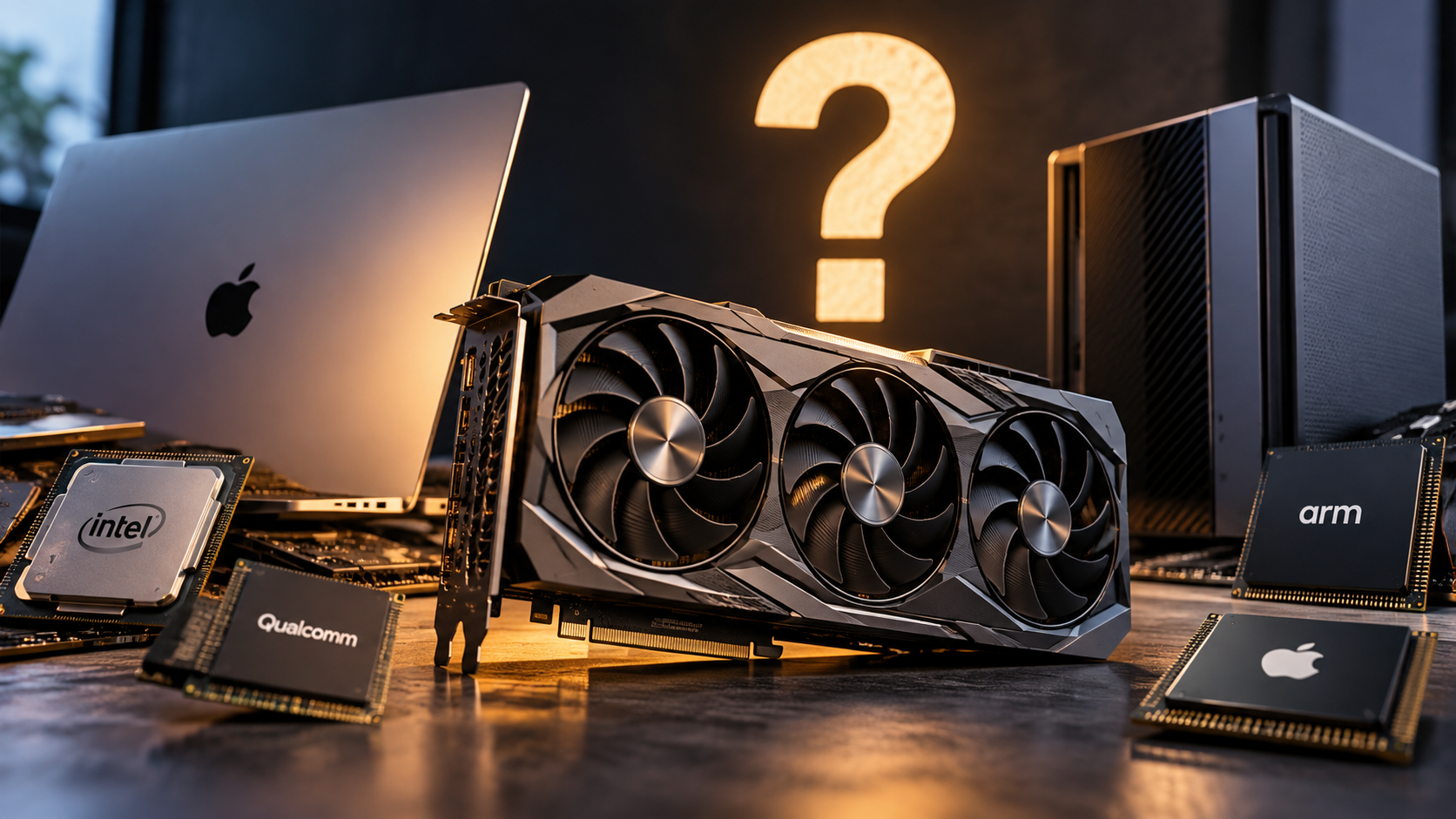
Who makes GPUs besides Nvidia and AMD? While these two companies dominate the consumer graphics card market, they are not the only companies developing graphics processors. Intel, Apple, Qualcomm, ARM, and other semiconductor companies also design GPUs for PCs, smartphones, servers, and embedded devices.
However, Nvidia and AMD do not represent the entire GPU industry. Once you look beyond retail desktop graphics cards, the market becomes much more diverse. Millions of computers, smartphones, vehicles, servers, and embedded devices use GPUs designed by other technology companies.
The answer to who makes GPUs besides Nvidia and AMD depends on what you consider a GPU. Some companies build discrete graphics cards. Others design integrated GPUs for processors, smartphones, or laptops. Some create GPU intellectual property that other semiconductor companies license.
This distinction matters because companies such as Intel, Apple, Qualcomm, ARM, and Imagination Technologies participate in the GPU market in very different ways.
China also has several domestic GPU developers. India is developing its own semiconductor and accelerator ecosystem, although advanced GPU manufacturing remains dependent on overseas foundries.
Who Else Makes GPUs Other Than Nvidia?
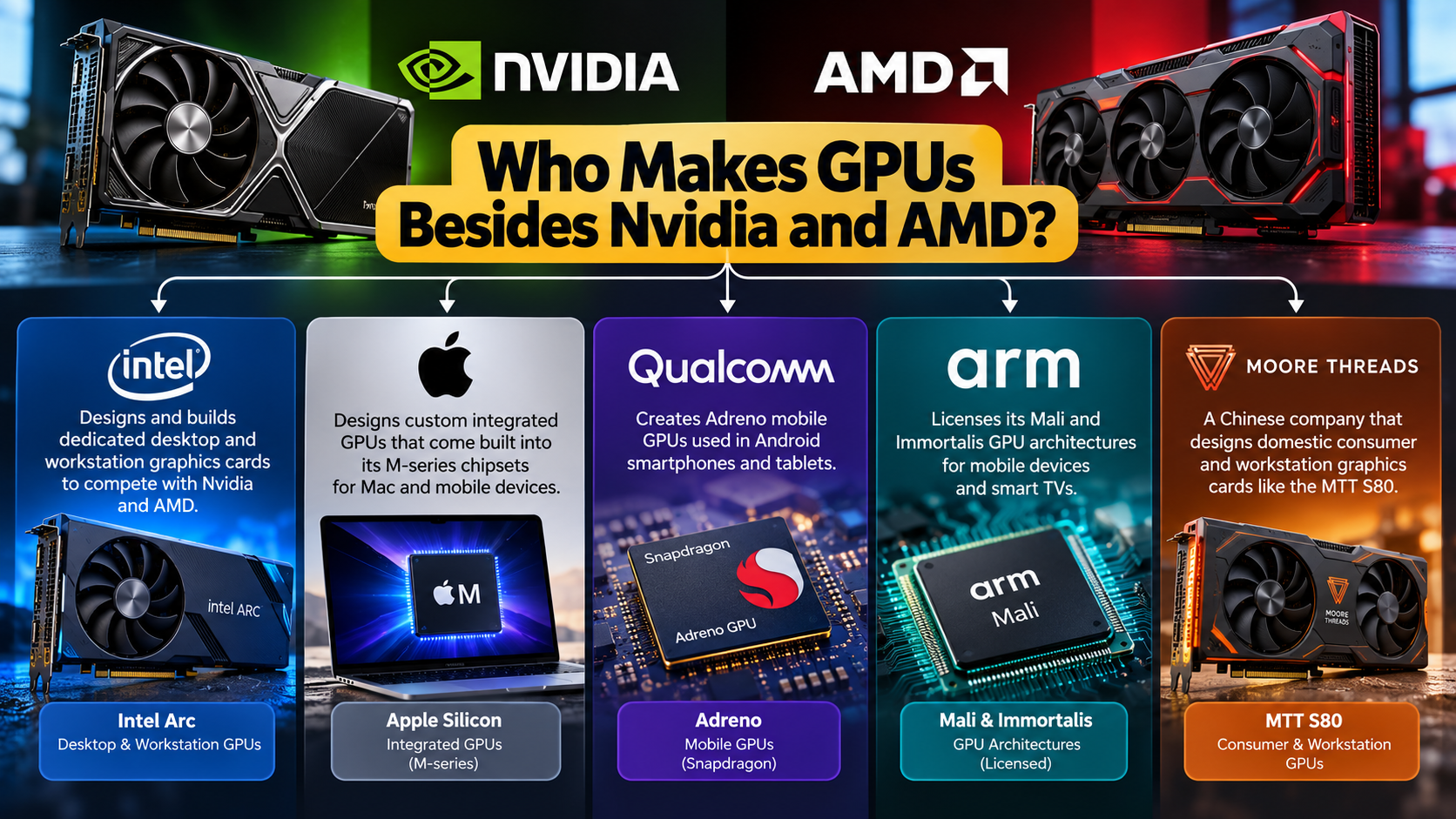
The GPU market extends well beyond Nvidia and AMD. Companies such as Intel, Apple, Qualcomm, ARM, and Imagination Technologies design graphics processors or GPU architectures for different types of devices. Their products may appear inside CPUs, mobile SoCs, laptops, servers, cars, televisions, and embedded systems rather than traditional desktop graphics cards. For a closer look at what modern graphics processors can do beyond gaming, explore things your GPU can do besides playing games.
This means that asking who makes GPUs besides Nvidia and AMD requires looking at the entire graphics ecosystem. A company can participate by designing a complete GPU, integrating a GPU into an SoC, licensing GPU intellectual property, or developing specialized accelerators for artificial intelligence and other workloads.
Several Chinese semiconductor companies are also developing domestic graphics and compute processors. Their products are mainly aimed at local consumer, enterprise, scientific, and AI markets.
The following companies show how broad the GPU industry has become.
1. Intel: Arc and Xe Architectures
Intel is one of the world’s largest suppliers of PC graphics hardware by unit volume because its processors include integrated GPUs. These graphics processors are built directly into many desktop and laptop CPUs, giving Intel a huge presence even when users do not purchase a separate graphics card. Intel’s Core Ultra processors also combine CPU, GPU, and AI capabilities in a single platform.
Intel also develops discrete GPUs under the Intel Arc brand. Its Xe architecture family supports both integrated and standalone graphics products.
Key areas include:
- Intel Arc: Discrete graphics cards designed for consumer PCs and gaming.
- Xe architecture: GPU technology used across integrated and discrete products.
- Xe2: The newer architecture family associated with Intel’s next-generation graphics products.
- Datacenter graphics: Intel has also developed the Data Center GPU Max family for high-performance computing workloads.
- Gaudi accelerators: Intel develops Gaudi processors for artificial intelligence workloads.
Intel therefore occupies several parts of the graphics market. It competes in discrete PC graphics while also supplying integrated graphics for its own processor platforms.
2. Apple: Custom GPU Designs
Apple develops custom GPUs as part of its Apple Silicon processors. These graphics processors are integrated into the company’s system-on-chip designs rather than sold as standalone graphics cards.
The approach became especially important after Apple moved away from Intel processors and discrete AMD graphics in its Mac lineup. Apple Silicon combines CPU, GPU, memory, and other processing components within a unified architecture.
Apple’s GPU technology appears across its M-series processors and A-series mobile chips. Higher-end M-series variants can include substantially more GPU resources for demanding workloads.
Apple’s custom graphics designs support features such as:
- Hardware-accelerated ray tracing on supported generations.
- Mesh shading for modern graphics workloads.
- Integrated GPU resources that share unified memory with the CPU.
- Dedicated neural-processing hardware for machine-learning workloads.
This makes Apple an important GPU designer even though it does not compete with Nvidia and AMD through traditional retail graphics cards.
3. Qualcomm: Adreno GPUs
Qualcomm develops Adreno GPUs, which are integrated into many Snapdragon system-on-chip platforms. Rather than selling standalone desktop graphics cards, Qualcomm combines its graphics technology with CPUs, AI processors, modems, and other components.
Adreno became particularly important in smartphones and other mobile devices. Qualcomm’s Snapdragon processors have used Adreno graphics across numerous generations of Android devices.
The company’s graphics technology has also expanded beyond smartphones. Snapdragon platforms are used in devices such as virtual-reality hardware and Windows-on-Arm computers.
Qualcomm’s PC strategy is especially relevant because integrated Adreno graphics allow thin and lightweight systems to provide GPU capabilities without requiring a separate graphics card.
The main distinction is therefore product design. Nvidia and AMD are major suppliers of discrete graphics cards, while Qualcomm primarily integrates its GPU technology into complete SoC platforms. This difference between integrated and discrete graphics can also affect performance, power consumption, and how a system handles demanding workloads.
For users asking who makes GPUs besides Nvidia and AMD, Qualcomm is an important example of a company whose GPU business is largely hidden inside other products.
4. ARM: Mali and Immortalis
ARM participates in the GPU industry differently from Nvidia, AMD, or Intel. it generally does not manufacture physical GPUs for consumers. Instead, it licenses GPU intellectual property to semiconductor companies that incorporate those designs into their own chips.
Two important ARM GPU families are Mali and Immortalis. Immortalis is designed for higher-end mobile graphics and supports hardware-accelerated ray tracing on compatible implementations.
ARM’s licensing model allows its GPU technology to appear across many types of products. Companies such as MediaTek and other semiconductor manufacturers can integrate licensed ARM GPU designs into their SoCs.
These GPUs can support workloads involving:
- Smartphone and tablet graphics.
- Mobile gaming.
- Automotive displays and computing.
- Smart televisions.
- Embedded devices.
This makes ARM an important part of the GPU supply chain without requiring the company to sell traditional graphics cards.
The distinction between GPU designer and GPU manufacturer is important here. ARM supplies the underlying IP, while another semiconductor company typically produces the final physical chip.
5. Imagination Technologies: PowerVR and IMG GPUs
Imagination Technologies is a UK-based semiconductor IP company with a long history in graphics processing. Its GPU technology has appeared in mobile devices, embedded systems, automotive products, and other specialized hardware.
The company is best known for its PowerVR graphics technology. It now develops newer GPU families and modular graphics IP designed for different applications.
Unlike Nvidia or AMD, Imagination generally licenses its technology rather than selling consumer graphics cards under its own brand.
Its GPU IP can be used in areas such as:
- Automotive dashboards and infotainment systems.
- Embedded and IoT devices.
- Mobile and low-power hardware.
- Graphics and compute applications.
- Specialized semiconductor designs.
This licensing model makes Imagination an example of a company that helps create GPUs without operating like a traditional desktop graphics-card manufacturer.
Its role also shows why GPU market comparisons can be misleading. A company does not need to sell a GeForce- or Radeon-style graphics card to be an important GPU technology provider.
6. Chinese Domestic GPU Manufacturers
China has developed several domestic GPU and general-purpose GPU companies. These firms have gained attention as the country seeks greater independence across advanced semiconductor technologies.
Moore Threads develops discrete graphics and compute products under its MUSA architecture. Its products target consumer graphics, professional workloads, and artificial intelligence applications.
Other companies focus more heavily on enterprise computing:
- Biren Technology: Develops high-performance processors and accelerators for AI and computing workloads.
- MetaX: Develops domestic GPU and accelerator technology for enterprise and AI applications.
- Innosilicon: Has developed graphics-related semiconductor technology and products for domestic markets.
- Zhaoxin: Has worked on domestic processor and graphics technologies for PCs and workstations.
These companies operate in a challenging environment. Software compatibility, semiconductor manufacturing access, performance, and developer ecosystems all influence the success of a GPU platform.
Their development is nevertheless significant because it demonstrates that the global GPU market is broader than the Nvidia-AMD duopoly visible in Western consumer graphics cards.
| Manufacturer | Core GPU Brand / Architecture | Primary Form Factor | Key Target Market |
|---|---|---|---|
| Intel | Arc, Xe / Xe2, Gaudi | Discrete, integrated, datacenter | PCs, creators, AI clusters |
| Apple | Apple Silicon custom GPU | Integrated SoC | Macs, laptops, mobile |
| Qualcomm | Adreno | Integrated SoC | Smartphones, Windows-on-Arm PCs |
| ARM | Immortalis, Mali | Licensed GPU IP | Mobile, automotive, smart displays |
| Moore Threads | MUSA architecture | Discrete PCIe cards | Consumer PCs, AI inference |
| Imagination | PowerVR / IMG series | Licensed GPU IP | Automotive, embedded, mobile |
Can India Make Its Own GPU?
India can design its own GPU and accelerator architectures, but designing a processor is different from manufacturing it. Indian engineers and semiconductor organizations already work on processor architecture, chip design, and related technologies.
The more difficult challenge is advanced semiconductor fabrication. Modern high-performance GPUs require sophisticated manufacturing processes, advanced packaging, large production capacity, and a highly developed semiconductor supply chain.
India’s semiconductor ecosystem is expanding through government initiatives, private investment, academic research, and new fabrication and assembly projects. These efforts can support future domestic chip production.
However, building a complete high-end GPU ecosystem requires more than a successful chip design. It also requires software drivers, development tools, manufacturing capacity, packaging, memory technology, testing infrastructure, and a large developer ecosystem.
That distinction explains India’s current position. Domestic teams can work on GPU and accelerator designs, while advanced commercial fabrication remains dependent on established international foundries for many leading-edge applications.
Chip Design vs. Chip Fabrication
Chip design and chip fabrication are two different parts of semiconductor production. A company can design a processor without owning a factory capable of manufacturing it.
GPU design involves creating the architecture and translating that design into hardware description languages such as Verilog or VHDL. Engineers then develop physical layouts and optimize the processor for parallel workloads.
India has a substantial semiconductor engineering workforce. Major technology companies operate research and development centers in cities such as Bengaluru, Hyderabad, and Noida.
Fabrication is a separate challenge. Leading GPUs require highly advanced manufacturing processes and sophisticated lithography equipment. Only a limited number of companies operate foundries capable of producing chips at the most advanced commercial nodes.
Important global foundry companies include:
- TSMC
- Samsung Foundry
- Intel Foundry
This distinction is critical when discussing whether India can make its own GPU. A domestic company can create the architecture and design, but manufacturing the finished silicon requires access to an appropriate semiconductor foundry.
Indigenous Indian GPU Initiatives
India has several semiconductor research and development efforts that contribute to its broader goal of developing domestic computing technology.
One example is the Shakti ecosystem, which originated from the open-source RISC-V processor project associated with IIT Madras. Indian academic and technology teams have used this ecosystem to develop processors, microcontrollers, and related computing technologies.
Another organization is C-DAC, or the Centre for Development of Advanced Computing. Under the Ministry of Electronics and Information Technology, C-DAC has worked on domestic processor architectures and high-performance computing initiatives.
India’s private semiconductor sector is also developing. Emerging fabless companies are working on specialized processors, AI accelerators, and compute-oriented intellectual property.
These projects do not all represent conventional gaming GPUs. Many focus on areas such as:
- Artificial intelligence.
- High-performance computing.
- Edge computing.
- Automotive vision.
- Embedded systems.
- Sensor processing.
Therefore, India’s progress should be viewed as a broader domestic semiconductor and accelerator ecosystem, rather than only a race to build a consumer graphics card.
The Manufacturing Reality
India’s semiconductor manufacturing ambitions are expanding through the India Semiconductor Mission (ISM) and private-sector investments. Projects include semiconductor fabrication and outsourced semiconductor assembly and testing facilities.
One major example is the Tata Electronics semiconductor fabrication project in Dholera, Gujarat, developed with Taiwan’s Powerchip Semiconductor Manufacturing Corporation. Other projects focus on packaging and testing rather than wafer fabrication.
However, building a factory does not automatically create the ability to manufacture the world’s most advanced GPUs. High-end processors require advanced process technology, specialized equipment, sophisticated packaging, and access to high-bandwidth memory.
This creates an important distinction between domestic semiconductor manufacturing and leading-edge GPU manufacturing.
India’s semiconductor facilities can strengthen the country’s electronics ecosystem and reduce dependence on overseas production over time. Yet advanced gaming and datacenter GPUs still depend heavily on international manufacturing infrastructure.
For the foreseeable future, an Indian company could develop its own GPU architecture while using an overseas foundry to manufacture advanced chips.
What GPU Does Elon Musk Use?
The question of what GPU Elon Musk uses has two different answers because his technology operations span personal computing and industrial-scale artificial intelligence infrastructure.
For ordinary computing, publicly discussed hardware has included high-end consumer PCs and gaming systems. These machines can use powerful Nvidia GeForce graphics cards for gaming and other GPU-intensive tasks.
At the infrastructure level, the picture is very different. Musk’s companies operate large-scale computing systems for artificial intelligence, autonomous driving, and other workloads.
xAI’s Colossus supercomputer is built around large numbers of Nvidia accelerators. These systems are designed to train large AI models such as the Grok family.
Tesla also develops specialized computing hardware for autonomous driving. Its vehicle computers use custom processors rather than conventional desktop graphics cards.
Tesla has additionally developed the Dojo D1 processor for its AI training infrastructure. The D1 is designed as a specialized processor for Tesla’s particular workloads.
This means there is no single answer to what GPU Musk uses. Consumer hardware, AI training systems, and Tesla’s automotive computers use different types of processors.
Does Samsung Make GPUs?
Samsung participates in the GPU industry, but not primarily as a company selling Samsung-branded desktop graphics cards. Its role spans mobile GPU technology, semiconductor manufacturing, and memory production.
Samsung’s mobile processors have used different GPU technologies over time. Some Exynos processors have used ARM Mali graphics, while Samsung has also partnered with AMD on its Xclipse GPU architecture.
The company is also one of the world’s major semiconductor foundries. This means Samsung can manufacture chips designed by other companies, including graphics and AI processors.
Samsung also produces high-speed memory used throughout the graphics industry. Technologies such as GDDR and HBM are critical to modern GPUs because processors need very high memory bandwidth for graphics and AI workloads.
Therefore, Samsung’s involvement is broader than simply designing a GPU. It participates at multiple points in the semiconductor supply chain.
This makes Samsung a useful example of why the question “who makes GPUs” needs careful wording. Designing a GPU, manufacturing one, and supplying its memory are separate roles.
1. The AMD Partnership: Xclipse GPUs
Samsung’s mobile GPU strategy changed significantly when the company partnered with AMD. Before that collaboration, Samsung’s Exynos processors commonly used ARM Mali graphics technology.
The partnership introduced AMD’s RDNA graphics architecture into Samsung’s mobile processors.
The first major implementation was the Xclipse 920, introduced with the Exynos 2200. It was based on AMD’s RDNA 2 architecture and brought features such as hardware-accelerated ray tracing to compatible mobile devices.
Samsung later introduced the Xclipse 940 in the Exynos 2400. This implementation used AMD’s RDNA 3 architecture and continued the partnership’s focus on higher-performance mobile graphics.
This approach gives Samsung access to AMD graphics technology while integrating it into Samsung’s own mobile processor platform.
Samsung has also continued research into semiconductor and processor technologies for different applications. These efforts can include low-power computing, automotive systems, and other edge workloads.
The partnership demonstrates another important point about the GPU market. A company can build a mobile GPU platform using licensed technology from another GPU architecture developer rather than designing every part of the graphics architecture independently.
2. Semiconductor Foundry Services: Fabricating Other GPUs
Samsung also participates in the GPU industry as a semiconductor foundry. In this role, it manufactures chips designed by other companies instead of selling those processors under the Samsung brand.
One major example is Nvidia’s GeForce RTX 30-series, based on the Ampere architecture. Nvidia used Samsung’s 8-nanometer process to manufacture these consumer GPUs.
The distinction between design and manufacturing is important. Nvidia designed the GPU architecture and product, while Samsung provided the manufacturing process used to produce the physical chips.
Samsung’s foundry business serves a wide range of semiconductor customers. These can include companies developing mobile processors, automotive chips, AI processors, and other specialized silicon.
This means Samsung can contribute to a GPU even when the final product carries another company’s name.
For consumers, the graphics card manufacturer and chip foundry can therefore be different companies. A GPU may be designed by one company, fabricated by another, packaged with memory from another supplier, and then assembled into a finished graphics card by a board partner.
Samsung’s role illustrates how interconnected modern GPU manufacturing has become.
3. High-Bandwidth Memory for GPUs
Samsung is also a major memory supplier for the graphics and artificial intelligence industries. Modern GPUs require extremely fast memory because graphics rendering and AI workloads can move enormous amounts of data every second.
For consumer graphics cards, Samsung produces memory technologies such as GDDR6 and GDDR7. These memory chips can be installed on graphics boards alongside the GPU.
For AI and datacenter accelerators, Samsung also develops High Bandwidth Memory (HBM) technologies. HBM uses stacked memory dies and a wide interface to provide very high bandwidth.
Memory is especially important for AI accelerators because large models can require enormous amounts of data to move between memory and compute units.
Samsung’s memory business therefore connects it directly to the GPU ecosystem even when Samsung is not designing the main processor.
The modern GPU supply chain can involve several specialized companies:
- One company designs the GPU.
- A foundry manufactures the processor.
- A memory company supplies GDDR or HBM.
- A packaging company combines the components.
- A board manufacturer creates the finished product.
Samsung participates in several of these areas, making it a significant part of the broader GPU ecosystem.