What Does the VoLTE Symbol on Your Phone Mean?
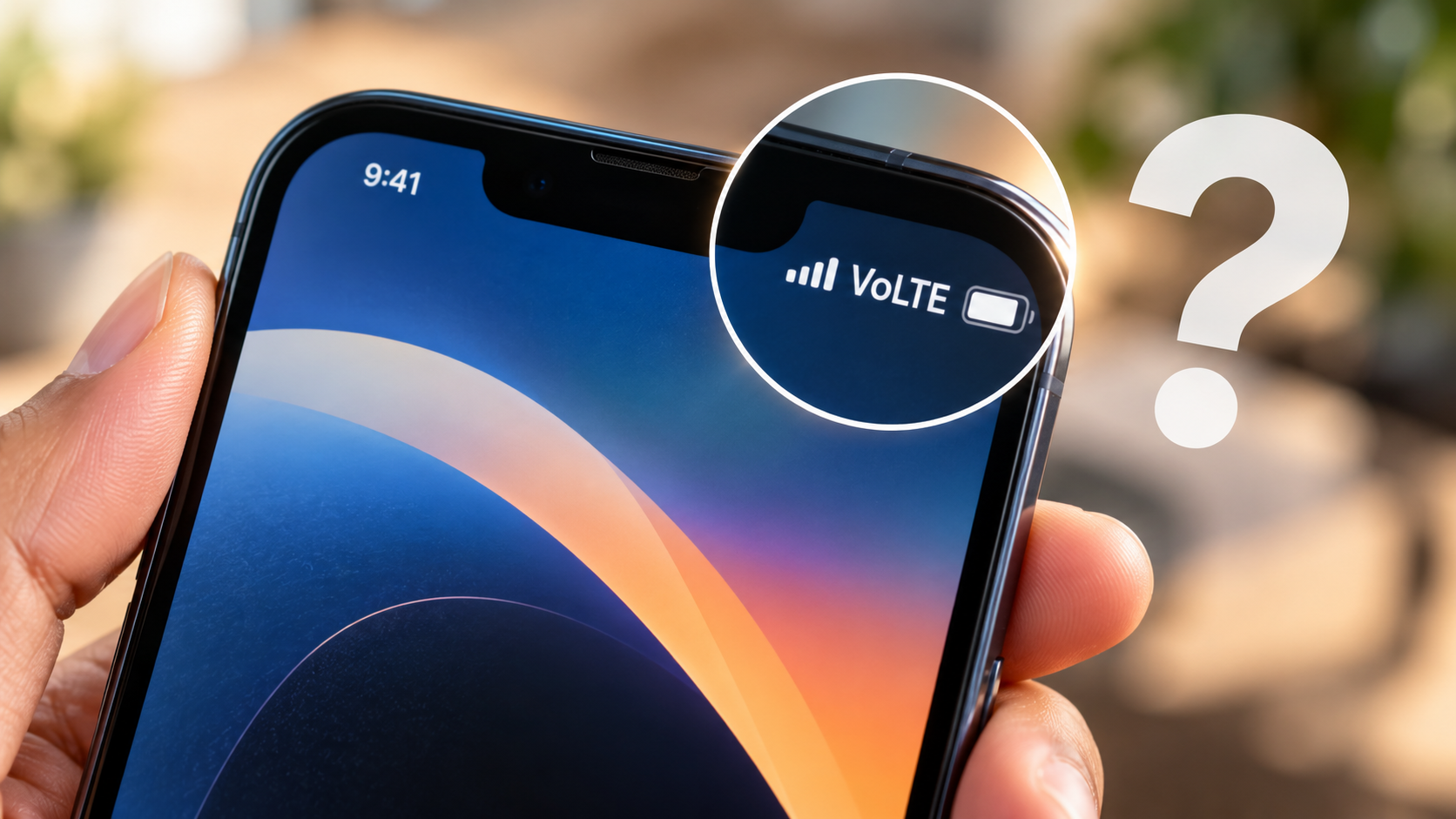
Have you noticed a new icon beside the cellular signal bars on your phone? The VoLTE symbol on your phone means your device is using Voice over LTE for cellular voice calls. VoLTE stands for Voice over Long-Term Evolution. It allows compatible phones to make calls over a 4G LTE network instead of older circuit-switched networks.
The technology improves how mobile networks handle voice calls. It can provide clearer audio, faster call connections, and better integration between voice and mobile data. VoLTE has become increasingly common as carriers reduce their reliance on older 2G and 3G networks.
The icon also indicates that your phone, SIM, carrier, and network configuration support VoLTE. Its appearance can vary between manufacturers and software versions.
If you are wondering what the VoLTE symbol on your phone means, this guide explains it in simple terms. You will learn whether to keep VoLTE enabled, how it relates to 4G and 5G, what happens when you disable it, and what limitations you should know about.
Is It Better to Have VoLTE On or Off?
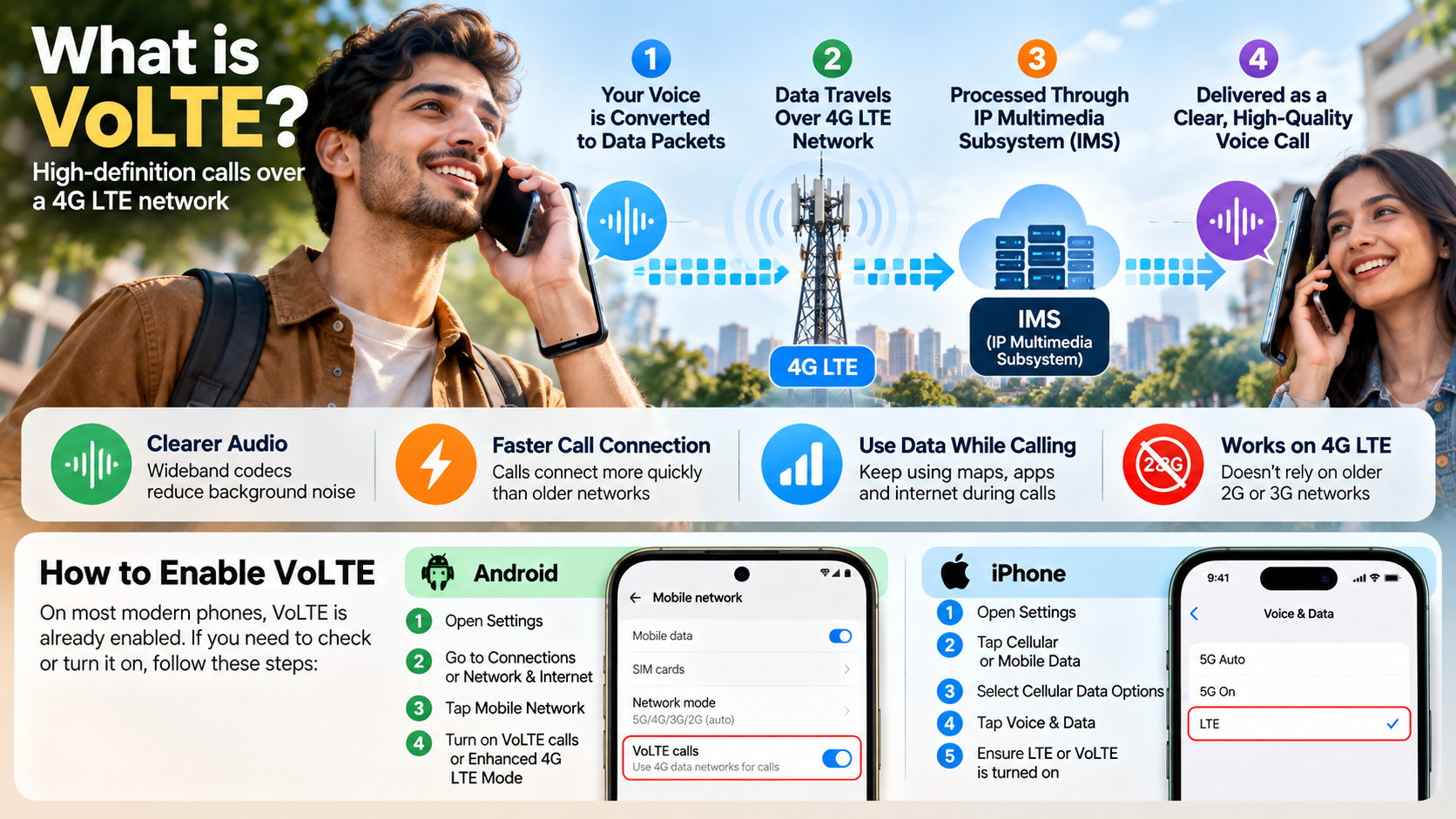
For most compatible phones, keeping VoLTE turned on is the practical choice. It allows your phone to use the carrier’s 4G LTE network for voice calls. This can provide clearer audio and faster call setup than older network technologies.
Another major benefit is that VoLTE allows your phone to maintain a 4G data connection during a voice call. You can continue using maps, browsing websites, sending messages, or using other online services while talking. If you regularly rely on navigation apps, you may also want to compare Google Maps Vs. Waze when choosing which service to use.
The exact experience depends on your carrier, device, and location. Some networks now rely heavily on LTE for voice services because their older 2G and 3G networks have been retired.
If you see the VoLTE symbol on your phone, keeping the feature enabled can help maintain compatible voice service. Turning it off may force your device to use an older network where one is available. On some modern networks, there may be no suitable fallback.
Unless you have a specific compatibility problem, leaving VoLTE enabled is usually the simplest option. If disabling it causes calling problems, restore the setting and check your carrier’s requirements.
Critical Network Shutdowns Make VoLTE Essential
The retirement of older 2G and 3G networks has made VoLTE increasingly important. Many carriers have reduced or discontinued legacy services, although availability varies by country, carrier, and region.
If your carrier uses LTE for voice calls, switching off VoLTE may prevent normal calls from working. Where compatible 2G or 3G fallback remains available, your phone may instead switch to one of those networks.
This explains why the VoLTE symbol on your phone can have different practical importance on different networks. Your device model, SIM configuration, carrier provisioning, and network coverage all affect how calling works.
You should also avoid assuming that disabling VoLTE affects emergency calling identically everywhere. Emergency-call support depends on local regulations, carrier infrastructure, device compatibility, and available network technologies.
If calls stop working after you disable VoLTE, turn the setting back on. Then check your carrier’s compatibility information. This is especially important after changing SIM cards, switching carriers, or traveling to another region.
The safest approach is to understand which voice technologies your carrier currently supports before changing the setting.
Why Do I Have a VoLTE Icon on My Phone?
You see the VoLTE symbol on your phone because your device and carrier have enabled Voice over LTE. When you insert a compatible SIM, your phone checks the carrier configuration and network capabilities available in your area.
If your carrier supports VoLTE and your device is correctly provisioned, the phone can register for voice services over LTE. The icon indicates that VoLTE service is available or active. The exact design can differ between Android phones, iPhones, and manufacturers.
The symbol does not mean that you installed a separate calling application. VoLTE is part of your phone’s cellular communication system. It works through your carrier’s network and the modem built into your device.
The icon may disappear when you leave compatible coverage or when network conditions change. Software updates and carrier configuration changes can also affect how the icon appears.
Therefore, the VoLTE symbol on your phone is generally a sign that your device has access to the carrier’s LTE-based voice service. It is not a warning or error message.
Carrier Provisioning and Device Compatibility
VoLTE requires more than simply owning a 4G-compatible phone. Your device, SIM, carrier, software, and network configuration must support the service.
Carriers use network provisioning to identify compatible devices and enable supported voice features. When the configuration is correct, your phone can register for IMS-based voice services and display a VoLTE indicator.
Different manufacturers may use different labels or locations. Samsung, Xiaomi, Google, and other manufacturers can display VoLTE differently. Some phones may show the icon only while the service is actively registered.
A compatible phone can also lose VoLTE availability after you change carriers or use an unsupported SIM. Software updates may change the location or appearance of the setting as well. If you regularly change network settings or connect to unfamiliar networks, understanding how long your router password should actually be can also help protect devices on your home network.
If you cannot find a VoLTE option, that does not necessarily mean your phone lacks the technology. Some carriers manage the feature automatically and do not provide a manual switch.
If the VoLTE symbol on your phone disappears unexpectedly, check your network connection first. Then verify that your SIM and carrier support VoLTE.
For persistent problems, check the carrier’s supported-device information and contact customer support if necessary.
Is VoLTE 5G or 4G?
VoLTE is a 4G LTE technology, not a native 5G voice technology. The name stands for Voice over Long-Term Evolution. LTE is the technology associated with fourth-generation mobile networks.
VoLTE was developed to carry voice calls as packet-based traffic across LTE networks. This differs from the circuit-switched technology historically used by many 2G and 3G networks.
Having a 5G phone does not mean every voice call uses 5G. Depending on your carrier and network configuration, your phone can use 5G for mobile data while using LTE for voice calls.
This is why the VoLTE symbol on your phone can still appear when your phone shows a 5G connection. Your phone may use 5G for data while maintaining LTE-based voice service.
Newer 5G networks can use Voice over New Radio (VoNR) for voice calls. VoNR allows compatible voice services to operate directly over 5G radio networks.
However, VoNR availability depends on carrier deployment, device compatibility, network coverage, and other technical requirements. A 5G signal alone does not prove that VoNR is active.
For most users, the phone and network manage this process automatically. You usually do not need to manually select the technology used for each call.
The Role of VoNR in Next-Generation Voice
VoNR is the 5G counterpart to VoLTE. Instead of routing voice through LTE, VoNR allows compatible voice services to operate directly over a 5G New Radio network.
A 5G-capable phone can support both technologies. The network determines which voice technology is used based on coverage, carrier configuration, device compatibility, and network deployment.
In many situations, your phone can remain connected to 5G for data while using LTE for voice. This allows carriers to provide 5G data services without requiring complete VoNR coverage everywhere.
As 5G networks expand, more carriers may introduce VoNR in supported locations. However, the presence of a 5G signal alone does not prove that VoNR is active.
This explains why the VoLTE symbol on your phone can appear even when the status bar shows 5G. Your phone may be using different network technologies for data and voice.
For everyday users, there is usually no need to switch manually between VoLTE and VoNR. The device and carrier normally manage the connection automatically.
If you want to know which technology your phone currently uses, check your device settings and carrier documentation.
What Happens If I Turn Off VoLTE Calls?
When you turn off VoLTE, your phone may stop using LTE for voice calls. What happens next depends on your carrier and the older networks still available in your area.
If your carrier supports compatible 2G or 3G voice fallback, your phone may switch to one of those networks during a call. This can affect mobile data performance and may result in slower call setup or different voice quality.
On networks without suitable legacy voice service, disabling VoLTE can cause regular calls to fail. The phone may not have another compatible network available for traditional cellular voice calls.
You may also notice changes in mobile data during calls. On some older network configurations, the phone cannot maintain a normal mobile-data connection while using a circuit-switched voice connection.
Because carrier support varies, there is no single result for everyone. If the VoLTE symbol on your phone disappears after you disable the feature, your phone may be using another available voice technology.
If calls begin failing, turn VoLTE back on and check your carrier’s requirements. Avoid changing the setting without checking network compatibility first.
Inability to Connect on Modern Cellular Carriers
Modern carrier networks increasingly depend on LTE and newer technologies for voice services. As operators retire older networks, VoLTE becomes more important for compatible devices.
If your carrier has removed 3G service and does not provide suitable 2G fallback, disabling VoLTE can prevent normal voice calls from connecting. Your phone may display a calling error instead.
The same problem can occur when you travel to a region where your device does not have compatible legacy coverage. A setting that works on one network may produce different results on another.
The VoLTE symbol on your phone therefore depends partly on the network around you. Your device may display the icon in one location and behave differently in another.
You should not assume that disabling VoLTE will always block emergency calls. Emergency communications depend on local requirements, carrier infrastructure, device support, and available network technologies.
If you depend on your phone for important calls, check your carrier’s supported voice technologies before disabling VoLTE. This is particularly important when traveling internationally or changing carriers.
What Are the Disadvantages of VoLTE?
VoLTE has relatively few disadvantages for everyday users, but it still depends on compatible network conditions. Because voice calls use an LTE connection, call quality can be affected by weak or unstable LTE coverage.
In areas with poor coverage, you may experience dropped calls, distorted audio, or temporary interruptions. Your phone may also switch between available network technologies as coverage changes.
Battery usage can vary as well. Maintaining a cellular connection requires power, but the difference between VoLTE and older voice technologies is not necessarily large on modern phones. Actual battery use depends on the device, signal strength, network conditions, and call duration.
Interoperability is another consideration. HD voice features may not always work at the highest quality when calling users on incompatible networks or while roaming internationally.
If the VoLTE symbol on your phone is visible and your calls work normally, there is usually no reason to disable the feature simply because it uses LTE.
The main limitation is that VoLTE depends on compatible carrier infrastructure and stable LTE coverage. Network availability matters more than the icon itself.
Network Inconsistencies and Edge Coverage Gaps
VoLTE works best when your phone has a stable LTE connection. Problems can occur when you move into areas where LTE coverage becomes weak or changes frequently.
For example, a phone moving between strong and weak coverage may need to manage changing network conditions during a call. Depending on the carrier’s configuration, this can contribute to audio interruptions or dropped calls.
Rural areas, underground locations, large buildings, and other places with limited cellular coverage can create similar problems. The underlying limitation may be network coverage rather than VoLTE itself. Physical objects can also affect wireless signals, which is why questions about whether wrapping your phone in aluminum foil blocks signals often come up.
Your phone may also consume additional power when it repeatedly searches for or switches between available network signals. This behavior can occur with cellular technologies generally.
If the VoLTE symbol on your phone is present but your calls sound poor, check your signal strength before blaming VoLTE. Weak LTE coverage can affect any LTE-based service. When using wireless connections in public places, it is also important to understand public Wi-Fi risks and how to stay safe on open networks.
You can also check for software updates and confirm that your device is supported by your carrier.
For most users, stable LTE coverage and a compatible device provide reliable VoLTE calling without requiring manual adjustments.
Conclusion
The VoLTE symbol on your phone simply indicates that your device supports voice calls over a 4G LTE network. For most users, keeping VoLTE enabled provides clearer calls, faster call connections, and the ability to use mobile data while talking.
VoLTE is different from 5G voice technology, although 5G phones can still use LTE for calls. Newer networks may also support VoNR, which handles voice calls directly over 5G.
The GSMA’s official VoLTE guide explains that VoLTE uses IP-based voice services over an LTE access network.
If you notice the VoLTE symbol on your phone disappearing, check your carrier support, SIM configuration, network coverage, and phone settings. In most cases, there is no reason to turn VoLTE off unless your carrier or device requires a different configuration.
Keeping the feature enabled is generally the simplest way to maintain compatible voice service on modern LTE networks.