
Unstructured Play in Early Childhood Development: The Complete Guide
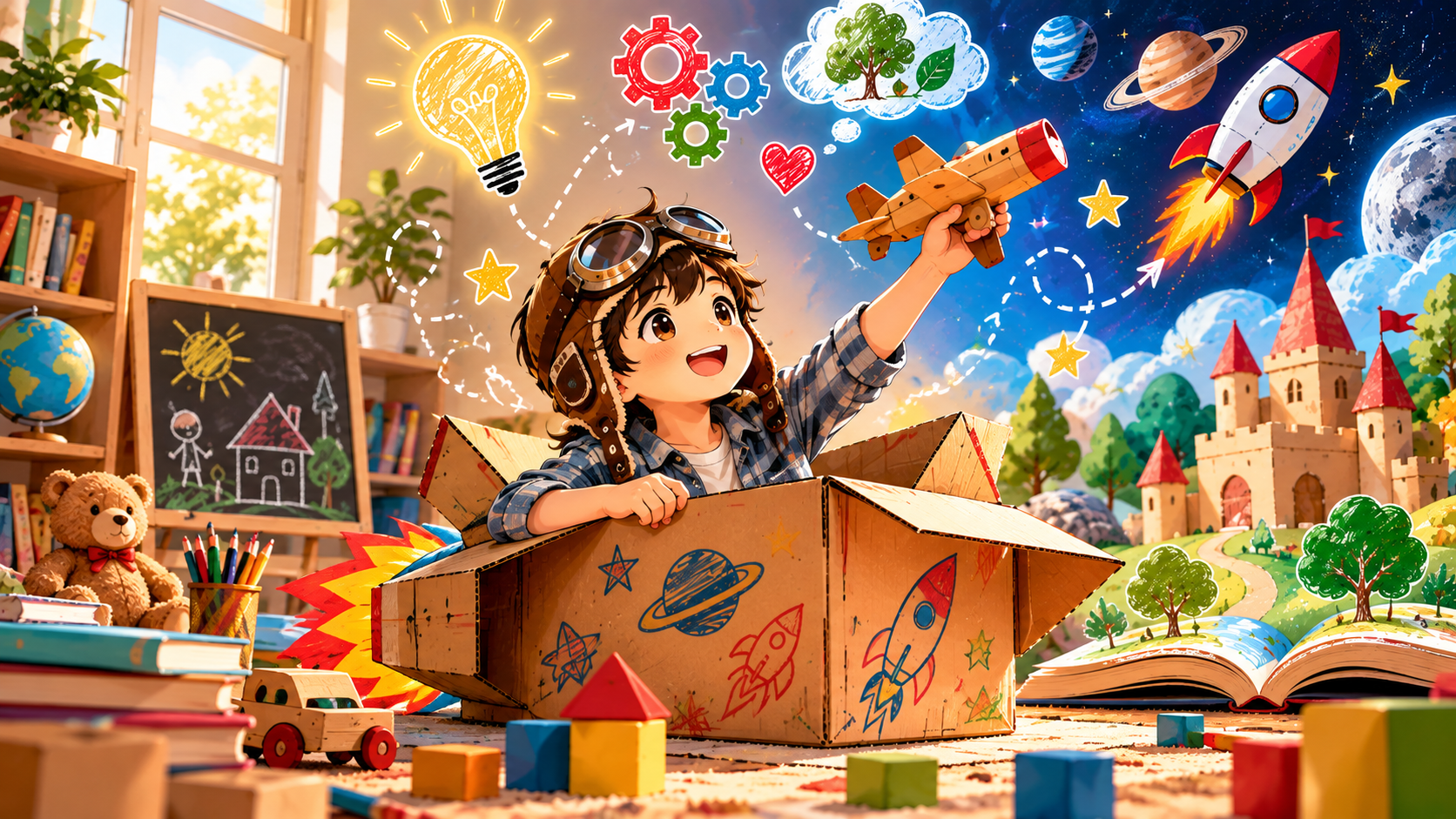
Watching a child turn a simple cardboard box into an intergalactic spaceship reveals how children learn through imagination. This kind of self-directed discovery is an important part of healthy growth. Understanding unstructured play in early childhood development helps parents and educators support children’s cognitive, social, emotional, and physical development.
According to the American Academy of Pediatrics, play supports healthy development and helps children build essential life skills. When children choose their activities freely, they experiment, solve problems, and explore their surroundings at their own pace.
However, busy schedules can leave little room for spontaneous play. Structured classes, academic activities, and screen time often take priority over independent exploration. Children need opportunities to make their own decisions, follow their curiosity, and learn through everyday experiences.
This guide explores the advantages of unstructured play, its ten key developmental benefits, and the six stages of social play. It also explains guided play, four common types of play, and Jean Piaget’s influential theory of play. Understanding these concepts can help parents, caregivers, and educators create environments where children learn naturally through exploration.

What are the advantages of unstructured play?
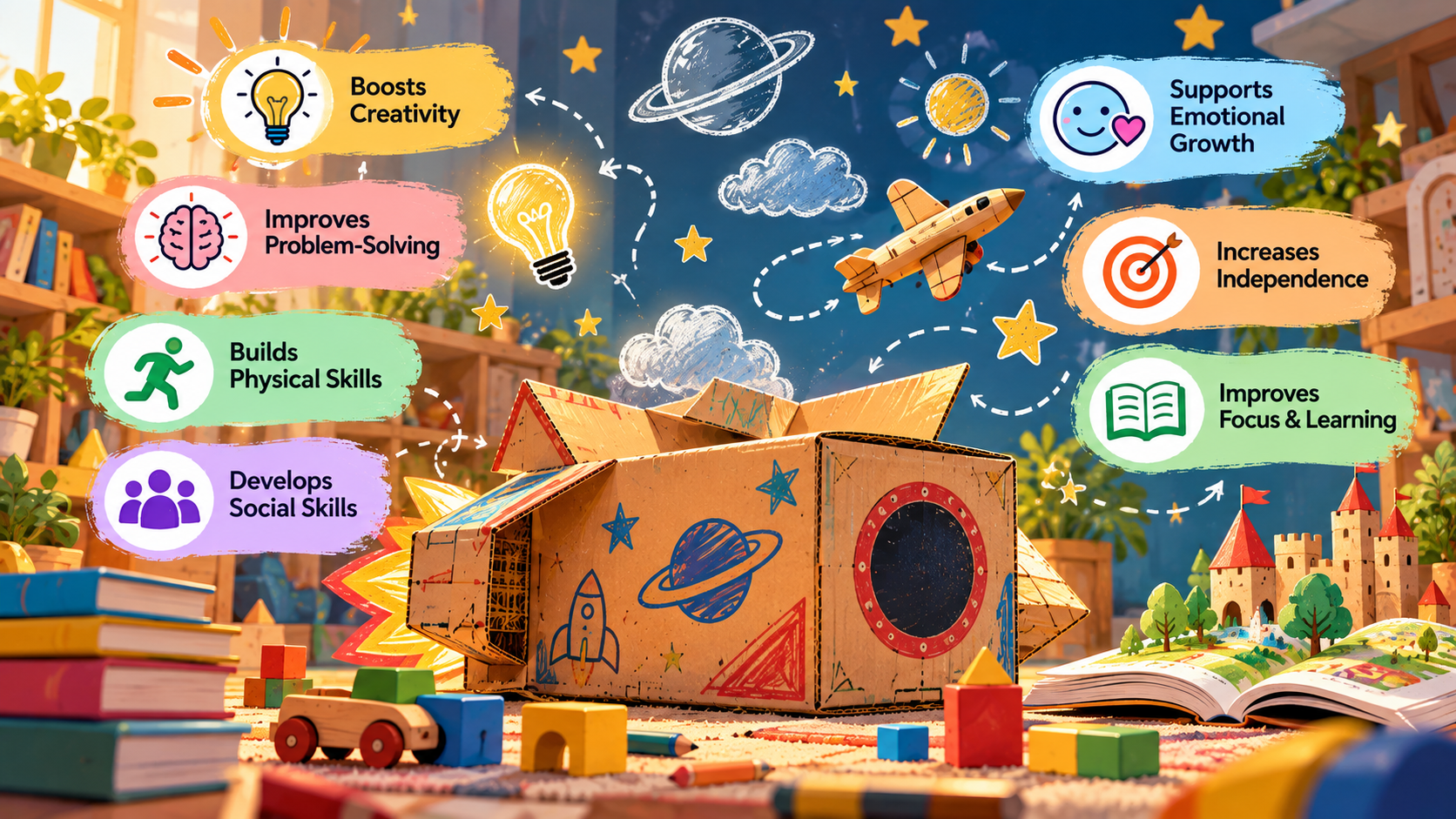
Unstructured play allows children to choose their activities without following strict instructions or predetermined outcomes. This freedom encourages curiosity, independence, and creative thinking. Instead of completing tasks designed by adults, children decide what to explore and how to approach challenges.
One of the biggest advantages of unstructured play in early childhood development is that children can learn at their own pace. They choose activities based on their interests, experiment with different ideas, and discover solutions independently. These experiences encourage creativity, confidence, and flexible thinking.
Unstructured play also supports emotional and social growth. Children learn to manage frustration, negotiate with peers, and express their feelings. Independent play can help them recognize their interests and build confidence in their decisions. Teachers can further support children’s individual needs by learning how to help sensory-sensitive students create comfortable learning environments.
Physical exploration offers additional benefits. Running, climbing, jumping, and balancing help develop coordination and body awareness when the environment is appropriate for the child’s age.
Other important advantages include:
- Creativity: Children invent stories, games, and imaginative situations.
- Independence: They make choices and learn from their experiences.
- Social development: They practise communication, cooperation, and conflict resolution.
- Emotional resilience: They learn to handle mistakes and adapt to challenges.
- Concentration: Self-chosen activities can encourage sustained attention.
These benefits develop gradually through regular opportunities for free exploration. Adults can support the process by providing safe spaces, suitable materials, and time without controlling every activity. They should also pay attention to why students lose their curiosity and how to address it so children remain engaged in learning.
What are 10 benefits of play in child development?
Play supports several areas of early childhood development, including language, movement, thinking, relationships, and emotional well-being. Different activities encourage different skills, so children benefit from a variety of playful experiences. Parents can also explore fun games to teach kids English at home to support language development. Unstructured play is particularly valuable because children can follow their interests and practise skills at their own pace.
Here are ten important benefits of play in child development:
- Language development: Talking during pretend games helps children learn vocabulary and express ideas.
- Motor skills: Running, climbing, drawing, and stacking objects develop coordination and physical control.
- Problem-solving: Children experiment with different solutions when activities present challenges.
- Empathy: Pretend play helps children explore different perspectives and understand feelings.
- Social skills: Playing with others encourages sharing, cooperation, negotiation, and communication.
- Emotional regulation: Play gives children opportunities to express feelings and practise managing frustration.
- Creativity: Imaginative activities encourage original ideas and flexible thinking.
- Concentration: Interesting, self-chosen activities can help children practise maintaining attention.
- Executive function: Games and self-directed activities can support planning, working memory, and impulse control.
- Stronger relationships: Shared play creates opportunities for parents, caregivers, and children to connect.
These benefits often overlap. For example, building a pretend shop with friends can develop language, counting, cooperation, and creative thinking simultaneously.
Parents do not need expensive toys or elaborate activities to support these outcomes. Everyday objects, outdoor spaces, household materials, and opportunities for imaginative play can provide meaningful learning experiences.
What are the 6 stages of play in child development?
Sociologist Mildred Parten identified six patterns of children’s play that describe how social interaction develops. These stages are commonly used to explain changes in children’s play behaviour. However, they should not be treated as a strict developmental timetable. Children may move between different patterns depending on their age, interests, environment, and comfort with other children.
The six stages of play are:
- Unoccupied play: Infants make spontaneous movements, observe their surroundings, and explore what happens around them.
- Solitary play: Children play independently and focus on their own activities without needing to interact with nearby peers.
- Onlooker play: Children watch others playing and may ask questions, even when they do not participate.
- Parallel play: Children play beside one another, often using similar toys, but do not actively coordinate their activities.
- Associative play: Children interact, share materials, and talk while playing, although they may pursue different goals.
- Cooperative play: Children work together toward a shared goal, organise roles, and follow agreed rules.
These patterns help adults understand how social play can develop over time. For example, a toddler playing beside another child may be practising important social skills without directly cooperating.
Parents and educators should avoid forcing children to participate in group activities before they feel comfortable. Instead, they can offer welcoming play environments and allow relationships to develop naturally. Independent play also remains valuable as children become more socially confident.
What is guided play in early childhood?
Guided play combines child-led exploration with gentle adult support. It sits between completely free play and direct instruction. Adults create an environment that encourages particular learning goals, while children retain meaningful control over their activities and decisions.
For example, a teacher interested in introducing basic science concepts might provide leaves, magnifying glasses, and sketchbooks. Children can examine leaf shapes, compare textures, draw observations, and ask questions. The teacher supports discovery without requiring every child to follow identical steps.
The adult’s role is to encourage curiosity rather than provide every answer. Open-ended questions such as “What do you notice?” or “What might happen if you try that?” help children think independently. These questions also create opportunities for language development, reasoning, and observation.
Guided play in early childhood education can support learning goals involving mathematics, language, science, and problem-solving. However, its effectiveness depends on balancing adult guidance with children’s freedom to explore. Too many instructions can turn the activity into a conventional lesson.
Unstructured play and guided play serve complementary purposes. Unstructured play gives children greater freedom to choose their goals, while guided play introduces gentle direction toward specific learning outcomes.
Parents can use both approaches at home. They might provide building blocks for free exploration one day and suggest comparing tower heights another day. In both situations, children should have room to experiment, ask questions, and discover solutions.
What are the four types of play in early childhood?
Play takes several forms, and each offers different opportunities for learning and development. Understanding these types helps parents support unstructured play in early childhood development through everyday activities. Four commonly discussed categories are functional play, constructive play, dramatic play, and games with rules. These categories can overlap, allowing children to develop several skills through a single activity.
Functional play involves repeating movements or actions for enjoyment and exploration. Babies might shake rattles, while toddlers repeatedly jump, roll balls, or run across an open space. These activities help children explore movement, sensory experiences, and cause-and-effect relationships.
Constructive play involves creating or building something. Children might use blocks, sand, clay, cardboard, or recycled materials to make structures and objects. This type of play encourages spatial awareness, planning, experimentation, and problem-solving.
Dramatic or symbolic play allows children to represent people, objects, and situations through imagination. A child might pretend to be a doctor, turn a cardboard box into a bus, or create a pretend restaurant. These activities support language, creativity, emotional expression, and perspective-taking.
Games with rules involve agreed instructions, turn-taking, and shared expectations. Examples include simple board games, playground games, and age-appropriate team activities. These experiences help children practise cooperation, patience, fairness, and self-control.
Each type of play contributes differently to children’s growth. Regular opportunities for unstructured play in early childhood development allow children to explore their interests, practise new skills, and learn at their own pace. Providing varied materials and enough free time encourages children to discover different ways of playing without unnecessary adult direction.
What is Piaget’s theory of play?
Swiss psychologist Jean Piaget viewed play as an important part of children’s cognitive development. His theory explains how children build knowledge by interacting with their surroundings. Through play, they practise existing skills, explore new ideas, and adjust their understanding of the world.
One important concept in Piaget’s theory is assimilation. This occurs when children interpret new experiences using knowledge they already have. For example, a toddler who knows how to push a toy car may use the same action with a different wheeled toy.
Another concept is accommodation, which occurs when children adjust their existing understanding to incorporate new information. If a toy behaves differently than expected, the child may change how they approach it. Together, assimilation and accommodation help explain how learning develops through experience.
Piaget described three broad forms of play associated with cognitive development:
- Practice play: Common during the sensorimotor stage, this involves repeating actions to explore movement, objects, and cause and effect.
- Symbolic play: Often associated with the preoperational stage, this involves imagination, pretend situations, and using objects to represent other things.
- Games with rules: These become increasingly important as children develop logical thinking and understand shared expectations, particularly during the concrete operational stage.
These categories describe broad developmental patterns rather than rigid age limits. Children may revisit earlier forms of play as they encounter new experiences or explore familiar ideas in different ways.
Piaget’s theory highlights why active exploration matters. Children learn by doing, experimenting, and making discoveries, not simply by receiving information from adults. Understanding the classification of the human brain, its structure, and developmental stages can provide additional context for exploring cognitive development. Providing opportunities for unstructured play can therefore support curiosity, independent thinking, and cognitive growth throughout early childhood.
Frequently Asked Questions
How much unstructured play does a young child need each day?
Child development specialists recommend that toddlers and preschoolers receive at least two hours of active, unstructured play every day. This time should be split between indoor imaginative exploration and outdoor physical play. Providing dedicated, unhurried periods allows children to sink into deep, concentrated play states without adult interruptions, fostering emotional balance and sustained personal focus.
Can screen-based games replace physical unstructured play?
Digital games cannot replace the rich benefits of three-dimensional, real-world play. While some educational applications support digital literacy, they lack sensory richness, authentic physical exertion, and dynamic social negotiation. Real-world exploration requires gross motor movement, spatial reasoning, and real-time social problem-solving that pre-programmed digital interfaces simply cannot replicate.
How can parents encourage unstructured play without directing it?
Parents can foster self-directed exploration by offering open-ended materials such as wooden blocks, fabric scarves, cardboard boxes, and natural elements like pinecones. Create an accessible, safe environment where children can freely access their supplies. Step back to observe rather than instructing, intervening only when physical safety requires it.
Conclusion
Embracing unstructured play in early childhood development provides children with the authentic freedom they need to blossom. Throughout this guide, we explored how self-directed discovery unlocks ten essential developmental benefits, from enhanced brain plasticity and social empathy to stress reduction and physical coordination. By understanding Parten’s six social stages and Piaget’s cognitive theories, educators and parents can better appreciate the complex learning unfolding behind everyday pretend games.
While guided learning has a place in early education, safeguarding generous blocks of self-directed time remains critical. Open-ended play is neither empty downtime nor an aimless distraction; it is the natural engine of early human development. By stepping back, reducing screen exposure, and offering simple, open-ended materials, you create an environment where natural curiosity thrives. Protect these playful hours in your child’s daily routine, and watch their creativity, independence, and emotional resilience flourish for years to come.