
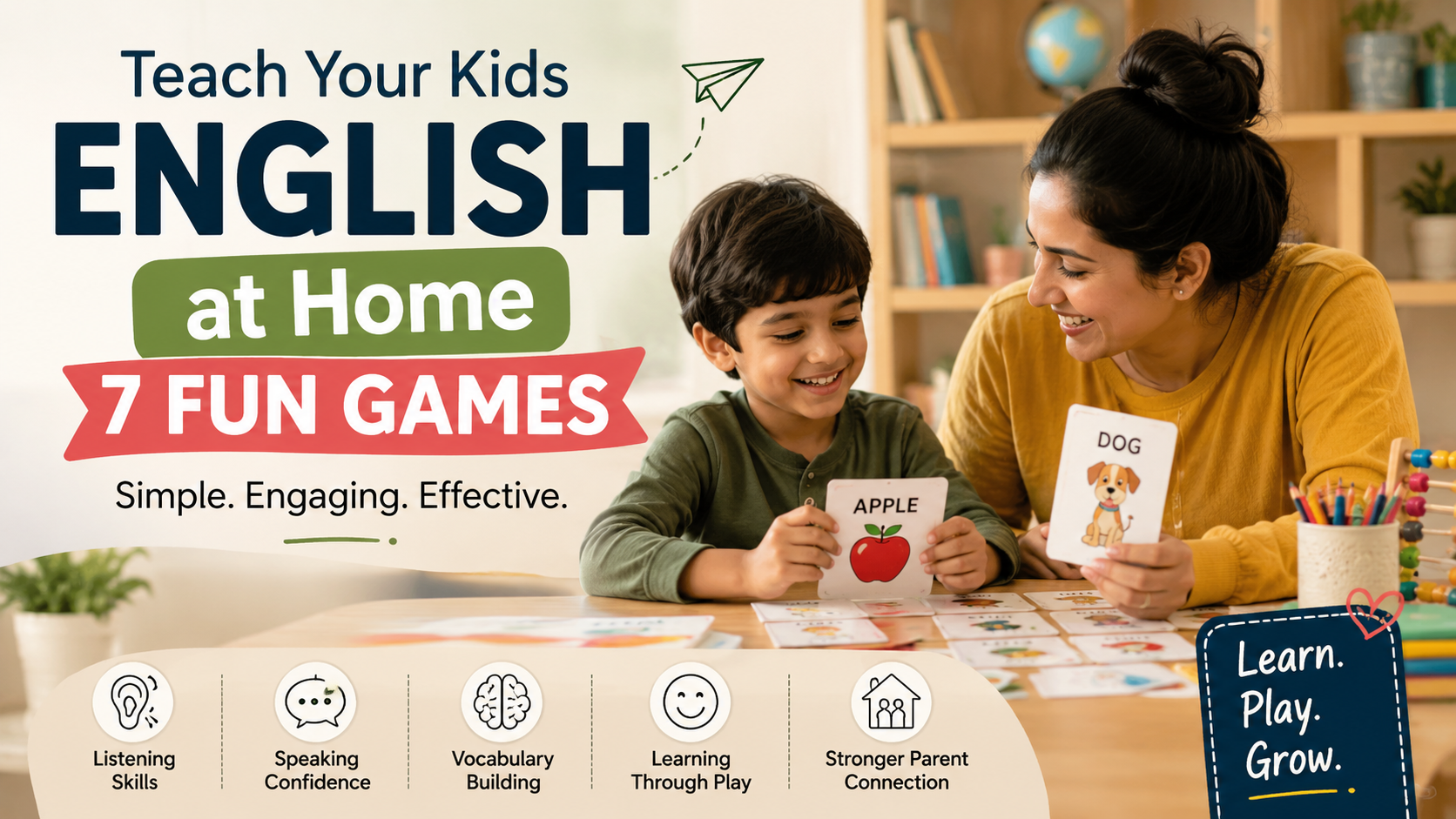
Teach Your Kids English at Home: 7 Fun Games
Teaching young children a foreign language can feel like a tough task. Consequently, many parents struggle when relying on traditional flashcards and boring grammar sheets. However, young minds absorb new language skills best during active play. Therefore, if you want to teach your kids English at home, turning study time into interactive games is the best strategy. According to research on early childhood development published by the British Council, young learners acquire vocabulary naturally through play. As a result, immersive play works far better than formal academic instruction.
In addition, gamifying language education removes artificial stress and performance anxiety. Because of this, your child will not feel evaluated or tested during these activities. Instead, they become enthusiastic participants solving puzzles and winning friendly challenges. Ultimately, this organic learning process builds active listening skills. Furthermore, it expands essential everyday vocabulary and fosters genuine speaking confidence.
In this guide, we will break down seven engaging games. Specifically, you can start playing these low-prep activities in your living room today. They require no teaching background and use simple items you already own. By using these play sessions daily, you will create a supportive learning environment. In short, this setup prepares your child for lifelong linguistic success.
Simple Activities to Teach Your Kids English at Home
Introducing a second language works best when you keep expectations realistic. For this reason, keep your routines flexible and centered around pure fun. You do not need expensive software subscriptions or complicated lesson plans. Likewise, you do not need hours of free time every day. In fact, short blocks of ten to fifteen minutes yield great results. Thus, these brief sessions work better than long, exhausting study routines.
Overall, the secret to success lies in consistent practice and positive reinforcement. Children often associate English with giggles and friendly competition. Moreover, they enjoy quality bonding time with their parents. When these factors align, their natural curiosity takes over. Consequently, gamifying your routine keeps motivation high while removing the fear of mistakes. The following seven activities make early language learning an exciting daily adventure. As a result, your whole family can enjoy these simple exercises together.
Game 1: Simon Says (Listening Practice to Teach Your Kids English at Home)


Simon Says is a classic party game that works as an extraordinary learning tool. Specifically, it helps parents teach your kids english at home by focusing on action verbs and body parts. Moreover, this activity builds active listening comprehension skills quickly. Children must listen carefully to every single word before physically moving. Therefore, it bridges the gap between hearing a word and understanding its physical meaning.
To set up the game, first assume the role of “Simon.” Next, give clear physical instructions starting with the phrase “Simon says.” For example, say, “Simon says touch your nose.” Similarly, you can say, “Simon says jump three times.” However, if you give a command without saying “Simon says” first, your child must stay completely still. If they move anyway, they take a short pause from the round.
-
Vocabulary taught: Action verbs like run, jump, touch, clap, and sit. Body parts like head, knees, and toes.
-
Why it works: Physical movement reinforces memory retention through movement. Consequently, this makes verb acquisition remarkably quick and intuitive for young minds.
-
Parent tip: Keep the speed fast and silly. In turn, this keeps your child laughing while practicing their listening skills.
Game 2: The Living Room Treasure Hunt (Home Vocabulary Games to Teach Kids English)
Children have an innate love for searching and finding hidden objects. For example, a room-based treasure hunt transforms routine vocabulary practice into an exhilarating mission. Furthermore, it forces kids to process descriptive English phrases quickly. As a result, they locate the target item faster.
First, give your child a list of three to five items to find around the house. Be sure to use descriptive English clues for each object on the list. For instance, you might ask them to locate “a small red ball” or “a soft blue pillow.” As they retrieve each item, ask them to name it out loud. Additionally, have them describe its color, texture, or shape using a full sentence.
-
Vocabulary taught: Primary colors, basic geometric shapes, descriptive adjectives, and common household items.
-
Why it works: It connects abstract vocabulary words directly to real physical objects in a memorable context.
-
Parent tip: Set a gentle timer on your phone. Thus, you add extra excitement for older children who enjoy time challenges.
Game 3: Picture Bingo (Visual Tools to Teach Your Kids English at Home)
Bingo translates exceptionally well into early language education for young learners. Primarily, it trains children to connect spoken English words with visual images. Because of this, the game strengthens their auditory comprehension and word recognition skills without relying on written text. Therefore, it is a fantastic way to teach your kids english at home using visual markers.
You can easily create your own game boards at home. First, draw a simple grid on a piece of paper. Next, fill each square with basic sketches or clipped images of animals, foods, or clothing. Then, call out the English words one by one. Meanwhile, your child searches their board and covers the matching picture with a coin or marker. Finally, the first player to complete a full row shouts “Bingo!” in English.
-
Vocabulary taught: Farm animals, wild animals, favorite foods, items of clothing, and common household objects.
-
Why it works: It provides immediate visual reinforcement for newly introduced auditory vocabulary words.
-
Parent tip: Let your child take turns playing the host. Indeed, calling out the words helps them practice their speaking pronunciation.
Game 4: “I Spy” (Speaking and Observation Skills for Home Learning)
“I Spy” is a fantastic language game because it requires zero preparation or equipment. Besides, you can play it anywhere in your daily life. For instance, try playing in the living room, during dinner, or during long car rides. Consequently, it develops keen observational skills while expanding descriptive vocabulary naturally.
To begin, start the game by picking an object in the immediate surroundings. However, do not point at the item or reveal its identity. Instead, say the classic phrase, “I spy with my little eye, something green.” Next, your child will take turns guessing nearby objects in English. For example, they can ask questions such as “Is it the plant?” Once they guess the item, swap roles. In effect, swapping lets them create their own descriptive clues.
Key Takeaway: Games that swap roles give children valuable practice in both passive listening comprehension and active speech production.
-
Vocabulary taught: Color variations, size descriptions, spatial prepositions, and everyday objects.
-
Why it works: It trains children to think directly in English by describing the real world around them.
Game 5: The Mystery Bag Guessing Game (Sensory Learning to Teach Kids English)
Tactile learning activities engage a child’s sense of touch. Above all, touch heightens focus and sparks natural curiosity. Therefore, the Mystery Bag game encourages kids to use descriptive English adjectives. In this way, they learn to articulate feelings and textures before even seeing the hidden object.
To set up the activity, first place several familiar items inside an opaque cloth bag. Alternatively, you can use a pillowcase or a decorated cardboard box. Next, have your child reach inside without looking at the items. They must feel one specific item with their hands. Then, ask them to describe the object using English words like hard, soft, smooth, or round. Finally, have them guess the item’s name out loud before pulling it out.
-
Vocabulary taught: Descriptive adjectives, texture words, physical properties, and everyday object names.
-
Why it works: Relying solely on touch forces the brain to search for descriptive words instead of visual shortcuts.
-
Parent tip: Include contrasting textures like a fluffy sock and a hard plastic toy. As a result, this expands their descriptive vocabulary.
Game 6: Word Association Ball Toss (Building Spontaneous Speech)
This fast-paced physical activity helps children retrieve English words quickly from memory. Because it speeds up response time, it reduces hesitation. Furthermore, it builds natural speaking fluency over time by bypassing internal mental translation.
First, stand opposite your child in an open area. Next, gently toss a soft ball or beanbag back and forth. However, before tossing, choose a specific category like “Animals” or “Fruits.” Every time a player catches the ball, they must call out a relevant English word. Specifically, they should speak within three seconds before tossing the ball back.
-
Category ideas: Household items, vehicles, colors, clothing items, favorite foods, and action verbs.
-
Why it works: Rhythmic physical movement prevents children from overthinking grammar. Thus, this encourages spontaneous and natural speech output.
-
Parent tip: Keep the game lighthearted. For example, allow silly entries or give gentle hints when your child gets stuck on a tricky category.
Game 7: Action Charades (Movement Games to Teach Your Kids English at Home)
Charades turns everyday language practice into a silly guessing game. Because it is simple, entire families can play this activity together. Moreover, it is a powerful tool to teach your kids english at home without relying on native language translations. In particular, it works well for action verbs, emotions, and daily routines.
To play, first write or draw simple daily activities on small slips of paper. For instance, you can include actions like eating soup, brushing teeth, or riding a bike. Next, players take turns drawing a slip from a bowl. They act out the phrase using gestures without making any sounds. Meanwhile, the other players call out their guesses in English using complete sentences like “You are brushing your teeth!”
-
Vocabulary taught: Action verbs, present continuous verb tenses, and daily routine phrases.
-
Why it works: Associating physical gestures directly with English phrases builds strong cognitive connections. Eventually, these connections improve long-term recall.
-
Parent tip: Use exaggerated expressions and theatrical body language. Indeed, silly actions make the game hilarious and memorable for younger kids.
Practical Strategies for Home Language Learning
To get the most out of these activities, keep sessions short and consistent. Consequently, ten to fifteen minutes of daily play works far better than an intense two-hour session once a week. Because young brains thrive on frequent repetition, brief play sessions yield faster progress.
Above all, always celebrate small efforts. Focus on successful communication rather than flawless grammar. When your child makes a mistake, avoid correcting them harshly. Instead, simply repeat the sentence back to them correctly in your response. For example, if your child says “He run fast,” reply warmly, “Yes, he runs so fast!” Ultimately, this gentle recasting technique preserves confidence while modeling accurate English grammar naturally.
FAQ SECTION
1: How often should I play English learning games with my child?
Consistency is far more critical than session length when helping a child learn a new language at home. Therefore, aim to play short language games for 10 to 15 minutes every single day. Consequently, brief, frequent sessions keep children enthusiastic without causing mental exhaustion or boredom. Furthermore, fitting simple activities naturally into your existing daily routine makes English feel like an enjoyable lifestyle habit rather than a forced chore. For example, you can play “I Spy” during breakfast or “Simon Says” right before bath time.
Additionally, young children thrive on predictable routines. When they expect a fun game at the same time each day, their brain prepares to engage in English effortlessly. Over time, these brief daily play sessions accumulate into dozens of hours of natural exposure every month. In short, these small moments build continuous momentum without making your child feel overwhelmed by academic tasks.
2: What if I am not a native English speaker myself?
You do not need native fluency or a perfect accent to teach your kids english at home effectively. On the contrary, young children benefit immensely from hearing basic everyday vocabulary and simple sentence structures directly from their parents. First, focus on interactive physical games where you can learn new words together as a team. This collaborative approach shows your child that learning is a shared, positive experience.
In addition, you can supplement your play sessions with high-quality English audiobooks, interactive nursery rhymes, and educational songs. Similarly, using native-speaking videos ensures balanced pronunciation exposure. Most importantly, your child looks to you for emotional comfort and encouragement. Therefore, your positive attitude, active participation, and enthusiasm matter far more than flawless grammar or perfect native accent control.
3: At what age can children start playing these language games?
Children can start participating in simplified language games as early as two or three years old. For toddlers, focus primarily on basic sensory activities, active listening, and simple physical gestures. Likewise, you can practice identifying basic colors, familiar objects, or fun animal sounds during routine playtime. At this early stage, the goal is simply building positive associations with the sounds of the language.
As children grow older and develop stronger cognitive abilities, you can introduce structured, rule-based games like Picture Bingo, Memory Match, and Charades. Furthermore, you can try category-based ball toss games as their reflexes and recall speed improve. Because these advanced activities require faster processing speed, they build broader vocabulary recall and conversational fluency over time. Therefore, always adapt the rules to match your child’s specific developmental stage.
4: How can I encourage a shy child to speak English out loud?
Shy children often feel self-conscious or anxious about making mistakes when speaking a new language. To lower their stress levels, start with passive listening games like “Simon Says” or room treasure hunts where speaking is not immediately required. In these activities, your child demonstrates understanding through action rather than vocal response, which builds silent confidence.
Next, gradually transition to cooperative games where you work together as a team rather than competing against each other. In addition, you can use puppets, action figures, or stuffed animals as conversational partners. Roleplaying through a toy dramatically reduces performance anxiety because the pressure shifts away from the child. Consequently, letting your child speak through a character allows them to express themselves freely and start speaking out loud without fear of judgment.
5: How long does it take for kids to show progress with home games?
Most parents notice measurable improvements in their child’s listening comprehension within three to four weeks of consistent daily play. For instance, your child will likely begin understanding spoken instructions, reacting to English prompts, and following multi-step commands without needing native language translations. Likewise, they will start identifying common household objects and colors with ease.
Furthermore, active speaking progress usually follows shortly afterward as their confidence grows naturally through repetition. However, keep in mind that every child processes language at an individual pace depending on their age, personality, and overall exposure. Therefore, avoid comparing your child’s timeline to others, and focus instead on celebrating minor victories, praising effort, and maintaining a supportive, pressure-free environment at home.
CONCLUSION
Teaching your child a new language does not have to involve tedious workbooks or memorization drills. On the contrary, by turning everyday lessons into interactive activities, you build a joyful environment where learning happens naturally. Therefore, when you teach your kids english at home using creative games, you transform study time into a memorable bonding experience. As a result, your child will genuinely look forward to these sessions every day.
To further support your journey, explore some of the best platforms for learning English to discover digital tools, apps, and interactive resources that complement home play. Ultimately, the key to home language success lies in remaining patient and maintaining consistency. Above all, always prioritize fun over perfect grammar. Focus on boosting your child’s speaking confidence, validating their efforts, and expanding their practical vocabulary step by step. Consequently, as you integrate these simple activities into your daily routine, you will watch your child’s skills flourish. In conclusion, pick one or two games from this list to try with your child today, and start building a strong foundation for lifelong English learning.