
Top Enterprise Security Standards You Need to Know
In today’s interconnected digital landscape, organizations face sophisticated cyber threats every day. Strong enterprise security standards help protect digital infrastructure, customer information, intellectual property, and critical business systems. Organizations can use established frameworks and security guidance, such as the NIST Cybersecurity Framework, to reduce risk, improve resilience, and build consistent security practices.
Without unified security frameworks, businesses may struggle to manage expanding attack surfaces and meet regulatory obligations. Security leaders must address changing threats, third-party risks, cloud environments, identity threats, and internal vulnerabilities. A structured approach makes security easier to measure and improve.
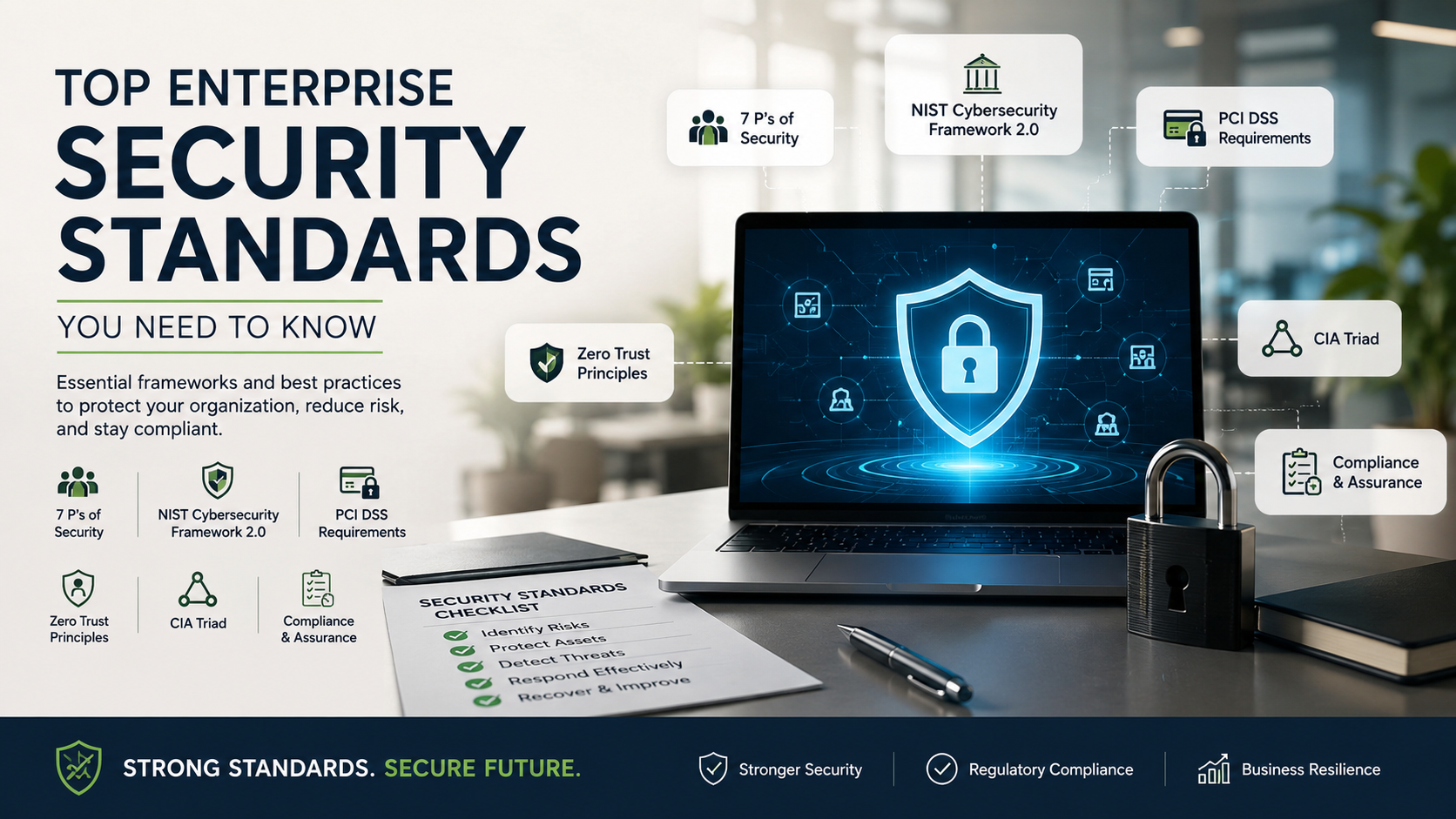
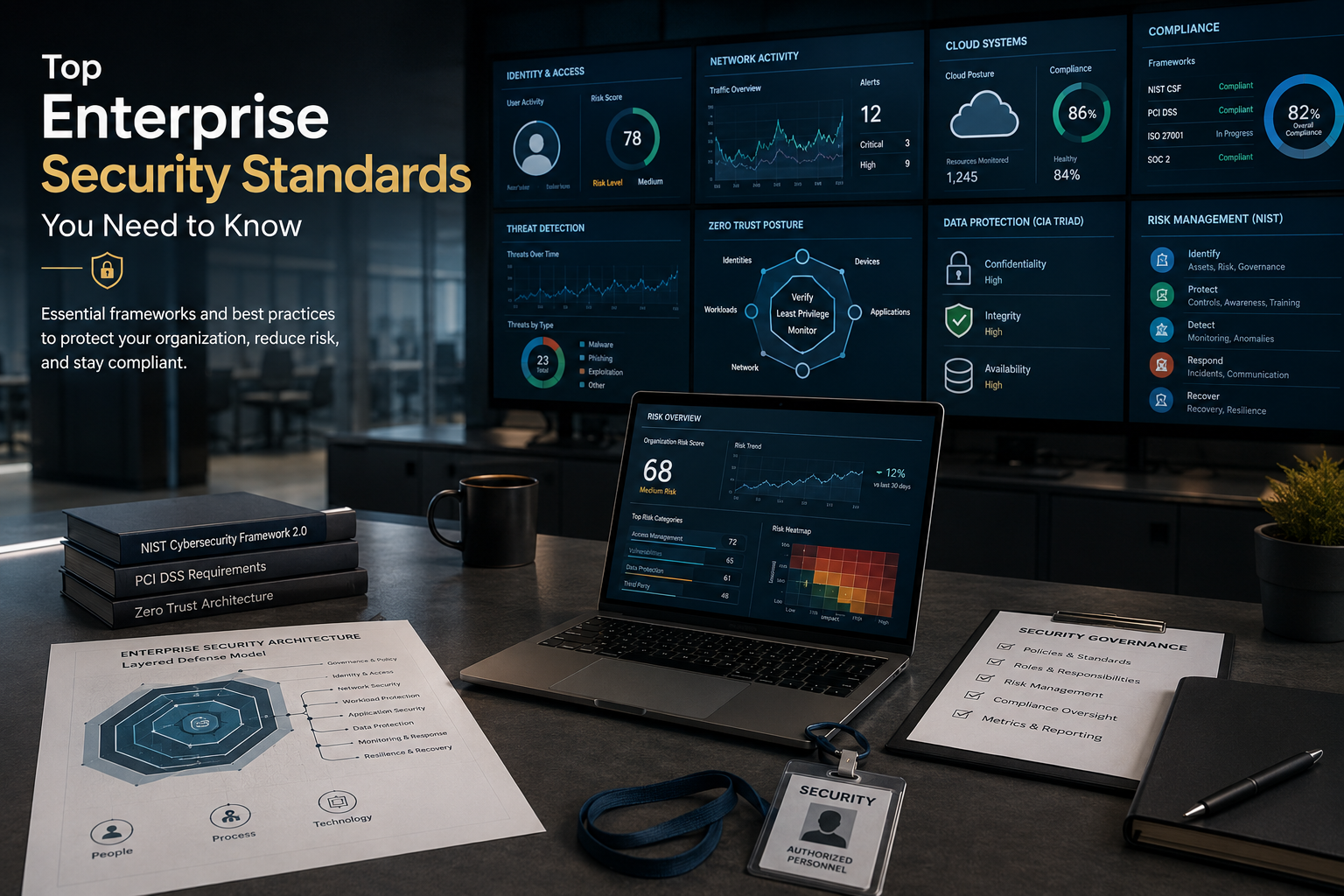
This guide explains several widely used enterprise security concepts and standards. It covers the 7 P’s as an organizational security model, the current NIST Cybersecurity Framework, PCI DSS requirements, seven commonly used Zero Trust security pillars, and the CIA triad. These principles can help organizations strengthen controls, support compliance, and protect critical business assets.
What Are the 7 P’s in Security?
The 7 P’s of security can be used as a broad organizational model for protecting physical, human, and digital assets. However, unlike NIST or PCI DSS, the 7 P’s are not one universally standardized cybersecurity framework. Different security programs may define the seven elements differently. In this model, they include People, Policies, Procedures, Perimeter, Physical Access, Protection Mechanisms, and Proof of Compliance.
People represent employees and other users who must follow security practices. Policies establish formal security expectations, while procedures explain how teams apply those rules during normal operations and incidents. Perimeter controls protect network boundaries and facilities, while physical access controls restrict entry to sensitive locations.
Protection mechanisms include technical and administrative safeguards. Proof of compliance provides evidence that controls operate as intended through assessments, audits, testing, and documentation. Together, these elements provide a practical way to organize enterprise security standards across departments and facilities.
Prioritizing People and Policy in Layered Defense
People and policy remain essential because security technology cannot eliminate human risk. Employees can still expose credentials, mishandle sensitive information, or approve fraudulent requests. Strong technical controls therefore need clear policies and regular security awareness training.
Organizations should define responsibilities before deploying security tools. Employees need to understand acceptable use, password practices, access requirements, reporting procedures, and incident escalation. Managers should also know which security decisions require additional approval.
Policies become more useful when procedures translate them into daily actions. For example, an access policy can require least-privilege permissions, while a procedure explains how teams request, approve, review, and remove access.
Security leaders should also measure whether employees follow established controls. Phishing simulations, access reviews, policy acknowledgments, and incident reporting metrics can provide useful evidence.
This layered approach reduces dependence on any single defense. People, policies, procedures, physical safeguards, technical controls, and compliance evidence work together to support stronger enterprise security standards and more consistent risk management.
What Are the 6 Functions of the NIST Cybersecurity Framework?
The original NIST Cybersecurity Framework used five functions: Identify, Protect, Detect, Respond, and Recover. However, NIST Cybersecurity Framework 2.0 added a sixth function called Govern. The current framework therefore contains Govern, Identify, Protect, Detect, Respond, and Recover.
Govern establishes cybersecurity strategy, expectations, responsibilities, policies, and risk-management oversight. Identify helps organizations understand assets, suppliers, business context, and cybersecurity risks. Protect focuses on safeguards that reduce or contain potential harm.
Detect supports timely discovery of cybersecurity events and anomalies. Respond covers actions used to manage and contain confirmed incidents. Recover focuses on restoring affected capabilities and improving resilience after an incident.
These functions operate together rather than as a simple linear checklist. NIST describes the CSF as a flexible framework for managing cybersecurity risk across different organizations and technology environments.
For businesses reviewing enterprise security standards, this distinction matters. Referring to the NIST CSF as a five-function framework is now outdated unless specifically discussing CSF 1.1.
Implementing Continuous Detection and Incident Recovery
Effective NIST implementation requires more than documenting security controls. Organizations need processes that continuously identify risks, protect important assets, detect suspicious activity, respond to incidents, and restore disrupted services.
Continuous monitoring can help security teams identify unusual authentication attempts, endpoint activity, network behavior, or data access. Automated alerts can shorten the time between detection and investigation. However, automation should support trained analysts rather than replace security judgment.
Incident response plans should also define clear responsibilities. Teams need documented procedures for containment, communication, evidence preservation, recovery, and post-incident review. Regular exercises can expose gaps before a real incident occurs.
Recovery deserves equal attention. Backups, redundant systems, tested restoration procedures, and defined recovery priorities can reduce operational disruption. Organizations should also capture lessons from incidents and update controls accordingly.
NIST CSF 2.0 treats cybersecurity risk management as an ongoing activity. Its six functions provide a common structure for connecting governance with practical security operations. This makes the framework useful when building measurable enterprise security standards.
What Are the 12 PCI DSS Requirements?
The Payment Card Industry Data Security Standard (PCI DSS) contains 12 primary requirements designed to protect payment card data. PCI Security Standards Council guidance describes these requirements as covering organizations that store, process, or transmit cardholder data.
The requirements address several core security areas:
- Build and maintain secure network and systems controls.
- Protect stored cardholder data and encrypt transmission.
- Maintain vulnerability management and secure applications.
- Restrict access based on business need and user identity.
- Monitor access and regularly test security systems.
- Maintain an information security policy.
PCI DSS also requires organizations to control physical access, use appropriate authentication, monitor security events, and maintain secure processes. The exact validation obligations can depend on the organization’s role, payment environment, and applicable PCI DSS assessment requirements.
For businesses handling payment information, PCI DSS should not be treated as a one-time certification exercise. It provides a structured security baseline for reducing risks around cardholder data. Organizations should continuously assess their environment and maintain evidence that required controls operate effectively.
Maintaining Continuous Compliance and Log Auditing
PCI DSS compliance requires ongoing security management rather than a once-a-year checklist. Organizations should regularly review their cardholder data environment, monitor access, investigate suspicious activity, and address identified vulnerabilities.
Centralized logging can help security teams investigate unusual access to payment systems. Logs should support accountability by showing relevant authentication, administrative, and system activity. Monitoring becomes more effective when alerts are tied to defined response procedures.
Vulnerability testing also plays an important role. Organizations should identify weaknesses, prioritize remediation, and verify that fixes work as expected. Security testing should reflect the actual scope and requirements of the payment environment.
Employee awareness is another important component. Staff should understand how to handle payment information and recognize suspicious behavior. PCI Security Standards Council guidance specifically highlights security awareness as part of PCI DSS compliance.
Organizations should maintain clear evidence of their controls and remediation activities. This documentation helps demonstrate compliance and supports faster investigations when problems occur.
What Are the 7 Pillars of Cybersecurity?
The phrase seven pillars of cybersecurity does not refer to one universal industry standard. It is commonly used in different security models, including Zero Trust approaches. One commonly referenced seven-pillar model covers Workforce or Identity, Devices, Networks, Workloads and Applications, Data, Visibility and Analytics, and Automation and Orchestration.
Identity controls verify users and services before granting access. Device controls assess endpoint security and device trust. Network controls help segment environments and restrict unauthorized movement between systems.
Workload and application security protects software, services, and computing environments. Data security focuses on protecting sensitive information wherever it resides. Visibility and analytics help security teams understand activity across users, devices, applications, and networks.
Automation and orchestration can accelerate repetitive security tasks and incident response. These capabilities become particularly useful in large environments with thousands of identities, endpoints, applications, and events.
For enterprise security standards, the main value of such a model is coverage. It encourages organizations to examine security across multiple layers rather than relying only on a traditional network perimeter.
Unifying Identity Verification and Data Protection
Identity and data protection are closely connected in modern enterprise environments. Traditional perimeter defenses cannot fully protect organizations when employees access cloud applications, remote systems, and third-party services from many locations. Organizations supporting remote employees can also benefit from following secure home network practices for remote engineers.
Strong identity controls can reduce unauthorized access by applying authentication, authorization, and least-privilege principles. Organizations should review privileged accounts carefully and remove unnecessary permissions. Multi-factor authentication can provide another layer of protection when passwords are compromised, as explained in this complete guide to multi-factor authentication and its factors.
Data protection adds a separate defense layer. Encryption can protect information while stored or transmitted. Role-based access controls can limit who can view or modify sensitive records. Data classification can also help organizations apply stronger safeguards to higher-risk information.
Visibility supports both areas. Security teams need enough telemetry to understand who accessed a resource, what device was involved, and what activity occurred.
A layered approach limits the impact of individual failures. If an attacker compromises one credential or endpoint, additional controls can prevent easy access to sensitive systems. This principle supports stronger enterprise security standards across cloud and hybrid environments.
What Is the CIA Triad in Cybersecurity?
The CIA triad is one of the most established concepts in information security. It consists of Confidentiality, Integrity, and Availability. These principles help organizations evaluate whether security controls protect information appropriately and support reliable business operations.
Confidentiality means sensitive information should be available only to authorized people, systems, or processes. Encryption, access controls, authentication, and data classification can support confidentiality.
Integrity means information should remain accurate, complete, and protected against unauthorized modification. Access restrictions, change controls, checksums, and integrity monitoring can help identify or prevent unwanted changes.
Availability means authorized users should be able to access systems and information when needed. Redundant infrastructure, backups, resilience planning, monitoring, and disaster recovery can support availability.
These priorities can sometimes compete. Strong access restrictions may improve confidentiality but create usability problems. Aggressive availability requirements may increase system exposure if resilience is poorly designed.
Security leaders should therefore balance all three principles according to business risk. The CIA triad remains a useful foundation for evaluating security architecture, policies, controls, and enterprise security standards.
Balancing Triad Priorities in Enterprise Risk Management
Applying the CIA triad requires organizations to understand which risks matter most to their business. Not every system needs identical controls. A public marketing website and a payment database may have very different confidentiality, integrity, and availability requirements.
Organizations should classify systems and information based on business impact. Sensitive customer records may require strong access controls and encryption. Financial systems may require stronger integrity monitoring. Critical operational platforms may need redundant infrastructure and tested recovery procedures.
Security teams should also examine how one control affects another objective. Excessive restrictions can slow legitimate work. Weak access controls can increase confidentiality risks. Poor resilience can create costly outages even when data remains secure.
Risk assessments help organizations make these trade-offs deliberately. Leaders can then select controls that match business priorities, regulatory obligations, and realistic threat scenarios.
The CIA triad should not operate alone. It works best alongside recognized frameworks, technical controls, incident response procedures, and governance processes. Used together, these practices create a more balanced foundation for enterprise security standards and long-term information security management.
Final Thoughts on Enterprise Security Standards
Enterprise security standards provide structure for managing cybersecurity risk across people, systems, applications, networks, and data. No single framework can address every security requirement. Organizations usually need a combination of governance practices, technical controls, compliance requirements, and risk-management processes.
The 7 P’s can provide a practical organizational model, but they should not be confused with a formal universal standard. NIST CSF 2.0 offers a broader risk-management structure through six functions: Govern, Identify, Protect, Detect, Respond, and Recover.
PCI DSS remains particularly important for organizations that handle payment card data. Its 12 requirements establish a focused security baseline for payment environments. Zero Trust pillar models add another perspective by emphasizing identity, devices, networks, workloads, data, visibility, and automation.
Finally, the CIA triad provides a simple way to evaluate confidentiality, integrity, and availability. Together, these concepts help security leaders build layered defenses, prioritize risk, support compliance, and improve organizational resilience.
Frequently Asked Questions
How does ISO/IEC 27001 differ from the NIST Cybersecurity Framework?
ISO/IEC 27001 is an internationally certified compliance standard, whereas NIST CSF serves primarily as a voluntary, risk-based management framework. ISO 27001 requires formal third-party audits to achieve official organizational certification, focusing heavily on establishing an Information Security Management System (ISMS). In contrast, NIST provides flexible, outcome-driven guidelines commonly adopted by government agencies and private enterprises in the United States. Organizations often implement NIST to build their operational security controls while using ISO 27001 to demonstrate proven compliance to international clients and external stakeholders.
Why are enterprise security standards essential for small to medium businesses?
Enterprise security standards provide structured blueprints that help small and medium businesses prevent costly data breaches and ensure regulatory compliance. Cybercriminals frequently target smaller organizations because they often lack sophisticated defenses, using them as stepping stones to breach enterprise supply chains. Adopting standardized baselines allows growing companies to prioritize limited security budgets effectively, implement essential access controls, and build customer trust. Standardized security practices also streamline customer vendor risk assessments, helping smaller organizations win enterprise contracts and maintain uninterrupted business operations.
How frequently should an enterprise audit its security posture?
Organizations should conduct comprehensive security audits annually, complemented by continuous vulnerability scanning and quarterly reviews. Regulatory frameworks like PCI DSS and HIPAA enforce regular evaluation cycles to guarantee that controls adapt to emerging risks. Whenever an enterprise implements major architectural changes, integrates new cloud services, or undergoes corporate restructuring, additional ad-hoc audits become necessary. Routine penetration testing alongside continuous configuration monitoring ensures organizations identify operational blind spots early, remediate system vulnerabilities rapidly, and maintain compliance throughout changing threat landscapes.
What role does employee training play in enterprise security frameworks?
Employee training serves as the primary human defense mechanism across all major enterprise cybersecurity frameworks. Technology solutions like firewalls and endpoint protection cannot fully mitigate human error, phishing deception, or insider negligence. Conducting routine security awareness training empowers staff members to identify malicious emails, maintain credential hygiene, and follow incident reporting protocols correctly. An educated workforce significantly reduces organizational risk, transforming employees from potential security liabilities into active defenders who reinforce digital safeguards across everyday operations.
Conclusion
Establishing a resilient defensive posture requires a multi-layered security approach grounded in established methodologies. Throughout this guide, we examined how foundational principles, such as the 7 P’s and the CIA triad, shape everyday security and operational integrity. Additionally, we explored structured frameworks, including the NIST Cybersecurity Framework, the 12 PCI DSS requirements, and common cybersecurity pillars. Together, these frameworks provide practical roadmaps for identifying risks, strengthening controls, and reducing vulnerabilities.
Furthermore, adopting recognized enterprise security standards is essential for modern organizations seeking long-term operational resilience. As cyber threats continue to grow in complexity, isolated security measures are no longer enough. Instead, businesses should align physical security, identity governance, network architecture, data protection, and recovery processes with proven security practices. As a result, organizations can better protect critical assets while also strengthening stakeholder trust.
Therefore, take the initiative by evaluating your current infrastructure against relevant security frameworks. First, conduct regular gap assessments and train employees on evolving threats. Next, implement continuous monitoring across critical systems and review security controls regularly. Organizations should also follow a structured process for evaluating new technology before making a purchase. Ultimately, proactive security management helps organizations reduce risk, improve resilience, and turn cybersecurity into a strategic business advantage.