

The Power of Consistency: Your Guide to Lasting Success
Most people assume major success requires radical changes and dramatic transformations. In reality, meaningful breakthroughs often come from small, deliberate actions repeated over time. Understanding the power of consistency can change how you set goals, build habits, and approach personal and professional growth. Behavioral research shows that repeated routines can gradually make behaviors more automatic. Research published by the National Institutes of Health explores how habits develop through repeated behavior.
When your daily schedule supports your long-term ambitions, you rely less on temporary motivation. Motivation naturally rises and falls, especially during difficult periods. A reliable system helps you continue even when you do not feel motivated. The American Psychological Association provides additional resources on behavioral patterns and healthy behavior change.
This guide explores the core principles behind consistent action. You will learn why regular practice can outperform sporadic effort, how the three C’s support disciplined behavior, and which psychological barriers can disrupt momentum.
You will also discover practical ways to build sustainable routines. Historical wisdom can offer useful lessons about discipline, repetition, and long-term achievement.
Whether you want to advance your career, develop a technical skill, or improve your physical health, steady effort connects intention with results. Consistency does not guarantee instant success. However, it gives your goals enough repeated effort to produce meaningful progress.
What is the power of consistency?
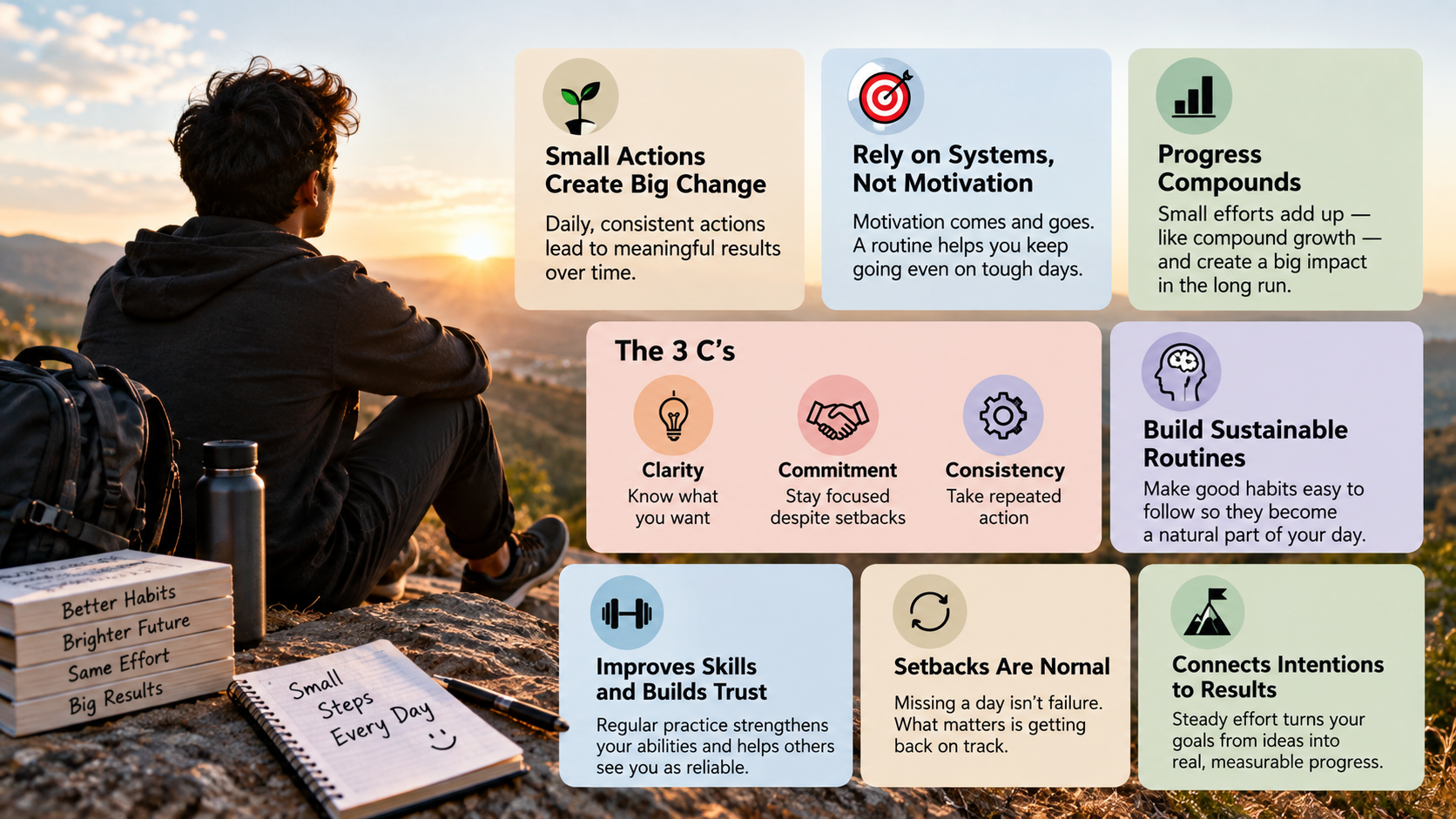
The power of consistency comes from repeating small, positive actions over time. Instead of depending on occasional bursts of intense effort, consistency creates steady momentum toward meaningful goals. A single action may seem insignificant today. Repeating that action for weeks, months, or years can create a substantial difference.
Consistency also reduces the number of daily decisions you must make. When useful behaviors become routines, you spend less energy deciding whether to act. You simply follow the system you have created.
Regular execution can strengthen skills through repeated practice and feedback. It can also help others see you as reliable and dependable. Over time, these effects can support personal growth, professional development, and stronger habits.
However, consistency does not mean doing everything perfectly. Missing one day does not destroy progress. The important part is returning to the behavior instead of allowing one setback to become a permanent stop.
Compounding Daily Action into Lasting Impact
Consistent effort works much like compound growth. A small action may produce little visible progress at first. The results become more noticeable as the behavior continues.
For example, reading ten pages each day may seem modest. Over a year, that habit can add up to thousands of pages. Writing a few hundred words daily can eventually produce a substantial body of work.
The same principle applies to learning, fitness, saving money, and professional skills. Small actions become powerful when repetition gives them enough time to accumulate.
Consistency also creates momentum. Once a behavior becomes familiar, starting often requires less effort. This makes it easier to continue the habit and gradually increase its impact.
What are the 3 C’s commitment consistency?
The three C’s of commitment and consistency are Clarity, Commitment, and Consistency. Together, they provide a simple framework for turning intentions into repeated action.
Clarity means knowing exactly what you want to achieve. A clear goal gives your effort a specific direction. It also helps you identify the daily or weekly actions required to move forward.
Commitment is your decision to pursue that goal despite distractions, setbacks, or changing emotions. It matters because enthusiasm rarely remains constant. A committed person continues working even when the initial excitement disappears.
Consistency is the repeated execution of those planned behaviors. It transforms goals from ideas into observable progress.
Each element supports the others. A lack of clarity can leave you working hard without a clear direction. Strong commitment helps you stay focused when distractions appear. Even with a clear goal and strong resolve, progress remains limited without consistent action.
Why is consistency so important?
Consistency matters because it creates reliability, supports skill development, and makes progress easier to measure. When you complete important tasks regularly, people learn that they can depend on you. This can strengthen professional relationships and personal trust.
Regular practice also creates more opportunities for feedback. Each attempt gives you information about what works and what needs improvement. You can then adjust your approach and continue practicing. This principle is particularly useful when building skills through regular learning and practice routines.
Sporadic effort creates a different pattern. Working intensely for a short period may produce quick progress, but it can also increase fatigue and make the routine difficult to maintain. Sustainable effort is usually easier to repeat.
Consistency also makes large goals feel more manageable. Instead of focusing on the entire outcome, you focus on the next action. That approach can reduce overwhelm and make progress visible. For students deciding how to structure their learning, choosing between tuition and coaching can also help clarify the type of consistent support they need.
Most importantly, consistency keeps progress moving when motivation is low. You do not need to feel highly motivated every day. A practical routine can carry you through ordinary days and difficult periods.
Building Lasting Trust and Professional Authority
Reliability is an important part of professional reputation. Producing excellent work once can demonstrate ability. Producing dependable work repeatedly demonstrates reliability.
Clients, managers, colleagues, and partners often value people who meet expectations consistently. They know what to expect from someone who communicates clearly and delivers work on schedule.
Consistency can also strengthen your own confidence. Each completed commitment provides evidence that you can follow through on your plans.
This does not mean you must maintain perfect performance. Everyone has difficult days, changing priorities, and unexpected problems. Professional consistency is about dependable standards, not flawless performance.
Over time, reliable behavior can create more opportunities for responsibility. People are more likely to trust important tasks to someone who has demonstrated dependable execution.
What is the secret of consistency?
The secret of consistency is not unlimited willpower. It is creating systems that make useful behaviors easier to repeat. Willpower can fluctuate because of stress, fatigue, distractions, and competing responsibilities.
A better approach is to reduce the effort required to begin. Break large goals into small actions that feel manageable. Make the first step so clear that you do not need to spend time deciding what to do.
Your environment also matters. A prepared workspace, scheduled routine, or visible reminder can reduce friction. Pairing a new habit with an existing routine can make the behavior easier to remember.
Tracking progress can provide useful feedback. However, tracking should remain simple. If the tracking system becomes more complicated than the habit itself, it may create unnecessary resistance.
Consistency becomes easier when your system works on ordinary days. Design routines that remain realistic when motivation, energy, and time are limited.
Lowering Resistance to Automate Daily Progress
Reducing friction can make daily habits easier to maintain. Start by identifying what usually prevents you from beginning.
For morning study sessions, prepare your materials the night before. Keep your exercise equipment ready when you plan to work out. For focused tasks, schedule a specific time block and remove unnecessary distractions. If waking up is the first obstacle, learning how to beat sleep inertia and wake up without brain fog can make morning routines easier to follow.
You can also connect a new habit with an existing behavior. For example, review your daily goals after breakfast. This creates a predictable cue for the new routine.
Small starting points can help as well. Instead of promising to study for three hours, commit to opening your notes and working for ten minutes. Starting is often harder than continuing.
The goal is not to eliminate effort completely. It is to make the desired action easier to start and repeat. When unnecessary barriers disappear, your routine becomes more sustainable.
What is a famous quote about consistency?
A famous saying often associated with Aristotle states, “We are what we repeatedly do. Excellence, then, is not an act, but a habit.” The wording is commonly attributed to Aristotle, but the modern formulation was popularized by historian Will Durant in his 1926 work The Story of Philosophy.
The idea remains relevant because it focuses attention on repeated behavior rather than occasional achievements. One successful action does not automatically create mastery. Skills, habits, and character develop through patterns of behavior repeated over time.
This principle also changes how we view progress. Instead of asking whether we performed perfectly today, we can examine whether our overall pattern supports the person we want to become.
The quote should not be interpreted as a demand for perfection. Missing a workout, study session, or work target does not erase previous progress. What matters is the broader pattern and your willingness to return to the routine.
The central lesson is simple: repeated actions shape long-term outcomes more than occasional bursts of effort.
What causes lack of consistency?
A lack of consistency can come from vague goals, unrealistic expectations, exhaustion, distractions, and poor environmental design. When a goal feels unclear or overwhelming, starting becomes harder. This can lead to procrastination and repeated delays. For people whose consistency is disrupted by worry at night, practical tips for managing nighttime anxiety may also help create a more reliable routine.
Unrealistic schedules create another problem. People may plan more tasks than their available time and energy can support. When the plan inevitably breaks, frustration can make them abandon the routine entirely.
Depending only on motivation can also create inconsistent behavior. Motivation changes with sleep, stress, mood, workload, and other circumstances. A routine that works only when motivation is high is difficult to sustain. Building healthier routines can also include natural habits to boost energy without caffeine, especially when low energy makes regular action harder.
Another common issue is the absence of feedback. If you never review your progress, you may not know whether your approach is working. Small adjustments can then be delayed until frustration becomes significant.
Your environment can either support or obstruct your habits. Constant notifications, an unprepared workspace, or unclear priorities can increase friction.
Instead of blaming yourself for every setback, examine the system. Consistency often improves when the routine becomes clearer, smaller, and easier to repeat.
Frequently Asked Questions
How long does it take to build a consistent habit?
Research shows that building an automatic habit takes anywhere from 18 to 254 days, with an average of 66 days depending on the complexity of the behavior. Simple behaviors like drinking water each morning solidify quickly, while rigorous fitness regimes require extended time. The key is prioritizing continuous repetitions over speed. Focus on executing the behavior every single day without judging initial output.
What is the difference between intensity and consistency?
Intensity refers to large, exhausting bursts of effort packed into short periods, while consistency focuses on steady, manageable actions repeated indefinitely. Intense sprints often cause burnout, injury, or emotional fatigue. Conversely, consistency fosters sustainable progress, neural adaptation, and long-term mastery. While occasional intensity helps with short deadlines, consistency guarantees foundational skill acquisition and long-term viability.
How can I track my consistency effectively?
Use minimal, friction-free tracking methods like a wall calendar, a simple habit-tracking mobile app, or a pocket journal. Mark an “X” or log a completion check immediately after finishing your daily task. Visual progress bars trigger dopamine releases, reinforcing your positive behaviors. Keep tracking frictionless so the recording process never becomes an obstacle to execution.
What should I do when I break a consistent streak?
Apply the “never miss twice” rule immediately. If life interrupts your routine today, treat it as a temporary pause rather than a complete failure. Analyze what friction point caused the lapse, adjust your plan, and resume your baseline routine tomorrow. Resilience lies in quickly recovering momentum, not in maintaining an artificial, unbroken streak forever.
Conclusion
Harnessing the power of consistency can change how you approach work, health, learning, and personal goals. The power of consistency comes from repeating small actions instead of waiting for perfect motivation. By using clarity, commitment, and consistency, you can create routines that support steady progress. The power of consistency also reminds you that setbacks do not erase progress. Return to your routine and keep moving forward. Focus on manageable actions each day, whether you write one page, complete a workout, or study one lesson. Over time, the power of consistency allows these small efforts to compound into meaningful, sustainable achievements.