Giving Students a Choice in How They Will Demonstrate Their Learning
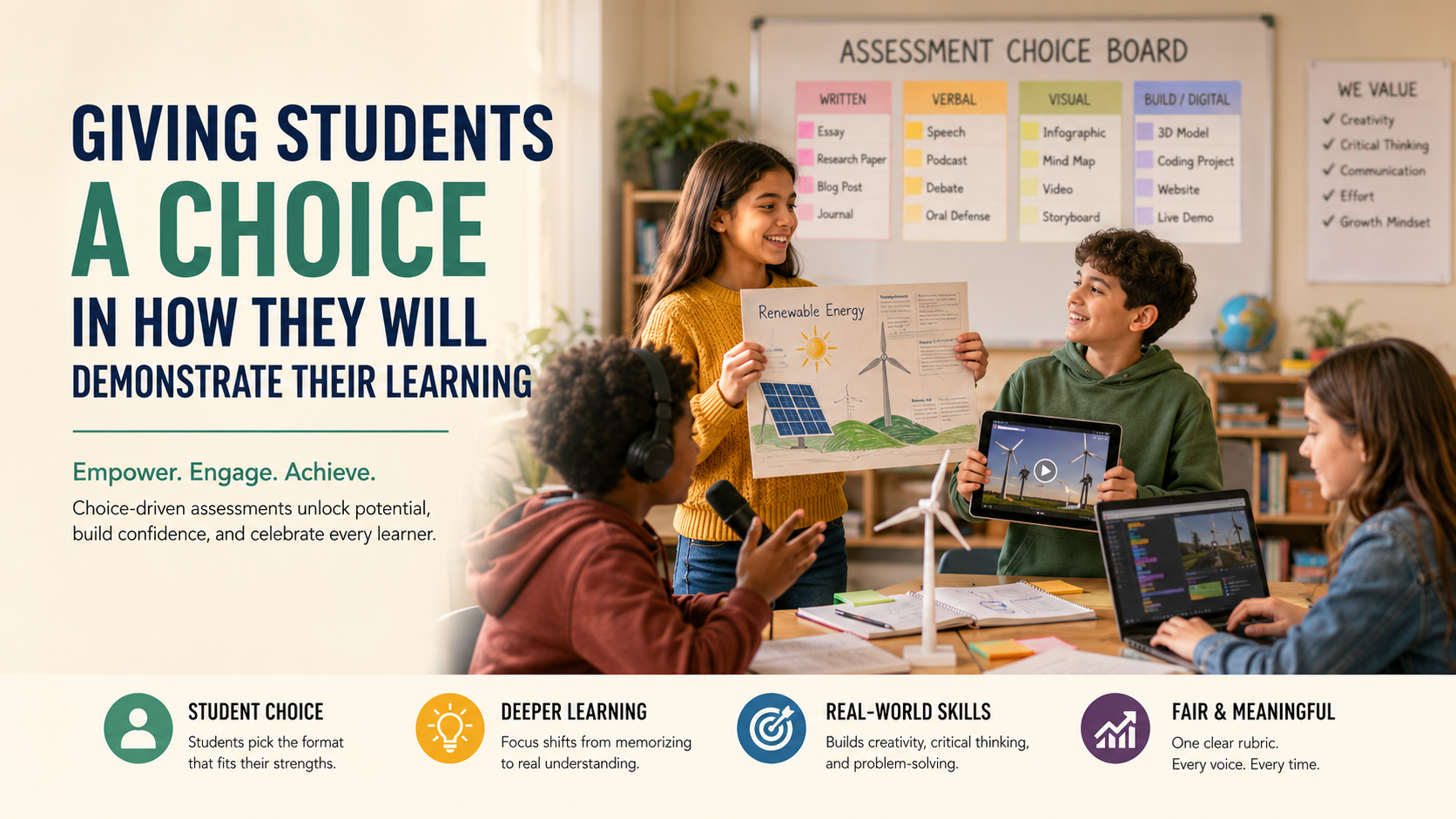
Traditional assessment methods often fail to capture what a student truly understands. When we embrace student choice in learning, we shift the focus to authentic evaluation. Research from the Edutopia framework on student engagement shows that giving learners autonomy over assessments increases motivation and academic performance. By allowing students to select how they show knowledge, educators build an inclusive classroom culture that celebrates diverse talents.
When you give students control over their expression, anxiety drops and curiosity spikes. Instead of memorizing facts for a standardized test, students concentrate on deep comprehension. This strategy accommodates multiple intelligences perfectly. Visual, auditory, and kinesthetic learners all receive an equal playing field. Introducing autonomy changes your classroom dynamic, turning education into a collaborative journey rather than a top-down mandate.
The Power of Student Choice in Learning
Every classroom is filled with unique individuals who possess distinct strengths and communication styles. Forcing every student down the exact same assessment path often measures test anxiety rather than actual knowledge. Embracing student choice in learning allows educators to remove these artificial barriers. When students select their own path, they take psychological ownership of their education. The task turns from a passive requirement into an active project. They no longer complete assignments simply to earn a grade. Instead, they create something personal that reflects their intellect.
Moreover, this approach fosters essential 21st-century skills. In the modern workforce, professionals rarely sit down to take multiple-choice exams. Instead, they solve complex problems, build presentations, write reports, and design prototypes. By introducing choice into assessments, you prepare students for real-world scenarios. They learn to choose the best medium for their specific message. This practice builds independence, improves time management, and teaches students how to evaluate their own capabilities critically.
Designing a Flexible Assessment Matrix
Implementing choice does not mean creating a chaotic classroom environment where anything goes. Successful teachers use structured frameworks to guide their students seamlessly. A choice board or an assessment matrix provides clear, curated options. This structure ensures that all students hit the required academic benchmarks. By limiting choices to a predefined grid, you maintain control over the curriculum. At the same time, you grant students the freedom they crave. This balance keeps the assignment focused on core targets while respecting individual learning preferences.
Creative Options for Demonstrating Knowledge
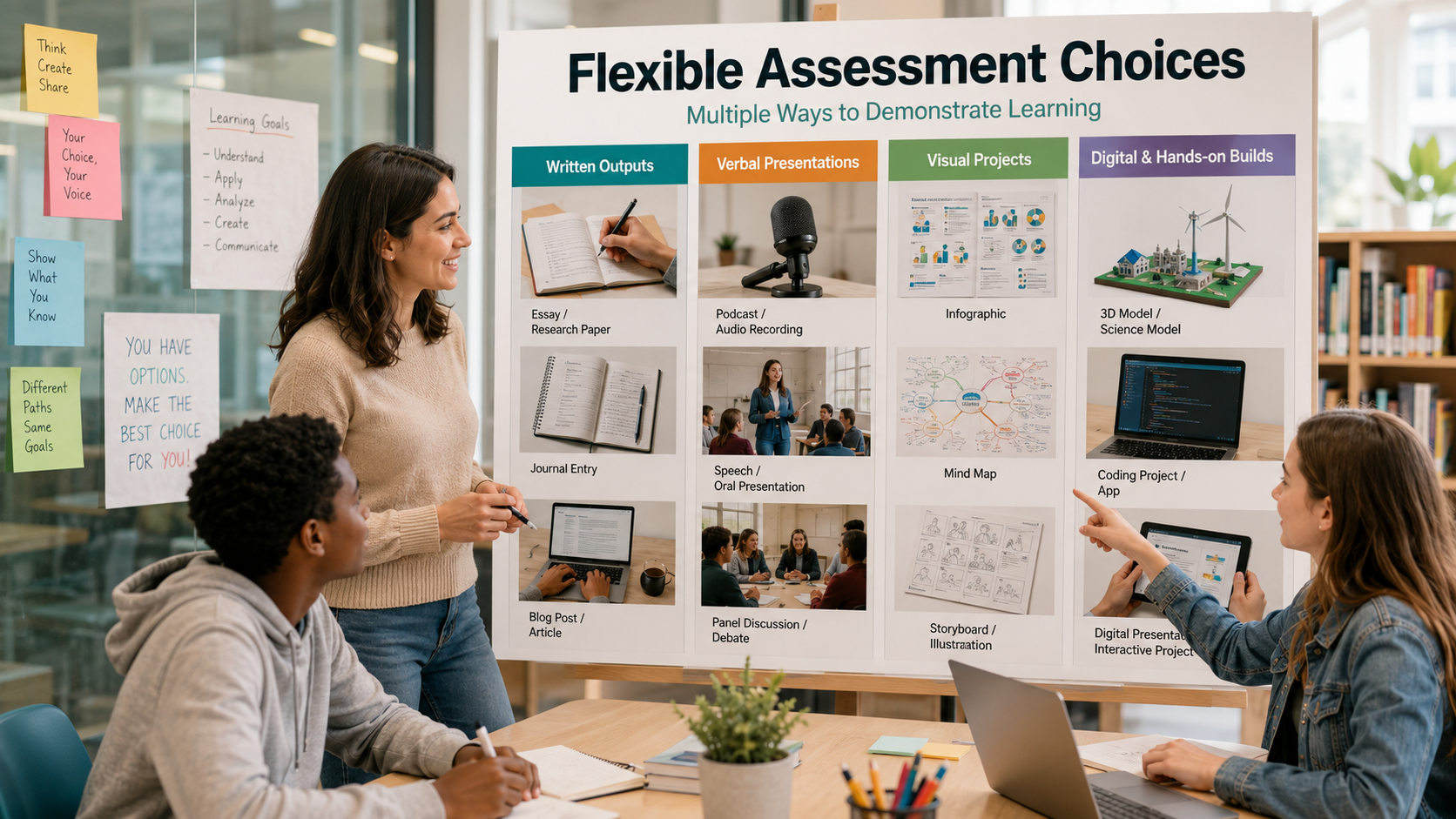
To find inspiration for your classroom, consider dividing assessment options into four distinct categories:
-
Written Outputs: Traditional essays, research papers, blog posts, scripted dialogues, or creative journals.
-
Verbal Presentations: Live speeches, recorded podcasts, panel debates, or oral defenses.
-
Visual Projects: Infographics, detailed mind maps, documentary videos, or illustrated storyboards.
-
Kinesthetic and Digital Builds: 3D models, coding projects, interactive websites, or live science demonstrations.
Offering at least one option from each category ensures that all learners have an equal opportunity to excel. This variety keeps the classroom dynamic. It also exposes students to new mediums they might not otherwise try.
Maintaining Rigor and Simplifying Grading
A common concern among educators is the grading workload associated with non-traditional assignments. If thirty students submit thirty different projects, how can a teacher grade them fairly without working all weekend? The secret lies in decoupling the format of the assignment from the learning objectives. You do not need a separate grading rubric for an infographic, a podcast, and an essay. Instead, you simply focus on the underlying skills being demonstrated.
The Universal Rubric Strategy
Instead of creating a new rubric for every project type, design a single universal rubric focused entirely on core mastery. This rubric evaluates criteria that apply universally, regardless of the medium chosen by the student.
| Evaluation Criteria | What It Measures |
| Content Mastery | Does the project accurately demonstrate the required subject knowledge? |
| Critical Thinking | Does the student analyze, evaluate, and synthesize information deeply? |
| Clarity and Organization | Is the argument or presentation structured logically and easy to follow? |
| Effort and Craftsmanship | Does the final output show care, attention to detail, and thoroughness? |
By using this structured layout, you can easily grade a podcast, an essay, and a poster using the exact same matrix. This keeps grading fast, consistent, and exceptionally fair for everyone involved.
Overcoming Common Classroom Challenges
Shifting toward student-driven choices requires a cultural adjustment for both teachers and students. Many students are conditioned to just follow explicit directions. Because of this, absolute freedom can occasionally cause severe decision paralysis. When faced with endless possibilities, some learners freeze because they fear making the wrong choice. Teachers must act as facilitators during this transition. You can guide students through their options without taking away their autonomy.
To prevent this issue, introduce options gradually rather than all at once. Start by offering a choice between just two alternatives, such as an essay or a slide deck. As students gain confidence in their decision-making, expand the choices to include more creative formats like videos or physical models. Furthermore, always set clear interim milestones to keep students accountable. Require them to submit their chosen format and a brief outline early in the process. This step allows you to catch potential issues before they waste time.
FAQ Section
Why is student choice in learning important?
Student choice is crucial because it honors the diverse learning profiles present in every classroom. When students select how they demonstrate their knowledge, they become deeply invested in the final outcome. This autonomy builds intrinsic motivation, reduces behavioral disruptions, and fosters critical thinking skills. It transforms assessment from something done to students into a collaborative process done with them. Additionally, it models real-world accountability. Students learn how to map out a project from conception to execution using their personal strengths. By honoring their voice, you build a supportive environment where students feel safe taking academic risks. This trust leads to a much deeper level of cognitive engagement and long-term knowledge retention.
How do you grade completely different projects fairly?
You can grade diverse projects fairly by using a universal, criteria-based rubric. This tool focuses on core learning targets rather than the artistic medium. Instead of grading the technical mechanics of a video or the formatting of a poster, focus entirely on content mastery. You evaluate argument quality, research depth, and critical thinking. For example, consider a student writing a traditional essay and another recording a podcast episode. Both must still present a clear thesis statement, back it up with credible evidence, and organize their thoughts logically. By aligning your grading scales with the overarching educational standards rather than the cosmetic presentation, you create an equitable evaluation process that rewards true understanding regardless of the format chosen.
Does offering choices increase a teacher’s workload?
It does not have to increase your workload if you plan efficiently from the very beginning. By utilizing universal rubrics and setting clear project boundaries, the actual grading time remains virtually identical to traditional testing methods. In fact, many teachers report that grading becomes far less tedious and much more enjoyable. They appreciate reviewing a diverse mix of creative projects rather than reading thirty identical worksheets or essays. The upfront time spent designing a solid choice board pays off immensely during the assessment phase. Because students are genuinely interested in what they are creating, they tend to turn in higher-quality work. This eliminates the need for extensive corrections, revisions, or stressful follow-up interventions.
What should I do if a student cannot decide on an option?
When a student experiences decision paralysis, you should provide a structured default option to alleviate their anxiety. Let the class know during the project launch that unchosen paths have a backup. Anyone who cannot decide on a custom format by a specific date will automatically complete a pre-selected standard option. A short written report works well for this purpose. You can also schedule a brief one-on-one conference to help the student match their personal strengths with an available choice. Ask simple questions about how they prefer to communicate ideas outside of school. By acting as a sounding board, you can guide them toward a manageable selection. This keeps them moving forward without losing their autonomy.
Can young elementary students handle assessment choices?
Yes, young students can absolutely handle choices, provided the options are kept simple, clear, and strictly limited. For early elementary learners, limit the selection to two or three distinct options. They might choose between drawing a picture, building with blocks, or speaking directly to the teacher during circle time. This practice builds foundational decision-making skills without overwhelming developing minds with too many variables. As young kids experience the positive consequences of choosing their own path, their academic confidence grows substantially. Teachers can use visual choice boards with clear icons to help non-readers understand their options. This modification makes the entire assessment process highly accessible, inclusive, and developmentally appropriate from the very start of their schooling.
Conclusion
Embracing student choice in learning is a powerful way to cultivate a modern, equitable, and highly engaging classroom environment. By moving away from rigid, one-size-fits-all testing, you give students the freedom to leverage their unique strengths. They can express their true understanding in ways that make sense to them. Whether they write, speak, build, or design, the core focus remains firmly on mastering the educational material. Implementing universal rubrics and structured choice boards keeps this learner-centered strategy sustainable for teachers and highly effective for students.
When educators respect their students enough to offer options, the entire classroom dynamic shifts from compliance to genuine curiosity. Students stop asking how many points an assignment is worth. Instead, they start focusing on the quality of what they are creating. This pedagogical shift builds self-efficacy and prepares learners for life outside school walls, where mastering independent organizational habits like time blocking for students becomes essential. Ultimately, providing these choices prepares students for a complex world. Creative problem-solving, self-direction, and adaptability are the ultimate keys to long-term professional success in the future workforce.