
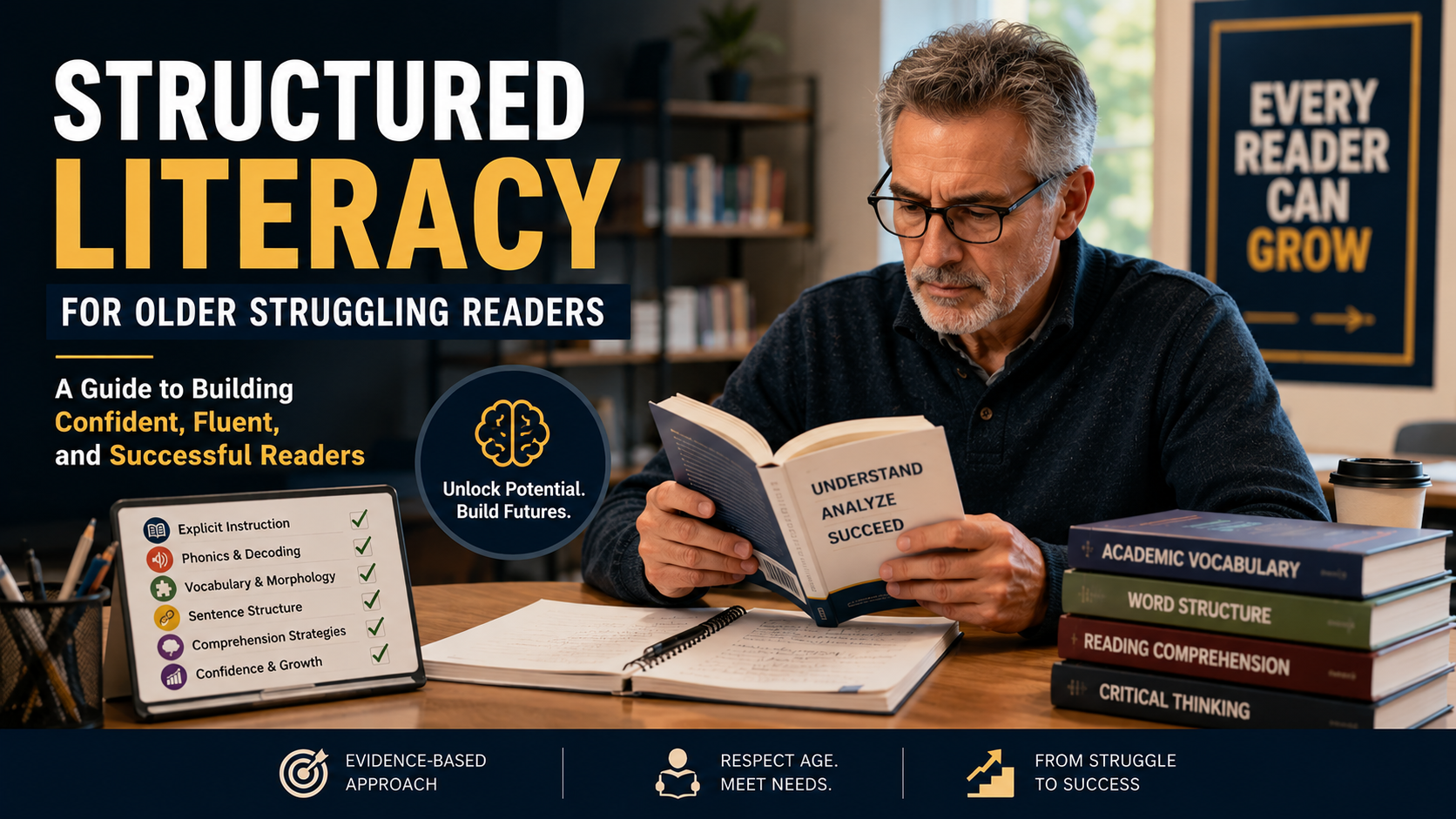
Structured Literacy for Older Struggling Readers: A Guide
When a student reaches middle school without fluent reading skills, academic stakes intensify dramatically. Traditional reading interventions often fail this older demographic because they rely heavily on babyish materials designed for primary students. Implementing structured literacy for older struggling readers offers a systematic, explicit, and evidence-based pathway to bridge these critical learning gaps before graduation. According to research highlights compiled by the International Dyslexia Association, explicit literacy instruction benefits learners of all ages by demystifying the complex code of the English language.
This educational methodology matters profoundly because literacy serves as the ultimate gateway to academic autonomy across all subjects. When older students struggle to decode complex polysyllabic words, they cannot access grade-level content in science, history, or literature classes. Consequently, their academic confidence plummets, often leading to disengagement, behavioral challenges, and higher dropout rates. This comprehensive guide explores why explicit reading instruction works so well for mature learners. We will discuss how to adapt foundational skills without damaging crucial student dignity, and outline actionable strategies for secondary classrooms. By shifting our instructional paradigm, we can help struggling adolescents transform from hesitant guessers into fluent, critical readers.
Why Older Readers Need an Explicit Literacy Method
Older struggling readers are not merely older versions of struggling first graders. Treating them as such is an instructional mistake. By the time a student reaches middle or high school, they have spent years developing highly sophisticated compensatory strategies. They use these tactics to hide their deficits. They guess words from context clues, skip words entirely, or memorize visual shapes. However, these fragile coping mechanisms fail entirely when students encounter complex secondary textbooks. These texts are packed with dense, unfamiliar academic language.
To address these unique cognitive profiles, educators must decisively pivot away from balanced literacy models. We must reject approaches that encourage guessing. Instead, teachers need a robust instructional framework. This framework must respect the cognitive development, life experiences, and maturity of adolescent learners. This means explaining the logical patterns of language directly. We cannot simply hope students will catch on through immersive reading alone. When we treat reading instruction as an analytical investigation into linguistic patterns, we honor their intellect. Simultaneously, we address their specific skill gaps.
Overcoming the Interventions Gap with Age-Appropriate Content
Most reading intervention programs on the market feature childish illustrations, oversized fonts, and simplistic themes. These elements quickly alienate older teenagers. When an adolescent is handed a book designed for a seven-year-old, they immediately internalize a deep sense of shame. This emotional barrier completely shuts down their willingness to learn. Effective secondary intervention requires a careful pairing of age-appropriate, high-interest content with rigorous phonetic analysis.
Educators must seek out or adapt materials that deal with mature themes. High-interest topics like survival, sports, history, or science work best. However, the underlying text must remain highly decodable. This approach protects the student’s emotional well-being and social status among peers. At the same time, it systematically rebuilds their reading foundation. When students see that their instructional materials respect their age, their willingness to engage increases exponentially. They become much more open to practicing challenging phonetic concepts.
Core Elements of Structured Literacy for Older Struggling Readers
Adopting structured literacy for older struggling readers requires an unyielding, explicit focus on the structural architecture of human language. This systematic approach breaks the daunting process of reading down into predictable, manageable components. Students can then master these pieces sequentially.

Word Identification and Advanced Decoding Frameworks
Older students frequently stumble when encountering multisyllabic words. These long words make up the vast majority of academic vocabulary in secondary textbooks. Instruction must rapidly move beyond basic letter-sound correspondences. Teachers must address complex syllable patterns and morphology.
-
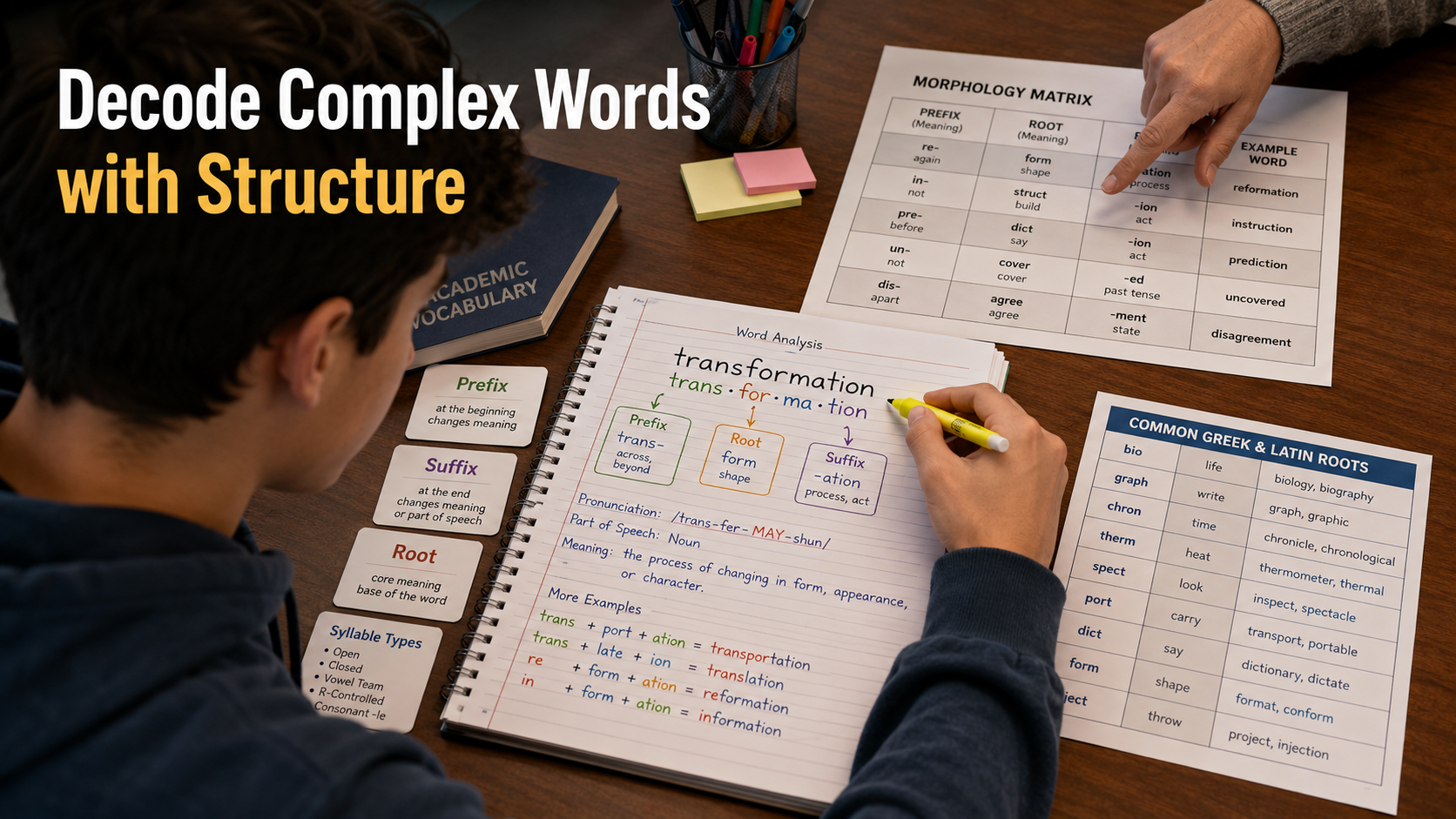
Syllable Division: Teaching students how to systematically break down long words like transformation or epidemic based on recognized syllable types (open, closed, vowel team, r-controlled) gives them an exact roadmap for pronunciation.
-
Morphology: Emphasizing prefixes, suffixes, and Latin or Greek roots allows students to unlock meanings structurally. Understanding that the Greek root bio means life helps students instantly decode and comprehend biology, biography, and biodegradable.
Sentence Structure and Adolescent Reading Comprehension
Reading comprehension frequently breaks down at the sentence level rather than the word level for older struggling readers. Modern academic texts utilize highly complex sentence structures, passive voice constructions, and multiple dependent clauses. These elements easily confuse weak readers. Structured literacy teaches students to consciously deconstruct sentences. By doing so, they identify the true agent and the action, which directly improves overall comprehension.
By practicing sentence combining and diagramming, students learn how punctuation alters meaning. They see how clauses fit together logically. This explicit syntactic instruction bridges the gap between basic decoding skills and deep, analytical comprehension of textbook chapters. Furthermore, understanding syntax directly translates into improved writing skills. This allows students to express complex ideas clearly in their own academic essays.
Modifying the Orton-Gillingham Approach for Secondary Classrooms
The Orton-Gillingham approach is a highly respected, multisensory instructional model. It was originally designed to assist individuals with dyslexia. While it was initially utilized for young children, creative teachers can successfully adapt its core tenets for teenagers. They can do this without making students feel diminished.
Pacing and Diagnostic Multisensory Phonics Teaching
Adolescents rarely have a uniform lack of reading ability. Instead, they possess scattered, highly uneven phonics knowledge due to years of fragmented schooling. They might know basic short vowels perfectly but lack any understanding of complex vowel digraphs or diphthongs.
-
Assess accurately: Use precise diagnostic assessments to pinpoint specific code gaps rather than forcing students to start from the absolute beginning of a curriculum.
-
Fast-track mastery: Move rapidly through known concepts during sessions so students can focus their mental energy on their specific areas of weakness.
-
Maintain high expectations: Treat the mechanics of reading as an intriguing linguistic puzzle rather than a remedial chore meant to punish them for past failures.
Adolescent Linguistic Engagement Without Visual Clutter
Secondary students respond remarkably well to analytical discussions surrounding etymology and language origins. Explaining why a word is spelled a certain way engages their higher-order thinking skills naturally. For instance, teachers can explore French, Latin, or Anglo-Saxon historical influences.
This approach honors their intellectual capacity by treating them like language scientists. It avoids treating them like struggling pupils, which quietly fixes foundational reading mechanics behind the scenes. Classrooms should feature clean, distraction-free workspaces that omit elementary posters. Instead, opt for sophisticated morphology matrices and root-word trees. By elevating the environment, we signal to these students that their remediation is a serious, mature, and entirely achievable academic endeavor.
FAQ SECTION
What is structured literacy for older struggling readers?
Structured literacy for older struggling readers is an explicit, systematic, and cumulative approach to reading instruction designed specifically for struggling adolescents. It focuses heavily on phonology, sound-symbol association, syllable structure, morphology, syntax, and semantics. Unlike traditional balanced literacy methods, it completely removes guesswork by teaching the predictable, mathematical rules of the English language. For older students, this framework utilizes sophisticated, age-appropriate content to teach advanced decoding and deep comprehension. This ensures that students receive vital remedial instruction without feeling patronized by childish materials. Ultimately, it provides an intellectual scaffolding that helps mature learners decode complex academic textbooks, build vocabulary, and achieve genuine reading independence in secondary school and beyond.
How does this secondary reading remediation differ from elementary interventions?
This approach differs primarily in its tone, pacing, presentation, and content selection. Elementary interventions focus intensely on basic phonemic awareness using playful games, large fonts, and simple stories. Secondary interventions, however, fast-track through basic concepts, targeting only the specific structural gaps identified through diagnostic testing. Furthermore, the instructional materials feature mature themes, advanced academic vocabulary, and complex morphology like Greek and Latin roots. This framework intentionally respects the student’s chronological age and life experiences while systematically addressing the advanced decoding skills required for high school textbooks. It replaces the repetitive, child-centric drills of primary school with sophisticated linguistic analysis that appeals to the developing adolescent brain.
Can older adolescent students genuinely improve their reading skills?
Yes, older students can make massive, measurable gains in reading proficiency when provided with systematic, evidence-based instruction. Neurological research proves that brain plasticity continues throughout adolescence, meaning that targeted, explicit interventions can successfully rewire reading pathways in older brains. The critical key lies in providing direct, explicit instruction rather than expecting students to naturally absorb reading skills through mere exposure to literature. When teachers explicitly show adolescents how the English language works, these students quickly learn to decode unfamiliar words independently. With consistent practice using structured literacy, older struggling readers can make up multiple grade levels of growth in a relatively short timeframe, permanently altering their academic trajectories.
What role does word morphology play in secondary literacy instruction?
Morphology plays a massive role in secondary literacy because the vast majority of academic vocabulary in middle and high school is multisyllabic and rooted in Greek and Latin origins. By teaching meaningful word parts like prefixes, suffixes, and roots, educators give older students the analytical tools to unlock thousands of words independently. For example, knowing that the Latin root “fract” means to break helps a student instantly understand fracture, fraction, and infraction without needing to memorize each word separately. This strategic focus enhances vocabulary acquisition, spelling accuracy, and reading comprehension simultaneously, making it an indispensable component of any secondary structured literacy program.
How do you maintain engagement with discouraged adolescent readers?
Maintaining engagement with discouraged adolescent readers requires prioritizing student dignity above all else and connecting literacy to tangible, real-world autonomy. Educators must utilize high-interest, low-readability texts that match the chronological age, hobbies, and intellectual capabilities of the student. Classroom discussions should focus on the mechanics of language as an analytical science or a secret code to be cracked. When students realize they are learning the hidden architectural rules of English rather than performing childish tasks, their defensiveness fades away and their academic confidence returns. Celebrating small, data-driven victories also helps rebuild their trust in the instructional process.
CONCLUSION
Implementing structured literacy for older struggling readers is a powerful, indispensable mechanism for closing the achievement gap in secondary education. Educators cannot simply sit back and wait for older struggling readers to magically catch up through simple exposure to grade-level books. Instead, these mature learners require explicit, highly systematic instruction that intentionally targets their unique phonetic, syntactic, and morphological blind spots. By focusing heavily on syllable division, sentence syntax, and Greek and Latin roots, teachers give adolescents the precise analytical keys required to decode complex academic texts independently. Recognizing early interventions remains vital; you can review the key signs your child might need a reading tutor to identify gaps before they widen in higher grades.
Ultimately, transforming an adolescent’s reading trajectory requires a delicate, intentional balance of rigorous cognitive science and deep instructional empathy. When schools respect the inherent intelligence of older struggling readers by utilizing age-appropriate materials, these students can successfully overcome years of profound academic frustration. Investing in structured literacy changes the entire educational landscape for vulnerable students, opening previously closed doors to higher education, technical certifications, and meaningful future careers. It is never too late to teach an individual how to read, provided we use the right framework.