
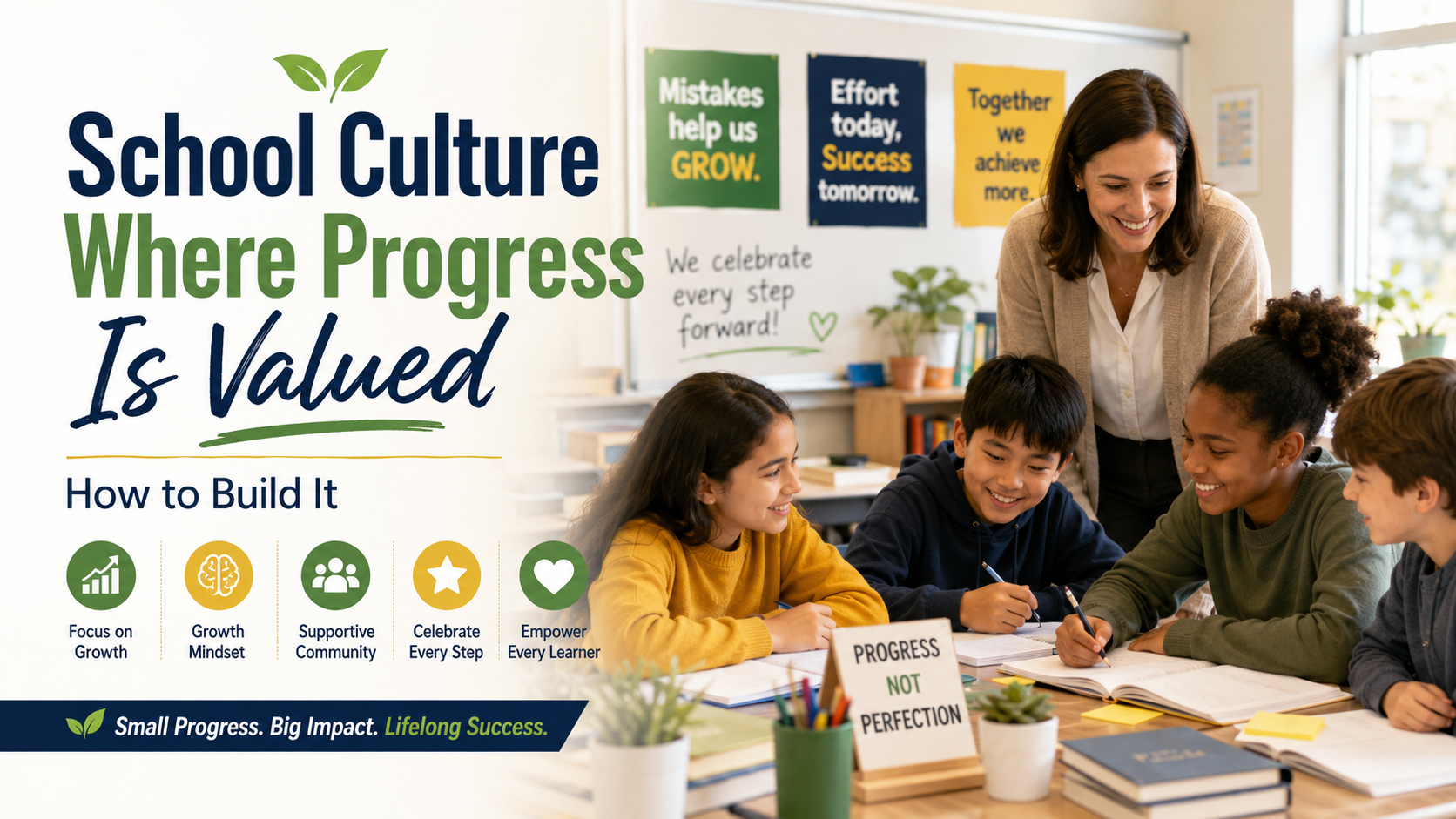
School Culture Where Progress Is Valued: How to Build It
Every educational institution strives for academic excellence. However, the path chosen to reach that peak matters immensely for long-term student development. Creating a school culture where progress is valued transforms the entire learning environment into a deeply supportive space. This supportive space benefits both students and educators. When an educational community shifts its primary focus away from static letter grades, remarkable changes happen. Student anxiety drops significantly, while active engagement or motivation skyrockets. Research published by the U.S. Department of Education highlights a key fact. Positive school climates directly correlate with improved academic achievement and emotional well-being. By prioritizing incremental improvement, schools foster resilience, self-efficacy, and a lifelong love of learning.
This comprehensive article explores actionable, real-world strategies designed to shift your school’s foundational mindset. We will cover the core components of growth-oriented leadership, practical classroom methodologies, and systemic ways to involve families in this cultural journey. Through deliberate planning and collective commitment, any school can move away from high-stakes pressure. School leaders can build a sustainable ecosystem where every small victory counts as meaningful academic advancement.
Defining a Growth-Oriented Educational Environment
A supportive and dynamic learning environment does not happen by accident. It requires a deliberate shift in how everyone in the building views success, failure, and capability. In a traditional educational setting, high raw scores and perfect grades are often the only metrics that earn public praise. Consequently, students who struggle feel immediately defeated and detached. At the same time, natural high achievers become intensely risk-averse. They develop a paralyzing fear of losing their top status. This binary view of intelligence limits creative thinking. It prevents students from tackling complex, unfamiliar challenges.
Conversely, celebrating personal milestones creates a safe harbor for deep intellectual curiosity and academic experimentation. When students realize that their effort and persistence matter far more than their initial starting point, they change. They begin to take true ownership of their educational journey. This psychological shift forms the bedrock of a healthy school community. It allows learners to see mistakes not as final verdicts on their intelligence, but as vital data points. These data points direct their next steps. By redefining achievement as a continuous upward trajectory rather than a static destination, schools cultivate a robust community. Learning becomes an accessible, lifelong pursuit for all individuals.
Steps to Establish a School Climate Focused on Student Growth
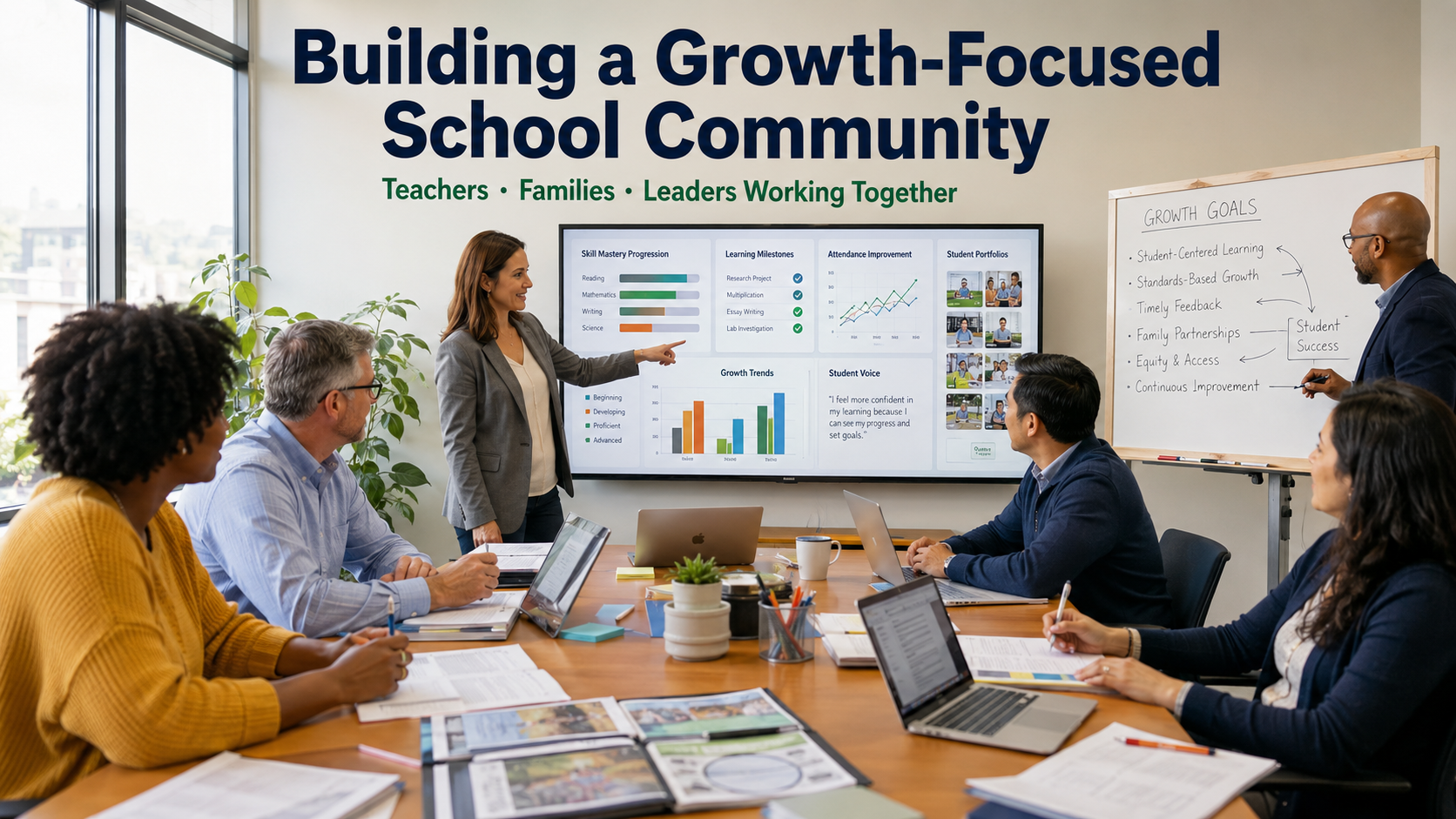

Shifting an entire school climate requires systemic, intentional changes. These changes must pierce through traditional administrative structures and everyday classroom routines. It is not enough to simply hang motivational posters on the walls. School leaders must embed growth-centric philosophies into their grading policies, daily communications, and professional development frameworks. Here are the foundational pillars needed to make continuous improvement a core institutional value across all grade levels.
1. Shift the Language Around Achievement
The words educators use carry immense psychological weight. They shape how students view their own potential for years to come. Instead of praising innate intelligence with vague phrases like “you are so smart,” teachers should change their approach. They must deliberately focus their feedback on strategy, focus, and sustained effort. Using phrases like “I see how hard you worked on this multi-step problem” helps immensely. Similarly, saying “You haven’t mastered this specific concept yet” fundamentally alters how students perceive their academic capabilities. This slight linguistic adjustment teaches children a vital lesson. Ability is malleable and developed through hard work rather than being a fixed trait. Over time, this consistent framing builds a resilient student body. Students welcome difficult assignments instead of avoiding them out of fear.
2. Implement Standards-Based Grading
Traditional grading systems often mask actual student growth by averaging early failures with later successes. This practice structurally penalizes students who take longer to master a concept. Standards-Based Grading (SBG), however, focuses entirely on a student’s ultimate proficiency in specific skills over the course of a semester. Suppose a student fails an initial quiz on fractions but demonstrates complete mastery two weeks later through targeted intervention. Their final grade reflects that ultimate understanding rather than the messy learning process. This transparent approach reinforces the core idea that learning is an evolving journey. It is not a single, high-stakes testing event. It encourages students to review their past mistakes, request extra help, and resubmit work. They know their dedication will reflect accurately in their academic record.
3. Provide Professional Improvement Pathways for Teachers
School administrators cannot realistically expect teachers to cultivate a vibrant growth mindset in students if the teachers themselves face rigid, punitive metrics. School leaders must actively model the exact growth behaviors they want to see reflected in their classrooms. They can achieve this by transforming professional development into a supportive, non-threatening space.
-
Peer Observations: Allow teachers to regularly visit colleagues’ classrooms. This practice lets them observe new methodologies and innovative instructional strategies in real-time.
-
Action Research: Encourage staff members to run small, low-stakes experiments with curriculum design. Teachers should not fear negative performance reviews if an idea fails.
-
Feedback Loops: Replace stressful annual evaluations with frequent, low-stakes coaching sessions. Focus these sessions on collaborative problem-solving and long-term career goals.
Overcoming Obstacles to Continuous Classroom Improvement
Every major cultural shift in education inevitably faces resistance from various stakeholders. Many individuals feel comfortable with legacy systems. Skeptics, including some traditional educators and parents, may worry about this focus. They believe that focusing heavily on individual advancement lowers overall academic standards or dilutes school competitiveness. However, empirical educational data proves that the exact opposite occurs when a growth model runs properly. When you honor incremental development, you systematically raise the performance floor for struggling students. Simultaneously, you remove the artificial ceiling that often limits advanced learners. The primary administrative challenge lies in carefully balancing rigorous, state-mandated academic standards with compassionate, individualized student support frameworks.
To achieve this delicate balance, schools must learn to look at academic data holistically. They should not rely on isolated metrics. Standardized test scores offer a limited snapshot of a single day. On the other hand, digital learning portfolios, project-based assessments, and regular formative growth data tell a complete story of a child’s development. By analyzing multiple diverse data points, educators can make highly informed instructional decisions. They avoid reducing human beings to a simple three-digit test score. Overcoming resistance requires ongoing transparency, constant dialogue, and a shared commitment. The community must celebrate the varied paths students take to reach high proficiency.
Engaging Families in the Continuous Progress Journey
Parents and guardians are essential partners in reshaping school values. The messages students hear at home heavily reinforce or dismantle classroom culture. Suppose families return home each day and only ask their children binary questions like “What grade did you get on the test?” This interaction completely undermines the school’s internal efforts to maintain a school culture where progress is valued. Therefore, schools must proactively educate families on the long-term cognitive benefits of tracking personal improvement. This approach yields better results than competitive peer ranking.
Hosting interactive evening workshops on growth mindsets bridges this communication gap effectively. Sending home redesigned progress reports that highlight specific skill mastery achieves the same goal. Parents learn to celebrate a child’s persistence through a difficult reading assignment rather than focusing solely on perfect report cards. Consequently, the vital home-school alignment strengthens significantly. This unified front ensures that students receive a consistent message about the value of effort and resilience. They hear the same core philosophy whether they are sitting at a classroom desk or working at the kitchen table.
Frequently Asked Questions
How do you measure progress if you aren’t focusing entirely on traditional letter grades?
We measure progress by tracking a student’s evolving mastery of specific, clearly defined learning standards over an extended period. Instead of averaging all test scores from the entire semester, which structurally punishes early academic struggles, educators look closely at the student’s most recent level of understanding. Formative assessments, digital learning portfolios, and self-reflection rubrics help paint a detailed, multidimensional picture of individual growth. This comprehensive method ensures that educators notice, document, and celebrate incremental improvements that traditional GPA metrics often completely hide. By focusing on skill acquisition rather than point accumulation, the assessment process becomes an educational tool. It guides future instruction rather than serving as a final, punitive judgment on a student’s worth.
Will focusing on growth lower the academic standards of our school?
No, focusing on growth actually raises academic standards and increases overall rigor for every student in the building. Traditional grading systems often allow naturally high-achieving students to coast through easy assignments without ever facing real intellectual challenges. At the same time, this system causes struggling students to shut down and give up entirely. A growth-focused culture actively pushes advanced students to tackle highly complex challenges. These challenges force them out of their comfort zones. Meanwhile, it provides struggling students with an accessible, realistic, and motivating path to eventually reach grade-level proficiency. By expecting continuous upward movement from every single individual regardless of their baseline, the school eliminates complacency. It creates a high-achieving environment built on genuine mastery.
How can school administrators support teachers during this cultural shift?
Administrators must provide teachers with targeted professional development, adequate planning time, and a psychologically safe environment to innovate. School leaders should replace stressful, high-stakes annual evaluations with regular, supportive coaching conversations centered on professional goals. When administrators openly treat teacher mistakes or failed lesson plans as valuable learning opportunities, teachers feel empowered. They try new instructional strategies without fear of professional reprisal. Providing structured, collaborative planning periods also allows staff members to share successful growth-oriented practices. They analyze student portfolio data together and design interdisciplinary projects. Ultimately, systemic cultural change requires leadership that protects teachers from administrative burnout and actively celebrates their professional growth alongside student success.
What role do students play in creating a growth-focused environment?
Students are the central, active participants in this cultural transformation rather than passive recipients of an educational curriculum. They learn to set personal short-term and long-term learning goals, systematically track their own performance data, and reflect deeply on their mistakes during assessments. By actively participating in student-led conferences, they learn to articulate exactly what they have mastered and where they still need to dedicate time and effort. This deep level of personal involvement builds strong self-regulation skills and self-efficacy. It transforms them into highly motivated scholars who view education as a personal journey. When students take the lead in analyzing their own growth, they develop a resilient mindset that serves them well into their future careers.
How do we explain a progress-valued culture to anxious parents?
We communicate with families by sharing clear, actionable data that explicitly highlights their child’s specific skill developments over time. School leaders can host interactive informational workshops to explain the cognitive and emotional benefits of a growth mindset over traditional peer competition. Teachers should focus parent-teacher conferences around student work portfolios and visible learning milestones rather than discussing abstract percentages or class rankings. When parents clearly see that their children are genuinely mastering complex concepts, retaining knowledge longer, and experiencing vastly decreased academic anxiety, their systemic skepticism disappears. Providing parents with specific, growth-oriented praise prompts to use at home further solidifies this vital partnership and eases community anxiety.
Sustaining a School Culture Where Progress Is Valued
Sustaining a school culture where progress is valued requires continuous attention from leadership. A school community must regularly review its core values to ensure legacy habits do not return. Teachers need ongoing collaboration time to align their assessments with growth goals. When the school hires new staff, the onboarding process must emphasize these continuous improvement methodologies. By institutionalizing these practices, the focus on progress becomes permanent.
Furthermore, celebrating growth should extend beyond academics. Schools should honor improvement in attendance, behavior, and extracurricular activities. This holistic approach reinforces the idea that growth applies to the whole person. When every aspect of the school community aligns around development, the environment becomes truly transformative. Students graduate with a deep understanding that their potential is not fixed, preparing them for long-term success.
Conclusion
Sustaining a school culture where progress is valued is a deeply transformative journey that fundamentally redefines institutional success. Understanding the foundational role of culture in education allows school communities to align their daily actions with shared values. By moving away from rigid, high-stakes performance metrics, schools unlock the true potential of every student and educator within the building. This progressive approach does not lower the academic bar. Instead, it provides everyone with the psychological safety, emotional security, and structural support needed to clear it confidently.
When administrators, teachers, and families align to praise sustained effort, analyze data constructively, and embrace mistakes as necessary learning opportunities, the entire school community thrives. Teaching children that their capacity to learn can expand with focused effort is the greatest lifelong gift an educator can give. Implement these holistic strategies today to build a resilient, forward-thinking, and highly successful school community that honors growth above all else.