
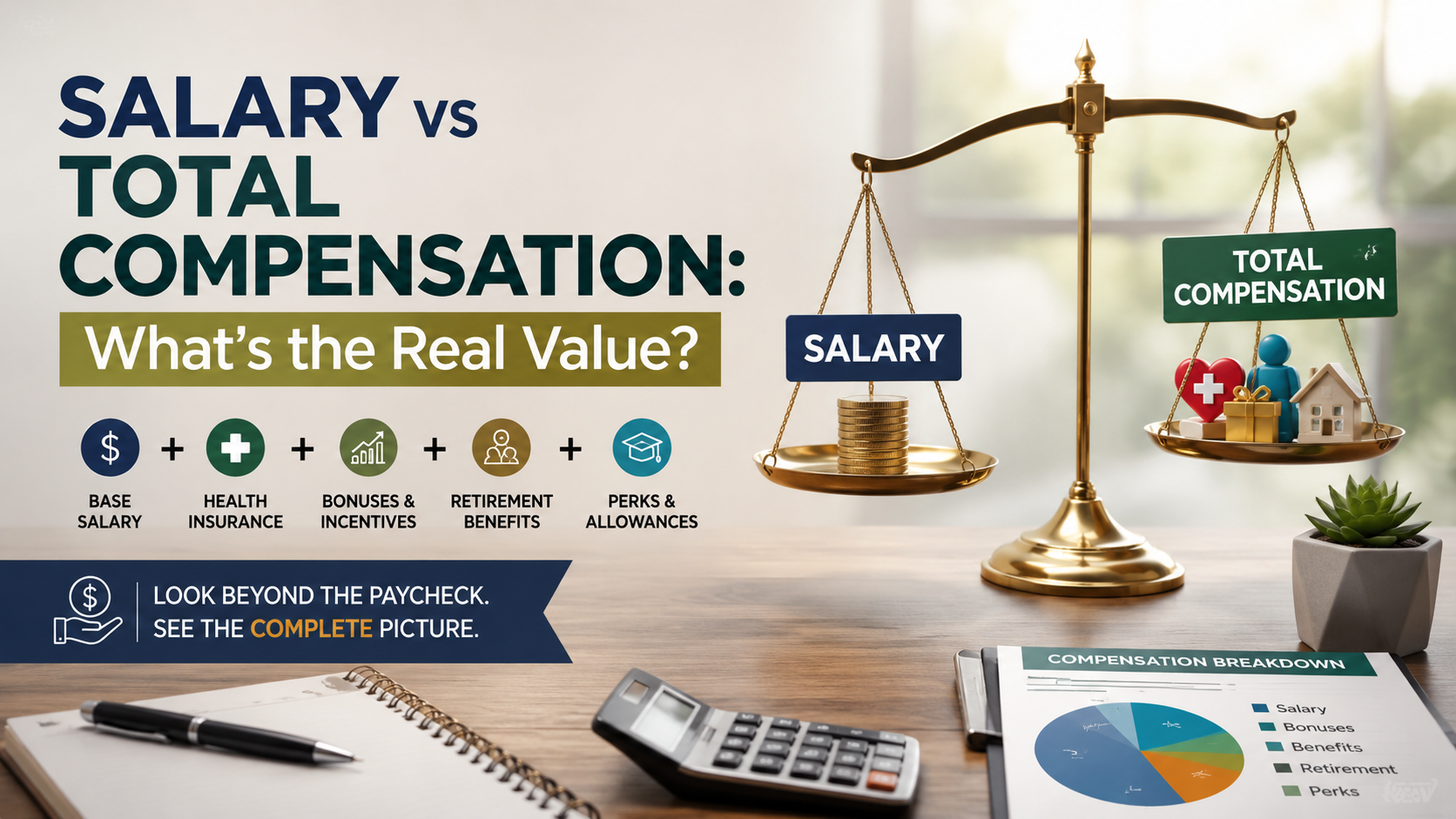
Salary vs Total Compensation: What’s the Real Value?
When looking at a new job offer, evaluating your true financial rewards goes far beyond your base paycheck. Professionals often overlook extra benefits that significantly boost their overall earnings. According to the U.S. Bureau of Labor Statistics, employer costs for employee compensation stretch far past standard wages, covering essential insurance, retirement contributions, and paid leave. Understanding this dynamic ensures you never undervalue your professional worth in the marketplace. Many workers mistakenly focus only on cash earnings, ignoring valuable perks like health coverage and stock options. This comprehensive guide explores these crucial differences. We break down answers to what is the difference between salary and total compensation, what is the difference between basic salary and total compensation, is salary the same as compensation, are CTC and total compensation the same, salary vs total compensation vs base salary, and a clear salary vs total compensation example.
What Is the Difference Between Salary and Total Compensation?
The difference between salary and total compensation comes down to the scope of the financial rewards you receive from an employer. Salary usually refers to the fixed cash amount you earn for performing your job. Employers typically pay it monthly, biweekly, or according to another regular schedule.
Total compensation is broader. It includes your base salary plus additional financial and employment benefits provided by the company. These may include performance bonuses, health insurance, retirement contributions, stock awards, tuition assistance, and wellness benefits.
For example, a job offering a $70,000 salary may provide another $15,000 in benefits and variable compensation. Your salary is still $70,000, but your total compensation could reach $85,000.
Understanding this difference gives you a more accurate view of an employment offer. Focusing only on your paycheck can make one job appear less valuable than another. Comparing the complete compensation package helps you understand what an employer is actually offering.
Evaluating Extra Benefits
Calculating your complete financial package requires looking beyond your monthly bank deposit. Employers often provide benefits that have significant monetary value but never appear as regular salary payments.
Health insurance is one common example. If your employer pays part or all of your insurance premium, that contribution reduces your personal expenses. Retirement matching can also add substantial value to your annual compensation.
When reviewing a job offer, request a detailed breakdown of the entire package. Look for:
- Employer-paid health insurance premiums
- Retirement plan contributions or matching
- Performance bonuses and commissions
- Stock awards or equity
- Tuition reimbursement
- Paid time off and other benefits
You should also distinguish between guaranteed and variable compensation. A guaranteed benefit has a predictable value, while a bonus may depend on performance or company results.
Adding these components to your base salary gives you a clearer estimate of your total annual compensation. This approach is especially useful when comparing competing job offers.
What Is the Difference Between Basic Salary and Total Compensation?
Basic salary is the guaranteed cash foundation of your employment agreement. It is the fixed amount you and your employer agree upon before considering bonuses, benefits, deductions, or other variable payments.
Total compensation builds on that foundation. It includes basic salary along with additional financial rewards and employer-provided benefits. Depending on the employer, these may include bonuses, commissions, retirement contributions, insurance, stock awards, allowances, and other benefits.
The biggest difference is certainty. Your basic salary generally remains consistent from one pay period to another. Total compensation can change because some components depend on performance, company results, stock value, or eligibility requirements.
For example, an employee may have a $60,000 basic salary and a potential $10,000 annual performance bonus. Their guaranteed salary is $60,000, while their potential compensation could be $70,000 before considering other benefits.
Understanding this difference helps you avoid confusing potential earnings with guaranteed income when evaluating an employment offer.
The Role of Variable Pay
Variable pay can significantly change your annual earnings. Unlike basic salary, these payments usually depend on specific performance targets, sales results, commissions, company profitability, or other conditions.
Common forms of variable compensation include:
- Annual performance bonuses
- Sales commissions
- Profit-sharing payments
- Project-based incentives
- Signing or retention bonuses
- Stock awards tied to performance
Employers often use variable pay to connect employee rewards with business results. A sales professional, for example, may receive a moderate base salary but earn substantial commissions by exceeding sales targets.
However, you should not treat potential variable pay as guaranteed income. Before accepting an offer, ask how the bonus is calculated and what percentage of employees typically receive it.
A compensation package with a lower base salary and a large variable component may look attractive. Yet it can carry more financial uncertainty than a job with a higher guaranteed salary.
Is Salary the Same as Compensation?
Salary is not the same as compensation, although people often use the terms interchangeably in everyday conversation. Salary generally refers to fixed cash pay, while compensation describes the broader rewards an employee receives for their work.
Think of salary as one component of compensation. Your salary might be $65,000 per year, while your total compensation could be considerably higher after adding insurance, retirement contributions, bonuses, equity, and other benefits.
This distinction matters during job searches and salary negotiations. If a recruiter says a position offers $80,000 in compensation, you should clarify what that figure includes. It could represent base salary, total compensation, or a target amount that includes variable incentives.
For practical guidance on discussing your pay after receiving an offer, see these salary negotiation tips after an offer.
Clear terminology prevents misunderstandings when comparing employment contracts. Ask employers for a written breakdown showing base salary, variable compensation, employer contributions, and benefits.
The broader definition of compensation also recognizes benefits that do not directly appear as cash. These benefits can still have meaningful financial or personal value.
Non-Monetary Compensation Perks
Compensation is not limited to salary, bonuses, insurance, and retirement contributions. Employers may also provide non-monetary benefits that affect your overall employment experience and financial position.
Examples include flexible working arrangements, additional vacation days, remote work options, professional development programs, employee discounts, and wellness programs.
These benefits do not necessarily increase your bank balance. However, they can reduce personal expenses or provide value that would otherwise cost you money or time.
For example, an employer-funded professional certification could save you hundreds of dollars. Flexible remote work could also reduce commuting costs and travel time.
When comparing job offers, consider how each benefit affects your priorities. A company offering a slightly lower salary may provide significantly more flexibility or professional development opportunities.
Still, avoid assigning arbitrary cash values to every perk. Some benefits have clear financial value, while others depend heavily on your personal circumstances. Evaluate them separately from guaranteed cash compensation to create a realistic picture of each employment offer.
Are CTC and Total Compensation the Same?
CTC, or Cost to Company, and total compensation are closely related concepts, but they are not always identical. The exact definition depends on the employer, country, and way the compensation package is calculated.
CTC is especially common in India. It generally represents the total annual cost a company associates with employing a person. Depending on the organization, CTC may include basic salary, allowances, bonuses, employer provident fund contributions, gratuity, insurance, and other benefits.
Total compensation usually focuses on the overall value of rewards provided to the employee. Some definitions may exclude certain employer costs or administrative expenses that appear within a company’s CTC calculation.
This distinction is important when reviewing an Indian job offer. A company may advertise a ₹10 lakh CTC, but that does not necessarily mean you will receive ₹10 lakh in your bank account.
Before comparing offers, request a complete CTC breakup. Identify fixed salary, variable pay, employer contributions, taxes, and benefits separately. This gives you a more realistic estimate of your monthly take-home pay and annual financial value.
Understanding CTC Deductions
A CTC figure can contain components that you never receive directly as monthly cash. This is one of the biggest reasons employees sometimes confuse CTC with take-home salary.
For example, an employer may include gratuity, employer provident fund contributions, insurance premiums, or other benefits in the advertised CTC. These amounts contribute to the employer’s cost but may not appear in your monthly bank deposit.
When reviewing a CTC structure, separate the components into three categories:
- Fixed cash salary
- Variable or performance-based pay
- Employer-paid benefits and contributions
You should then examine deductions from your gross salary separately. Employee provident fund contributions, income tax, and other applicable deductions can reduce your actual take-home pay.
A ₹10 lakh CTC therefore does not automatically mean you will receive approximately ₹83,333 every month.
The safest approach is to ask the employer for the complete salary structure. Compare gross salary, deductions, take-home pay, and total CTC rather than relying on the headline figure alone.
Salary vs Total Compensation vs Base Salary
Salary, total compensation, and base salary describe different layers of an employee’s earnings. Understanding these terms makes it easier to compare job offers and negotiate compensation effectively.
Base salary is the fixed cash amount agreed upon for your role. It generally excludes bonuses, commissions, and employer-provided benefits.
Salary is often used as a general term for regular cash earnings. In many contexts, people use salary and base salary interchangeably. However, the exact meaning can depend on the employer and the compensation structure.
Total compensation is broader. It combines base salary with additional financial rewards and employer-provided benefits. These may include bonuses, insurance, retirement contributions, equity, commissions, and other benefits.
For example, Company A might offer a $75,000 base salary with limited benefits. Company B could offer a $68,000 base salary with a large retirement contribution, strong insurance coverage, and a substantial bonus.
The second offer may have greater total compensation despite the lower base salary. That is why comparing only salary can produce an incomplete picture of the financial value of a job.

Comparing Competing Job Offers
Comparing job offers requires more than choosing the position with the highest advertised salary. You should evaluate the complete compensation package and separate guaranteed income from potential earnings.
Start by comparing each offer’s base salary. Then examine bonuses, commissions, employer retirement contributions, insurance coverage, equity, and other benefits.
A simple comparison can include:
| Compensation component | Offer A | Offer B |
|---|---|---|
| Base salary | $75,000 | $68,000 |
| Expected bonus | $3,000 | $8,000 |
| Retirement contribution | $2,500 | $6,000 |
| Insurance value | $5,000 | $7,000 |
| Estimated total value | $85,500 | $89,000 |
These numbers should be based on realistic assumptions. Do not treat a maximum possible bonus as guaranteed income.
Also consider taxes, commuting costs, paid leave, work location, and career development. A slightly smaller package may still be preferable if it provides better stability or significantly improves your long-term career prospects.
If you are comparing employment structures rather than just compensation packages, you can also explore freelancing vs full-time jobs to understand how income and benefits can differ.
Salary vs Total Compensation Example
A practical example shows why salary and total compensation should not be treated as the same figure. Imagine Jane receives a job offer with an annual base salary of $70,000.
At first glance, it may seem that Jane’s employer is paying her $70,000 for the year. That figure represents her fixed salary, but it does not capture the complete value of her employment package.
Her employer also offers a $5,000 performance bonus, $10,000 worth of health insurance coverage, and a $4,000 retirement contribution. If Jane qualifies for the full bonus, these components add another $19,000 to the package.
Her potential total compensation is therefore:
- Base salary: $70,000
- Performance bonus: $5,000
- Health insurance: $10,000
- Retirement contribution: $4,000
- Total compensation: $89,000
However, Jane should not assume that all $89,000 will reach her bank account. The bonus may depend on performance, while insurance and retirement contributions are benefits rather than direct cash wages.
Visualizing Your Annual Package
Breaking your annual compensation into separate categories makes financial planning easier. Instead of looking at one large number, identify how much comes from fixed salary, variable pay, and employer-provided benefits.
Start with your guaranteed cash compensation. This is the amount you can reasonably expect before considering performance-based payments.
Next, identify variable compensation. Include bonuses, commissions, and other incentives, but use realistic estimates rather than maximum potential amounts.
Finally, calculate the value of employer-paid benefits. These may include health insurance, retirement contributions, tuition assistance, and other benefits.
A simple breakdown could look like this:
- Fixed salary: $70,000
- Expected variable pay: $5,000
- Employer benefits: $14,000
- Estimated total compensation: $89,000
This approach helps you understand your actual financial package without confusing benefits with take-home pay.
It also makes job comparisons easier. When two employers use different compensation structures, separating each component reveals which offer provides more guaranteed income and which provides greater overall value.
Frequently Asked Questions
How do employee benefits impact total compensation?
Employee benefits significantly increase your total compensation by covering essential expenses you would otherwise pay out of pocket. Comprehensive health insurance, dental coverage, and retirement matching plans add thousands of dollars in hidden value to your annual earnings. When evaluating a career opportunity, factoring in these non-cash benefits often reveals that a lower base salary with superior perks provides greater overall financial security.
Are bonuses and stock options guaranteed parts of total compensation?
Bonuses and stock options are variable components of total compensation rather than guaranteed cash earnings. Performance bonuses depend on company milestones and individual achievements, meaning payouts fluctuate yearly. Similarly, stock options rely on company valuation and vesting schedules. While they boost your potential total compensation significantly, you should always prioritize a solid base salary for reliable daily living expenses.
Why do companies emphasize total compensation over base salary?
Companies emphasize total compensation because it reflects their entire investment in recruiting and retaining top talent. Highlighting comprehensive benefits allows organizations to showcase a competitive workplace culture without inflating fixed payroll costs. For employees, understanding total compensation provides a clearer picture of corporate investment, helping them recognize hidden perks that support long-term financial health and professional growth.
How can I negotiate for better total compensation?
Negotiating better total compensation involves looking beyond standard base pay increases to request additional valuable perks. If an employer cannot raise your base salary due to internal budget caps, you can negotiate for extra paid time off, remote work stipends, signing bonuses, or higher retirement contributions. Presenting data-driven justifications for these additions ensures you secure a comprehensive and rewarding employment package.
Conclusion
Navigating the complexities of salary vs total compensation is essential for making informed career choices and building long-term financial security. While your base paycheck provides immediate cash flow, total compensation delivers the broader value of your employment package.
By evaluating health benefits, retirement contributions, bonuses, equity, and other benefits alongside your base pay, you can assess job offers more accurately and negotiate effectively.
Your career choice also depends on the type of employment you pursue. If you are exploring different paths, resources covering government jobs vs private jobs, top government jobs after graduation, and internship vs full-time job can help you compare opportunities from different perspectives.
If you are considering less traditional career paths, jobs in the creator economy can also provide useful context on alternative income models.
Ultimately, do not judge an opportunity by its advertised salary alone. Compare guaranteed pay, variable compensation, employer benefits, and long-term career value before making your decision.