
Rocket Flight Control: How Rockets Stay Stable in Flight
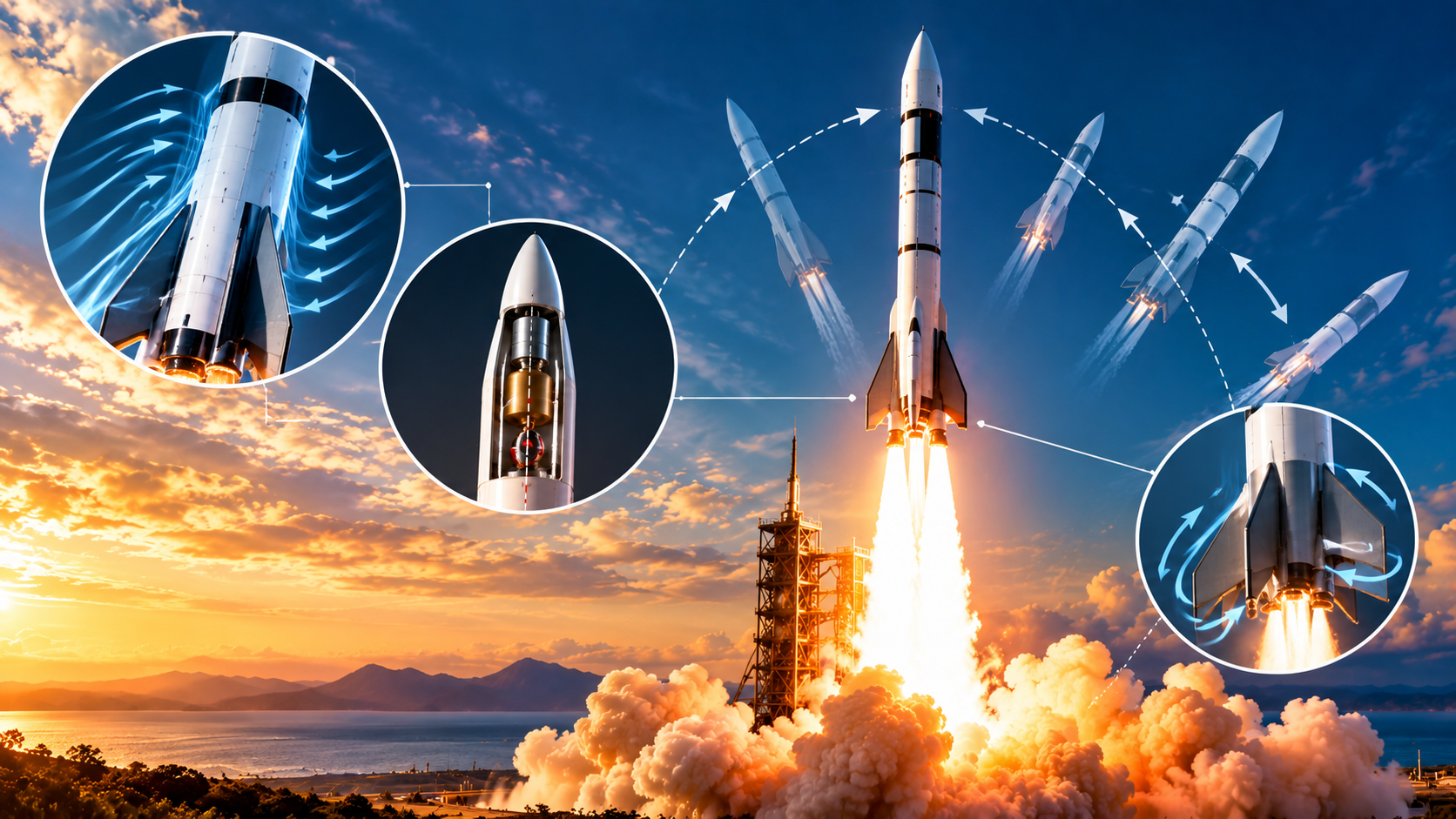
Mastering rocket flight control requires a careful balance between aerodynamics, propulsion, and guidance. When a rocket climbs into the sky, its stability depends on precise physical forces rather than chance. Aerodynamic stability determines whether the vehicle follows a controlled path or begins to tumble after launch. Organizations like the National Aeronautics and Space Administration (NASA) spend years refining these principles to improve flight performance and safety.
Understanding these principles helps hobbyists, students, and aerospace engineers understand common flight failures. Stability affects whether a rocket maintains its intended direction or begins moving into an unwanted arc.
This guide explains how rockets maintain stability and how you can improve it. It covers the relationship between the center of gravity and center of pressure. It also explains how fins provide stability and why excessive stability can cause windcocking. Finally, it examines ways to increase total flight time through better mass management, lower drag, and effective recovery systems.

How do rockets stay stable in flight?
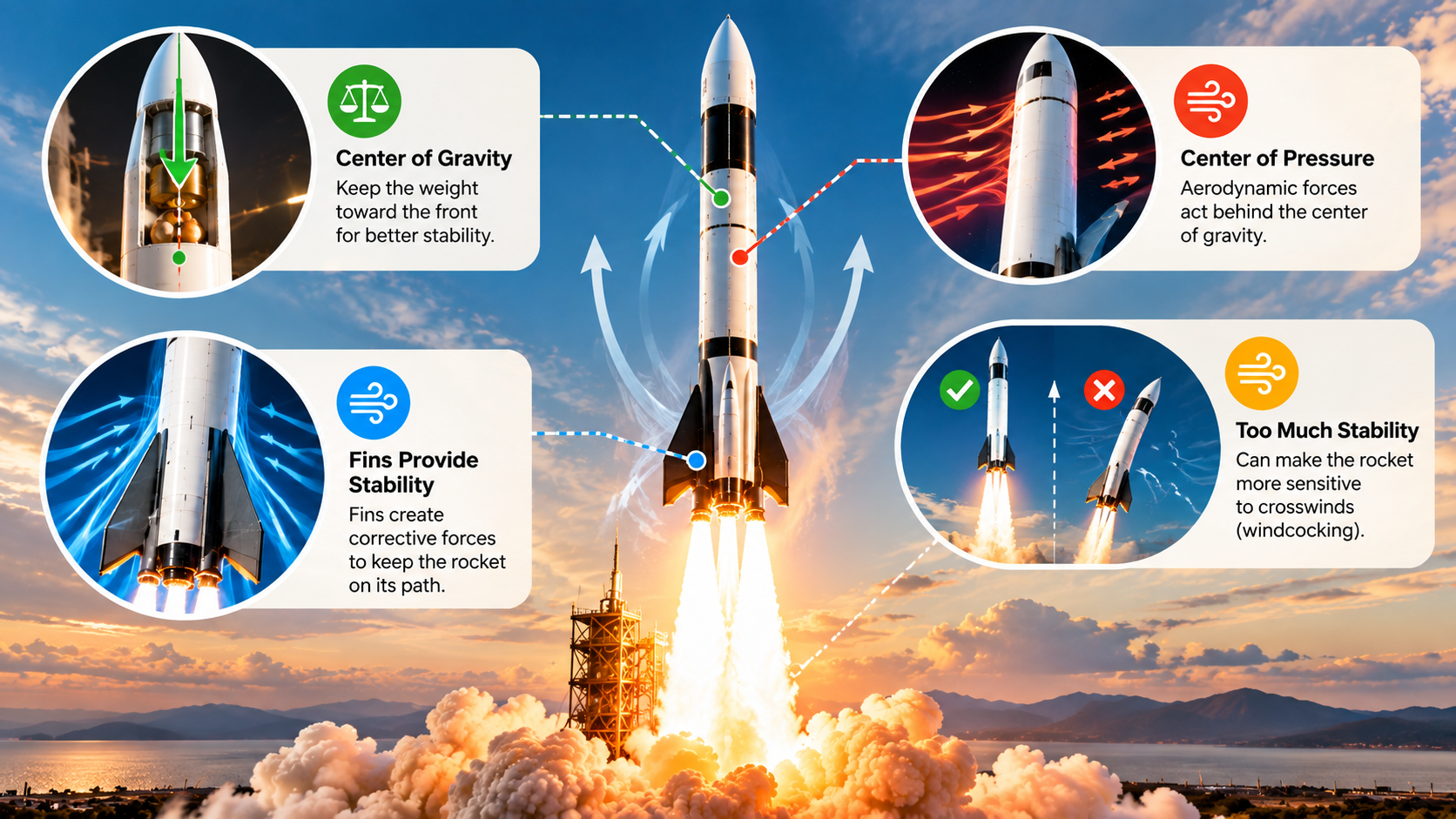
Rockets stay stable by maintaining a controlled relationship between their center of gravity and center of pressure. The center of gravity represents the point where the rocket’s total weight balances. The center of pressure represents where aerodynamic forces act on the vehicle. For stable flight, the center of pressure should remain behind the center of gravity. This arrangement creates a restoring force when the rocket begins to tilt.
When wind pushes the rocket away from its intended direction, aerodynamic forces act against the disturbance. Tail fins help generate corrective forces that bring the rocket back toward its original flight path. Modern vehicles also use active rocket flight control systems. These systems can include gimbaled engines, reaction control thrusters, and onboard guidance computers. Together, passive stability and active control help maintain the vehicle’s orientation. This combination allows rockets to remain pointed along their intended trajectory during demanding phases of flight.
Center of Gravity Versus Center of Pressure
The distance between the center of gravity and center of pressure strongly affects rocket stability. When the rocket tilts, aerodynamic forces around the center of pressure create a restoring torque. This torque helps return the rocket toward its original orientation. The farther the center of pressure remains behind the center of gravity, the stronger this restoring effect can become.
Engineers and rocketry hobbyists often describe this separation using calibers. One caliber equals the rocket body’s outside diameter. A common stability target is keeping the center of pressure roughly one to two calibers behind the center of gravity. This provides a useful stability margin during flight.
However, stability should not be increased without considering wind conditions and aerodynamic drag. An excessively stable rocket can respond strongly to crosswinds. Therefore, proper rocket flight control requires a practical balance. The goal is controlled stability rather than simply creating the largest possible separation between these two points.
How to make a rocket more stable?
You can make a rocket more stable by moving its center of gravity forward or its center of pressure backward. Adding a small amount of ballast inside the nose cone moves the center of gravity toward the front. This increases the separation between the two balance points and can improve stability during flight.
Another approach involves changing the rocket’s aerodynamic surfaces. Larger fins can move the center of pressure toward the rear while providing greater corrective forces. Sweeping the fins backward can also change how aerodynamic forces act on the vehicle. Increasing the rocket’s overall length can further influence its aerodynamic balance. Heavy-lift rockets use different design considerations when balancing stability, propulsion, and payload requirements.
These changes should be made carefully because additional weight can reduce performance. Oversized fins can also increase aerodynamic drag and make the rocket more sensitive to crosswinds. Effective rocket flight control therefore depends on finding a practical balance between stability, weight, and drag. Understanding rocket engines also helps explain how thrust interacts with these design factors during flight. Testing the rocket’s balance before launch helps identify problems before they become dangerous during flight.
What happens if a rocket is too stable?
A rocket that is excessively stable can become more sensitive to crosswinds during powered flight. This effect is commonly associated with windcocking. Windcocking occurs when aerodynamic forces from a crosswind cause the rocket to rotate toward the incoming wind. A highly stable rocket can respond strongly because its large restoring forces encourage rapid directional correction.
When the rocket turns into the wind, its trajectory can move away from a vertical path. Instead of continuing upward, the vehicle may begin following a flatter arc. This can reduce peak altitude and increase the distance traveled horizontally. Understanding how atmospheric layers affect airflow can provide additional context for how rockets behave as they climb. In some situations, that can create additional recovery and launch-site safety concerns.
Oversized fins can contribute to excessive stability because they generate stronger aerodynamic forces. The problem is therefore not stability itself but an unsuitable stability margin for the flight conditions. Effective rocket flight control requires enough stability to resist disturbances without creating excessive wind response. Launch conditions, rocket design, fin size, and expected wind all need consideration before flight.
The Dynamics of Severe Windcocking
Severe windcocking occurs when crosswind forces produce enough aerodynamic torque to redirect the rocket during ascent. The fins experience airflow from the side, creating a force that pushes the vehicle toward the wind. A highly stable design can amplify this response because its restoring torque is strong.
As the rocket changes direction, the engine continues producing thrust along the vehicle’s new orientation. Instead of directing most thrust upward, the vehicle begins moving downrange. This reduces the vertical component of its motion and can lower the eventual peak altitude.
A severe trajectory change can also affect recovery. The rocket may travel farther from the intended launch area before reaching apogee. Its descent can therefore occur outside the planned recovery zone. For this reason, launch conditions matter as much as the rocket’s physical design. Avoiding excessive stability, oversized fins, and unsuitable launch conditions can reduce unwanted windcocking. Proper rocket flight control aims to maintain predictable movement throughout powered ascent and coast.
How do fins keep a rocket stable?
Fins keep a rocket stable by acting as passive aerodynamic control surfaces near the rear of the vehicle. During straight flight, airflow moves relatively evenly around the fins. If turbulence or a wind gust pushes the nose sideways, the rocket develops an angle of attack. This changes the airflow around the fins and creates an aerodynamic force.
Because the fins sit behind the rocket’s center of gravity, this force produces a restoring torque. The torque works against the unwanted rotation and helps bring the rocket back toward its intended orientation. Fin placement therefore provides important passive rocket flight control without requiring electronics or moving components.
Fin shape and size also influence stability and drag. Larger surfaces can generate stronger corrective forces, but they can increase aerodynamic resistance. Symmetrical fin designs can provide predictable behavior while limiting unnecessary drag. Properly positioned fins can help control unwanted yaw, pitch, and other directional movements during flight. Their effectiveness depends on the entire rocket design, including its mass distribution, body shape, and relationship between the center of gravity and center of pressure.
How to make a rocket stay in the air longer?
Making a rocket stay in the air longer involves improving both its ascent and recovery performance. During ascent, reducing unnecessary mass can help the rocket reach a greater altitude. However, the structure must remain strong enough to withstand launch forces. Reducing aerodynamic drag can also improve performance by allowing more of the available thrust to contribute to upward motion. These design goals are also important when developing reusable spacecraft technology for repeated missions.
The rocket’s exterior should have smooth surfaces and well-designed transitions. These features can reduce unnecessary aerodynamic resistance during flight. After reaching apogee, the recovery system becomes the main factor affecting descent time.
A properly sized parachute or streamer increases aerodynamic drag and slows the rocket’s descent. Lightweight recovery materials can help limit additional mass while maintaining effective drag. Some designs use staged recovery systems to manage descent at different points in the flight. Increasing hang time therefore requires more than simply adding a larger parachute. The complete design must balance mass, drag, altitude, structural strength, and recovery performance. These factors work together to determine total flight duration.
FAQ SECTION
What is the one-caliber rule in rocketry?
The one-caliber rule states that a rocket’s center of pressure should sit at least one body diameter behind its center of gravity. This physical distance provides sufficient aerodynamic leverage to correct inflight wobbles. If the margin drops below one caliber, the rocket risks tumbling. Exceeding two calibers can cause windcocking. Adhering to this proportional balance point ensures straight, predictable climbs.
Why do orbital rockets lack large fins?
Orbital rockets like the Falcon 9 or Saturn V operate without large aerodynamic fins because they rely on active thrust vector control. Hydraulic or electric actuators swivel the rocket engine nozzles rapidly, redirecting thrust to steer the vehicle. Because orbital launchers fly through the upper atmosphere where air is thin, passive aerodynamic fins provide negligible stability compared to direct thrust vectoring.
How does fuel consumption affect rocket balance during flight?
As a rocket burns propellant, its internal mass distribution changes dramatically. Liquid fuel and solid propellant sit inside large tanks along the fuselage. As these propellants deplete, the center of gravity shifts continuously along the body tube. Flight computers and engineers must calculate these progressive mass movements to ensure the center of gravity never slips behind the center of pressure.
What is the swing test for model rockets?
The swing test is a quick physical method used to verify rocket stability before launch. You tie a strong string around the rocket at its exact center of gravity, balancing it horizontally. Then, you swing the rocket in a wide circle around your body. If the nose points forward into the wind continuously, the rocket possesses adequate passive aerodynamic stability.
Conclusion
Achieving reliable flight stability requires respecting the core aerodynamic laws of aerospace engineering. A successful launch depends on the delicate balance between your center of gravity and your center of pressure. By correctly sizing your fins, distributing ballast carefully, and avoiding over-stabilization, you keep your vehicle on a predictable flight path.
Moreover, true flight control balances both the powered climb and the gentle recovery glide. Over-correcting your airframe creates severe windcocking hazards, while under-stabilizing leads to tumbling airframes. Balancing passive design elements like swept fins with reliable recovery hardware creates consistent success.
As you plan your next build, evaluate your weight distribution and fin alignments carefully before heading to the launch pad. Apply these core principles of rocket flight control during your design phases to achieve stable flights, higher apogees, and secure recoveries every single time.