
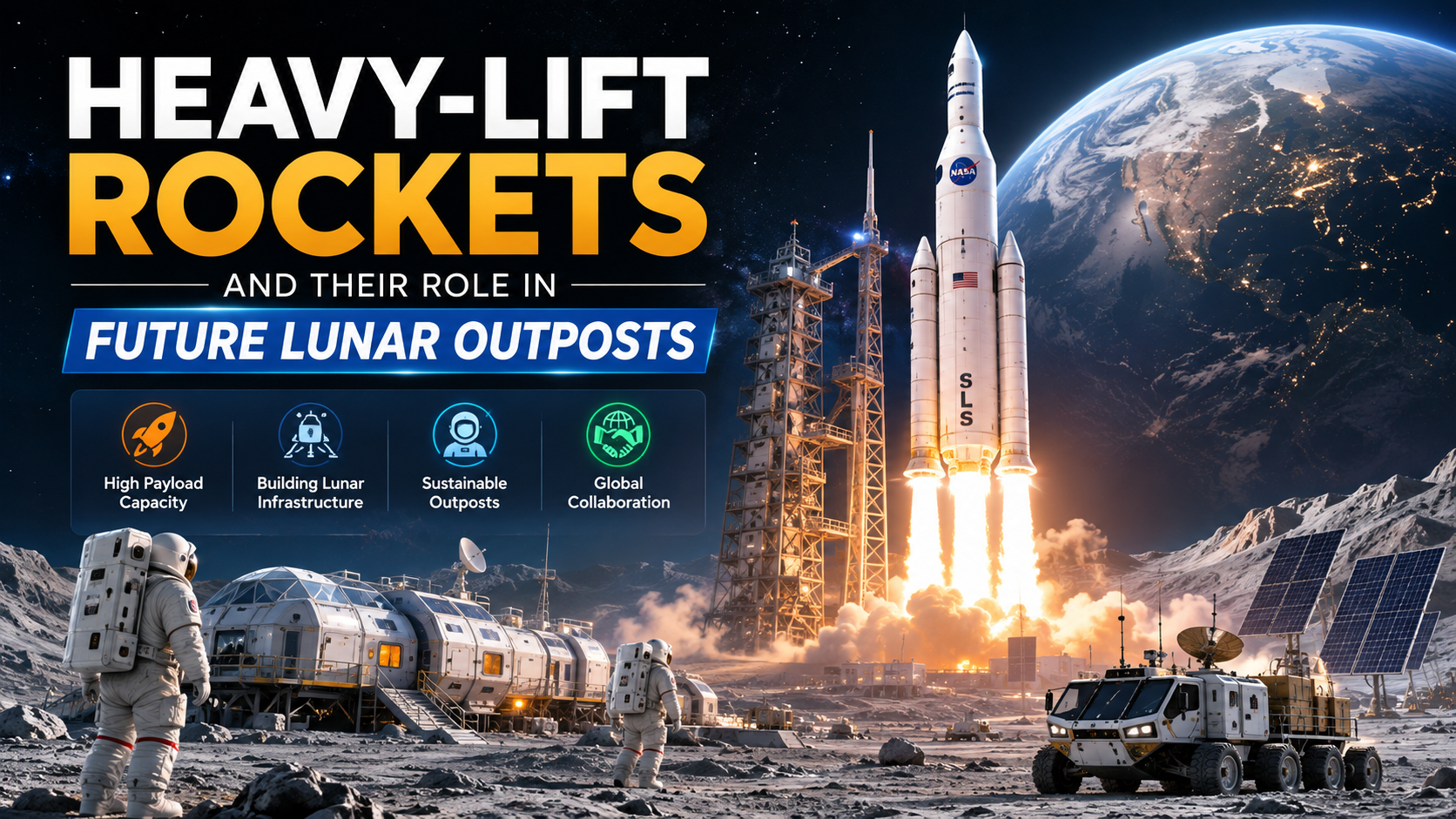
Heavy-Lift Rockets and Their Role in Future Lunar Outposts
Humanity is moving toward a new era of lunar exploration, with plans focused on sustained activity rather than short visits. Heavy-lift rockets will play a central role because lunar outposts require large amounts of equipment, cargo, and infrastructure.
These launch vehicles can transport heavy spacecraft, habitation modules, rovers, power systems, and scientific equipment beyond Earth orbit. Without high-capacity launch systems, building and supplying a long-term lunar base would require many more launches and complex logistics.
The future of lunar exploration also involves more than rockets. Astronauts will need reliable life-support systems, waste-management equipment, surface transportation, and international cooperation. Programs such as NASA’s Artemis campaign are developing several of these capabilities.
This article explains what heavy-lift rockets are, why payload capacity matters, and how future Moon missions could develop. It also examines astronaut waste management, lunar outpost planning, NASA’s Space Launch System, and India’s LVM3. Together, these technologies show how modern launch systems could support a longer-term human presence beyond Earth.
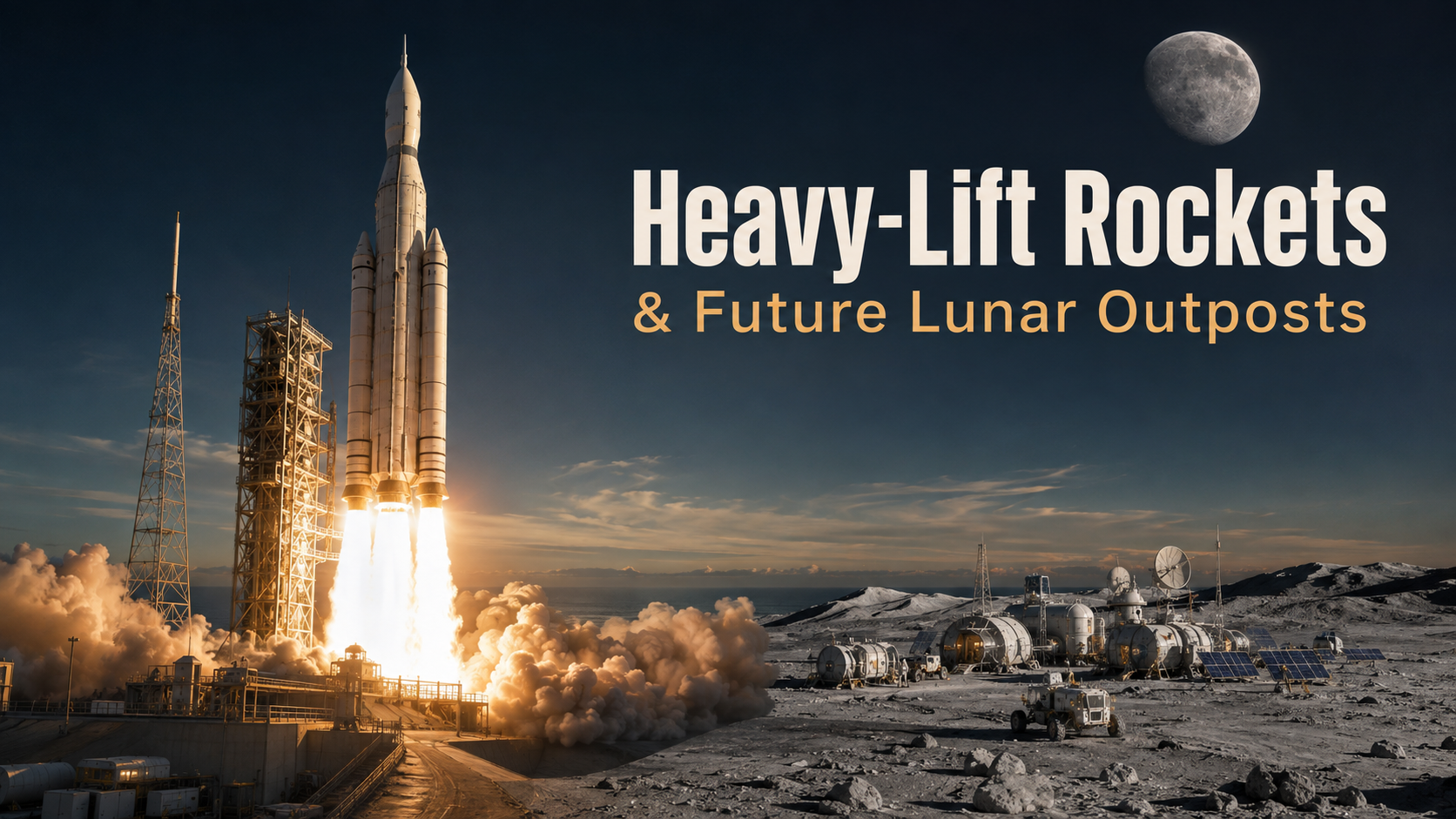

What is a heavy-lift rocket?
A heavy-lift rocket is a launch vehicle designed to carry very large payloads into low Earth orbit or toward destinations such as the Moon. Depending on its design, a heavy-lift rocket can place tens of metric tons into orbit. Its large engines, propellant tanks, and multiple stages provide the energy needed to overcome Earth’s gravity. Rocket design also varies considerably, including why some rockets do not have fins and instead rely on other methods for stability and control.
These vehicles support missions that smaller rockets cannot handle efficiently. They can launch crew spacecraft, lunar landers, habitats, scientific equipment, and large cargo in fewer flights. That capacity is especially important when agencies need to build infrastructure beyond Earth.
Modern heavy-lift rockets may also use reusable hardware to reduce turnaround time and launch costs. However, reusability is not required for a rocket to qualify as heavy lift. Its defining feature is high payload capability and the ability to support demanding missions.
Defining the Payload Capacity Thresholds
Heavy-lift rockets stand apart from conventional launchers mainly because of their payload capacity. Smaller rockets commonly carry satellites, probes, or other commercial spacecraft. Heavy-lift vehicles can transport much larger payloads, including lunar landers, crew vehicles, habitat modules, and major scientific instruments.
There is no single worldwide payload threshold that defines every heavy-lift rocket. Definitions vary by agency and industry, and mission capability depends on the destination. A vehicle may lift far more mass to low Earth orbit than it can send toward the Moon.
That distinction matters for lunar construction. A spacecraft delivering cargo beyond Earth orbit needs enough performance for the required trajectory, not simply a large orbital payload rating.
Heavy-lift rockets can reduce the number of launches needed for major projects. Fewer launches may simplify logistics, but complex missions can still require multiple flights, orbital refueling, or staged assembly. Payload capacity is therefore only one part of overall mission capability.
What are the future plans for Moon missions?
Future Moon missions increasingly focus on sustained exploration rather than short visits. NASA’s Artemis program and other international efforts aim to build the capabilities needed for repeated lunar missions. The lunar south pole is a major target because permanently shadowed regions may contain water ice. These ambitious missions will also create demand for space industry careers for non-astronauts across engineering, science, operations, and other fields.
Robotic missions will help map terrain, study resources, and test technologies before larger human operations expand. Future crews could use surface habitats, power systems, communications equipment, rovers, and scientific laboratories. These systems must operate through radiation, extreme temperatures, lunar dust, and long periods without direct sunlight.
Heavy-lift rockets will move major hardware from Earth into the transportation chain. They can also support large cargo missions that smaller launchers cannot handle efficiently. Over time, lunar operations could provide experience with resource use, surface construction, and long-duration living.
Those capabilities could inform later human missions to Mars. However, a permanent lunar presence will require sustained funding, dependable transportation, reliable surface systems, and technologies that can operate with limited support from Earth.
Establishing Sustainable Outposts
Building a sustainable lunar outpost requires more than landing astronauts on the surface. Crews need dependable supplies, power, communications, shelter, mobility, and spare equipment. Heavy-lift rockets can deliver large modules and cargo while reducing the number of separate launches required for major hardware. These systems will also depend on space industry careers for non-astronauts to design, operate, and maintain the technologies supporting long-term exploration.
Early outposts are likely to grow in stages. Robotic systems can prepare sites, move cargo, and test technologies before larger crews arrive. Modular habitats can then expand as mission needs increase. This approach allows agencies to learn from each mission instead of committing to one enormous construction effort.
Water ice could become an important resource if it proves accessible and usable at the required scale. Extracted water could support life and potentially provide oxygen and hydrogen for propulsion.
However, large-scale lunar resource use remains technically challenging. Sustainable operations will depend on reliable hardware, efficient logistics, power generation, and long-term international and commercial cooperation. Heavy-lift launch systems will remain important because surface infrastructure cannot be built without moving substantial mass from Earth.
What if astronauts need to pee during launch?
Astronauts may need to use the bathroom during long launch or landing operations, especially when they cannot leave their seats or spacesuits. For these situations, crews can use specialized absorbent garments called Maximum Absorbency Garments, or MAGs.
These garments are designed to manage urine and other bodily waste while helping astronauts remain focused during critical phases of flight. Launch preparations can last for hours, and delays can extend the time astronauts spend inside their suits or seats. Waste management therefore becomes part of routine mission planning rather than an unusual emergency.
Once astronauts reach a spacecraft with an operating life-support system, they can use dedicated toilet facilities designed for microgravity. These systems use airflow instead of gravity to direct waste.
Spacecraft waste systems also aim to control odors and maintain hygiene. Although this topic sounds mundane, reliable waste management is essential for crew comfort, health, and mission safety. Future lunar missions will need similarly dependable systems because crews may spend much longer away from Earth.
Advanced Waste Management Technology
Modern human-spaceflight systems use several technologies to manage bodily waste safely. During launch and landing, astronauts may rely on absorbent garments when movement is restricted. These garments use absorbent materials that help contain moisture and reduce discomfort during long operations.
Inside a spacecraft, microgravity toilets use controlled airflow to move liquid and solid waste into separate collection systems. Airflow is essential because waste does not naturally fall away from the body in microgravity. Engineers also design these systems to limit odors, simplify cleaning, and support reliable operation.
Waste management becomes more important as missions grow longer. Future lunar outposts will need systems that operate for extended periods with limited resupply.
Recycling technologies may recover useful water from wastewater, reducing the amount that must be launched from Earth. This principle supports broader efforts to make deep-space missions more efficient. Small operational details can have major consequences when crews live far from Earth.
Who is the lunar outpost?
The lunar outpost refers to a planned long-term human presence on the Moon, rather than a single spacecraft or one national facility. Different programs use different names and architectures, but the broader goal is to create infrastructure that supports repeated crewed operations and scientific work.
A lunar outpost could include habitats, power systems, communications equipment, landing areas, rovers, laboratories, and storage facilities. Its exact design will depend on location, mission goals, available technology, and international agreements. The lunar south pole is especially important because of potential access to water ice and favorable lighting conditions in some areas.
The outpost would support science and technology demonstrations while helping engineers learn how people can live and work beyond Earth. It could also test resource utilization, surface mobility, construction methods, and long-duration life-support systems.
Rather than replacing Earth-based infrastructure, the outpost would extend human capabilities into the lunar environment. Its development would likely occur gradually as transportation, surface systems, and mission experience improve.
International Collaboration and Management
A multinational lunar outpost would require more than shared hardware. Participating organizations would need common technical standards, communication procedures, safety rules, and agreements covering operations and responsibilities. These arrangements become especially important when crews and equipment from different countries work together.
International cooperation can distribute costs and reduce duplicated development work. One partner might provide a habitat, another a rover, and another scientific instruments or communications equipment. Commercial companies may also supply landers, transportation services, or surface technologies.
Management would still present difficult challenges. Partners must coordinate schedules, interfaces, emergency procedures, data sharing, and maintenance responsibilities. Different national policies can also affect how missions are planned and operated.
A successful lunar outpost would therefore depend on both engineering compatibility and sustained cooperation. If these systems work well, the Moon could become a practical environment for testing multinational operations before more complex missions farther into space. The experience could also shape future international missions to Mars.
NASA biggest rocket in the world
NASA’s Space Launch System, or SLS, is a heavy-lift rocket developed to send crewed Orion spacecraft and large payloads toward the Moon. It is one of the most powerful rockets ever developed, but calling it the biggest rocket in the world is too broad. Other launch vehicles can exceed it in size or thrust.
SLS combines four RS-25 engines with two solid rocket boosters around a large core stage. Its configuration gives it the performance needed for Artemis missions beyond low Earth orbit. The rocket is designed for major deep-space missions rather than routine satellite launches.
SLS forms a central part of NASA’s Artemis architecture. It launches Orion from Earth, while other systems handle later parts of the lunar mission. Future Artemis missions will depend on several vehicles and surface systems working together.
The rocket’s heavy-lift capability is valuable because lunar missions require substantial mass for crew vehicles, equipment, and other mission hardware. Its role demonstrates why powerful launch vehicles remain important for deep-space exploration.
Powering the Artemis Generation
SLS provides the launch power needed to send Orion and its crew toward the Moon. Its core stage uses four RS-25 engines, while two solid rocket boosters add substantial thrust during the early part of flight. Together, these systems produce the high energy required for missions beyond low Earth orbit.
The rocket’s role extends beyond raw thrust. Its performance helps place Orion on a trajectory toward the Moon without relying on the same kind of large-scale orbital assembly used by some alternative mission designs. However, Artemis still depends on multiple spacecraft and launch systems for later mission stages.
Heavy-lift capability also allows agencies to consider larger cargo and crew architectures. Future lunar operations could require more equipment than a single spacecraft can carry. SLS therefore serves as one element of a broader transportation system.
Its importance comes from the combination of payload capacity, deep-space performance, and integration with NASA’s Artemis missions. These capabilities make it an important part of NASA’s current approach to crewed lunar exploration and future outpost development.
What is ISRO’s heaviest rocket?
ISRO’s heaviest operational rocket is the Launch Vehicle Mark-3, or LVM3. It was previously known as the Geosynchronous Satellite Launch Vehicle Mark III. The vehicle is designed to place large payloads into orbit and supports India’s growing spaceflight ambitions.
LVM3 uses two large solid strap-on boosters, a liquid core stage, and a cryogenic upper stage. This combination gives it the performance needed for heavy satellite launches and other demanding payloads. Its development also established an important foundation for India’s human spaceflight program.
The rocket has flown major missions, including Chandrayaan-3, which helped demonstrate India’s lunar landing capability. LVM3 is also the launch vehicle selected for India’s Gaganyaan human-spaceflight program, with human-rating and mission-specific requirements applied to the system.
Future Indian lunar missions may require additional launch architectures and vehicles depending on payload size and mission design. Still, LVM3 remains a major step in India’s development of independent heavy-lift launch capability. Its evolution will help determine how effectively India can support increasingly complex human and robotic missions.
Advancing India’s Space Ambitions
LVM3 strengthens India’s ability to launch large spacecraft using a domestically developed heavy-lift vehicle. Its capacity supports communication satellites, scientific spacecraft, lunar missions, and other demanding payloads. That capability reduces dependence on foreign launch providers for missions within its performance range.
The vehicle also provides an important foundation for Gaganyaan, India’s human-spaceflight program. Human-rated launch operations require additional testing, reliability, safety systems, and mission controls beyond ordinary satellite launches. Those requirements make crewed missions a more demanding step than simply increasing payload capacity.
LVM3’s lunar role was demonstrated by Chandrayaan-3, which used the rocket to begin its journey from Earth. India’s future exploration plans could require larger payloads, more complex spacecraft, or different launch architectures.
Heavy-lift capability alone does not guarantee a permanent lunar presence. India would also need dependable spacecraft, landing systems, surface infrastructure, life-support technology, and sustained mission funding. LVM3 is therefore an enabling tool, not the entire lunar exploration strategy.
FAQ SECTION
How much payload can a heavy-lift rocket carry into orbit?
A heavy-lift rocket typically carries between 20 to 50 metric tons of payload into low Earth orbit. Super-heavy variants can exceed 100 metric tons, enabling massive interplanetary spacecraft assembly. This high capacity allows space agencies to launch entire modules and heavy rovers in a single flight.
How long do astronauts spend suited up before a rocket launch?
Astronauts often spend three to four hours inside their spacecraft suits before liftoff occurs. This duration includes ingress, cabin leak checks, communications tests, and holding during potential countdown delays. Specialized absorbent garments are essential for managing bodily needs throughout this lengthy pre-launch window.
Why is the lunar south pole chosen for future outposts?
The lunar south pole harbors vast deposits of water ice trapped inside permanently shadowed craters. This accessible water can supply drinking water, breathable oxygen, and processed hydrogen rocket propellant for missions. Establishing a base near these resources drastically reduces the cost of shipping supplies from Earth.
Can heavy-lift rockets be reused like smaller commercial launchers?
Modern heavy-lift rockets increasingly incorporate reusable booster technology to lower the cost of deep space exploration. While traditional designs were entirely expendable, newer architectures recover core stages and boosters successfully. Reusability represents a major economic turning point for sustainable lunar and Martian colonization efforts.
Conclusion
Heavy-lift rockets and future lunar outposts represent the next great frontier of human exploration and technological achievement. Throughout this guide, we explored how heavy-lift rockets provide the essential thrust required to carry massive infrastructure beyond Earth orbit. We examined upcoming lunar mission plans, innovative astronaut waste management solutions, and the specific vehicles driving agencies forward. Understanding these systems highlights the incredible engineering precision required to establish sustainable human settlements on another world. As international space agencies and private enterprises continue collaborating, permanent lunar habitation moves closer to reality. Readers can apply this knowledge by following ongoing space missions and exploring space industry careers. The journey to the Moon is well underway, and heavy-lift rockets will lead humanity into a bold new spacefaring era.