

Resume Mistakes Recruiters Notice Immediately (And How to Fix)
Applying for jobs can often feel like sending your application into a black hole. If you only receive silence in return, you might be making the exact resume mistakes recruiters notice immediately. You spend hours perfectly crafting your cover letter, only to wonder what went wrong.
In today’s highly competitive job market, understanding these errors provides the first step toward landing your dream role. According to recent economic outlooks from the IMF (International Monetary Fund), global labor markets are experiencing shifting dynamics. This means competition for top-tier roles is fiercer than ever. Consequently, hiring managers receive hundreds of applications for a single opening. They simply do not have the time to read every single word on every document.
Instead, they scan. During this rapid review process, specific red flags jump off the page and cause instant rejection. From confusing formatting to vague bullet points, these errors communicate a lack of professionalism or attention to detail.
Fortunately, you can prevent most of these errors once you know what to look for. In this article, we explore the critical pitfalls job seekers face. By the end, you will know exactly how to polish your application, bypass the dreaded rejection pile, and capture the attention of top-tier employers. Be sure to check out our complete job hunting guide for more foundational strategies.
Spelling and Grammar: Top Resume Mistakes Recruiters Notice
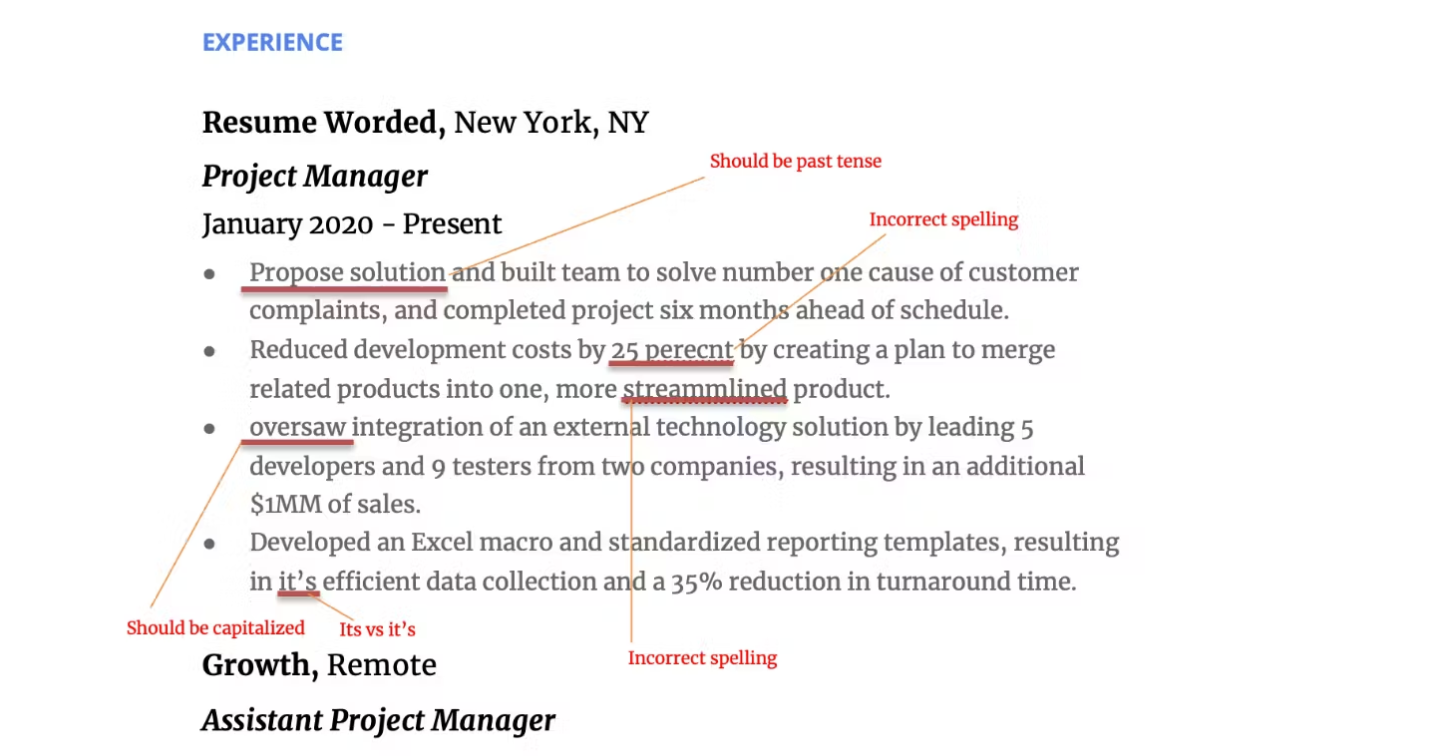
It might sound incredibly obvious, but spelling and grammar mistakes remain the number one reason hiring managers toss resumes aside. Recruiters view your application as a reflection of your best possible work.
Therefore, if your most polished document contains typos, employers assume your everyday work lacks care. Even a single misplaced comma or using “their” instead of “there” ruins your chances.
Furthermore, relying solely on automated spell-checkers creates a dangerous game. Software often misses context, meaning a correctly spelled word might still represent the wrong choice for your sentence. Always read your document out loud or have a trusted friend review it before hitting subm
Formatting Resume Mistakes Recruiters Notice

When a hiring manager opens your file, the visual presentation makes the very first impression. If a massive wall of text, tiny margins, and five different fonts greet them, they will likely move on.
A cluttered layout overwhelms the reader and makes finding key information impossible. Moreover, overly creative designs with graphics or charts can actually harm your chances.
Many companies use Applicant Tracking Systems (ATS) to parse your data. Consequently, complex formatting confuses the software, which results in a blank or scrambled profile on the recruiter’s end. Keep it clean, use standard fonts like Arial or Calibri, and embrace white space. Learn more about passing these digital filters in our ATS optimization guide.
Listing Vague Duties Instead of Measurable Achievements
One of the most common resume mistakes recruiters notice is treating the document like a generic job description. Simply listing your daily tasks does not tell an employer how well you performed them.
For instance, stating that you “managed a team” is far less impactful than saying you “directed a team of 15 employees, increasing departmental productivity by 20% over six months.”
Whenever possible, you must quantify your impact. Use numbers, percentages, and dollar amounts to give your achievements concrete context. This shift transforms you from a passive employee into a proactive problem-solver.
Failing to Tailor the Resume to the Job Description
Sending the exact same document to fifty different companies guarantees low response rates. Hiring managers easily spot a generic, one-size-fits-all resume.
When you fail to align your skills with the specific requirements of the job posting, the recruiter assumes you lack genuine interest in the role. Therefore, you must take the time to mirror the language the job description uses.
If the company wants a “project management expert,” do not just list “organized tasks” on your page. Adjust your terminology to match theirs. This small effort impresses human readers and helps you score highly in automated ATS screenings.
FAQ SECTION
What common resume mistakes do recruiters spot?
Recruiters are trained to spot a variety of common resume mistakes almost instantly, and these errors often dictate whether a candidate moves forward. First and foremost, they notice unprofessional email addresses. Using a quirky or outdated email provider immediately signals a lack of professional maturity. You should always use a simple variation of your first and last name.
Another glaring mistake is the inclusion of an outdated “Objective Statement.” Telling a company what you want from them is no longer standard practice. Instead, recruiters look for a “Professional Summary” that highlights the value you bring to their organization.
Additionally, inconsistent formatting stands out like a sore thumb. If your first job title is bolded, but your second one is italicized, it shows poor attention to detail. Missing employment dates or unexplained gaps in work history also raise immediate red flags. Hiring managers want a clear, logical timeline of your career progression. Ultimately, any element that forces the recruiter to guess or work hard to understand your background is considered a major mistake.
What is the 7 second rule in resume?
The 7-second rule refers to the shockingly brief amount of time a recruiter spends looking at a resume before deciding whether to keep it or reject it. Studies utilizing eye-tracking technology have shown that hiring managers scan resumes in an “F-pattern.” This means they read across the top, scan down the left side, and read across the middle.
Because of this incredibly tight timeframe, your document must be optimized for immediate impact. During those crucial seven seconds, recruiters are not reading your paragraphs; they are hunting for specific data points. They look for your current job title, your current company, your employment dates, and your educational background.
If these key elements are buried beneath dense paragraphs or hidden by confusing formatting, the recruiter will simply move on to the next candidate. To survive the 7-second rule, you must ensure that your most impressive and relevant qualifications are positioned prominently at the top of the page. Use clear headings, bold text for job titles, and bullet points to make your document as scannable and user-friendly as possible.
Why do some resumes get ignored quickly?
Resumes get ignored quickly primarily because they fail to communicate immediate relevance to the open position. When a recruiter opens a file and sees a dense, jargon-filled document that doesn’t align with the job description, they lose interest. They are looking for a solution to their company’s problem, and if your resume doesn’t look like that solution at first glance, it gets skipped.
Another major reason for quick dismissal is visual fatigue. Hiring managers review hundreds of applications a week. If a resume features tiny fonts, zero margins, and massive blocks of text, it causes instant cognitive overload. The reader simply doesn’t have the energy to sift through the clutter to find your skills.
Furthermore, resumes that focus too heavily on irrelevant past experiences are often ignored. For example, if you are applying for a senior marketing role, devoting half a page to your college job as a barista is a waste of valuable real estate. Resumes must be highly curated marketing documents, not exhaustive autobiographies. If the content isn’t strictly tailored to the target role, the application will inevitably land in the rejection pile.
What resume mistakes cause automatic rejection?
Automatic rejection often happens before a human being even sees your application, primarily due to Applicant Tracking System (ATS) failures. The most common mistake here is submitting your resume in an incompatible file format. If the system asks for a Word document or a PDF, but you submit an image file, the ATS cannot read your text, resulting in immediate disqualification.
Beyond software filters, glaring human errors lead to instant rejection. Lying or heavily exaggerating your credentials is a massive mistake. Background checks and targeted interview questions will eventually expose the truth, destroying your professional reputation.
Applying for roles where you possess absolutely none of the required qualifications is another guaranteed rejection. While you don’t need to meet 100% of the criteria, applying to be a software engineer when your only background is in retail sales shows a lack of self-awareness. Finally, saving your document with a careless file name—like “Resume_Final_v4_Updated.pdf”—looks incredibly sloppy. Always save your file as “Firstname_Lastname_Resume.pdf” to maintain a polished, professional image from the very start.
What are the 5 golden rules of resume writing?
The 5 golden rules of resume writing provide a foolproof framework for creating a winning application. Rule one: Tailor every single resume. Never send a generic document; always modify your keywords and bullet points to directly mirror the specific job description you are targeting.
Rule two: Focus on achievements, not just responsibilities. Employers don’t just want to know what you did; they want to know how well you did it. Always quantify your successes using metrics, percentages, and tangible results.
Rule three: Keep it concise and highly readable. For most professionals, a one to two-page resume is perfectly sufficient. Use ample white space, clear section headings, and short bullet points to ensure the document is easy to skim.
Rule four: Ensure flawless spelling and grammar. A single typo can destroy your credibility. Proofread your work multiple times and utilize tools like Grammarly, but always perform a manual read-through.
Rule five: Be honest and authentic. Never stretch the truth about your employment dates, job titles, or technical skills. Building your application on a foundation of honesty ensures you can confidently speak to your experiences during the interview process.
CONCLUSION
Navigating the job hunt can be a stressful experience, but understanding the inner workings of the recruitment process gives you a massive advantage. By recognizing the critical resume mistakes recruiters notice, you can transform your application from a simple piece of paper into a powerful marketing tool.
Remember, your goal is to make the hiring manager’s job as easy as possible. You must eliminate the clutter, banish typos, and present a clean, scannable document. Furthermore, always prioritize concrete, measurable achievements over vague lists of daily duties. When you show exactly how you added value in the past, employers can easily visualize the value you will bring to their team in the future.
Ultimately, your resume is the key that unlocks the interview door. It requires time, strategy, and meticulous attention to detail. Therefore, take a step back and review your current document with a highly critical eye.
Are you making it easy for ATS software to read? Are your best achievements front and center? Fix these common errors today, and you will dramatically increase your chances of standing out in a crowded market and securing the job you truly deserve.
To take your preparation even further and learn how to perform confidently in interviews, check out this detailed guide on how to interview like a pro and improve your chances of landing the job.
How to interview like a pro tips you must know