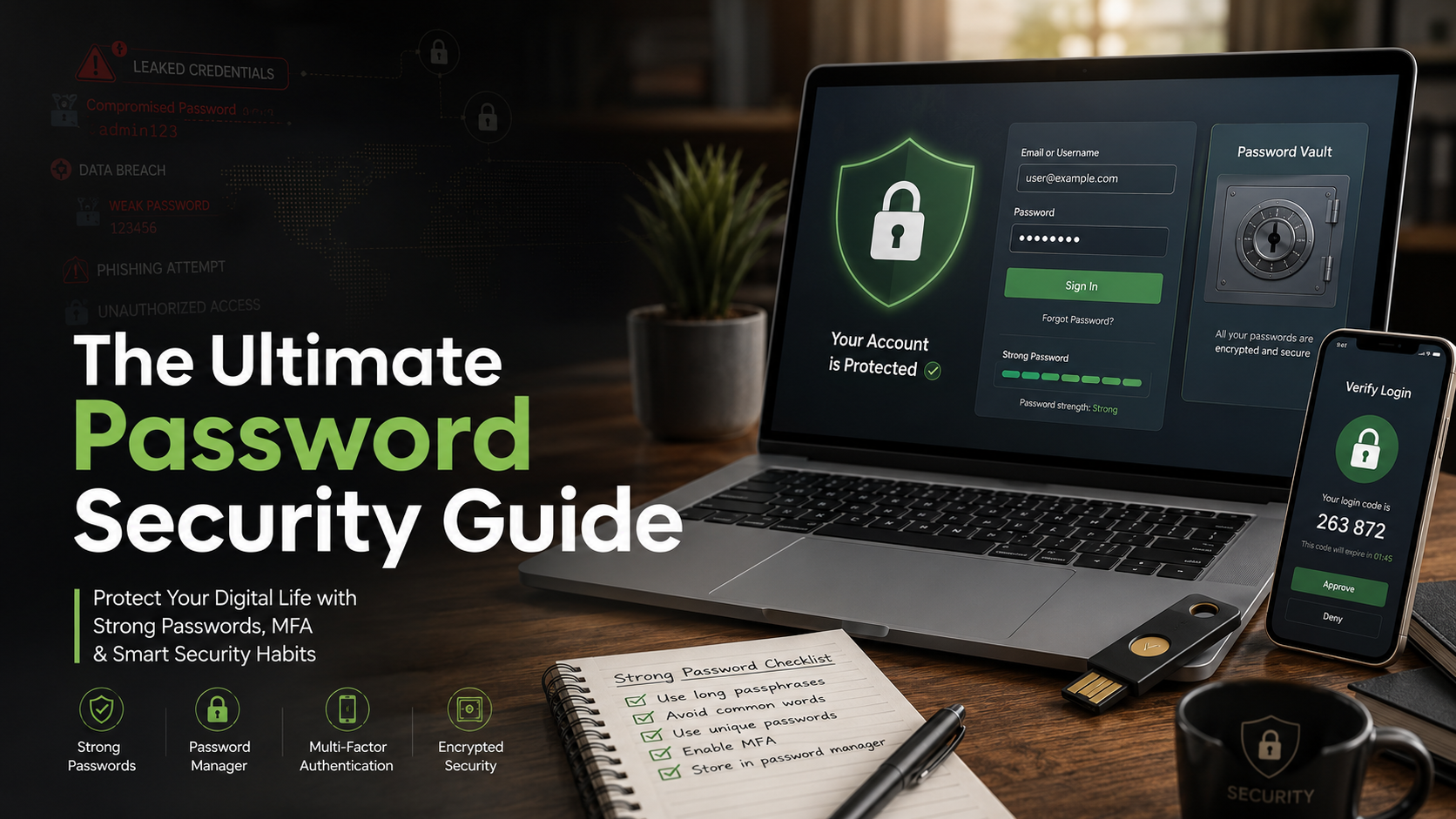
The Ultimate Password Security Guide: How to Safeguard Your Digital Life
In today’s connected digital world, protecting your online accounts is no longer optional. A strong password security guide helps you understand how to defend your personal information against cyberattacks, data breaches, and identity theft.
Every time you sign in to an online service, you share sensitive information through digital networks. Without proper protection, attackers can exploit weak passwords and gain access to personal, financial, or confidential data.
Modern security practices focus on creating strong authentication habits. Organizations such as the National Institute of Standards and Technology (NIST) recommend using secure authentication methods to reduce unauthorized access risks.
Cybercriminals no longer rely only on manual password guessing. They use automated tools to identify weak passwords, test stolen credentials, and exploit reused login details.
Many users still create simple passwords or repeat the same password across multiple accounts. This creates a major security weakness. If one website suffers a breach, attackers may use those leaked credentials to access email accounts, banking services, and social platforms.
This password security guide also covers practical security habits that help users protect accounts, manage credentials safely, and reduce online risks.
Password Security Guide: Understanding Modern Security Threats
Cyber threats have become more advanced over time. Attackers now use automated systems that can test millions of password combinations quickly. Understanding these methods helps you create stronger protection strategies.
Weak passwords often fail because they follow predictable patterns. Common words, personal information, and repeated login details make accounts easier to compromise.
Some of the most common password attacks include:
- Credential stuffing: Attackers use stolen username and password combinations from previous breaches. They test these credentials across multiple websites because many users reuse passwords.
- Phishing attacks: Criminals create fake emails, messages, or websites to trick users into revealing login details.
- Brute-force attacks: Automated programs attempt every possible password combination until they discover the correct one.
- Dictionary attacks: Attack tools test common words, phrases, and predictable character replacements often used in weak passwords.
These attacks show why traditional password habits are no longer enough. A short password with minor changes, such as adding numbers or symbols, may still be vulnerable.
Strong account protection requires longer passwords, unique credentials, and additional security layers. Understanding attacker methods is the first step toward building a safer digital environment.
The Mechanics of Credential Theft
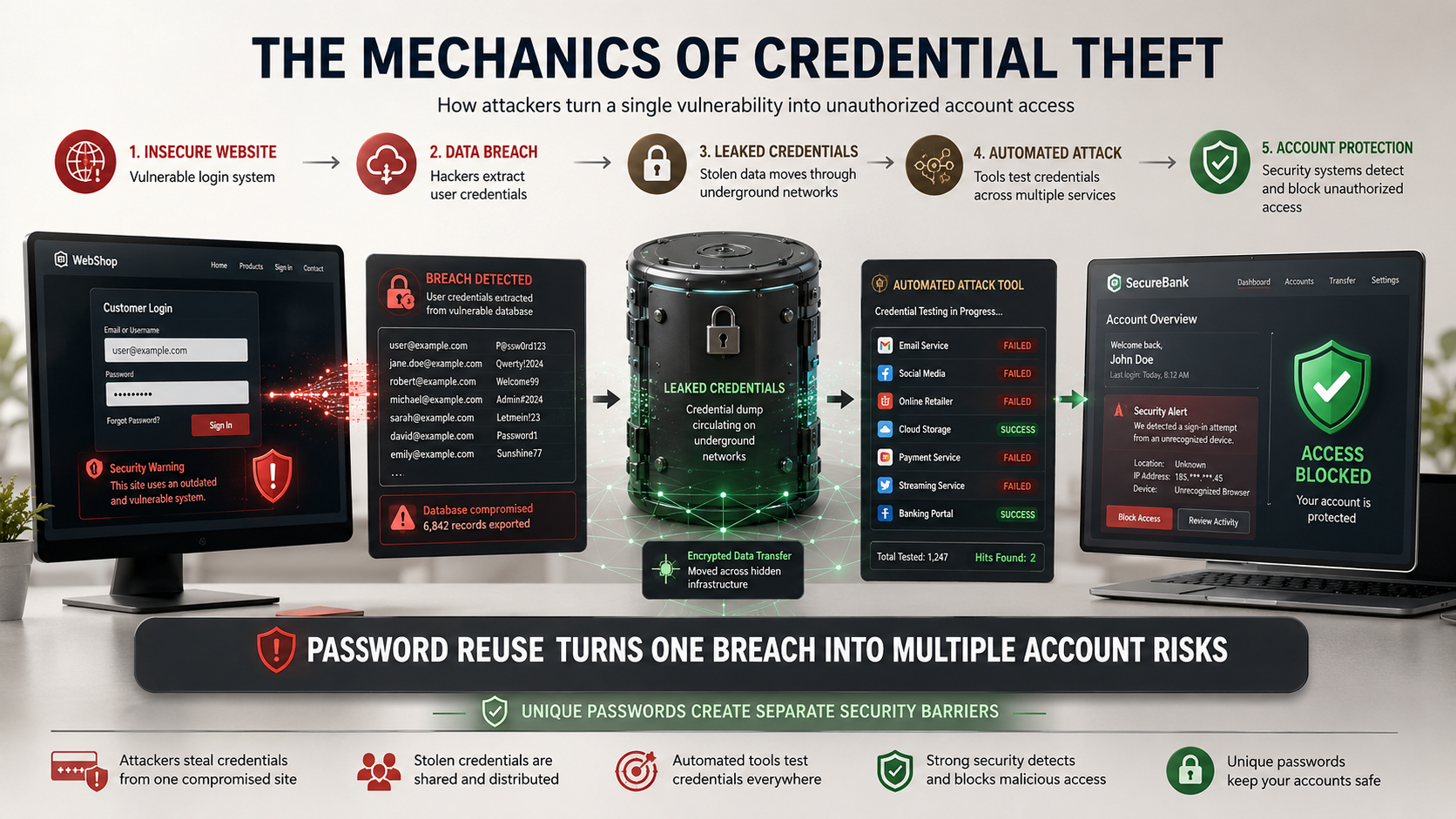
Password theft often begins with a data breach. When a company experiences a security incident, attackers may obtain stored usernames, email addresses, and password information.
Criminal groups can sell or share stolen credentials through illegal marketplaces and private networks. Attackers then use these details to target other services.
The biggest problem occurs when users reuse the same password across multiple platforms. A breach on a small website can create a chain reaction that affects important accounts.
For example, if an attacker discovers your reused password from an unrelated website, they may attempt to access your email account. From there, they could reset passwords for banking, shopping, or social media accounts.
A unique password for every account limits this damage. If one service becomes compromised, your other accounts remain protected.
A secure password strategy creates separate security barriers around each digital account.
Password Security Guide: Core Rules for Creating Strong Passwords
Creating secure login credentials requires changing outdated password habits. Many older recommendations focused on short passwords with complex symbols. Modern security guidance places greater importance on password length and uniqueness.
A strong password should be difficult for computers to guess but practical for users to manage.
The best approach combines long passphrases, password managers, and multi-factor authentication. These methods create stronger protection without making everyday account access difficult.
Length Over Complexity
Password length plays a major role in security strength. A longer password creates more possible combinations, making automated attacks significantly harder.
Short passwords with symbols and numbers may appear secure, but predictable patterns are often easy for attackers to identify.
For stronger protection:
- Use passwords with at least 16 characters.
- Avoid personal information such as names, birthdays, or locations.
- Create unique passwords for every account.
- Use random combinations rather than familiar phrases.
Long passphrases provide better protection because they increase the number of possible combinations attackers must test.
The Power of Passphrases
Passphrases combine multiple unrelated words into a longer password. They are easier for people to remember and harder for automated tools to crack.
For example:
Weak password: P@ssword123!
This password looks complex but follows common patterns.
Strong passphrase: correct-horse-battery-staple
A strong passphrase uses random words rather than predictable phrases, quotes, or common expressions.
Avoid famous sayings and repeated word combinations. Attack tools often include these patterns in their databases.