
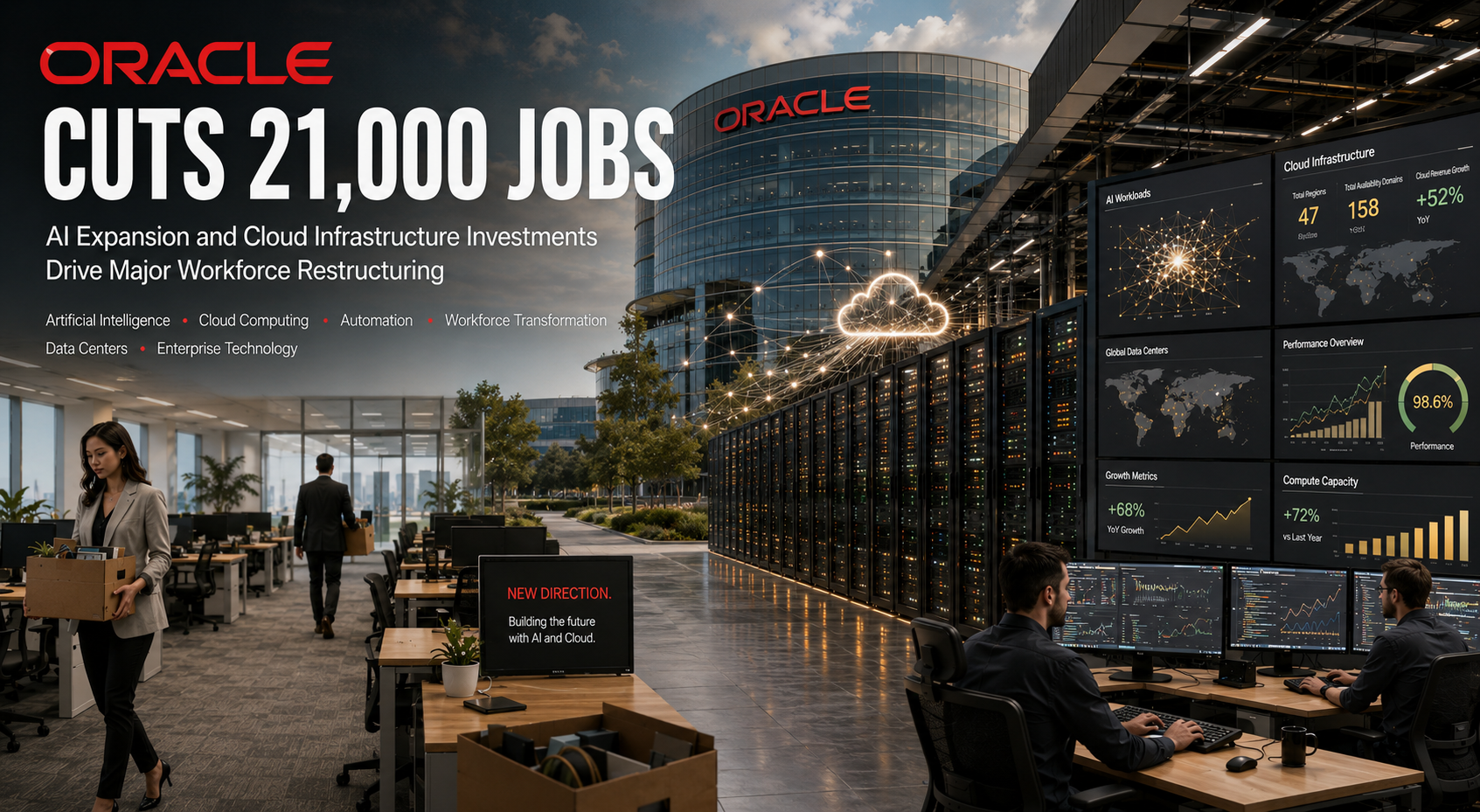
Oracle Cuts 21000 Jobs: AI Expansion Drives Massive Workforce Reduction
Oracle cuts 21000 jobs in what is being described as one of the most significant workforce restructurings in the technology sector. The company disclosed a substantial reduction in employee headcount as part of a broader strategic transformation focused on artificial intelligence, cloud computing, and infrastructure expansion. The layoffs represent a major shift in how large technology companies are allocating resources as competition in the AI market intensifies.
Key factors behind the restructuring include:
- Increased investment in artificial intelligence infrastructure
- Expansion of cloud computing capabilities
- Growing demand for automated business solutions
- Pressure to improve operational efficiency
The workforce reduction comes at a time when enterprise technology companies are investing billions of dollars into AI infrastructure, advanced computing systems, and large-scale data center projects. As organizations race to meet growing demand for artificial intelligence services, many are reviewing operating costs and reallocating capital toward high-priority growth initiatives.
For Oracle, the decision reflects a long-term strategy centered on strengthening its position in cloud infrastructure and AI services. While the layoffs affect thousands of employees worldwide, company leadership views the move as part of a broader effort to improve operational efficiency and support future business growth.
Furthermore, the restructuring comes amid a wider trend of workforce changes across the technology sector. According to a recent report from the BBC covering major AI-driven workforce transformations, companies are increasingly balancing employee costs with growing investments in artificial intelligence infrastructure and automation technologies. Readers can learn more about this broader industry trend in this BBC analysis.


Why Oracle Cuts 21000 Jobs Amid Rising AI Investments
The decision that Oracle cuts 21000 jobs appears closely linked to the company’s aggressive investment strategy in artificial intelligence and cloud infrastructure. Across the technology industry, organizations are directing enormous financial resources toward building data centers, purchasing advanced computing hardware, and developing AI-powered products and services.
Artificial intelligence projects require substantial capital expenditures. Companies must invest in:
- High-performance computing systems
- Advanced AI processors
- Cloud infrastructure
- Data storage solutions
- Cybersecurity platforms
- AI development tools
These investments can cost billions of dollars over multiple years, creating pressure to optimize spending in other areas of the business.
Oracle has been actively expanding its cloud infrastructure offerings to compete with leading cloud providers. As demand for AI-related computing power continues to increase, the company is focusing heavily on scaling its infrastructure capabilities.
This strategic shift has resulted in a reassessment of staffing needs across various departments, including:
- Traditional software operations
- Support functions
- Business services
- Administrative roles
Industry experts note that workforce restructuring has become a common trend among technology firms pursuing AI transformation. While layoffs reduce operational costs in the short term, companies hope that automation, productivity improvements, and AI-enabled systems will generate long-term efficiencies.
Impact of Oracle Cuts 21000 Jobs Across Business Units
The impact of Oracle cuts 21000 jobs extends across multiple departments and geographic regions. Rather than targeting a single division, the restructuring appears to affect a broad range of business functions.
Major areas impacted include:
- Sales and marketing teams
- Research and development departments
- Customer support operations
- Administrative functions
- Regional business units
Sales and marketing teams often experience significant changes during large-scale corporate transformations because companies increasingly rely on automation tools, digital engagement platforms, and AI-assisted customer relationship management systems.
These technologies can help businesses:
- Automate repetitive tasks
- Improve customer communication
- Analyze market trends faster
- Reduce manual workloads
Research and development functions may also be affected as organizations shift priorities toward projects that directly support artificial intelligence and cloud infrastructure objectives.
At the same time, specialized technical positions remain in high demand, especially roles involving:
- Machine learning
- Data engineering
- Cloud architecture
- Cybersecurity
- AI development
The layoffs have implications for employees, local economies, and the broader technology labor market. Workers affected by restructuring efforts may face challenges transitioning into new roles, while employers seek talent with increasingly specialized AI-related skills.
How Artificial Intelligence Is Reshaping the Technology Workforce
The fact that Oracle cuts 21000 jobs highlights a larger transformation occurring throughout the global technology industry. Artificial intelligence is changing how businesses operate, manage resources, and deliver products and services.
AI systems are increasingly being used for:
- Data analysis
- Customer service automation
- Software testing
- Business forecasting
- Workflow management
- Content creation
While automation can increase efficiency, it also changes the skills employers prioritize when hiring and retaining employees.
The growing emphasis on AI has created strong demand for professionals with expertise in:
- Artificial intelligence development
- Cloud computing
- Data science
- Machine learning
- Infrastructure engineering
Employees who develop these skills are often better positioned to adapt to evolving workplace requirements.
However, concerns remain about:
- Job displacement
- Workforce disruption
- Skills gaps
- Employee retraining needs
Policymakers, business leaders, and educational institutions continue to debate how organizations can balance technological innovation with workforce stability.
Oracle’s restructuring serves as a high-profile example of how AI adoption is influencing employment decisions across major corporations.
Financial Implications of Oracle Cuts 21000 Jobs
Large-scale layoffs typically involve significant financial costs before organizations realize long-term savings. Workforce reductions can create immediate expenses related to:
- Severance payments
- Employee benefits
- Legal requirements
- Restructuring programs
- Operational adjustments
Despite these upfront costs, businesses often pursue restructuring initiatives to:
- Improve efficiency
- Reduce recurring expenses
- Redirect investment toward growth areas
- Strengthen competitive positioning
In Oracle’s case, resources may be increasingly focused on:
- Cloud infrastructure expansion
- AI-related development
- Data center investments
- Enterprise technology solutions
Investors frequently evaluate restructuring announcements based on their potential impact on:
- Profit margins
- Revenue growth
- Innovation capacity
- Market competitiveness
Some market participants view workforce reductions as a sign that management is taking proactive steps to improve financial performance. Others raise concerns about possible impacts on employee morale, customer service, and long-term innovation.
The long-term success of any restructuring effort depends on whether the organization can achieve its strategic objectives while maintaining operational excellence.
Risks and Challenges Following Oracle Cuts 21000 Jobs
Although workforce reductions can improve efficiency, they also introduce significant operational risks. When organizations reduce staffing levels, they may lose:
- Institutional knowledge
- Technical expertise
- Experienced employees
- Customer relationships
Employee morale is another important consideration. Remaining workers may experience uncertainty about future organizational changes, which can affect:
- Engagement
- Productivity
- Retention
- Workplace confidence
Maintaining clear communication and providing support during periods of transition is often critical to minimizing disruption.
Customer service and product quality can also be affected if workforce reductions occur too quickly or without sufficient planning.
Companies must ensure:
- Essential teams remain properly staffed
- Critical knowledge is transferred
- Customers continue receiving quality support
- Business operations remain stable
The decision that Oracle cuts 21000 jobs demonstrates the complex balance companies face when pursuing transformation initiatives.
While leadership may anticipate long-term benefits from increased efficiency and AI adoption, the transition period can present considerable challenges. Successfully managing these risks will play an important role in determining whether the company’s strategic objectives are achieved.
Frequently Asked Questions
What Does Oracle Exactly Do?
Oracle is a global technology corporation that specializes in enterprise software, cloud computing, and database management systems. Most notably, the company is known for its Oracle Database platform, which enables businesses to securely store, organize, and retrieve massive amounts of information. As a result, many of the world’s largest organizations rely on Oracle’s technology to support critical business operations.
In addition to databases, Oracle develops a wide range of enterprise applications. For example, the company offers enterprise resource planning (ERP) software that helps organizations manage finances, human resources, procurement, and operations. Furthermore, Oracle provides customer relationship management (CRM) solutions that assist businesses in improving customer engagement and sales performance. Similarly, its supply chain management tools help companies optimize logistics, inventory management, and production planning.
Over the past several years, Oracle has increasingly focused on cloud computing. Specifically, Oracle Cloud Infrastructure (OCI) provides businesses with computing power, storage, networking, and artificial intelligence capabilities through cloud-based services. Moreover, companies can use OCI to host applications, process large datasets, and run advanced AI workloads.
Additionally, Oracle serves customers across industries such as healthcare, finance, retail, manufacturing, telecommunications, and government. Consequently, the company has become one of the most influential enterprise technology providers in the world. Overall, Oracle’s mission is to help organizations manage data more efficiently, improve productivity, and accelerate digital transformation through innovative software and cloud solutions.
Is Oracle Laying Off 30,000 Employees?
No, Oracle has not officially confirmed layoffs of 30,000 employees. However, speculation about significantly larger workforce reductions circulated earlier in the year through industry reports, analyst discussions, and employee posts on social media platforms. As a result, many observers believed the total number of job cuts could eventually approach 30,000 positions worldwide.
According to the company’s reported workforce figures, Oracle reduced its global employee count substantially during the most recent fiscal year. Nevertheless, the reported reduction was closer to 21,000 positions rather than the widely rumored 30,000. Consequently, Oracle’s total workforce declined from approximately 162,000 employees to around 141,000 employees globally. Although the final figure is lower than initial speculation, it still represents a major corporate restructuring affecting thousands of workers across multiple regions and business units.
Furthermore, the workforce reduction reflects broader changes occurring throughout the technology sector as companies invest heavily in artificial intelligence, cloud infrastructure, and automation technologies. In addition, many organizations are reevaluating staffing requirements while redirecting resources toward strategic growth initiatives.
Therefore, while Oracle has not announced 30,000 layoffs, the reported reduction of approximately 21,000 jobs remains one of the largest workforce restructurings in the company’s history. Overall, the situation highlights how rapidly evolving technology priorities are reshaping employment trends across the global tech industry.
Is Oracle a Big 4 Company?
No, Oracle is not considered a “Big 4” company. In fact, the term “Big 4” has a very specific meaning in the business world and refers exclusively to the four largest professional services and accounting firms: Deloitte, Ernst & Young (EY), KPMG, and PricewaterhouseCoopers (PwC). These organizations primarily provide audit, tax, consulting, risk management, and advisory services to businesses, governments, and institutions worldwide.
Oracle, on the other hand, operates in an entirely different industry. Specifically, Oracle is a global technology company that focuses on enterprise software, cloud computing, database management systems, and artificial intelligence infrastructure. Furthermore, Oracle is best known for its database technology, enterprise applications, and cloud services that help organizations manage business operations and digital transformation initiatives.
Although Oracle is not part of the Big 4 accounting firms, it remains one of the largest and most influential technology companies in the world. Moreover, Oracle competes with major technology providers such as Microsoft, Amazon, and Google in areas such as cloud infrastructure, enterprise software, and AI services. Additionally, many Fortune 500 companies rely on Oracle products to manage databases, financial systems, supply chains, and customer relationships.
Therefore, while Oracle is not classified as a Big 4 company, it is widely recognized as a leading enterprise technology provider with a significant global presence. Overall, Oracle occupies a prominent position in the software and cloud computing industry rather than the accounting and consulting sector.
Is Oracle Bigger Than JPMorgan Chase?
No, Oracle is generally not considered bigger than JPMorgan Chase when comparing key business metrics such as revenue, assets, employee count, and overall financial scale. Although Oracle is one of the world’s largest enterprise software and cloud computing companies, JPMorgan Chase operates on a much larger scale as a global banking and financial services institution.
To begin with, JPMorgan Chase serves millions of consumers, businesses, governments, and institutional clients across numerous countries. As a result, the bank manages trillions of dollars in assets and processes enormous volumes of financial transactions every day. Furthermore, JPMorgan Chase consistently ranks among the largest financial institutions in the world by total assets, market value, and profitability.
Oracle, meanwhile, is a technology company that specializes in database software, cloud infrastructure, enterprise applications, and artificial intelligence services. While Oracle generates tens of billions of dollars in annual revenue and serves thousands of organizations worldwide, its business model differs significantly from that of a global banking giant. Additionally, Oracle’s workforce is substantially smaller than JPMorgan Chase’s employee base.
However, the comparison depends on the metric being used. For example, Oracle is larger and more influential within the enterprise software industry than JPMorgan Chase because the bank does not primarily operate as a technology provider. Conversely, JPMorgan Chase is much larger in terms of total assets, revenue generation, workforce size, and overall financial reach.
Therefore, when evaluating overall corporate scale, JPMorgan Chase is generally considered the larger organization. Nevertheless, Oracle remains one of the most powerful companies in the global technology sector and continues to play a critical role in cloud computing, database management, and enterprise software solutions used by businesses around the world.
Why Are Tech Companies Doing Layoffs While Making Record Profits?
Many technology companies are announcing layoffs despite reporting strong profits and revenue growth. At first glance, this may seem surprising. However, these job cuts are often part of a broader business strategy rather than a response to financial problems.
One major reason is the rapid rise of artificial intelligence. Companies are investing billions of dollars in AI infrastructure, data centers, cloud computing, and advanced chips. Consequently, executives are reallocating resources to support these expensive initiatives. As a result, some departments experience workforce reductions while AI-focused teams continue to grow.
Furthermore, many tech firms expanded rapidly during the pandemic and hired thousands of employees to meet increased demand. However, as growth rates normalized, companies began reassessing staffing levels and operational costs. Therefore, layoffs are often viewed as a way to improve efficiency and maintain profitability.
Additionally, automation is helping organizations streamline routine tasks, reducing the need for certain roles. Ultimately, many layoffs reflect a shift toward AI-driven business models rather than financial weakness. Companies are prioritizing long-term competitiveness while adapting to changing technology and market demands.
Conclusion
The news that Oracle cuts 21,000 jobs serves as a landmark case study for the modern workplace, signaling a profound transformation in how the technology sector manages human capital. By explicitly stating in regulatory documents that internal AI deployment is actively shrinking its headcount, Oracle has turned a long-standing industry prediction into a tangible corporate reality. The company is wagering its future on an aggressive, debt-financed $70 billion infrastructure expansion, betting that automated efficiency can successfully replace traditional human corporate roles without sacrificing enterprise product quality.
For the broader workforce, this historic restructuring emphasizes the critical need for continuous technical upskilling. As corporate strategies continue to favor autonomous systems over traditional labor to protect margins, professionals must adapt to working alongside advanced automated systems. The ultimate takeaway is clear: the integration of artificial intelligence is no longer just a tool for future optimization, but an active catalyst rewriting the rules of corporate employment today.
As technology continues to transform the job market, students and professionals should focus on exploring future-ready career paths and building skills that remain valuable in an AI-driven economy. Students looking for guidance on choosing the right career direction after science education can explore different opportunities and options after 12th Science without NEET or JEE to better prepare for the evolving workforce.