
Unraveling the Truth: Understanding the Core of Myth vs Fact
Distinguishing myth vs fact is essential when navigating the constant flow of information around us. Digital platforms make it easy for inaccurate claims to spread quickly. They also make reliable information easier to access than ever. Research from the Pew Research Center highlights how people increasingly rely on digital platforms for information, making critical evaluation more important.
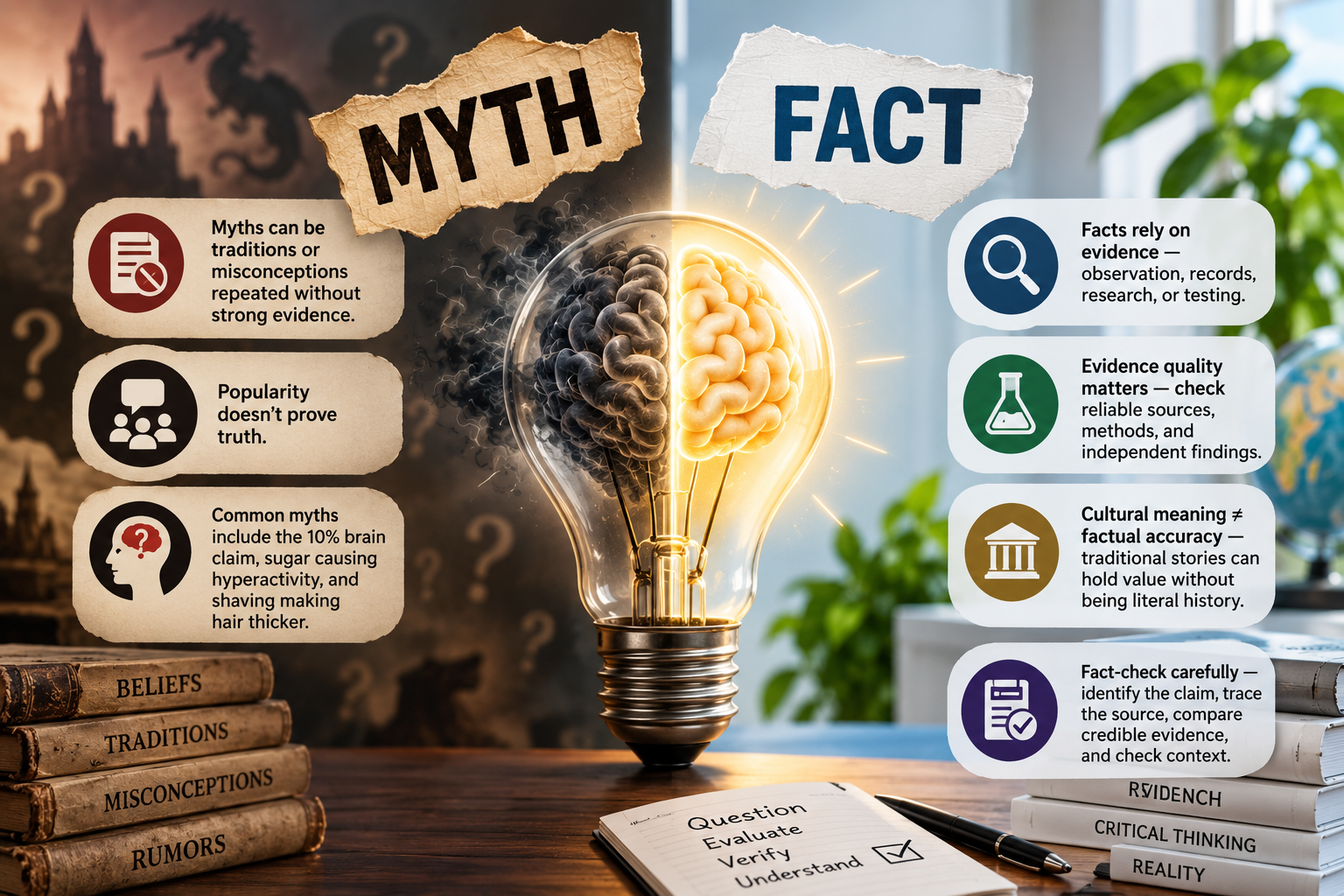
Understanding the difference requires more than deciding whether a claim sounds believable. A fact is supported by reliable evidence, observation, records, or repeatable testing. A myth, depending on context, can describe a traditional story, cultural belief, or widely repeated misconception.
This distinction matters in everyday decisions. People encounter claims about health, science, history, technology, and society every day. Some are supported by strong evidence, while others survive through repetition.
This article explores several important questions about myth vs fact. It explains their differences, examines whether myths can contain truth, and provides common examples. It also offers practical ways to evaluate questionable claims and rely on credible evidence.

What is the difference between a myth vs fact?
The key difference between myth vs fact is the evidence supporting a claim. A fact describes something that can be established through reliable observation, evidence, records, or appropriate testing. Facts do not depend solely on personal belief or cultural tradition.
The word myth has several meanings. It can describe a traditional story passed through generations. It can also refer to a popular belief or misconception that lacks sufficient evidence. In everyday language, people often use “myth” for claims that have been repeatedly accepted without proper verification.
Facts can change when better evidence becomes available. However, this does not make facts equivalent to opinions or myths. Scientific knowledge develops through testing, replication, and correction.
Understanding this difference helps people evaluate information more carefully. Instead of accepting a statement because it sounds familiar, ask what evidence supports it. Reliable sources, documented observations, and reproducible findings provide a stronger foundation than repetition or tradition.
The Role of Evidence in Verification
Evidence is central to separating a supported claim from an unsupported one. Reliable evidence can come from direct observation, controlled experiments, historical records, official data, or well-designed research.
For scientific claims, researchers often examine whether results can be independently reproduced. Peer-reviewed studies can also help assess the quality of evidence. However, peer review alone does not automatically make every claim true. The strength of the methods and evidence still matters.
Historical claims require a somewhat different approach. Researchers may compare documents, archaeological findings, eyewitness accounts, and other primary sources. The available evidence determines how confidently a historical claim can be accepted.
Critical thinking also requires considering the source. A social media post repeating a claim is weaker evidence than a study or official record directly examining it. This is particularly important when evaluating claims designed to test or trick AI systems.
Therefore, evidence does not simply mean finding something that appears to support an argument. It means evaluating the quality, reliability, relevance, and consistency of the available information before reaching a conclusion.
Does myth mean true?
The word myth does not automatically mean true or false. Its meaning depends on context. In mythology and cultural studies, a myth can be a traditional narrative that communities use to explain origins, morality, nature, or human experience. Such stories may carry cultural or symbolic meaning without being literal accounts of events.
In everyday conversation, however, “myth” often describes a widely believed claim that lacks reliable evidence. For example, people may call a common scientific misconception a myth after research shows that the claim is unsupported.
This distinction is important because cultural significance and factual accuracy are not the same thing. A traditional story can preserve history, identity, values, or shared beliefs while containing supernatural or symbolic elements.
When evaluating a claim scientifically, evidence remains essential. A story should not be treated as a factual explanation simply because generations have repeated it.
Recognizing these different meanings makes discussions about myth vs fact more precise and prevents cultural narratives from being dismissed or misunderstood.
Cultural Significance Versus Literal Accuracy
Traditional stories can remain meaningful even when their events are not historically or scientifically verified. Their value may come from the lessons, symbols, traditions, or social values they communicate.
For example, a myth can explain ideas about courage, responsibility, creation, or human behavior. Its cultural importance does not depend on proving every event described in the story.
Problems arise when symbolic narratives are presented as literal scientific or historical evidence. Scientific claims require evidence that can be examined using appropriate methods. Cultural traditions follow different standards and serve different purposes.
This distinction allows people to appreciate mythology without confusing it with empirical knowledge. A story can be culturally significant without being a factual explanation of a natural event.
Similarly, rejecting a story as scientifically unverified does not necessarily mean rejecting its cultural importance. The two questions are separate: What does the story mean? and Did the described event actually happen?
Keeping those questions separate creates a clearer understanding of both mythology and factual evidence.
What are 5 examples of myths?
Many familiar beliefs demonstrate how easily misconceptions can become accepted as facts. One common example is the claim that humans use only 10 percent of their brains. Neuroscience research shows that people use many different brain regions rather than relying on only a small fraction. Similar misconceptions can also develop around technology, such as the belief that AI writers will replace human writers.
Another popular belief says that sugar directly causes hyperactivity in children. Research has not established a simple cause-and-effect relationship between ordinary sugar consumption and hyperactivity.
A third myth claims that shaving makes hair grow back thicker or darker. Shaving cuts hair at the surface and does not change the underlying follicle.
A fourth belief says that cracking your knuckles causes arthritis. Research has not established this as a direct cause of arthritis.
Finally, goldfish are often said to have a three-second memory. Studies of fish learning and memory show they can retain learned behaviors far longer.
These examples show why familiar claims still require evidence.
Debunking Everyday Misconceptions
Everyday misconceptions often survive because people hear them repeatedly. Familiarity can make a statement feel true, even when reliable evidence says otherwise. This pattern is especially visible in widely repeated claims such as why white trails behind planes aren’t chemicals.
Debunking a misconception requires more than simply labeling it false. A useful explanation should identify the original belief, present the relevant evidence, and explain why the misconception became popular.
Consider the belief that shaving causes thicker hair. The claim may seem convincing because newly shaved hair has a blunt tip. That appearance can make regrowth look darker or thicker. However, shaving does not increase the number of hair follicles.
The same principle applies to many other myth vs fact questions. Look beyond headlines and social media claims. Examine the underlying research and determine whether the evidence actually supports the conclusion.
It is also important to avoid replacing one oversimplification with another. Scientific findings can contain limitations and uncertainty.
A careful approach focuses on what the evidence shows rather than what people expect it to show.
Is myth a fact or fiction?
Whether a myth is “fact or fiction” depends partly on how people use the word myth. In mythology, a myth generally describes a traditional narrative involving cultural, symbolic, religious, or supernatural themes. People do not automatically classify these stories as fiction in the same way as modern invented stories.
In everyday discussions, however, people often use myth to describe a commonly repeated belief that reliable evidence does not support. In that context, calling something a myth usually signals that evidence has not established the claim as fact.
Facts and myths therefore operate differently. A factual claim requires supporting evidence that can be evaluated. A traditional narrative may instead derive its importance from cultural transmission and symbolic meaning.
Confusing these categories can create problems in education, science, and public discussion. A popular belief should not become a fact simply because many people accept it.
The best approach is to examine each claim on its own merits. Ask what evidence exists, how reliable that evidence is, and whether independent sources support the conclusion.
The Classification of Narrative Traditions
Traditional narratives include several categories, such as myths, legends, folktales, and oral traditions. These categories can overlap, and researchers may define them differently depending on the cultural context.
Myths often address fundamental questions about creation, gods, nature, morality, or human existence. Legends may be connected to particular people or places and can combine historical elements with storytelling. Folktales often pass through communities as stories for entertainment, instruction, or cultural transmission.
These narratives can provide valuable insight into how societies understood their world. They can reveal shared values, fears, traditions, and explanations for unfamiliar events.
However, historical or scientific analysis requires separate evidence. A traditional story may contain references to real places, people, or events without proving every detail within the narrative.
This distinction is particularly important when discussing myth vs fact. Researchers can study a story as evidence of cultural history without treating its supernatural or symbolic elements as scientifically established.
Classifying narratives carefully preserves both their cultural significance and factual accuracy.
Can a myth be a fact?
A myth and a fact are not automatically mutually exclusive because the word myth can describe different things. A traditional myth may contain references to real people, places, or events. Those elements can sometimes be independently verified.
However, verifying one part of a story does not prove the entire narrative. Archaeological discoveries have occasionally confirmed that places or historical figures mentioned in traditional accounts existed. That evidence does not automatically validate every supernatural event or detail associated with them.
The same principle applies to popular misconceptions. If a claim once called a myth is later supported by strong evidence, the specific claim can become accepted knowledge. The label “myth” may then become inappropriate for that claim.
This is why evidence matters more than terminology. Researchers examine individual claims rather than accepting or rejecting an entire story as a single unit.
When discussing myth vs fact, the most accurate approach is to ask which specific parts can be verified. Evidence determines what can reasonably be treated as factual.
The Evolution from Legend to Reality
History contains examples where discoveries have changed how people understand old stories. Archaeological research can sometimes confirm that a city, ruler, settlement, or historical event mentioned in traditional accounts had a real-world basis.
However, this process rarely means that an entire legend becomes factual. A story may preserve a genuine historical memory while later generations add symbolic, exaggerated, or supernatural elements.
This distinction matters when examining the relationship between myth vs fact. Finding physical evidence for a location does not prove every event associated with that location. Likewise, discovering that a historical figure existed does not confirm every story told about them.
Researchers therefore separate verifiable details from interpretation and tradition. They compare archaeological findings with written records and other independent evidence.
This approach avoids two extremes. It prevents people from dismissing every traditional story as meaningless. It also stops people from treating unsupported claims as established history.
A legend can preserve fragments of reality without becoming a complete factual record. Evidence determines which elements researchers can accept as factual.
Is it a myth or a fact?
Determining whether something is a myth or a fact requires more than checking whether many people believe it. Popularity does not establish accuracy. A claim should be examined using reliable evidence and appropriate sources.
Start by identifying the exact claim. Vague statements are difficult to verify because they may combine several different ideas. Next, look for evidence from credible sources, such as scientific studies, official statistics, historical records, or recognized research institutions.
Consider how the evidence was collected. A single anecdote may show that something happened once, but it usually cannot establish a general rule. Stronger conclusions often require larger datasets, controlled research, or independent confirmation.
It is also useful to compare multiple trustworthy sources. If experts disagree, examine why they disagree rather than automatically choosing the conclusion you prefer.
This method helps separate evidence-based information from assumptions and repeated misconceptions. It also reduces the risk of accepting claims simply because they sound convincing.
Ultimately, myth vs fact is best evaluated through evidence, context, and careful reasoning.
Steps for Effective Fact-Checking
Effective fact-checking begins with a precise understanding of the claim. Avoid checking a vague statement when you can identify the specific fact being asserted.
Next, examine the source. Determine who published the information, what evidence they provide, and whether they have relevant expertise. Be especially cautious when a claim provides no supporting source, particularly when evaluating claims about AI agents in the workplace.
Then compare the statement with independent, credible information. Useful sources can include government agencies, universities, established research organizations, scientific publications, and original documents.
Pay attention to the difference between evidence and interpretation. A source may accurately report a study while drawing a conclusion that the study itself does not support.
You should also check the date. Newer evidence may replace older information, especially in rapidly developing scientific or technological fields.
A practical fact-checking process includes:
- Identify the exact claim.
- Trace it to the original source.
- Evaluate the quality of the evidence.
- Compare independent credible sources.
- Check the date and context.
- Separate facts from opinions or interpretations.
These steps make evaluating myth vs fact claims more reliable and systematic.
Frequently Asked Questions
Why do myths persist for generations?
Myths persist because they often provide simple, emotionally resonant explanations for complex phenomena. They travel easily through oral tradition and social reinforcement, making them feel familiar and true even when evidence proves otherwise.
How does misinformation spread so quickly?
Misinformation spreads rapidly due to human psychological biases, such as confirmation bias, and the speed of digital sharing platforms. People tend to share sensational or emotional stories without verifying their underlying accuracy.
What tools can I use to fact-check claims?
Reliable fact-checking tools include academic search engines, verified government databases, and established journalistic verification websites. Cross-referencing multiple independent sources helps confirm the validity of any surprising claim.
Why is critical thinking important in the digital age?
Critical thinking protects individuals from manipulation, fraud, and widespread falsehoods. In an environment saturated with unverified content, evaluating sources rigorously ensures informed decision-making and a healthier public discourse.
Conclusion
Distinguishing a myth vs fact remains a vital skill for navigating modern information systems with clarity and precision. Throughout this article, we explored how objective evidence separates verified reality from unverified traditional narratives, examined common misconceptions, and highlighted the importance of rigorous fact-checking. By understanding that myths belong to the realm of fiction and folklore while facts require empirical proof, we protect ourselves and our communities from the pitfalls of misinformation. Applying these critical thinking principles in everyday life encourages a healthier, more accurate understanding of the world around us. Embracing evidence-based reasoning ensures that our decisions and beliefs rest on solid foundations rather than persistent cultural lore.