

Listening Skills That Will Improve All of Your Relationships
Most conversations fail because people listen to reply rather than to understand. Learning listening skills that will improve all of your relationships can transform ordinary conversations into meaningful moments of connection. When you listen actively, you validate another person’s experience, reduce defensiveness, and build trust. These abilities also support the communication skills required in many careers, where clear listening and understanding are essential.
Misunderstandings often happen when we assume we already know what someone feels. Genuine listening requires patience, curiosity, and a pause in your own internal dialogue. It also requires attention to tone, body language, and emotional context. The American Psychological Association also highlights the importance of healthy communication in building stronger relationships.
These skills can help you communicate more effectively with partners, friends, family members, and coworkers. They can also make difficult conversations easier to manage.
This guide answers common questions about effective listening:
- What are 5 good listening skills?
- What are the 7 listening skills?
- How do we improve listening skills?
- What is listening in a relationship?
- How do I improve my listening skills in a relationship?
- What is the 7 7 7 rule for couples?
By practicing these habits consistently, you can reduce misunderstandings and create stronger, more respectful relationships.
What are 5 good listening skills?
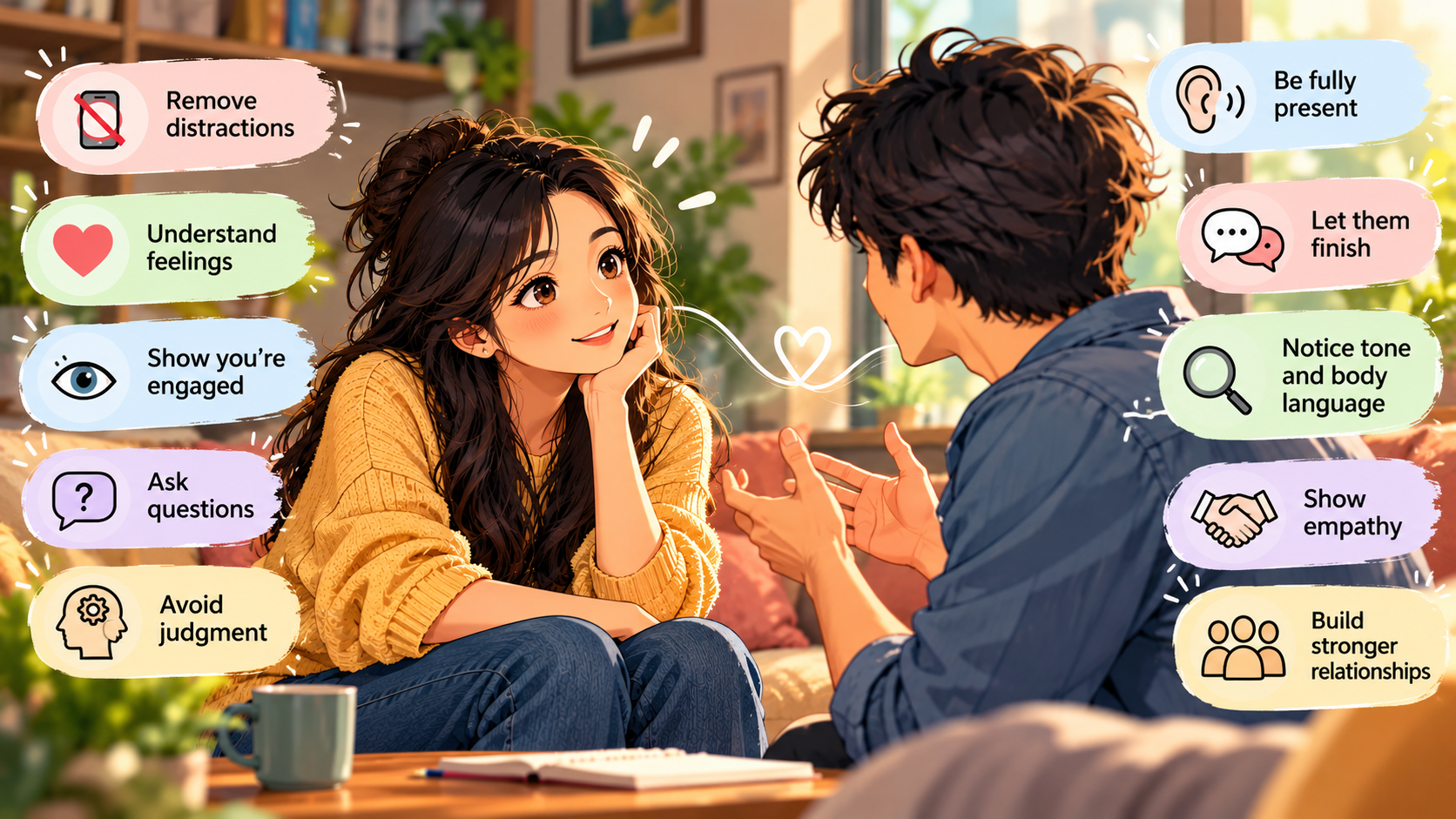
Five essential listening habits can strengthen everyday communication. First, practice active presence by removing distractions during important conversations. Put your phone away and give the speaker your full attention. Second, develop emotional empathy by noticing the feelings behind someone’s words. You do not need to agree with every feeling to acknowledge it. These abilities are examples of soft skills that complement technical skills, especially in workplaces where collaboration matters.
Third, use simple nonverbal signals. Nodding, maintaining appropriate eye contact, and keeping an open posture can show that you are engaged. Fourth, ask clarifying questions instead of making assumptions. Questions such as “What did you mean by that?” can prevent unnecessary misunderstandings.
Fifth, suspend judgment while someone is sharing their thoughts. Avoid preparing a defense before they finish speaking.
These listening skills that will improve all of your relationships work best when practiced consistently. They help people feel heard, respected, and understood. Over time, these habits can make conversations calmer and create greater emotional trust.
What are the 7 listening skills?
Seven listening approaches can help you respond appropriately in different communication situations. Informational listening focuses on understanding facts, instructions, or important details. Critical listening involves evaluating information and considering whether an argument is supported by evidence. Empathetic listening focuses on understanding another person’s emotions and perspective. These abilities can also contribute to the skills employers look for in graduates, particularly when employees need to communicate and work effectively with others.
Appreciative listening is used when you listen for enjoyment, such as during music or an engaging story. Relational listening helps strengthen personal connections by showing genuine interest in another person. Discriminative listening involves noticing differences in tone, volume, pauses, and other vocal cues.
The seventh approach is reflective listening, which involves restating or reflecting the speaker’s main message. This can confirm that you understood them correctly.
Not every conversation requires all seven approaches. The important skill is recognizing what the situation demands. A friend discussing a difficult experience may need empathy. A coworker explaining a task may need focused informational listening instead.
How do we improve listening skills?
Improving listening skills requires regular practice rather than simply learning communication techniques. Start by slowing down during conversations. Instead of planning your response while someone speaks, focus on understanding their complete message. This small change can make your conversations more attentive and productive. Consistent practice can also strengthen some of the most in-demand skills for jobs in 2026, particularly communication and collaboration.
Pay attention to your emotional reactions as well. Anger, embarrassment, or frustration can make you interrupt or become defensive. Notice these reactions without immediately acting on them. Give yourself a moment before responding.
Your body language also matters. Maintain comfortable eye contact, keep an open posture, and avoid repeatedly checking your phone. When something is unclear, ask a short question rather than guessing what the other person means.
Avoid interrupting unless it is necessary. Let the speaker finish before offering advice or sharing your own experience.
Developing listening skills that will improve all of your relationships takes patience. With consistent practice, you can become more attentive, reduce misunderstandings, and respond with greater emotional awareness.
What is listening in a relationship?
Listening in a relationship means giving your partner genuine attention instead of simply hearing their words. It involves trying to understand their thoughts, emotions, concerns, and perspective. Good relationship listening requires you to remain present, even when the conversation feels uncomfortable.
Pay attention to more than spoken words. Tone, pauses, facial expressions, and body language can provide useful context. However, avoid assuming you know what these signals mean. Ask questions when you need clarification.
Healthy listening also means creating emotional safety. Your partner should be able to share concerns without immediately facing criticism, dismissal, or defensiveness. You can acknowledge their feelings without automatically agreeing with their conclusions.
This approach becomes especially important during disagreements. Instead of preparing your counterargument, first make sure you understand the issue. You might say, “I want to understand what upset you.”
Consistent listening can strengthen trust and cooperation. It shows that your partner’s perspective matters. Over time, these listening skills that will improve all of your relationships can help create more respectful and connected communication.
Emotional Attunement Over Problem Solving
Couples often experience tension when one partner immediately offers solutions. The other person may simply want to feel understood first. Emotional attunement means paying attention to those feelings before rushing toward a solution.
For example, your partner may complain about a stressful day at work. Your first response might be to suggest a solution. Instead, try acknowledging the experience. You could say, “That sounds really frustrating.” This does not mean you agree with every detail. It shows that you heard the emotion behind the story.
After the person feels understood, you can ask whether they want advice. A simple question such as “Do you want me to listen, or would you like help finding a solution?” can prevent unnecessary tension.
Problem-solving still has an important place in relationships. Timing matters, though. Validation often needs to come before advice.
When couples balance empathy with practical support, difficult conversations can become less defensive and more collaborative.
How do I improve my listening skills in a relationship?
Start by creating small habits that protect focused communication with your partner. Put your phone away during dinner, important conversations, and moments when your partner needs emotional support. Removing distractions makes it easier to notice both words and nonverbal signals.
Try to understand your partner’s point before explaining your own. If something sounds unclear, ask a question instead of assuming their intention. You might say, “Can you help me understand what you mean?” This keeps the conversation open rather than defensive.
Reflecting back what you heard can also help. For example, you could say, “So you’re feeling ignored because we haven’t spent much time together.” Your partner can then correct you if you misunderstood.
Avoid interrupting, dismissing feelings, or immediately comparing their experience with your own. These habits can make people feel unheard. Similar communication habits are important in professional settings, particularly when developing effective leadership communication in the workplace, where listening and responding appropriately can affect collaboration.
Practicing listening skills that will improve all of your relationships requires consistency. You will not listen perfectly every time. The goal is to become more aware, correct mistakes, and keep improving how you communicate.
What is the 7 7 7 rule for couples?
The 7-7-7 rule is a popular relationship-maintenance framework that encourages couples to schedule regular quality time. The commonly described version suggests having a date every seven days, taking a weekend getaway every seven weeks, and planning a longer romantic vacation every seven months.
The idea is simple. Regularly scheduled time can help couples protect their connection despite work, household responsibilities, parenting, and other pressures. It can also create opportunities for uninterrupted conversation and shared experiences.
However, the 7-7-7 rule is not a universal relationship requirement. Couples have different schedules, budgets, responsibilities, and preferences. Following these exact intervals is not necessary for a healthy relationship.
You can adapt the idea to your circumstances. A weekly date could be a simple walk or dinner at home. A longer trip can happen when finances and schedules allow.
The most useful principle is intentional quality time. When couples consistently create opportunities to reconnect, they have more space to communicate, listen, and maintain emotional closeness.
Frequently Asked Questions
What is the difference between hearing and listening?
Hearing is an involuntary physiological process where the ears detect sound waves, requiring no conscious mental effort. Listening, by contrast, is an active psychological skill that demands focused attention, cognitive interpretation, and empathy. While anyone with functional hearing detects vocal sounds, only attentive listeners absorb meaning, decipher nuanced emotion, and build meaningful trust through their presence.
Why do people struggle with active listening?
Most people struggle with active listening because the human brain processes spoken words much faster than average speech rates. This cognitive gap tempts minds to wander, plan rebuttals, or check mobile notifications. Furthermore, emotional defensiveness, personal biases, and fatigue often lead individuals to interrupt rather than absorb what someone shares.
Can better listening skills resolve marital conflict?
Yes, attentive listening resolves marital tension by lowering personal defensiveness and diffusing escalating anger. When partners feel accurately heard and emotionally validated, they naturally abandon hostile strategies. Honest listening converts adversarial confrontations into cooperative problem-solving sessions, allowing couples to untangle complex grievances without damaging the underlying relational bond.
Conclusion
Transforming your daily conversations through intentional presence is one of the most rewarding investments you can make. When you consciously practice the listening skills that will improve all of your relationships, you replace miscommunication, resentment, and emotional distance with warmth, validation, and mutual safety. These fundamentals do not require complicated techniques; they simply demand your genuine curiosity, respectful silence, and a willingness to understand before seeking to be understood.
Whether you are engaging with a romantic partner, supporting a close friend, or collaborating with a coworker, how you listen defines how you love and respect others. Make the conscious choice today to put away your phone, quiet your internal monologue, and lean in to listen with an open heart.