
IP67 vs. IP68 Water Resistance Ratings: Everything You Need to Know
When shopping for a smartphone, fitness tracker, or outdoor gadget, you may notice an IP rating on the packaging. Understanding IP67 vs. IP68 water resistance ratings helps you choose the right level of protection for your device.
These ratings come from IEC 60529, the international standard for classifying the degrees of protection provided by electrical enclosures.
Many people assume an IP-rated device is completely waterproof. That is not the case. IP67 vs. IP68 water resistance ratings describe specific laboratory test conditions, not unlimited protection in every environment.
This guide explains what IP67 and IP68 mean, how they differ, and whether either rating is suitable for swimming. We will also cover water pressure, salt water, steam, warranties, and the higher IP69K rating.
By understanding these limits, you can better protect your smartphone, smartwatch, or other electronic device from accidental water exposure.

Is IP67 100% Waterproof?
No. IP67 does not mean a device is 100% waterproof. It means the enclosure meets a specific level of protection against dust and temporary water immersion.
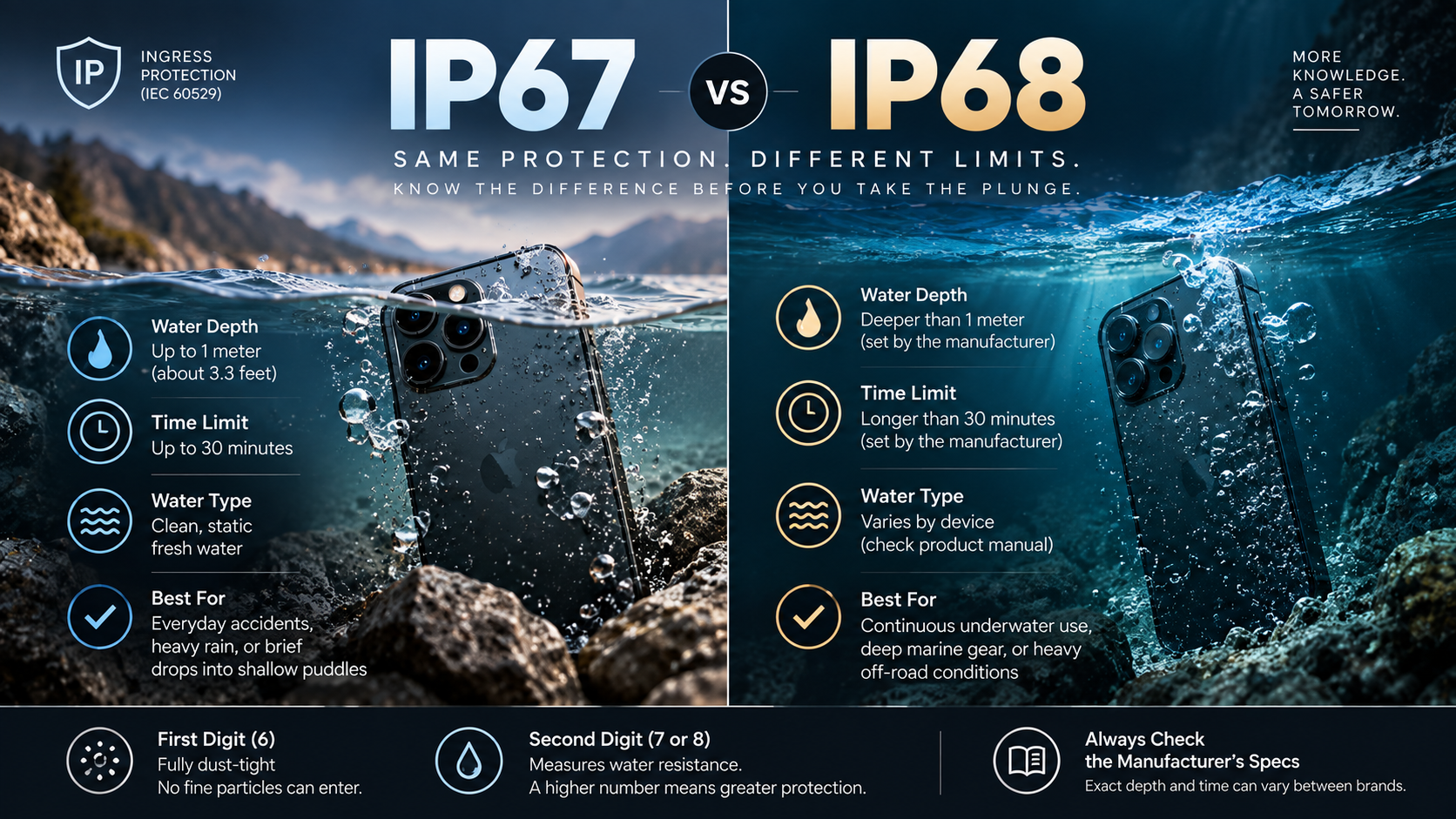
Under IEC 60529 testing, an IP67 enclosure must withstand immersion in water up to 1 meter deep for 30 minutes under defined test conditions. This does not mean the device can remain underwater indefinitely.
Real-world conditions can also differ from laboratory tests. Physical damage, worn seals, temperature changes, and normal aging may reduce water resistance over time.
IP67 protection is useful for everyday accidents. It can help protect against rain, splashes, spills, and an accidental drop into shallow water. However, it should not be treated as permission for regular underwater use.
When comparing IP67 vs. IP68 water resistance ratings, IP67 represents the lower immersion level. Its key characteristics include:
- IP6: Dust-tight protection.
- IP7: Protection against temporary immersion.
- 1 meter: Maximum test depth for the IP67 immersion test.
- 30 minutes: Maximum duration for that test.
For this reason, manufacturers generally recommend avoiding unnecessary water exposure, even with an IP67-rated product.
Why Water Pressure Can Affect IP67 Protection
IP67 testing does not represent every type of water exposure. The standard focuses on controlled immersion rather than every high-pressure or high-speed water situation.
A strong shower stream, water jet, or wave can create forces that differ from the conditions used during IP67 testing. This matters because water can enter through openings, seals, speaker meshes, or ports when exposed to pressure outside the tested conditions.
However, it is inaccurate to assume that any strong water stream will automatically defeat an IP67 device. The actual risk depends on the device design and the manufacturer’s specifications.
The safest approach is to treat the rating as a defined protection limit, not a guarantee against every form of water exposure. This is an important point when comparing IP67 vs. IP68 water resistance ratings.
Avoid deliberately exposing an IP67 device to:
- High-pressure water jets
- Powerful waves
- Extended underwater use
- Hot water or steam
- Salt water or chemically treated water
These environments can introduce risks that the basic IP67 rating does not address. If your device will regularly face demanding conditions, check its specific manufacturer guidance before use.
Is IP68 100% Waterproof?
No. IP68 is not the same as being completely waterproof. It provides a higher level of protection against immersion than IP67, but it still applies to specific test conditions.
IP68 means the enclosure can withstand continuous immersion beyond 1 meter under conditions specified by the manufacturer. Unlike IP67, the IEC standard does not define one universal maximum depth and duration for every IP68 product.
A manufacturer may certify one device for 1.5 meters, while another may specify a greater depth. The exact limits should always be checked in the product documentation.
IP68 devices can provide excellent protection against accidental drops, rain, and temporary immersion. However, the rating does not guarantee protection during swimming, diving, or exposure to every type of liquid.
Water resistance can also change after physical damage or prolonged use. Seals may weaken with age, while repairs or drops can affect enclosure integrity. This is worth considering alongside other common smartphone mistakes that reduce battery life, especially when evaluating the overall condition of an older device.
Therefore, IP68 means stronger tested water protection, not unlimited waterproofing. This is the main reason IP67 vs. IP68 water resistance ratings should be compared using the manufacturer’s stated depth and duration.
Salt Water and Chemical Exposure Dangers
IP ratings do not automatically mean a device is safe in every type of liquid. Salt water, chlorine, soap, and other chemicals can create additional risks for electronic devices.
Salt water is especially concerning because salt can remain on surfaces and electrical contacts after the water evaporates. Over time, residue may contribute to corrosion. Chlorinated pool water and other chemicals may also affect materials, seals, or adhesives.
This does not mean every IP68 device will immediately fail after brief exposure. Some manufacturers provide specific guidance for pool or salt-water contact. Always follow the instructions supplied with your particular device.
If an IP-rated device does come into contact with salt water or chemicals, follow the manufacturer’s cleaning instructions. Do not assume that an IP68 rating makes the device suitable for regular marine use.
For greater protection during water activities, consider a dedicated waterproof case designed for that environment. A case can provide an additional barrier beyond the device’s built-in IP protection.
When researching IP67 vs. IP68 water resistance ratings, remember that neither rating automatically covers salt water, chlorine, soap, or other liquids. The device’s specific care instructions remain important.
Is There a Higher Waterproof Rating Than IP68?
Yes. IP69K provides a different and more demanding type of water protection than IP68. However, it is important to understand that IP69K is not simply a “higher IP68” rating.
IP68 focuses on protection against continuous immersion under manufacturer-specified conditions. IP69K is designed to test resistance against high-pressure, high-temperature water jets.
This makes IP69K particularly useful for industrial equipment exposed to frequent washdowns. Applications can include food-processing machinery, agricultural equipment, vehicles, and other rugged systems.
IP69K testing uses powerful water jets at high temperatures. The exact test requirements are defined by the applicable standard and test setup. They are far more demanding than ordinary consumer-device water exposure.
Some modern rugged devices advertise both IP68 and IP69K protection. In that case, the two ratings cover different environmental challenges.
The important distinction is simple:
- IP67: Temporary immersion up to 1 meter.
- IP68: Continuous immersion beyond 1 meter under specified conditions.
- IP69K: Protection against high-pressure, high-temperature water jets.
When comparing IP67 vs. IP68 water resistance ratings, it is also useful to understand that IP69K addresses a different type of water exposure. A higher number does not mean every type of water protection is automatically covered.
Industrial Uses for IP69K Hardware
IP69K protection is especially valuable where equipment faces repeated cleaning, pressure washing, or harsh environmental conditions. Industrial systems may need to operate reliably after exposure to powerful water jets and elevated temperatures.
Common applications include:
- Agricultural machinery
- Food-processing equipment
- Industrial control systems
- Commercial vehicles
- Construction equipment
- Pharmaceutical manufacturing equipment
These environments can expose electronics to conditions far beyond normal consumer use. Regular washdowns may involve high-pressure water and elevated temperatures.
IP69K testing is designed around these demanding conditions. The test uses multiple high-pressure water jets directed at the enclosure from defined positions. Water is delivered at a high temperature and pressure according to the applicable test requirements.
However, IP69K should not be interpreted as protection against every environmental hazard. It primarily addresses the specific ingress test involved.
For consumers, IP69K is rarely necessary for everyday smartphones. IP68 is generally more relevant when evaluating mainstream phones and wearables. Rugged industrial equipment, however, may benefit greatly from the additional high-pressure washdown protection that IP69K provides.
Understanding this distinction also prevents confusion when researching IP67 vs. IP68 water resistance ratings. These consumer-focused ratings address immersion, while IP69K focuses on powerful water jets.
What Level of Waterproofing Is IP68?
IP68 represents a high level of protection against dust and continuous water immersion. The “6” means the enclosure is dust-tight, while the “8” indicates protection against continuous immersion under manufacturer-specified conditions.
The important point is that IP68 does not establish one universal depth for every product. Manufacturers determine and publish the specific immersion conditions their devices meet.
For example, one smartphone may be rated for a particular depth and duration, while another IP68 device may have different limits. You should therefore check the official specifications instead of assuming every IP68 device offers identical protection.
IP68 can be useful when accidental immersion is a concern. It may help protect against situations such as dropping a device into a sink or puddle.
However, IP68 does not automatically make a device suitable for swimming or diving. Water movement, chemicals, temperature, and physical wear can all affect performance.
Think of IP68 as tested resistance under defined conditions, rather than a universal waterproof guarantee. This distinction is essential when comparing IP67 vs. IP68 water resistance ratings for smartphones, smartwatches, cameras, and other electronics.
Manufacturer Discretion in IP68 Specifications
The IEC 60529 framework allows manufacturers to specify the exact conditions for an IP68 rating beyond the minimum requirements. This means two devices with the same IP68 certification can have different immersion limits.
One product might specify a relatively shallow depth. Another might advertise protection at a greater depth for a stated period. These specifications are product-specific and should never be assumed from the IP68 label alone.
Before buying a device, check:
- The manufacturer’s stated maximum depth
- The specified immersion duration
- Whether the rating applies to fresh water
- Any warnings about pools or salt water
- Whether water resistance changes after repair or damage
This information is usually available in the product specifications or user manual.
It is also worth remembering that an IP test reflects the condition of the device during testing. A phone that has been dropped, opened for repair, or exposed to heavy wear may not provide the same level of protection later.
For the most accurate answer, always use the manufacturer’s official IP68 specifications for your exact model. This is especially important when comparing products based on IP67 vs. IP68 water resistance ratings, because the IP68 depth and duration can vary between devices.
Which Is Better: IP67 or IP68?
When comparing IP67 vs. IP68 water resistance ratings, IP68 generally offers greater protection against immersion. Both ratings provide the same highest level of dust protection because the first digit is 6.
The main difference is water immersion. IP67 covers temporary immersion up to 1 meter under the standard test conditions. IP68 covers continuous immersion beyond 1 meter under manufacturer-defined conditions.
This makes IP68 the better choice if accidental deeper immersion is a realistic possibility. It can provide additional protection when a phone falls into a deeper sink, bathtub, or other body of water.
However, IP68 does not automatically make a device better for every water-related activity. Neither rating should be treated as a guarantee for swimming, diving, or prolonged exposure to chemicals.
The right choice depends on how you use the device:
- IP67: Suitable for many everyday splash and shallow-immersion risks.
- IP68: Better when deeper or longer immersion protection is important.
- IP69K: Better suited to high-pressure, high-temperature washdown environments.
Always compare the manufacturer’s detailed specifications before making a purchase. The best option depends on your environment, usage habits, and the manufacturer’s stated limits.
Choosing Between Ratings for Daily Use
For many everyday users, IP67 may provide enough protection. If your main concerns are rain, accidental spills, or a brief drop into shallow water, the rating can offer useful peace of mind.
IP68 becomes more attractive when your routine creates a higher chance of accidental immersion. Frequent travelers, outdoor users, runners, and people who spend time around water may prefer the additional protection.
However, the number alone should not determine your purchase. Check the exact depth and duration specified by the manufacturer. Also consider whether the device has been repaired or physically damaged. You should also consider how to speed up your Android phone if performance is another concern when choosing whether to replace an older device.
If you regularly participate in water-based activities, built-in IP protection may not be enough. A purpose-designed waterproof case can provide an additional layer of protection.
A simple way to compare the two ratings is:
- Choose IP67 for everyday splash and shallow-immersion protection.
- Choose IP68 when deeper immersion protection matters.
- Choose additional waterproof protection for regular swimming or underwater use.
Ultimately, IP67 vs. IP68 water resistance ratings should be evaluated according to your real-world needs. The best rating is the one that matches your actual environment and usage habits.
Frequently Asked Questions
Does an IP Rating Mean I Can Swim With My Phone?
No. An IP rating does not automatically mean you can swim with your phone. IP67 and IP68 ratings describe performance under defined laboratory conditions. They do not guarantee protection during swimming, diving, or other water sports.
Swimming creates movement and changing water pressure. Devices may also encounter chlorine, salt, soap, and other substances. These factors can differ significantly from the controlled conditions used for certification.
Manufacturers may also provide specific warnings against swimming or submerging their products. Always check the instructions for your exact model.
If you plan to use a device underwater, look for equipment specifically designed and certified for that purpose. A suitable waterproof housing can also provide extra protection.
For ordinary smartphones, the safest approach is to treat IP67 vs. IP68 water resistance ratings as information about tested protection. Neither rating should be viewed as an invitation to swim with the device.
Remember that water resistance may decline after drops, repairs, or prolonged use. Even a device that performed well when new may become more vulnerable later.
Does Smartphone Warranty Cover Water Damage on IP68 Devices?
Usually, a standard smartphone warranty does not automatically cover liquid damage, even when the phone has an IP68 rating. The exact terms depend on the manufacturer, region, warranty plan, and device.
An IP rating describes the conditions under which a product passed its ingress-protection testing. It does not necessarily create a warranty promise covering every type of liquid exposure.
Many smartphones also contain Liquid Contact Indicators (LCIs). These indicators can help service technicians determine whether the device has been exposed to liquid.
Warranty policies can vary significantly. Some manufacturers may offer separate protection plans that address accidental or liquid damage. Others may specifically exclude liquid-related failures from their standard warranty.
Before relying on an IP68 rating, check the warranty documentation for your specific device. Also review the manufacturer’s water-resistance warnings. If you are comparing devices before buying, factors such as iPhone or Android for students may also influence which model best suits your needs.
The key distinction is simple: water resistance is a product feature, while warranty coverage is a contractual policy. Understanding this difference is just as important as comparing IP67 vs. IP68 water resistance ratings before buying a device.
How Does Steam Affect IP67 and IP68 Water Resistance?
Steam and high temperatures can create risks that ordinary water exposure does not. An IP67 or IP68 rating does not automatically mean a device is safe in a sauna, steam room, or hot shower.
High temperatures can affect adhesives, seals, and other materials used in an enclosure. Condensation can also form when warm moisture reaches cooler internal surfaces.
This is why many manufacturers specifically advise users to avoid exposing water-resistant devices to steam, hot water, and extreme temperatures. The warning is important even when the device carries an IP67 or IP68 rating.
Steam should therefore be treated differently from ordinary accidental splashes. The certification does not cover every possible combination of temperature, pressure, and moisture.
If your device is exposed to steam or hot moisture, follow the manufacturer’s care instructions. Avoid charging the device until you are certain the charging port is dry.
Most importantly, do not assume that an IP68 smartphone is suitable for use in a hot shower or sauna. Water resistance and heat resistance are separate considerations, regardless of the advertised IP rating.
Can Water Resistance Degrade Over Time on Older Devices?
Yes. Water resistance can decrease as a device ages. IP testing reflects the condition of the enclosure under controlled test conditions. It does not guarantee that the same protection will remain unchanged for the entire product lifespan.
Daily wear can affect seals and other components. Drops, cracks, repairs, chassis flexing, and repeated temperature changes may also compromise enclosure integrity. If your phone has suffered physical damage, you should also understand the risks of using a cracked screen protector before relying on its water resistance.
Manufacturers often warn that water resistance is not permanent. The exact rate of degradation varies by product and usage, so there is no universal period when protection suddenly disappears.
An older device may still resist water effectively. However, you should be more cautious if it has experienced physical damage or has been opened for repair.
To reduce risk:
- Keep the device away from unnecessary water exposure.
- Inspect it for cracks or physical damage.
- Follow the manufacturer’s cleaning instructions.
- Avoid relying on water resistance after major repairs.
- Use additional protection for high-risk water activities.
An IP rating is best viewed as a protective feature, not permanent insurance against liquid damage. This remains an important consideration when evaluating IP67 vs. IP68 water resistance ratings on older devices.
Conclusion
Understanding IP67 vs. IP68 water resistance ratings can help you make smarter decisions when buying and using electronic devices. Both ratings provide strong dust protection, but their immersion capabilities differ.
IP67 protects against temporary immersion up to 1 meter under defined test conditions. IP68 provides continuous immersion protection beyond 1 meter, but the exact depth and duration depend on the manufacturer’s specifications.
Neither rating means a device is completely waterproof. Real-world factors such as physical damage, aging, temperature, water movement, salt, and chemicals can affect water resistance.
For everyday spills, rain, and accidental shallow immersion, IP67 may provide sufficient protection. IP68 offers a higher level of immersion protection and can be preferable when deeper accidental submersion is possible.
If you regularly swim or use electronics around salt water, chlorine, or high-pressure water, consider additional protection. A purpose-built waterproof case may offer a safer solution.
Ultimately, IP67 vs. IP68 water resistance ratings should be treated as tested protection levels, not guarantees of unlimited waterproofing. Always check your device’s official specifications and warranty terms before exposing it to water.