

How to Manage a Difficult Class: Practical Strategies That Work
Walking into a room full of disruptive students can test even the most dedicated educator. When chatter drowns out instructions, teaching can quickly become exhausting. Learning how to manage a difficult class is important for academic progress and teacher well-being. Research from the Institute of Education Sciences (IES) highlights evidence-based classroom management practices that can help teachers maintain a focused, positive learning environment.
Discipline problems do not automatically mean you are a bad teacher. They often show that your classroom needs clearer routines, stronger boundaries, or more targeted support. Evidence-based guidance also emphasizes teaching and reinforcing expectations, maintaining predictable routines, and actively engaging students to reduce problem behaviors.
In this guide, you will find practical answers to common classroom management challenges. We explain how to regain control of an unruly classroom and explore the 5 C’s of classroom management. You will also learn about the 70/30 teaching rule, practical classroom management tips, and effective intervention strategies.
The goal is not to control every student through punishment. Instead, effective management creates predictable routines, encourages positive behavior, and keeps students focused on learning.
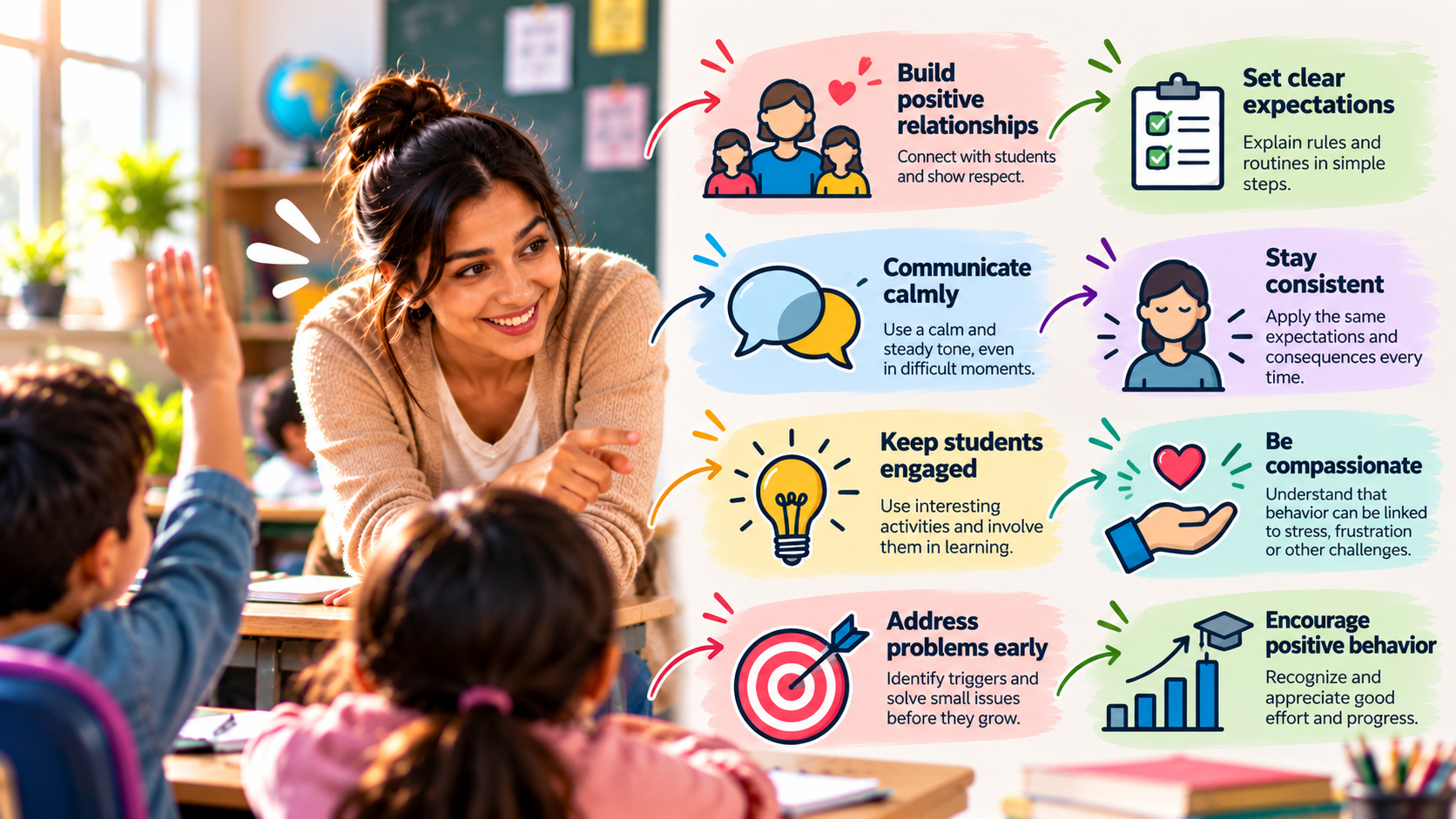

How to handle a very difficult class?
Handling a severely disruptive class starts with an objective reset. Avoid turning misbehavior into a public power struggle. Arguing with students in front of their classmates can encourage further attention-seeking behavior. Instead, use calm strategies such as proximity control, quiet signals, and private conversations. These approaches are also covered in classroom behavior management strategies.
If the class becomes consistently noisy, pause the lesson and reteach the expected behavior. Explain what students should do, when they should do it, and what happens when expectations are ignored. Avoid shouting over students because it can make the situation more stressful.
When learning how to manage a difficult class, consistency matters more than harsh punishment. Apply reasonable consequences calmly and predictably. Give students opportunities to correct their behavior without embarrassing them.
It can also help to identify what triggers repeated disruption. Boredom, unclear instructions, difficult work, peer conflict, or frustration can all contribute to challenging behavior. Addressing the underlying issue can make classroom management more effective.
De-escalating Tension Through Calm Consistency
When tension rises, your response can influence the entire classroom. Lower your voice instead of competing with students for volume. A calm, steady tone can encourage students to listen without making the situation more confrontational.
Use brief instructions and avoid sarcasm, threats, or public arguments. If a student continues disrupting the lesson, speak privately whenever possible. Explain the behavior you observed, remind the student of the expectation, and state the next reasonable consequence.
Recognize cooperation as soon as you see it. A simple acknowledgment can reinforce the behavior you want without interrupting the lesson. For example, you might say, “Thank you for getting started.”
Calm consistency also means following through. Do not announce consequences that you will not enforce. At the same time, avoid escalating a minor problem into a major confrontation.
The goal is to reduce tension while maintaining clear boundaries. Students should understand that expectations remain firm, even when the teacher stays calm.
What are the 5 C’s of classroom management?
The 5 C’s of classroom management provide a practical framework for creating a predictable and supportive learning environment. They are Connection, Consistency, Clarity, Calmness, and Compassion.
Connection means building positive relationships with students before problems occur. Students are more likely to respond constructively when they feel respected and understood. Giving students meaningful choice in learning can also help strengthen their sense of involvement and ownership.
Consistency means applying classroom expectations reliably. Rules should not change based on your mood or which student breaks them.
Clarity ensures students understand exactly what you expect. Explain procedures for transitions, group work, questions, assignments, and classroom movement.
Calmness helps teachers respond thoughtfully during difficult situations. A controlled response can prevent a small disruption from becoming a larger conflict.
Compassion recognizes that behavior can sometimes reflect frustration, learning difficulties, stress, or problems outside the classroom.
Together, these principles create structure without relying entirely on punishment. They can help challenging students understand boundaries while still feeling respected and supported.
What is the 70/30 rule in teaching?
The 70/30 rule in teaching generally describes a classroom structure where students spend about 70% of the lesson actively participating, while the teacher uses roughly 30% for direct instruction. It is better understood as a flexible guideline rather than a strict formula.
Long lectures can make some students lose focus, especially when lessons require little interaction. A difficult class may become harder to manage when students spend too much time passively listening.
Instead, keep direct instruction focused and purposeful. Use short explanations before moving students into activities such as problem-solving, reading, writing, discussion, or independent practice. For technology-supported activities, teachers can also explore STEM tools for modern classrooms that encourage hands-on participation.
The active portion of the lesson should still have clear expectations. Simply giving students more freedom does not automatically improve behavior. They need specific tasks, time limits, and clear outcomes.
When students are actively working, teachers can circulate, answer questions, check progress, and redirect off-task behavior. This approach can reduce unstructured downtime.
The main principle is simple: increase meaningful student participation while keeping teacher explanations focused and purposeful.
Maximizing Engagement During Active Student Time
Active learning works best when students know exactly what they need to accomplish. Instead of saying, “Work with your partner,” provide a specific task and a clear completion time.
Break longer activities into smaller stages when a class struggles with focus. For example, students might spend three minutes reading, three minutes discussing, and three minutes writing their response.
Give each activity a visible outcome. This could be a written answer, a completed problem, a short summary, or a response that students must share. Clear outcomes also make it easier to end class with effective wrap-up strategies that reinforce what students learned.
Move around the classroom while students work. Your physical presence can discourage distractions while allowing you to provide quick support. Avoid standing at the front for the entire activity.
Watch for students who finish early because unstructured time can quickly lead to disruption. Prepare an extension task when appropriate.
The purpose of active learning is not simply to keep students busy. Every activity should connect to the lesson objective. When students understand what they are doing and why it matters, engagement becomes easier to maintain.
What are 10 tips for good classroom management?
Effective classroom management usually comes from small practices applied consistently. The following 10 classroom management tips can help create a more predictable learning environment:
- Greet students at the door to establish a positive start. For online teaching, similar relationship-building can begin with icebreaker games for virtual classrooms.
- Set three to five clear rules using positive language.
- Teach routines explicitly instead of assuming students know them.
- Use visual or silent timers to manage transitions.
- Praise appropriate behavior while correcting problems privately.
- Arrange seating strategically when certain combinations create distractions.
- Plan lessons carefully to reduce unnecessary downtime. A clear structure starts with knowing how to write a lesson plan that organizes objectives, activities, and learning tasks.
- Use nonverbal signals for minor disruptions.
- Communicate with parents early, including positive observations.
- Reset expectations regularly and give students opportunities to start again.
These techniques work best when they become normal classroom habits. Avoid changing your approach every time a student misbehaves.
Good classroom management is not about preventing every disruption. It is about responding to problems quickly while protecting learning time and maintaining respectful relationships.
What are the top 5 classroom management strategies?
The most useful classroom management strategies focus on prevention rather than relying only on punishment. Five practical approaches are positive reinforcement, proximity, predictable consequences, restorative conversations, and structured breaks.
First, use positive reinforcement to recognize behaviors you want repeated. Specific feedback is more useful than general praise because students understand exactly what they did well.
Second, use proximity by moving around the classroom while students work. Standing near an off-task student can sometimes redirect behavior without interrupting the lesson.
Third, establish a predictable consequence system. Students should understand what happens when expectations are repeatedly ignored.
Fourth, use restorative conversations after significant incidents. A private discussion can help identify what happened, clarify expectations, and repair the relationship. These conversations can also support a more inclusive classroom environment where students feel respected and heard.
Fifth, use structured brain breaks when appropriate. Short movement activities can help students reset before demanding academic tasks.
These strategies work best together. None should be treated as a universal solution. The goal is to create a classroom where expectations are clear, learning activities are purposeful, and behavioral responses remain calm and predictable.
FREQUENTLY ASKED QUESTIONS
How do I regain control when students refuse to listen?
When learning how to manage a difficult class, stop talking instead of raising your voice. Stand still, use a familiar nonverbal signal, and wait calmly for silence. Acknowledge students who respond appropriately, then restate the immediate classroom expectation before continuing the lesson.
What should I do if a student openly defies me in class?
When learning how to manage a difficult class, avoid arguing with a defiant student in front of classmates. Keep your voice neutral, give one clear direction, and offer two acceptable choices. If the student still refuses, explain the consequence calmly and address the situation privately after class.
How do I avoid emotional burnout when teaching tough classes?
Understanding how to manage a difficult class also means protecting your own energy. Set boundaries around grading and work messages, avoid taking student behavior personally, and discuss challenging situations with trusted colleagues. Focus on manageable daily improvements while maintaining healthy routines outside school.
CONCLUSION
Transforming a chaotic learning environment into a calm, productive space does not happen overnight, but it is entirely achievable. Success relies on ditching reactive frustration in favor of structured systems, clear routines, and emotional steadiness. When you understand how to manage a difficult class, you stop viewing disruption as personal disrespect and start recognizing it as an invitation to lead with greater clarity.
By applying the 5 C’s of management, keeping student participation at seventy percent, and adhering to proactive routines, you eliminate the ambiguity that breeds disorder. Strong boundaries and genuine compassion work hand in hand to create mutual trust. Remember that consistency beats intensity every time; small, reliable corrections daily will yield long-term behavioral transformation.
Choose one or two strategies from this guide to implement tomorrow morning, whether rehearsing a transition or holding private restorative chats. Your students need your calm guidance, and with patience, your classroom can become the safe, focused community everyone deserves.