
How Large Language Models Work? Complete Beginner’s Guide
Every time you use ChatGPT, ask Google Gemini for a recipe, or let an AI assistant draft an email, you interact with advanced artificial intelligence. But have you ever wondered how large language models work behind the scenes? These systems can appear intelligent and human-like. In reality, they run on mathematics, code, and massive computer networks.
Researchers at Stanford University continue to study how these systems process language so effectively. Understanding this technology helps us navigate a world where AI plays a growing role. It also helps us see these tools for what they are. They are sophisticated software systems built on data and logic.
Artificial intelligence often seems difficult because of the technical jargon. However, the core concepts are easier to understand than many people think. This beginner’s guide explains how large language models work. It covers their architecture, training process, and text prediction capabilities. For readers who want to explore the field further, the Stanford Institute for Human-Centered Artificial Intelligence provides valuable research and educational resources on modern AI systems. By the end of this guide, you will understand the technology behind modern AI. You will also be better prepared for the changes it is bringing to our digital world.
What Is a Large Language Model (LLM)?
Before exploring the technical details, it helps to define what a Large Language Model (LLM) is. An LLM is a type of artificial intelligence trained on vast amounts of text data. It learns patterns in human language and communication. These models use deep learning to recognize, summarize, translate, predict, and generate text. They power many of today’s most popular AI applications.
The term “large” refers to two key aspects of the model. The first is the size of the training dataset. These datasets can contain billions of pages of text from many sources. The second is the number of parameters inside the model. Parameters are internal values that the AI adjusts during training. They help the system learn language patterns and relationships.
Modern LLMs often contain hundreds of billions of parameters. This scale helps them understand subtle patterns in grammar, style, and meaning. It also allows them to perform more advanced tasks. As a result, they are far more capable than earlier chatbots. Today, they support complex workflows across many industries and professions.
The Core Architecture: Understanding Transformers
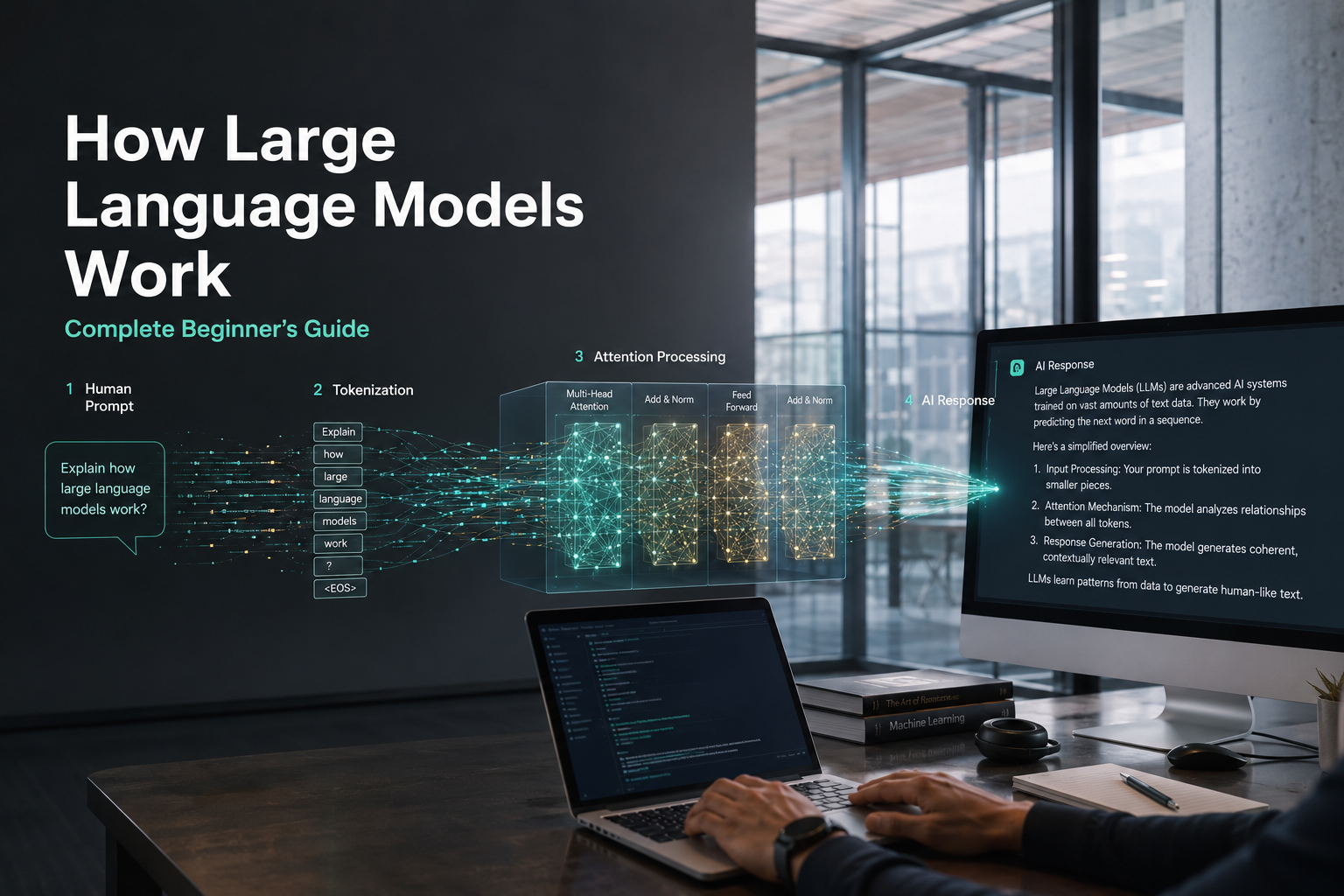
To understand how large language models work, you must first understand the structural framework that makes them possible. This framework is known as the Transformer architecture, which fundamentally changed the path of modern machine learning. Introduced by tech researchers in 2017, the Transformer revolutionized how machines process human language by treating sentences as interconnected networks rather than simple lists of words. This structural shift allowed computers to handle the vast complexity of human communication with unprecedented speed and accuracy.

The Power of Tokenization
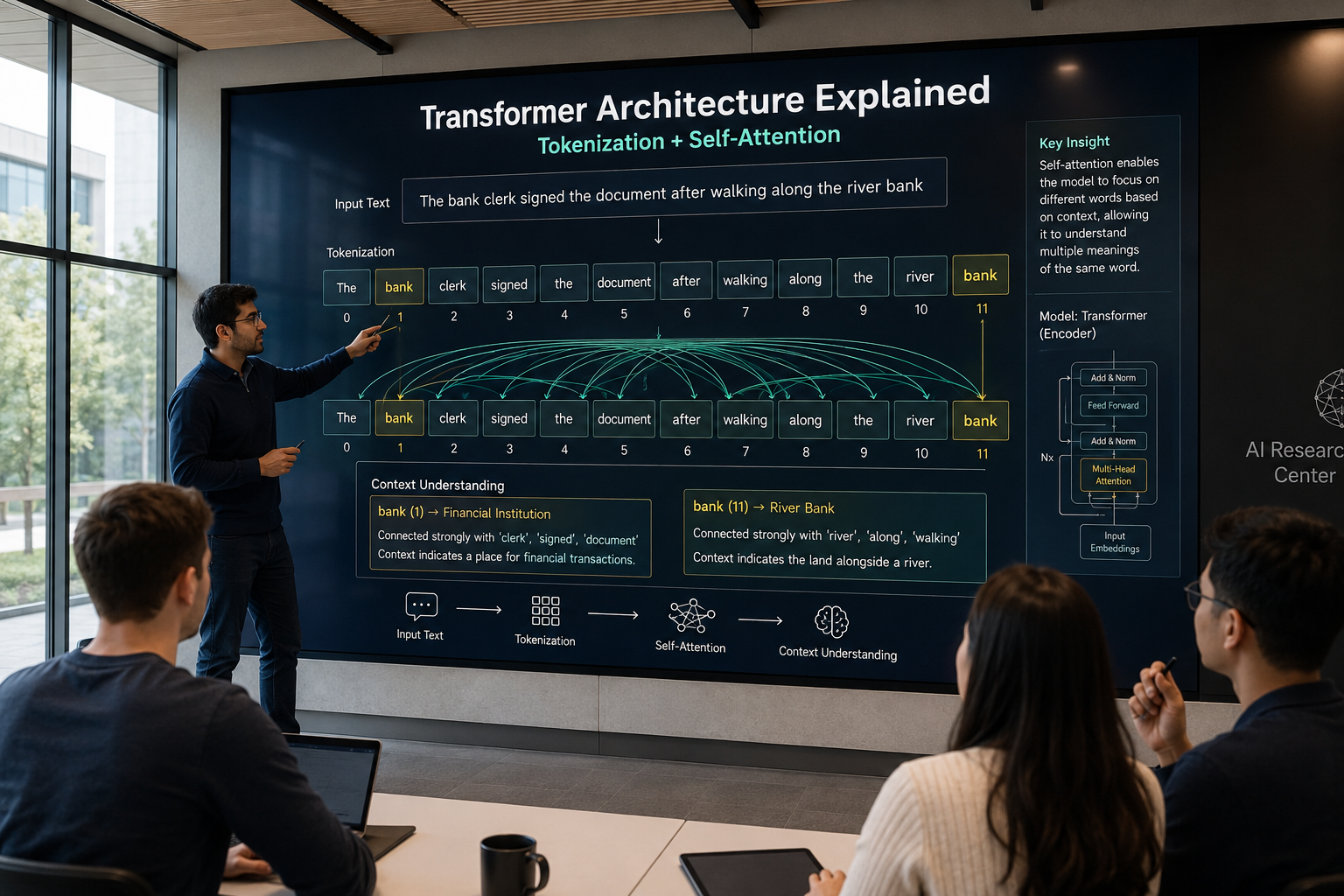
Computers do not read words or appreciate literature the way humans do. Instead, an LLM breaks text down into smaller, mathematically manageable pieces called tokens. A token can be a whole word, a syllable, or even a single character depending on the system’s configuration. The model converts these tokens into numerical values, which allows the system to perform complex mathematical calculations on raw text.
By turning language into math, the system can map words into a multi-dimensional conceptual space. In this space, words with similar meanings sit closer together, which helps the algorithm see connections between ideas. This foundational step ensures that every piece of text enters the processing pipeline in a structured format, enabling the computational layers to analyze the data efficiently.
The Self-Attention Mechanism
Older AI models processed text one word at a time, often forgetting the beginning of a sentence by the time they reached the end. Transformers solved this issue through a concept called self-attention, which acts as a dynamic spotlight for data. This mechanism allows the model to look at every word in a sentence simultaneously and weigh their relative importance to one another.
Consequently, the AI can determine how words relate to each other, regardless of how far apart they sit in the text block. For instance, in the sentence “The bank clerk signed the document after walking along the river bank,” self-attention helps the model instantly distinguish between the financial institution and the physical riverbank based on the surrounding context. This breakthrough enables deep contextual understanding across long essays.
How Large Language Models Work: The Training Process
Building a functional AI model requires a massive investment of time, computational power, and engineering expertise. This journey happens in two distinct phases: pre-training and fine-tuning, which move the system from a blank slate to a polished conversationalist.
Phase 1: Massive Pre-Training
During pre-training, the model devours vast libraries of data from books, articles, and websites to build its base knowledge. The primary goal here is simple next-word prediction, which serves as the ultimate teacher for the underlying algorithm. The system hides a word from itself, guesses what word should come next, and checks its own accuracy against the original source text.
At first, the model guesses randomly and makes endless mistakes because it has no concept of language. However, after repeating this process billions of times across massive server clusters, it starts to grasp grammar, facts, reasoning capabilities, and even subtle nuances of tone. This phase creates a broad, raw intelligence that understands how words fit together but lacks specific behavioral boundaries or conversational guidelines.
Phase 2: Fine-Tuning and Alignment
Pre-training creates a powerful text-completion machine, but it does not create a helpful assistant that can safely answer user queries. To fix this, developers use a process called fine-tuning, which shapes the raw model into a functional consumer product. Human reviewers grade the model’s responses and guide it toward being helpful, accurate, polite, and safe.
Developers also use reinforcement learning from human feedback to reward the system when it answers questions correctly and penalize it when it veers off course. This step ensures the system follows instructions, matches the user’s requested format, and actively avoids generating harmful or malicious content. It bridges the gap between raw statistical probability and helpful human interaction.
Advanced Capabilities of Modern Text Predictors
Once an LLM completes its training, it can execute an astonishing variety of language tasks that surprise even its creators. It no longer just mimics human speech; it actively solves problems based on context and demonstrates emergent capabilities that were not explicitly programmed into its code.
-
Contextual Understanding: The AI analyzes the surrounding text to distinguish between words with multiple meanings, ensuring the correct definition applies to the scenario.
-
In-Context Learning: Users can provide examples inside a prompt, and the model will rapidly adapt its output style without needing permanent updates to its core code.
-
Code Generation: Because programming languages follow strict logical rules, these systems excel at writing, debugging, and explaining complex software code across various languages.
The combination of these advanced capabilities allows the model to shift between roles seamlessly. A user can ask the system to write a poem, analyze a financial spreadsheet, and debug a python script all within the same conversation. This extreme adaptability stems from the model’s deep grasp of underlying patterns, making it a universal text interface rather than a single-use tool.
Real-World Applications and the Impact of Advanced AI
The practical applications of these systems extend far beyond conversational chatbots and casual experiments. Businesses across the globe deploy this technology to streamline operations, reduce overhead costs, and enhance human creativity in highly competitive fields.
For example, customer support departments use automated systems to resolve common user inquiries instantly, freeing human agents to tackle more nuanced problems. Writers and designers use these tools to conquer writer’s block, generate initial outlines, and organize complex brainstorms into coherent strategies. Additionally, medical researchers use language algorithms to comb through thousands of academic journals, which accelerates the discovery of new scientific insights and drug interactions. By processing information at a scale no human could ever match, these models act as powerful cognitive amplifiers for the global workforce.
Frequently Asked Questions
How do large language models work in simple terms?
An LLM works like an incredibly advanced version of the predictive text feature on your smartphone. When you write a message, your phone tries to guess the next word you want to type based on your past typing habits and basic grammar rules. Large language models operate on a much grander, global scale. They analyze the words you type into a prompt, look at the patterns they learned from billions of pages of internet text, and calculate the most statistically likely words to follow your request.
Instead of understanding concepts deeply like a human, they build responses word by word, or rather, token by token. They use complex mathematical probabilities to generate complete, coherent sentences that closely match the tone, context, and intent of your initial query. This enables them to draft essays, answer questions, or write poems by simply calculating what text should naturally come next based on historical patterns.
What data do developers use to train these systems?
Developers train these models using massive text datasets sourced from public internet data. This includes digitized books, news articles, academic journals, online encyclopedias, public discussion forums, and open-source code repositories. The main goal of collecting this vast library is to expose the system to as many diverse examples of human communication, logic, creative writing, and factual knowledge as possible. This wide exposure helps the model learn standard grammar, regional idioms, professional terminology, and overarching cultural contexts.
Creators carefully filter and clean this raw data to remove spam, explicit content, and repetitive low-quality text. This pre-processing ensures the model learns from high-quality language patterns that accurately reflect proper informational structures and diverse human perspectives. Some companies also license private datasets or hire human specialists to create custom question-and-answer pairs to expand the model’s specialized reasoning capabilities.
Do language models actually understand what they are saying?
No, these systems do not possess genuine consciousness, feelings, beliefs, or intentional understanding. They do not know what a concept actually feels or looks like in the physical world; a model knows the word “apple” only by its mathematical relationship to words like “fruit,” “red,” or “pie.” Instead of conscious thought, they excel at pattern recognition and mathematical probabilities. When a model gives a deeply thoughtful, wise, or empathetic response, it simply replicates the linguistic patterns that human writers used in its training data.
It processes symbols and tokens with extreme mathematical precision, but it lacks the real-world experience, self-awareness, and sentient thought that define actual human comprehension. It operates entirely as a reflection of human knowledge, acting as a highly advanced mirror rather than an independent, thinking mind that genuinely comprehends the meaning behind its own output.
Why Do Some AI Models Make Up False Information?
When an AI model generates false information, experts call it a hallucination. Hallucinations occur because the model focuses on producing fluent and believable text. It does not prioritize factual accuracy in the same way a database does. Instead, it predicts words based on patterns learned during training. If the model lacks reliable information about a topic, it may still generate an answer. Unless specifically trained to do so, it may not respond with “I don’t know.”
As a result, the model can produce statements that sound convincing but are incorrect. This happens because it relies on probability rather than verified facts. The system cannot independently confirm whether a claim is true. It simply predicts the most likely sequence of words. In some cases, this process can create fictional events, statistics, or sources.
What Is the Difference Between an LLM and Generative AI?
Generative AI is a broad category of artificial intelligence. It creates new content such as text, images, music, videos, voices, and 3D models. If you are new to the concept, read our complete guide to Generative AI. A Large Language Model (LLM) is a specific type of generative AI. It focuses on text generation and language understanding.
Understanding how large language models work helps clarify the difference between LLMs and other generative AI systems. All LLMs are generative AI tools. However, not all generative AI systems are LLMs. For example, an AI image generator can create digital artwork from a text prompt. It is a generative AI system, but it uses computer vision models instead of language models.
Learning how large language models work also shows why they excel at language-based tasks. LLMs are designed for text generation, conversation, and content analysis. Other generative AI systems focus on images, audio, video, or design. Together, these technologies form the modern AI ecosystem.
Conclusion
Large language models are not magical minds. They are advanced software systems built through modern engineering. Using the Transformer architecture and massive datasets, they convert human language into mathematical patterns. This process allows them to predict text with remarkable accuracy. As a result, they help bridge the gap between human communication and machine computation.
The impact of this technology will continue to grow. It is already changing business, education, and everyday life. Understanding the basics helps you use AI tools more effectively. It also helps you evaluate their outputs with a critical mindset. As AI becomes more common, this knowledge will become increasingly valuable. By learning how these systems work, you can write better prompts and achieve stronger results in both professional and personal projects.