
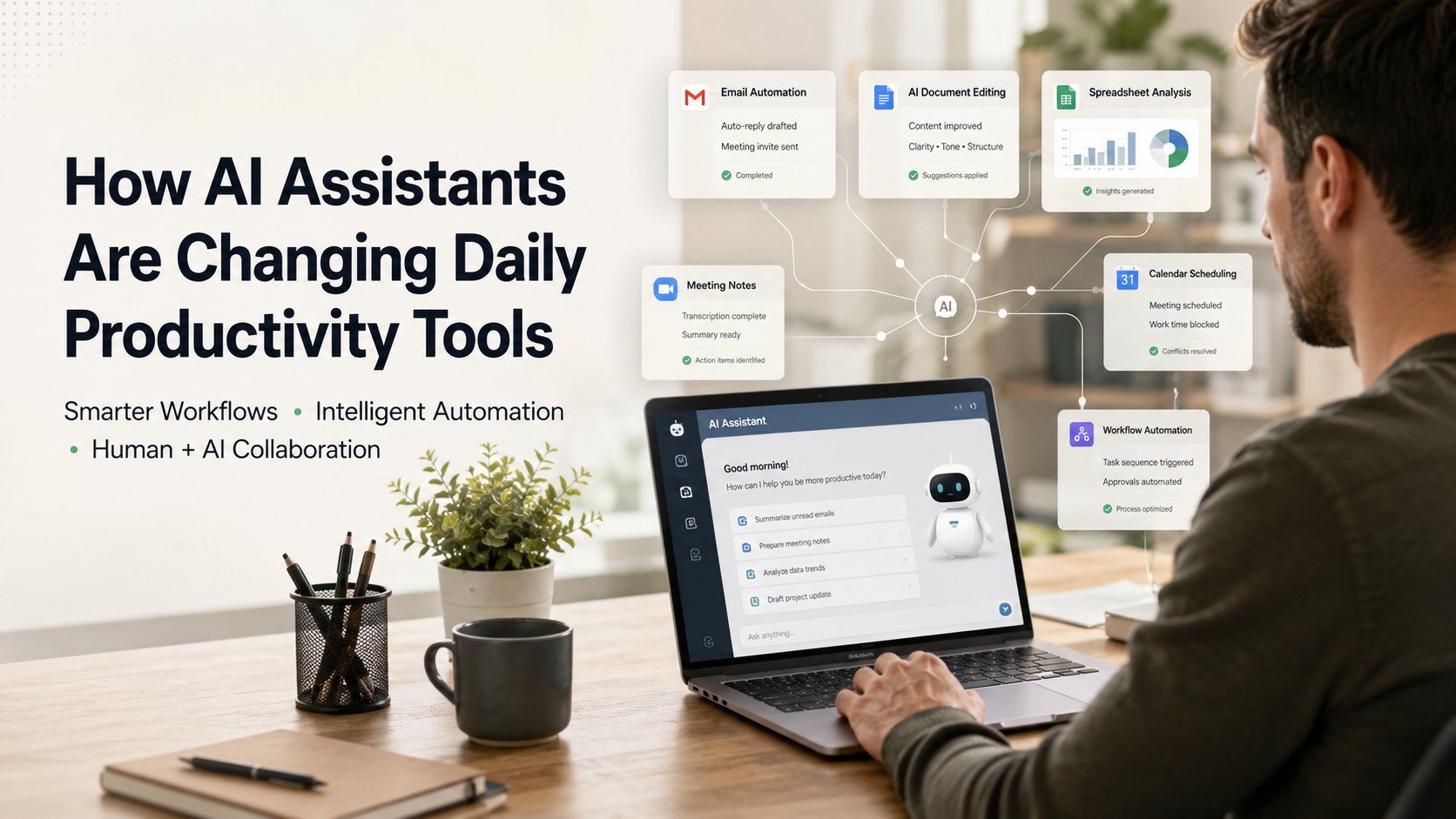
How AI Assistants Are Changing Daily Productivity Tools
Today, AI assistants are transforming the way professionals use everyday productivity tools. Traditional software applications once worked mainly as digital notebooks, spreadsheets, and task managers. Users had to complete most actions manually. Modern productivity platforms are changing this experience by adding intelligent features directly into their systems.
Leading technology companies are developing conversational tools that understand user requests, automate repetitive work, and organize complex information quickly. These AI-powered features help professionals save time and improve efficiency. For example, advancements in conversational AI models are enabling more natural interactions between users and software platforms, as explained by OpenAI Artificial Intelligence Research. Instead of spending hours managing emails, formatting documents, or scheduling meetings, users can focus on more valuable tasks.
The rise of AI assistants matters because modern workplaces require faster decision-making and greater flexibility. Businesses now depend on tools that can support creativity, collaboration, and productivity. Intelligent automation helps reduce daily workload while improving the quality of professional output.
This article explores how AI assistants are changing productivity software, the benefits they provide, and how they will continue shaping the future of workplace technology.


How is AI changing productivity?
Artificial intelligence is fundamentally altering daily productivity by automating manual processes and minimizing cognitive fatigue across standard office applications. Modern work environments rely heavily on digital software, and smart algorithms now sit quietly inside these programs to handle routine workloads. For instance, writing software can draft emails, spreadsheets can analyze complex financial trends automatically, and project management dashboards can predict timeline delays before they happen. This shift means professionals spend less time executing mechanical steps and more time steering projects toward success. Furthermore, personalization plays a major role, as these intelligent tools learn individual user habits over time to deliver tailored suggestions. Ultimately, this technological evolution transforms standard software from passive ledgers into active, intelligent collaborators that elevate overall efficiency.
Streamlining Workflow Automation
Smart automation has become the backbone of modern efficiency. By connecting disparate apps, machine learning models execute multi-step workflows instantly without human intervention. This capability eliminates routine friction, ensuring data moves seamlessly between systems. Professionals enjoy reclaimed hours, allowing them to redirect their focus toward strategic initiatives that truly drive business growth.
How can AI be used as a productivity tool?
Artificial intelligence has become one of the most valuable productivity tools for modern professionals. It helps users analyze information, create documents, manage projects, and complete tasks more efficiently.
AI assistants can process large amounts of data quickly. Moreover, they can identify patterns, summarize reports, and highlight important information from complex documents.
Professionals often use AI for:
- Drafting emails and reports
- Creating document outlines
- Summarizing research materials
- Analyzing spreadsheets
- Organizing project timelines
These capabilities reduce the time required for repetitive work. Therefore, employees can complete tasks faster while maintaining quality and accuracy.
Additionally, AI productivity tools support better decision-making. They provide insights that help teams understand information more clearly and respond to challenges quickly.
Instead of replacing human creativity, AI enhances it. Professionals can use AI-generated suggestions as starting points and then apply their own experience to create stronger outcomes.
Accelerating Document Creation and Editing
AI has significantly improved the process of writing and editing professional documents. Today, writers, marketers, analysts, and business teams use AI assistants to create drafts and improve communication.
These tools can help with:
- Developing content ideas
- Expanding short notes into complete drafts
- Improving grammar and clarity
- Adjusting tone for different audiences
By reducing the time spent on basic editing tasks, AI allows professionals to focus more on strategy and creativity.
For example, a writer can use an AI assistant to create an initial structure and then refine the content with personal expertise. This approach improves efficiency while maintaining human involvement.
Furthermore, AI-powered editing tools help maintain consistency across workplace communication. They support clearer emails, stronger reports, and more professional documents.
As businesses continue adopting AI solutions, document creation will become faster and more collaborative. Ultimately, AI assistants will continue supporting professionals by improving workflow speed and communication quality.
What Is the 30% Rule for AI?
The 30% rule for AI generally refers to the idea that artificial intelligence can automate around 30% of routine workplace activities. These activities often include scheduling, data organization, basic communication tasks, and repetitive administrative work.
However, this concept does not suggest replacing employees. Instead, it highlights how AI tools can remove time-consuming duties. As a result, professionals can focus more on higher-value responsibilities such as creativity, planning, and strategic decision-making.
Businesses often use automation benchmarks to measure whether their technology investments improve productivity. For example, companies may compare task completion times before and after introducing AI solutions. Therefore, these measurements help organizations understand whether their tools are delivering meaningful efficiency improvements.
Additionally, AI assistants support this transition by managing predictable workflows. Meanwhile, human professionals continue handling responsibilities that require judgment, creativity, and strategic thinking.
Measuring Workplace Efficiency Gains
Organizations measure AI-related productivity improvements by comparing performance before and after implementation. In many cases, these evaluations focus on saved working hours, faster task completion, and improved project delivery times.
For instance, companies often track:
- Time saved through automation
- Reduction in repetitive tasks
- Faster response times
- Improved workflow accuracy
These measurements help businesses understand the value of AI productivity tools. Moreover, they allow managers to identify areas where additional automation could improve operations.
Ultimately, when implemented correctly, AI systems create a balance between machine efficiency and human expertise. Employees gain more time for meaningful work, while technology manages routine processes more effectively.
How Is AI Changing Everyday Work?
AI is transforming everyday work by becoming part of common office applications and communication platforms. Today, professionals use AI tools to draft documents, summarize information, and generate ideas quickly.
Previously, employees often started projects from scratch. However, AI-generated suggestions now provide a useful starting point. As a result, workers can review, improve, and personalize content instead of spending excessive time on initial drafts.
Furthermore, AI assistants improve workplace communication. Automated transcription tools can record meetings, create summaries, and highlight important action items. Consequently, teams spend less time organizing information and more time focusing on collaboration.
Modern workflows are becoming faster because AI handles information-heavy tasks efficiently. Therefore, employees can dedicate more attention to creative thinking, problem-solving, and decision-making.
Transforming Modern Office Collaboration
Modern collaboration improves when teams use intelligent productivity platforms. These AI systems can analyze project updates, organize information, and identify important deadlines.
For example, AI tools can review communication patterns and project details to highlight potential issues early. This proactive approach helps teams address challenges before they become larger problems.
Additionally, these systems help employees understand priorities without searching through large amounts of data. They can highlight delays, suggest next steps, and provide useful reminders.
AI-powered collaboration also reduces unnecessary meetings. Instead, teams can access summaries, updates, and important information through centralized digital platforms.
As a result, AI assistants help organizations create smoother workflows. Employees can remain connected across different projects and locations while maintaining better productivity.
What Are 5 Uses of AI in Daily Life?
AI technology has become part of many everyday activities. Today, people use AI assistants to organize schedules, manage information, and complete personal tasks more efficiently.
One common use is personal scheduling and organization. For example, AI-powered tools can manage calendars, create reminders, and suggest better ways to plan daily activities. Therefore, users can stay organized across multiple devices with less effort.
AI also supports communication through language translation, email management, and automated responses. Additionally, people can understand different languages, filter unwanted messages, and prioritize important conversations more effectively.
Other common uses include:
- Navigation assistance: AI-powered maps analyze traffic patterns and suggest faster routes.
- Smart home management: Intelligent devices control lighting, temperature, and security settings.
- Health and fitness tracking: AI systems monitor activity levels and provide personalized recommendations.
- Entertainment recommendations: Streaming platforms use AI to suggest content based on user preferences.
Overall, these applications show how AI assistants improve convenience in everyday life. By handling routine decisions and organizing information, they help people save time and focus on more important activities.
Enhancing Personal Organization and Routine
AI tools are improving how people manage their personal routines. Digital assistants can analyze habits, identify patterns, and provide helpful reminders throughout the day.
For instance, AI calendar tools can suggest suitable times for meetings, focused work, or personal activities. As a result, users can create better schedules and reduce unnecessary stress.
Furthermore, personal productivity improves when different tools work together. Calendar apps, task managers, and communication platforms can share information and create smoother workflows.
AI does not simply store information. Instead, it can provide useful suggestions based on previous behavior. Consequently, daily planning becomes more efficient and personalized.
By supporting organization and routine management, AI assistants help people maintain better control over their responsibilities. Ultimately, these systems encourage smarter time management while allowing users to focus on meaningful goals.