
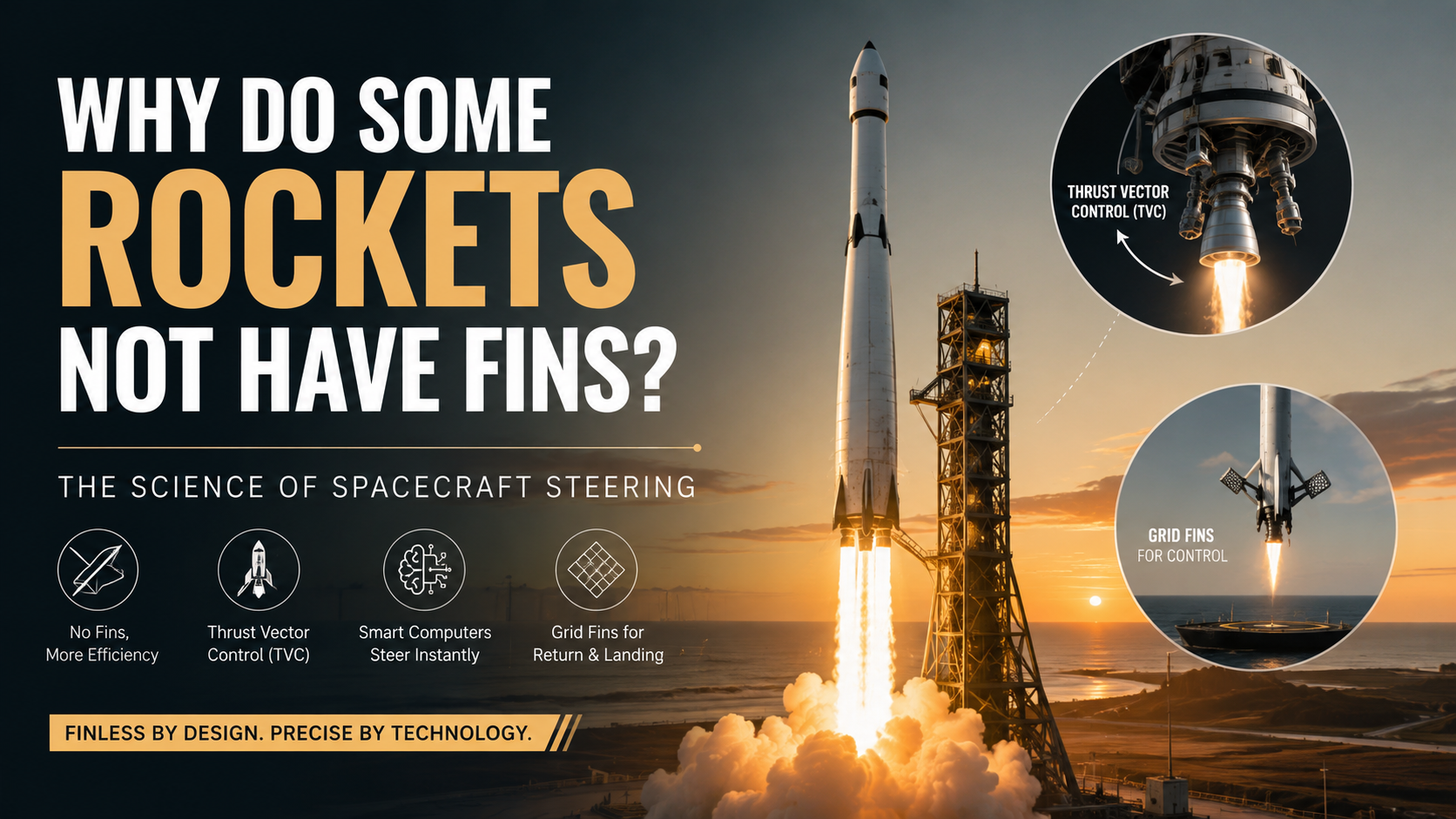
Why Do Some Rockets Not Have Fins? The Science of Spacecraft Steering
Have you ever watched a modern space launch and wondered why do some rockets not have fins? If you grew up building model rockets or watching classic science fiction movies, you probably expect every spacecraft to feature those iconic, dart-like wings at the base. However, if you look closely at modern launch vehicles like the SpaceX Falcon 9 or the Blue Origin New Shepard, those familiar fins are completely missing.
To understand this dramatic shift in aerospace design, we have to look at how engineering has evolved over the decades. Early rockets relied heavily on fins for stability. They worked exactly like the feathers on the back of an arrow. As the rocket flew through the thick atmosphere, the rushing air pushed against the fins to keep the vehicle pointed safely upward. You can explore the basics of this aerodynamic principle in the NASA beginner’s guide to rockets.
But here is the engineering catch. Fins only work when there is air moving around them. Once a rocket leaves the Earth’s atmosphere and enters the vast vacuum of space, fins become entirely useless dead weight. Therefore, brilliant engineers developed much smarter, computer-driven methods to keep massive rockets stable and on course.
In this article, we will explore the fascinating science of rocket steering. We will break down why modern spacecraft leave the fins behind, how thrust vector control works, and what the future of orbital design looks like.
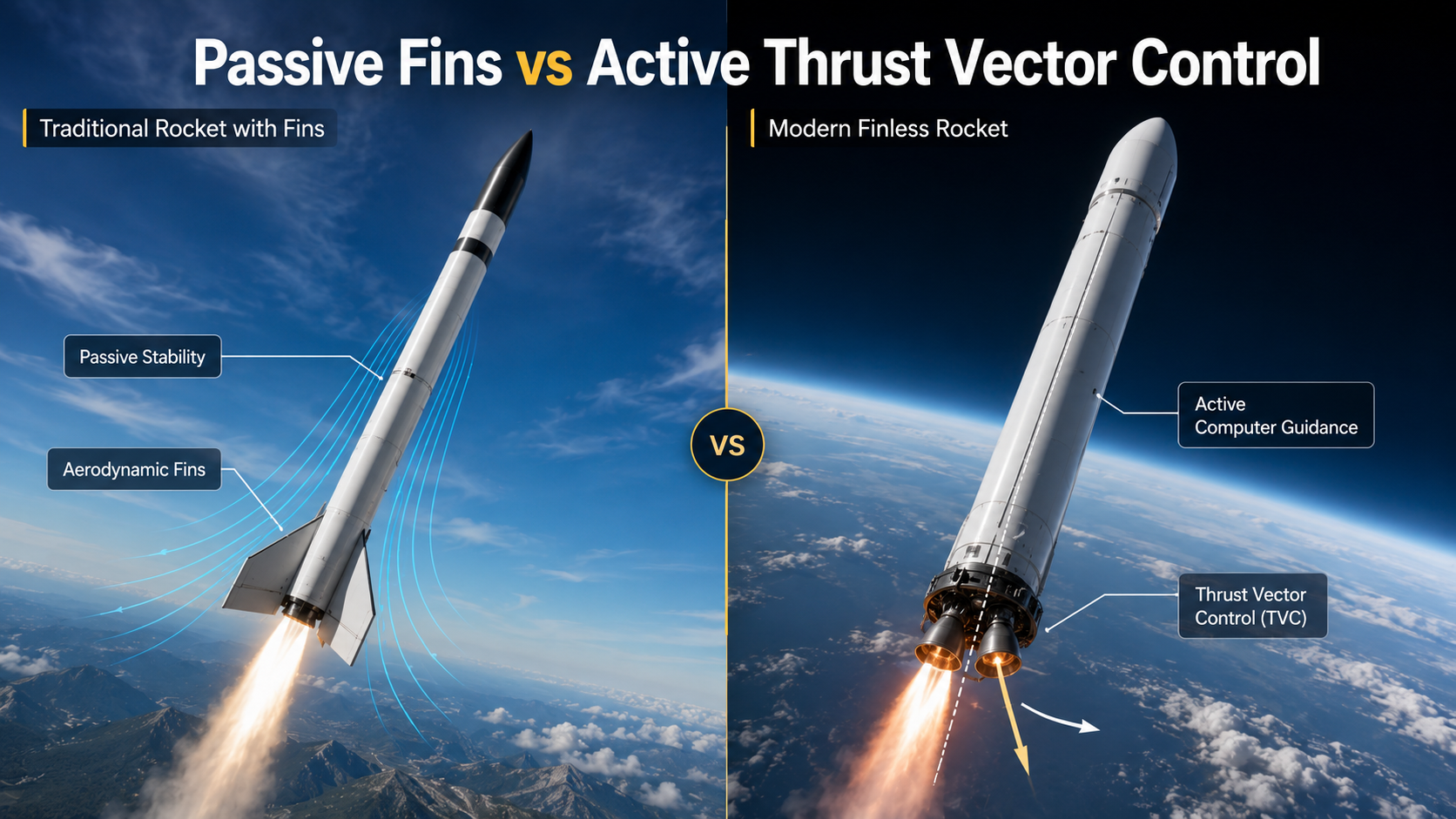

Why Don’t NASA Rockets Have Fins?
NASA rockets often do not use exterior aerodynamic fins because they rely on thrust vector control (TVC) instead of passive aerodynamic surfaces for stability. As large launch vehicles climb through Earth’s lower atmosphere, aerodynamic drag and structural loads become significant challenges. Large fixed fins increase skin friction drag, add structural weight, and reduce overall launch efficiency.
Instead of using fins, modern rockets continuously adjust the direction of their engine exhaust. This process, known as thrust vectoring, provides precise control throughout ascent. It reacts much faster than passive aerodynamic surfaces and maintains the rocket’s planned trajectory even in changing atmospheric conditions.
Engineers also aim to keep launch vehicles as lightweight as possible. Every kilogram saved can increase payload capacity or improve mission performance. Eliminating large exterior fins helps reduce unnecessary mass while maintaining excellent flight stability through advanced guidance systems.
The Role of Thrust Vector Control
Thrust Vector Control (TVC) is the primary reason modern orbital rockets can fly safely without large aerodynamic fins. Instead of depending on airflow over fixed surfaces, TVC changes the direction of engine thrust to steer the vehicle throughout flight.
Rocket engines are mounted on gimbals that allow them to pivot by small angles. Flight computers calculate the rocket’s position and attitude many times each second. If winds or other forces push the rocket away from its planned path, the engines immediately adjust to restore stability.
This active control system works during every phase of powered ascent, including periods when aerodynamic surfaces become less effective. Because thrust vectoring provides rapid and precise corrections, it completely replaces the stabilizing role that fins once served on many early rocket designs.
Is it better for a rocket to have 3 or 4 fins?
Deciding between three or four stabilizing surfaces involves balancing aerodynamic drag, weight, and roll stability during atmospheric ascent. Three fins, known as a tripod configuration, actually offer a distinct aerodynamic advantage over four. With only three points of contact, every single fin experiences a higher angle of attack, which generates stronger restoring forces with less overall structural weight. Furthermore, a three-fin design eliminates the risk of an indeterminate fit on a flat launch pad surface where four symmetrical pieces might wobble. However, four surfaces provide redundant stability and simpler manufacturing symmetry for traditional model rocketry enthusiasts. Engineers must carefully weigh these factors before finalizing any suborbital or atmospheric flight design.
Minimizing Aerodynamic Drag With Three Fins
Reducing extra mass on any launch vehicle saves valuable fuel during the critical atmospheric ascent phase. Three stabilizing surfaces create less surface area, which directly lowers skin friction and form drag. Aerospace designers prefer this minimalist approach because every ounce saved translates into higher payload capacities and better overall flight efficiency.
Why don’t rockets have fins?
Large orbital launch vehicles skip external stabilizing surfaces because active guidance systems control flight paths far better than passive aerodynamics can. As a vehicle climbs past the thickest parts of the atmosphere, aerodynamic forces decrease rapidly while the air thinned out. Massive orbital boosters rely instead on thrust vectoring, which involves pivoting the main rocket engine nozzles in real time to steer the vehicle. According to SpaceX engineering data, gimbaled engines make quick, precise adjustments that react instantly to wind shears. External surfaces would only add dead weight and extreme thermal stress once the vehicle reaches hypersonic speeds outside the sensible atmosphere.
Utilizing Thrust Vectoring for Precise Guidance
Gimbaled engine technology replaces passive stabilization by actively redirecting exhaust plumes to steer the vehicle along its trajectory. Computers calculate tiny directional corrections thousands of times per second. This active control method adapts dynamically to changing atmospheric conditions far more effectively than fixed aerodynamic surfaces ever could.
Why Do Some Missiles Not Have Fins?
Some modern missiles are intentionally designed without external fins. Their missions often demand high speed, compact storage, stealth, and rapid maneuverability. Large fins increase drag, require additional launch clearance, and occupy valuable space inside launch systems.
Finless missiles can fit more efficiently inside vertical launch cells, sealed canisters, aircraft weapon bays, or mobile launchers. Removing external surfaces may also help reduce the radar signature on certain designs while lowering aerodynamic heating during high-speed flight.
Instead of fixed fins, these missiles rely on advanced guidance technologies such as thrust vectoring, lateral control thrusters, or internal control mechanisms. These systems provide accurate steering and fast attitude corrections without the weight and structural penalties associated with large aerodynamic surfaces.
Benefits of Confined Launch Compatibility
Compact finless missiles are well suited for sealed launch systems used by many modern military platforms. Their streamlined shape allows engineers to maximize storage space while protecting the weapon from harsh environmental conditions.
Key advantages include:
- Higher storage density in launch cells and canisters
- Better protection from moisture, dust, and corrosion
- Faster deployment during operational missions
- Lower maintenance while stored for extended periods
- Improved compatibility with aircraft internal weapon bays
These benefits make finless designs especially valuable for modern defense systems where space, readiness, and reliability are essential.
Can a Rocket Fly Without Fins?
Yes. A rocket can fly without fins if it has an effective active stabilization system. Modern launch vehicles continuously monitor their orientation using onboard sensors and correct any unwanted movement through engine control systems.
Without active guidance, a symmetrical rocket moving through the atmosphere can become unstable and begin tumbling. Earlier rockets solved this problem with fixed fins, which shifted the center of pressure behind the center of mass to provide passive stability.
Today’s rockets replace that passive approach with advanced avionics. High-speed computers, inertial measurement units, hydraulic actuators, and thrust vector control work together to keep the vehicle stable. These systems respond within milliseconds, allowing rockets to maintain accurate flight paths through challenging atmospheric conditions.
Achieving Dynamic Stability via Avionics
Modern rockets depend on sophisticated flight computers and avionics to maintain stability throughout ascent. These systems continuously collect data from onboard sensors and compare the rocket’s actual position with its planned trajectory.
Whenever small deviations occur, the guidance system instantly commands engine adjustments. This rapid feedback loop keeps the vehicle properly aligned, even during periods of strong aerodynamic forces or changing wind conditions.
Because these corrections happen continuously, modern rockets can safely fly without relying on natural aerodynamic stability from fixed fins.
Why Does Falcon 9 Not Have Fins?
The SpaceX Falcon 9 does not use traditional fixed aerodynamic fins on its main body because it relies on engine gimballing during ascent and deployable grid fins during descent.
During launch, the rocket’s nine Merlin engines use thrust vector control to keep the vehicle stable. This system provides accurate steering while avoiding the extra weight and drag that permanent fins would create.
After stage separation, the returning first stage deploys four titanium grid fins. These movable control surfaces guide the booster through Earth’s atmosphere during reentry and help position it for a precise propulsive landing. Since the grid fins remain folded during ascent, they do not reduce payload performance like large fixed fins would.
The Function of Titanium Grid Fins
Titanium grid fins are specialized aerodynamic control surfaces used during Falcon 9’s return to Earth. Unlike conventional flat fins, they use an open lattice structure that performs efficiently across a wide range of flight speeds.
Their design offers several advantages:
- Excellent control at both supersonic and subsonic speeds
- Lower hinge forces than conventional fins
- High heat resistance during atmospheric reentry
- Precise steering for controlled booster landings
- Foldable design that minimizes drag during launch
These characteristics make grid fins ideal for reusable launch vehicles that must return safely for another mission.
Frequently Asked Questions
Do all rockets require stabilization to reach orbit safely?
Yes. Every rocket needs some form of stabilization during flight. Without it, the vehicle could tumble, experience excessive structural loads, or drift away from its intended trajectory.
Modern rockets achieve stability through active guidance systems rather than relying solely on aerodynamic fins. Flight computers, thrust vector control, inertial sensors, and navigation systems work together to keep the rocket properly aligned throughout ascent. Smaller rockets may still depend on fixed fins because they lack these advanced control technologies.
How do rockets stay on course without aerodynamic control surfaces?
Rockets remain on course by using sophisticated guidance, navigation, and control (GNC) systems. Inertial measurement units constantly track the vehicle’s position, orientation, and movement.
When the rocket begins drifting from its planned path, onboard computers calculate the required correction within milliseconds. They then command the engines to pivot slightly using thrust vector control. This redirects the exhaust plume and restores the correct trajectory much faster than passive aerodynamic fins could.
Are grid fins the same as traditional rocket fins?
No. Although both provide aerodynamic control, grid fins differ significantly from traditional solid fins. Grid fins have an open lattice structure that performs efficiently across a broad speed range, especially during transonic and supersonic flight.
Traditional fins mainly provide passive stability through airflow. Grid fins, however, are movable control surfaces that actively steer reusable boosters during atmospheric descent. Their design also requires less actuator force while maintaining excellent control authority.
Do small model rockets also fly without fins?
Most model rockets require fixed fins because they do not include the sophisticated guidance systems found on orbital launch vehicles. Passive aerodynamic stability is the simplest and most reliable way to keep these lightweight rockets flying straight.
Without fins, a typical model rocket would quickly become unstable after launch. Since hobby rockets usually lack thrust vector control, flight computers, and precision sensors, aerodynamic fins remain essential for safe and predictable flight.
Conclusion
As we have discovered, rocket science is all about maximizing flight efficiency and eliminating unnecessary weight. If you have ever wondered why some rockets do not have fins, the answer lies in remarkable advances in computer technology and active guidance systems.
Traditional fins played a vital role in early rocketry by providing passive stability through the dense lower atmosphere. However, they also create aerodynamic drag, add extra weight, and become ineffective once a spacecraft reaches the vacuum of space.
Today, aerospace engineers rely on Thrust Vector Control (TVC), which uses powerful onboard computers to continuously adjust the direction of a rocket’s engines. This sophisticated steering method enables modern launch vehicles to be lighter, more efficient, and capable of carrying heavier payloads into orbit. If you’re fascinated by space exploration, you’ll also enjoy exploring the best space gifts for space lovers, featuring unique ideas for astronomy enthusiasts and aspiring astronauts.
Furthermore, systems such as Reaction Control System (RCS) thrusters allow spacecraft to maneuver precisely once they are in space. The transition from finned rockets to sleek, finless launch vehicles represents one of the most significant engineering advancements in modern aerospace. The next time you watch a rocket launch, you’ll have a deeper appreciation for the sophisticated guidance systems and rapid computer calculations that keep it perfectly balanced on its journey beyond Earth’s atmosphere.