
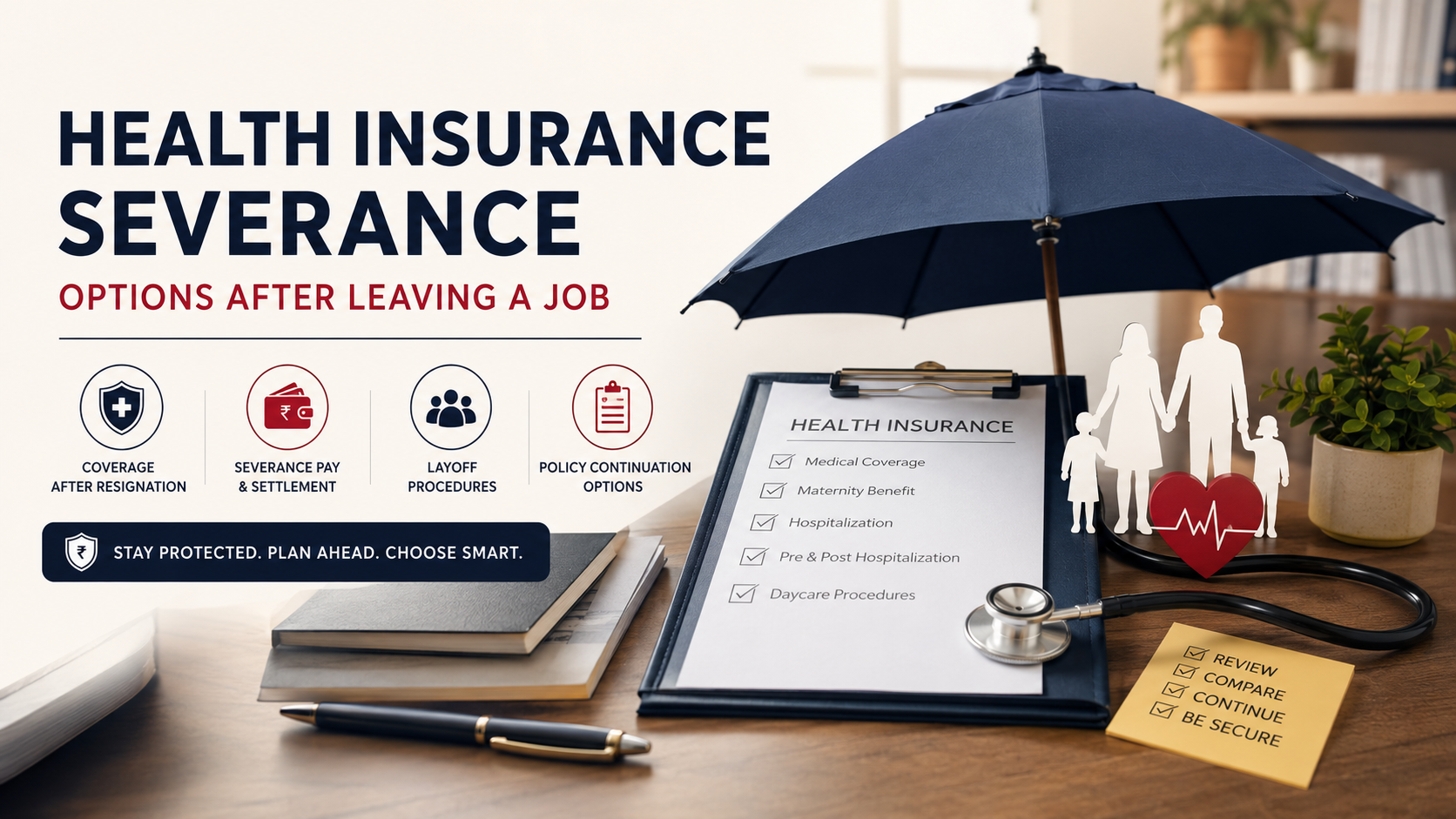
Health Insurance Severance: Options After Leaving a Job
Leaving a job brings significant career changes, but your financial and medical security should never be left to chance. Navigating health insurance severance requires understanding how your corporate policy transitions when you resign or face a layoff. According to the Insurance Regulatory and Development Authority of India (IRDAI), understanding your policy terms is essential for seamless medical coverage continuity. Many professionals assume their group health coverage extends indefinitely, which can lead to unexpected out-of-pocket medical expenses during a career transition. This comprehensive guide answers critical questions about health insurance severance, severance pay eligibility, layoff procedures, job loss insurance covers, policy continuation options, and corporate health insurance validity after resignation.
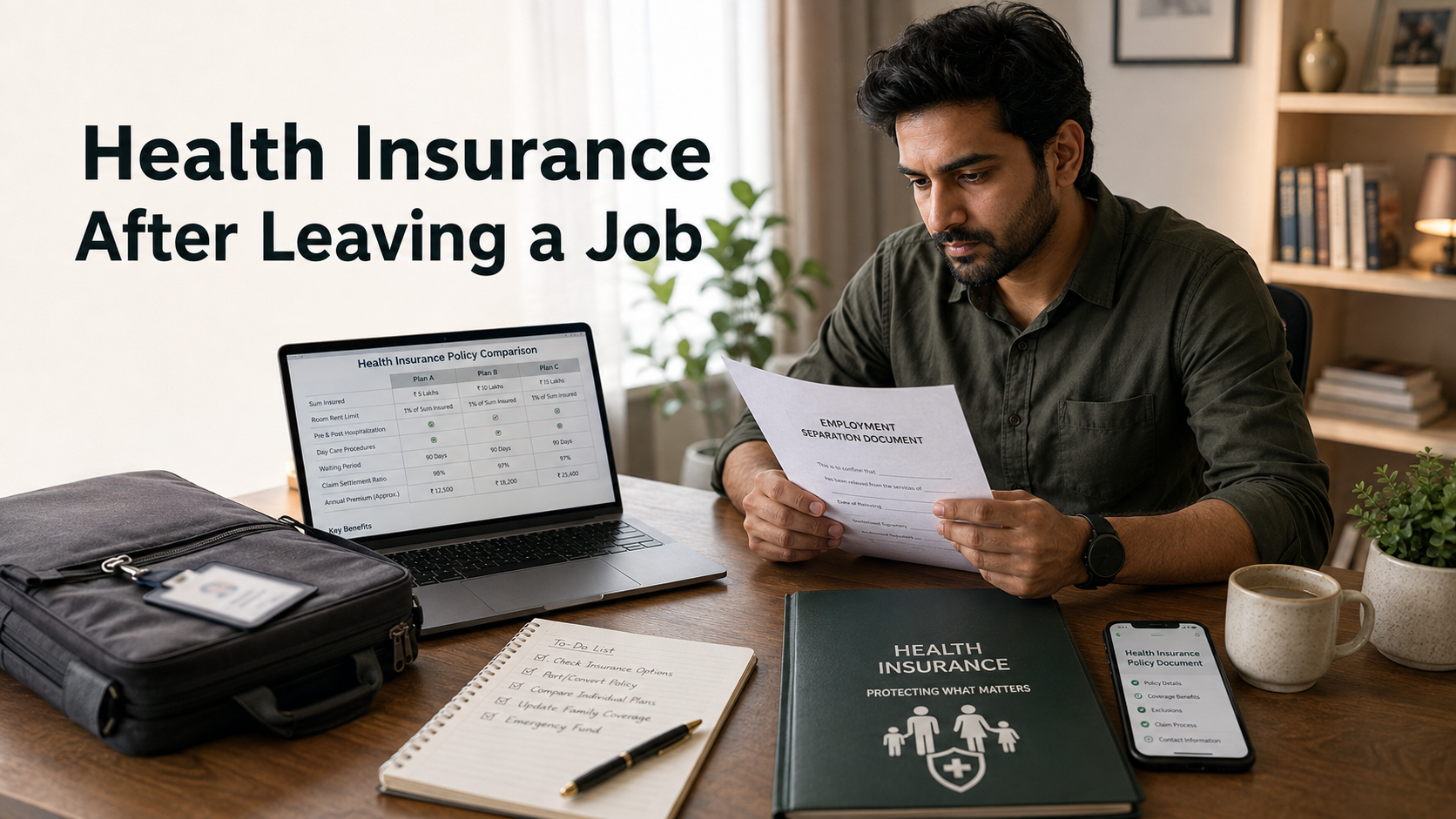
What Happens to My Health Insurance Coverage After I Resign in India?
When you resign from a job in India, your employer-sponsored health insurance usually ends when your employment ends. The exact termination date depends on your employer’s group policy terms. In many cases, coverage continues through the notice period and ends on your last working day.
Once the group policy stops covering you, you may lose access to benefits such as cashless hospitalization and employer-funded medical coverage. Your dependents may also lose coverage under the same corporate policy. For a broader understanding of policy coverage, exclusions, and key considerations, review medical insurance facts you should know.
Do not wait until your employment ends before reviewing your options. Medical emergencies can occur without warning, and even a short coverage gap can create significant financial pressure.
Before leaving your job, ask HR or the insurer for the exact coverage end date. Then compare individual health insurance, migration, and portability options. This gives you time to arrange replacement coverage before your corporate policy ends.
Portability and Retail Conversion Options
Depending on the policy and insurer, you may be able to migrate your group health policy to an individual policy or port to another insurer. These options can help preserve eligible continuity benefits, including credits for certain waiting periods.
Contact your insurer or HR team as early as possible. Do not rely on a fixed 30-day deadline without confirming the applicable policy terms and current regulatory requirements.
Do I Get Severance Pay If I Quit My Job?
Voluntarily resigning from a job in India does not normally create an automatic right to severance pay. Severance is generally associated with employer-initiated termination, redundancy, retrenchment, or other qualifying circumstances rather than a standard resignation. Before making an exit decision, employees can also review when and how to take a voluntary severance package.
However, resignation does not mean you lose everything owed by your employer. Your full and final settlement may include unpaid salary, eligible leave encashment, and other contractual or statutory amounts.
Gratuity may also be payable when you satisfy the applicable eligibility requirements. The commonly cited five-year service requirement has exceptions in certain circumstances, so employees should not assume that every case follows the same rule.
Your employment contract and company policies can also provide additional benefits. Some employers offer retention payments, contractual exit benefits, or other amounts under specific conditions.
Before accepting your final settlement, review the calculation carefully. Check your salary, deductions, leave balance, gratuity eligibility, bonuses, and notice-period adjustments.
Final Settlement Components
Your final settlement may contain several separate components. These can include unpaid wages, notice period adjustments, eligible leave encashment, incentives, bonuses, and statutory benefits.
Ask HR for a detailed settlement statement rather than relying only on the final amount credited to your bank account. Check whether deductions match your employment terms.
Also confirm when your employer-sponsored health insurance ends. Your final settlement and your medical coverage are separate issues, so resolving one does not automatically resolve the other.
What Should I Do After Being Laid Off?
A layoff requires faster financial and insurance planning than a normal resignation. Start by reviewing your layoff notice, employment agreement, separation documents, and any severance terms provided by your employer.
Pay particular attention to the date your salary stops and the date your health insurance ends. Do not assume your medical coverage continues simply because your insurance card shows a later policy expiration date.
Next, calculate how much cash you have available and create a realistic short-term budget. Update your resume and professional profiles while beginning your job search. Managing short-term vs long-term savings can also help you decide how much money to reserve for immediate needs versus future goals.
Your health insurance should be treated as a separate priority. Check whether you can migrate or port your group policy. Compare that option with purchasing an individual health insurance policy for yourself and your family.
Also check whether you qualify for any applicable government support or other financial assistance. The availability of such programs depends on your circumstances and location.
Managing Cash Flow Wisely
Create an emergency budget as soon as your employment ends. Start with essential expenses such as housing, food, utilities, loan payments, and insurance premiums. Building an emergency fund for financial stability can also help you manage unexpected expenses during periods of unemployment.
Then identify expenses that you can temporarily reduce or remove. Non-essential subscriptions, discretionary purchases, and unnecessary recurring payments can quickly consume savings during unemployment.
Avoid treating your entire severance payment as disposable income. Your savings may need to support you for several months while you search for another position. Following good financial habits that build wealth can make it easier to protect your savings during a career transition.
Set aside money for health insurance premiums before allocating funds to less urgent expenses. A medical emergency without adequate insurance can seriously damage your remaining savings.
Review your budget every few weeks. If your job search takes longer than expected, adjust spending early rather than waiting until your cash reserves become critically low.
What Type of Insurance Covers Job Loss?
There is no universal health insurance product in India that automatically replaces your salary after you lose your job. Some financial products provide limited protection against involuntary unemployment, but their coverage is usually narrower than people expect.
Job-loss protection may be available through credit protection or loan protection products. These products can sometimes cover loan installments for a limited period after an eligible involuntary job loss.
Such protection is more commonly linked to financial liabilities than to everyday living expenses. For example, a policy may help with certain EMI payments rather than provide unrestricted monthly income.
Traditional health insurance does not normally cover unemployment. Term life insurance also does not replace income simply because you lose your job.
Before purchasing job-loss protection, read the policy wording carefully. Check eligible employment conditions, waiting periods, exclusions, benefit limits, and claim requirements.
Do not assume that voluntary resignation qualifies. Many products specifically exclude resignation, dismissal for misconduct, or other non-qualifying employment exits.
Understanding Loan Protection Riders
Loan protection products can provide a temporary financial cushion after an eligible involuntary job loss. Their purpose is usually to help borrowers manage loan repayments rather than replace their complete income.
Coverage periods and conditions vary between products. Some may cover eligible installments for only a few months, subject to policy limits and other conditions.
Before buying such protection, check exactly what qualifies as job loss. Voluntary resignation may be excluded, while redundancy or certain employer-initiated terminations may qualify.
Also check the waiting period and documentation requirements. You may need evidence from your former employer before the insurer processes a claim.
Compare the premium with the actual benefit available. A product that covers only a small number of installments may not provide enough protection to justify its cost.
Can You Continue Health Insurance After Leaving a Job?
Yes, you may have options for continuing health insurance after leaving employment in India. However, the process is not as simple as assuming your corporate policy remains active.
Depending on the policy and insurer, you may be able to migrate from a group health policy to an individual or family floater policy. You may also have portability options if you want to move to another insurer.
These options can help preserve eligible continuity benefits earned under the previous policy. They can be particularly important when you have accumulated waiting-period credits.
You can also purchase a completely new individual health insurance policy. This can provide long-term independence from employer-sponsored coverage and support good financial habits that build wealth for a secure future.
Do not wait until after your employment ends to start the process. Ask your insurer about available options, deadlines, required documents, premiums, and coverage differences.
The best choice depends on your existing coverage, age, dependents, medical needs, budget, and policy terms.
Portability Rules and Timelines
Health insurance portability can allow you to move from one insurer to another while retaining eligible continuity benefits. Migration to an individual policy may also be available under applicable policy and regulatory provisions.
The exact process and timeline depend on the circumstances and the insurer’s requirements. Therefore, confirm the deadline directly with your insurer rather than relying on a generic time limit.
Ask for written confirmation of your options before your corporate coverage ends. You should also compare the new policy’s coverage, exclusions, waiting periods, room-rent limits, deductibles, and premiums.
Continuity benefits can be valuable, but they do not mean every condition becomes immediately covered. Existing waiting periods and policy conditions still need to be understood.
Starting the process early reduces the risk of an unintended insurance gap.
Is Corporate Health Insurance Valid After Resignation?
You should not assume that your corporate health insurance remains valid after your employment ends. Coverage normally depends on your membership in the employer’s group policy and the specific terms governing employee exits.
The important date is the actual end of your coverage, not simply the date displayed on an insurance card or mobile application. Your HR department or insurer can confirm when your coverage terminates.
A claim for treatment after coverage has ended may be rejected. However, the exact outcome depends on the policy terms and the circumstances of the claim.
This is why checking your health insurance coverage after resignation should be part of your exit planning. Ask for confirmation of the last date on which you and your dependents remain insured.
If your employer provides a migration option, begin the application process promptly. You can also compare an individual policy before your existing coverage ends.
Never rely on assumptions about your corporate insurance. Get the coverage end date in writing and arrange replacement protection when necessary.
Grace Periods and Emergency Claims
Some employers or insurers may have administrative procedures that affect the timing of coverage termination. However, you should not assume that an informal grace period automatically protects you after leaving employment.
Ask HR and the insurer whether any extension, migration window, or other arrangement applies to your policy. Get the response in writing whenever possible.
If you need medical treatment during the transition, confirm whether your existing policy is active before relying on cashless hospitalization.
The safest approach is to arrange replacement coverage before your employer-sponsored policy ends. This can reduce the risk of paying unexpected medical bills from your own savings.
Your health insurance severance planning should therefore focus on continuity rather than assuming your corporate policy will continue automatically. Review your options early, understand the applicable deadlines, and choose coverage that fits your needs after employment ends.
FAQ SECTION
What happens to my accumulated corporate health insurance bonus after leaving?
Accumulated no-claim bonuses or health checkup perks tied to a group corporate policy generally do not transfer when you leave a job. Group policies treat employees collectively, meaning individual bonuses rarely migrate to retail policies. When porting to an individual retail plan, you start fresh regarding cumulative bonuses unless specified otherwise by the insurer’s specific transition guidelines.
Can I buy a retail health policy if I have an ongoing medical condition?
Yes, you can purchase a retail health insurance policy even with an ongoing medical condition, but insurers may apply standard waiting periods or underwriting loadings. However, if you port your corporate group policy to a retail plan within the regulatory window, insurers must give you credit for the time you spent under the group policy, reducing your pre-existing disease waiting period.
Are family members covered under health insurance severance transition options?
Family members who were covered under your employer’s group health policy can usually be included when you convert or port your policy into an individual retail plan. Insurers permit family floater conversions during the transition window, provided you pay the corresponding individual premium rate. Always confirm dependent inclusion terms directly with your insurance provider before the corporate coverage deadline lapses.
How soon should I buy a new health policy after resigning?
You should ideally secure alternative health insurance coverage before your last working day or during the immediate 30-day post-resignation window. Acting quickly ensures there is zero gap in your medical protection. Maintaining continuous coverage is vital to safeguard your savings against unexpected accidents or sudden illnesses during your job transition period.
Conclusion
Navigating career changes requires a careful balance of professional planning and financial safeguarding, especially regarding your medical security. Understanding health insurance severance empowers you to take control of your healthcare needs without fearing sudden coverage gaps. Whether you resign voluntarily or face an unexpected layoff, proactive steps like converting your group policy, budgeting your severance pay, and purchasing retail health insurance protect your family’s financial future. Remember that corporate health insurance terminates immediately upon departure, making timely action essential. By applying the insights shared in this guide, you can transition smoothly into your next professional chapter with total peace of mind and robust medical protection intact.