Understanding the Complete Guide to Public Service Loan Forgiveness
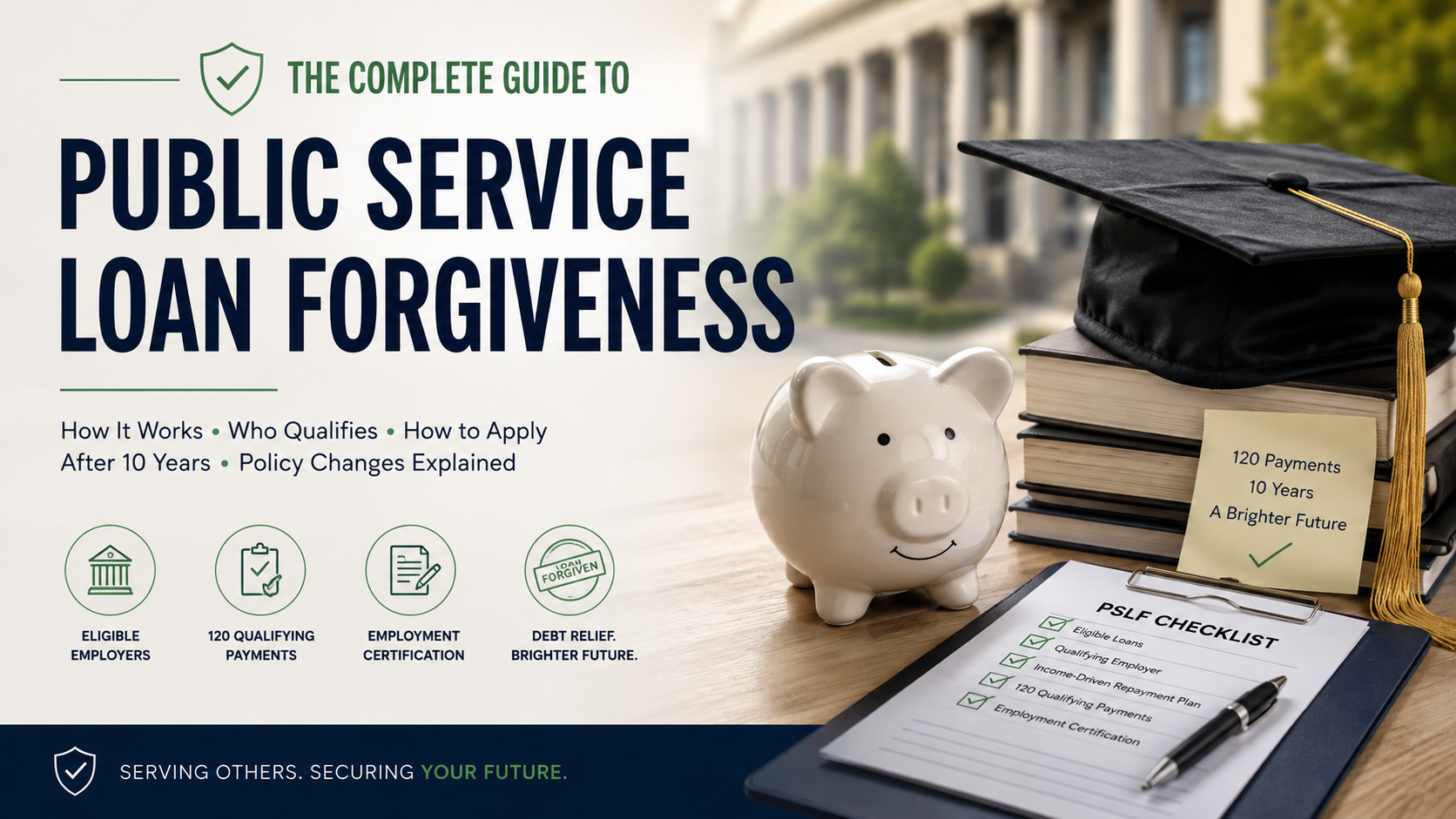
Navigating student debt can feel overwhelming when you are building a career in public service. Fortunately, Public Service Loan Forgiveness (PSLF) can help eligible borrowers eliminate the remaining balance on qualifying federal student loans.
The program is available to borrowers who meet specific requirements involving their employer, loan type, repayment plan, and qualifying payments. The rules are detailed, so checking your status regularly is essential. You can review current guidance and use official tools through Federal Student Aid.
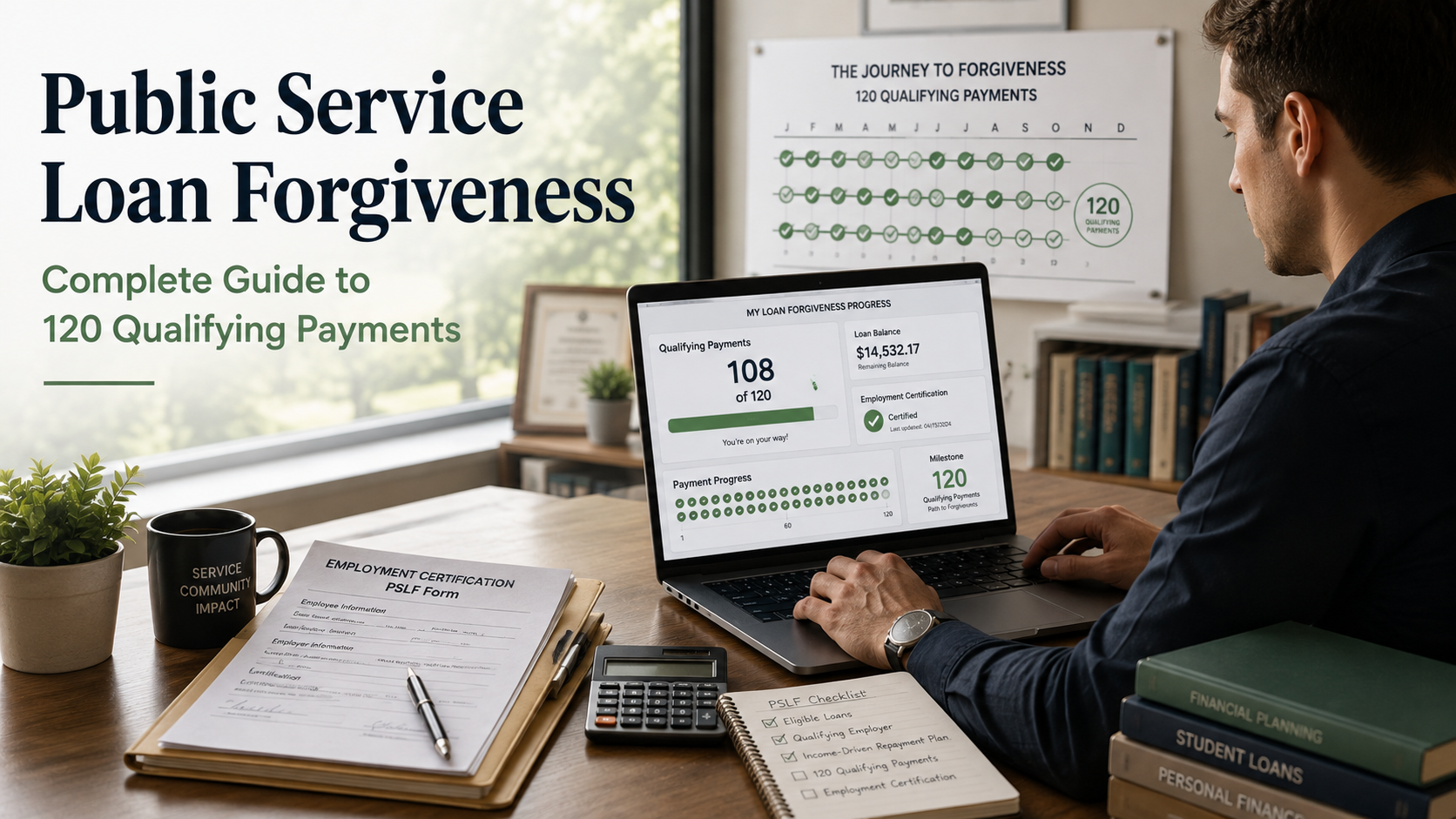
PSLF generally requires 120 qualifying monthly payments while working full-time for an eligible employer. Those payments do not need to be consecutive. Your eligible employment and loan status must also meet program requirements during the qualifying period.
This guide explains how Public Service Loan Forgiveness works, who qualifies, how to document employment, what happens after 10 years, and how recent policy changes may affect borrowers.
How to do Public Service Loan Forgiveness?
Successfully pursuing Public Service Loan Forgiveness requires careful attention to your loans, employment, repayment plan, and payment history. Start by checking whether your federal loans are eligible Direct Loans. Federal Family Education Loan and Perkins Loans generally do not qualify unless they are consolidated into a Direct Consolidation Loan.
Next, confirm that your employer qualifies. PSLF eligibility depends primarily on your employer rather than your specific job title. Government organizations and qualifying nonprofit employers can meet the requirement. Understanding how debt affects your broader finances is also important, so consider reviewing good debt vs. bad debt.
You should then review your repayment options and confirm that your payments can qualify. Federal Student Aid recommends using its repayment calculator when comparing plans for PSLF. Current repayment rules have changed, including new repayment options introduced in 2026. Managing these payments alongside other financial obligations can be easier with a clear budgeting strategy.
Finally, submit a PSLF form regularly to document your qualifying employment and track your payment count. Keeping copies of forms, employment records, and payment information can help resolve future discrepancies.
Submitting Employment Certification Forms
Submitting employment certification regularly is one of the most useful ways to monitor your Public Service Loan Forgiveness progress. Federal Student Aid encourages borrowers to submit a PSLF form each year. You should also consider submitting one when you change qualifying employers.
The form allows the Department of Education to verify your employer and update your qualifying payment information. Your employer must provide the required certification and signature. The PSLF Help Tool can help identify eligible employers and generate the appropriate form.
Annual certification is not the only time you can submit the form. Current guidance states that borrowers are required to submit it when they reach the required 120 qualifying months. However, submitting it more frequently can help identify problems earlier.
Keep copies of submitted forms and confirmation records. Also monitor your payment count through your StudentAid.gov account. If your count changes unexpectedly, review your employment and payment history promptly.
What qualifies under Public Service Loan Forgiveness?
Eligibility for Public Service Loan Forgiveness depends on several requirements working together. Your employer, loans, repayment plan, employment status, and payments all matter. Meeting only one or two requirements is not enough to receive forgiveness.
Your employer generally must be a qualifying government organization or eligible nonprofit organization. Federal, state, local, and tribal government employers can qualify. Certain tax-exempt nonprofit organizations also qualify, along with some other nonprofit organizations providing qualifying public services.
Your loans must generally be eligible Direct Loans. Federal Family Education Loan and Perkins Loans do not qualify for PSLF unless appropriate consolidation requirements are met.
You must also work full-time for a qualifying employer while making qualifying payments. PSLF requires 120 qualifying monthly payments before forgiveness can be granted. Those payments do not have to be consecutive.
Because repayment rules are changing, borrowers should verify their current repayment options through Federal Student Aid rather than relying on older PSLF guides. Borrowers can also benefit from managing education expenses wisely when planning their overall student finances.
Evaluating Eligible Employer Types
Your employer’s status is more important than your job title when determining Public Service Loan Forgiveness eligibility. A qualifying position does not automatically make an employer eligible, and a specific profession is not required for PSLF.
Government organizations at the federal, state, local, and tribal levels can qualify. Certain tax-exempt organizations under Section 501(c)(3) can also qualify. Some other nonprofit organizations may qualify when they provide specified public services.
Before assuming that your employer qualifies, use the official PSLF Employer Search. Federal Student Aid allows borrowers to search for an employer using identifying information such as the employer’s EIN.
This step is especially important before relying on future forgiveness as part of your financial plan. Employer eligibility can also change, so previously qualifying employment should not be treated as permanent proof of future eligibility.
Keep documentation showing where you worked and when you worked there. Regular PSLF certification can provide additional confirmation and help identify eligibility problems before you reach the end of your repayment period.
What happens after 10 years of PSLF?
Reaching 10 years of qualifying service does not automatically erase your loans. Instead, you generally need 120 qualifying monthly payments before requesting Public Service Loan Forgiveness. The payments must meet program requirements, and qualifying employment must also be established.
Once you reach the required number of qualifying payments, you can request forgiveness through the appropriate PSLF application process. The Department of Education reviews your qualifying employment and payment history before approving the discharge.
The amount forgiven generally includes the remaining principal and accrued interest on eligible loans after the final required payment.
Do not assume that every payment made during a 10-year period automatically qualifies. Periods involving certain repayment plans, deferments, forbearances, or employment changes may affect your payment count. If you are managing multiple balances, learning how to pay off debt faster can also help you stay financially organized.
The safest approach is to track your qualifying payment count throughout the process. Review your StudentAid.gov account regularly and resolve discrepancies before submitting your final forgiveness request.
Receiving Official Loan Discharge
The final stage of Public Service Loan Forgiveness involves submitting your forgiveness request and allowing the Department of Education to verify your eligibility. Reaching 120 payments does not mean that your balance disappears immediately.
The department must confirm that your payments and employment satisfy the applicable requirements. Current federal regulations provide that forgiveness covers the qualifying principal and accrued interest remaining when the borrower satisfies the final required monthly payment obligation.
Until your forgiveness is officially processed, follow instructions from your loan servicer regarding payments. Do not simply stop paying because your payment count appears to have reached 120.
Keep copies of your PSLF forms, employment certifications, payment records, and official correspondence. These documents can be useful if your account requires additional review. Maintaining an emergency fund can also provide a financial cushion while you wait for your loan status to be finalized.
After approval, monitor your loan account to confirm that the eligible balance has been discharged. You should also check your account for any remaining loans that were not included in the forgiveness request.
The important distinction is simple: 120 qualifying payments make you eligible to request forgiveness; they do not replace the final approval process.
Are PSLF loans still being forgiven?
Yes. Public Service Loan Forgiveness remains an active federal program in 2026. The program continues to provide forgiveness for eligible borrowers who satisfy the applicable requirements. Federal Student Aid continues to provide PSLF forms, employer verification tools, payment tracking, and forgiveness resources.
However, borrowers should not assume that older PSLF guidance remains completely unchanged. Federal student loan repayment rules have undergone significant changes during 2026. New repayment options took effect July 1, 2026, while some older repayment plans are being phased out.
The Department of Education has also implemented changes affecting PSLF regulations and employer eligibility. Some regulatory provisions have faced court action, so borrowers should rely on current federal guidance rather than outdated articles or social media claims.
For borrowers pursuing forgiveness, the practical priorities remain the same: verify your employer, understand your loan status, track qualifying payments, and submit PSLF documentation regularly.
Tracking Ongoing Program Updates
Following official updates is especially important because Public Service Loan Forgiveness rules can change through legislation, regulations, court decisions, and administrative actions. Borrowers should avoid making long-term financial decisions based solely on headlines or social media posts.
Start with StudentAid.gov and the Department of Education for authoritative information. The PSLF Help Tool can help borrowers check employer eligibility, submit forms, and monitor their progress.
Current repayment rules also deserve attention. Federal student loan reforms introduced new repayment options in 2026, while some existing plans are scheduled to end later. Borrowers pursuing PSLF should therefore review how their repayment plan fits their individual circumstances.
Keep records of important notices and changes affecting your account. If your payment count changes, investigate the reason rather than assuming the change is permanent.
Finally, be cautious with companies promising guaranteed student loan forgiveness. You can access official PSLF resources directly through Federal Student Aid without paying a third party to explain basic eligibility requirements.
What is Trump’s new student loan forgiveness?
The phrase “Trump’s new student loan forgiveness” can be misleading because there is not one new program that simply replaces Public Service Loan Forgiveness. Instead, the Trump administration has implemented broader federal student loan changes through legislation and Department of Education regulations.
The Working Families Tax Cuts Act introduced significant changes to federal student lending and repayment. Regulations effective July 1, 2026, established new repayment options, including the Repayment Assistance Plan and Tiered Standard plan, while phasing out certain existing plans.
PSLF itself continues as a separate statutory forgiveness program. Eligible borrowers still need qualifying Direct Loans, qualifying employment, and 120 qualifying monthly payments.
The administration has also pursued changes affecting which organizations can qualify as PSLF employers. However, a federal court vacated a related final rule shortly before its planned July 2026 effective date, and the Department subsequently moved to revise the PSLF form.
Therefore, borrowers should distinguish between PSLF, broader repayment reforms, and other federal loan relief programs.
Navigating Policy Shifts and Waivers
Federal student loan policy can change quickly. Following outdated PSLF information can therefore create unnecessary risks. Borrowers should verify their repayment plan, employer eligibility, and qualifying payment count through current federal resources.
In 2026, the Department of Education introduced the Repayment Assistance Plan and Tiered Standard plan. The department also began phasing out several older repayment options. Some existing plans will end no later than July 1, 2028.
PSLF borrowers should carefully review how these changes affect future qualifying payments. Your loan type, borrowing history, income, and other circumstances can influence which repayment option fits your situation. Keeping track of your overall financial position also makes understanding your assets and liabilities easier.
Court decisions can also change how federal agencies apply student loan rules. For example, a federal court vacated a PSLF employer-related final rule before its planned July 2026 effective date. The Department of Education then sought changes to the PSLF certification form to address the court’s decision.
Accurate documentation offers the best protection. Save employment certifications, payment records, account notices, and official correspondence. Check StudentAid.gov regularly before changing your repayment strategy or assuming a new policy changes your eligibility.
FAQ
What happens if I miss a monthly payment?
Missing a monthly payment means that specific month will not count toward your required 120 payments. To stay on track, you must make consecutive or cumulative qualifying payments rather than relying on grace periods. Setting up automatic debit can prevent accidental missed deadlines.
Can part-time employment count toward qualification?
Part-time jobs generally do not qualify unless you work multiple part-time positions for eligible employers totaling at least 30 hours per week. Your combined hours must meet the standard definition of full-time work established by your employers.
Do payments need to be consecutive?
Your 120 qualifying payments do not need to occur consecutively to qualify for PSLF forgiveness. If you leave public service or change employers, you can return to qualifying employment later. Your previous qualifying payments can still count toward the 120-payment requirement, provided they met the program rules when you made them.
Are Parent PLUS Loans Eligible for This Program?
Direct Parent PLUS Loans do not qualify directly for Public Service Loan Forgiveness (PSLF). However, borrowers can consolidate these loans into a Direct Consolidation Loan. After consolidation, the borrower must use the Income-Contingent Repayment (ICR) Plan to pursue PSLF. Qualifying employment and monthly payment requirements still apply.
Conclusion
Mastering Public Service Loan Forgiveness provides a clear pathway to eliminating student debt while building a meaningful career. By understanding qualifying employment, maintaining accurate paperwork, and tracking your monthly progress, you secure your financial independence. The journey requires patience and attention to detail, but the ultimate reward of debt freedom is well worth the effort. Apply these insights today by verifying your loan types and setting up your annual employment certification routine. Take control of your financial future and let your public service work for you.