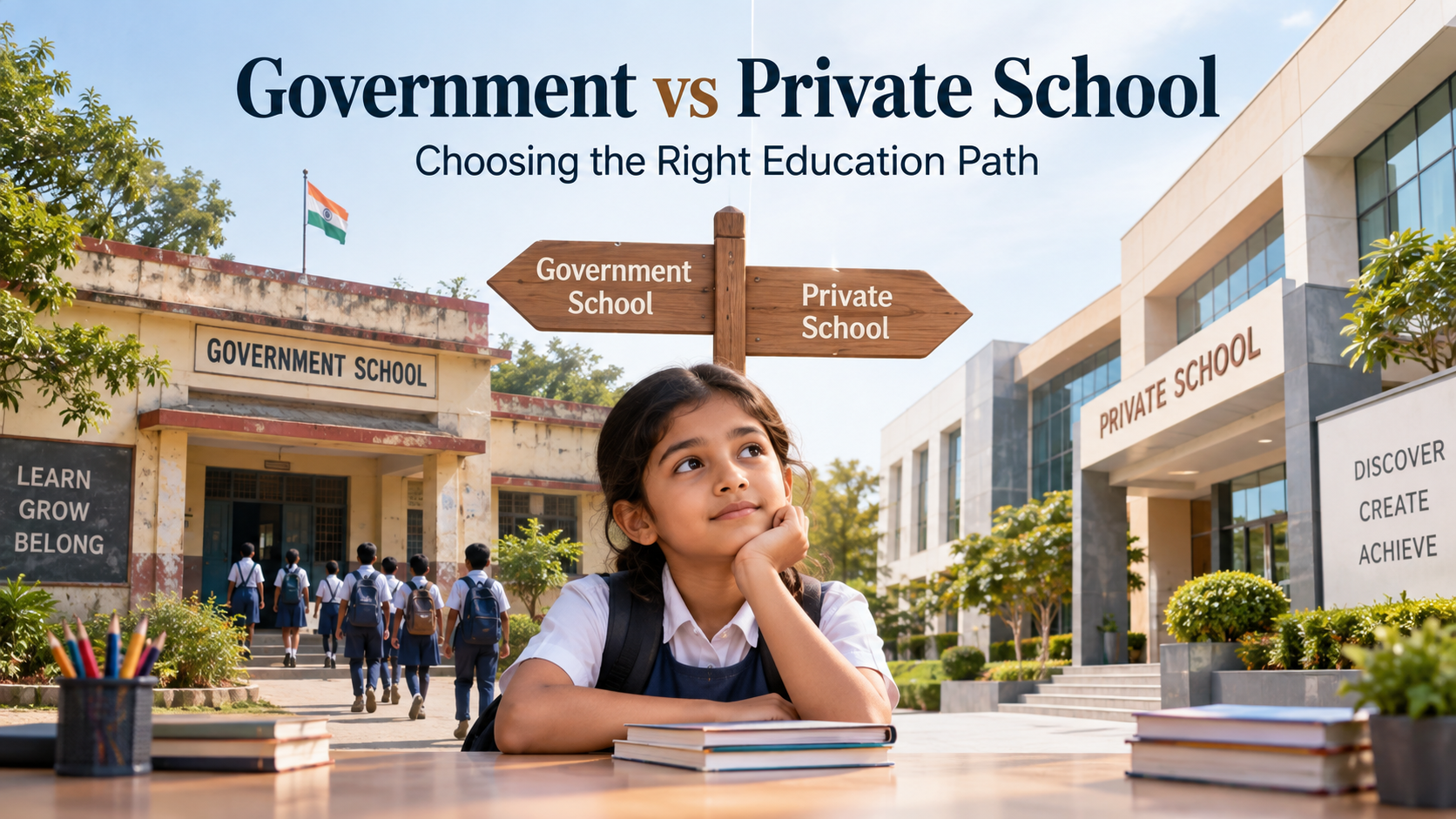
Government vs Private School: Choosing the Right Education Path
Choosing where to send your child is one of the most important decisions a parent can make. The debate over government vs private school education often involves affordability, teaching quality, infrastructure, and future opportunities. Some parents prioritize modern facilities and English-language instruction. Others value lower costs, standardized curricula, and wider social representation.
According to education policies outlined by the Ministry of Education, schooling should support universal access and foundational learning across different socioeconomic groups.
Both systems have strengths and limitations. Factors such as student-teacher ratios, classroom facilities, extracurricular activities, teacher qualifications, and school accountability can affect a child’s experience.
This guide compares government and private schools using practical considerations rather than common assumptions. It also explains the disadvantages of both systems, examines Class 8 detention rules under the amended Right to Education framework, and explores the financial pressures associated with private education. Understanding these differences can help parents make a more informed decision.
Is government school better than private?
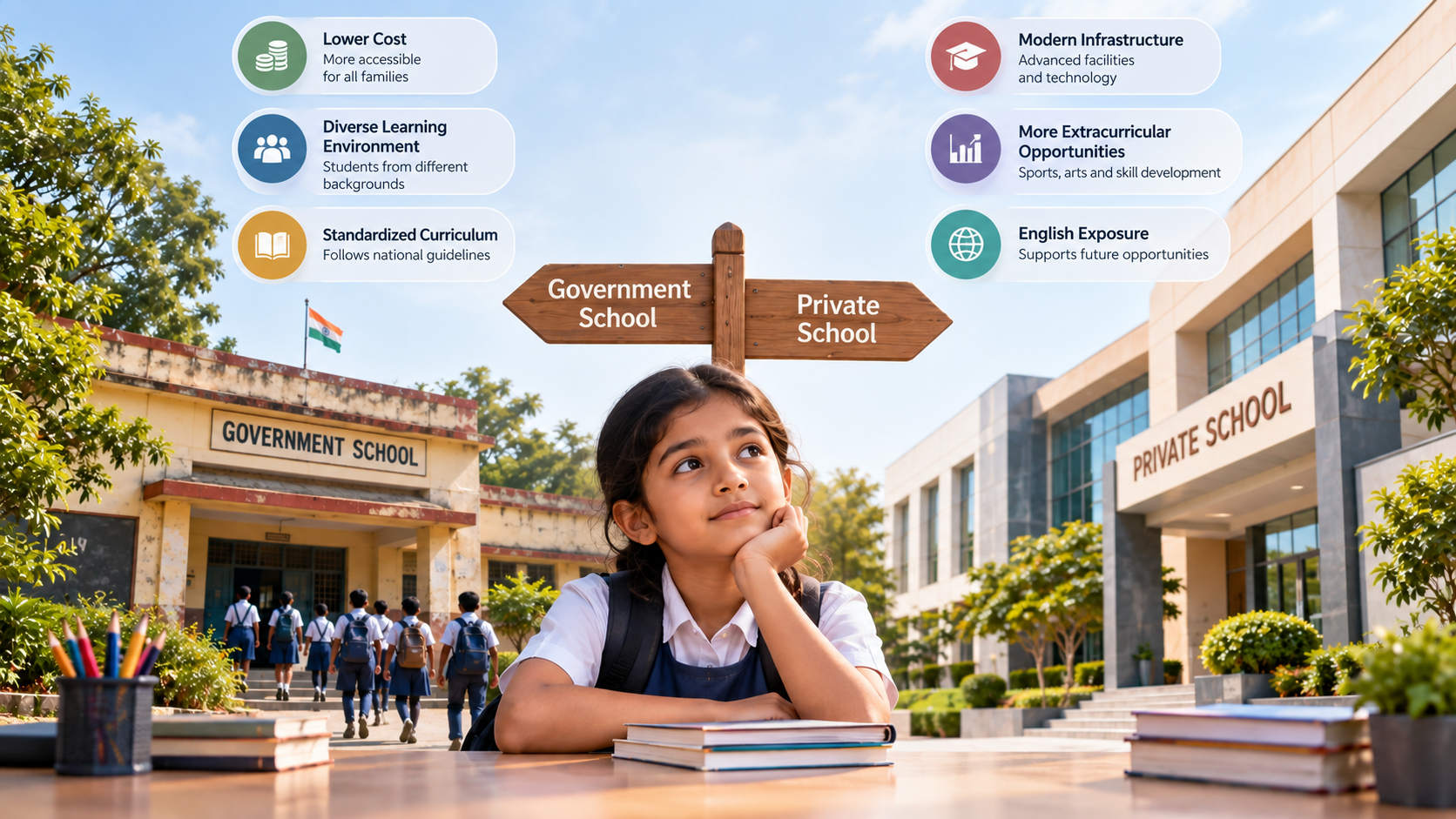
A government school can be a better choice than a private school when affordability, regulated recruitment, and accessibility are the main priorities. Government schools generally charge little or no tuition and may provide benefits such as textbooks, uniforms, or meals under applicable government schemes. This can significantly reduce the financial burden on families.
Government teachers are recruited through state or central processes that usually require prescribed educational qualifications and eligibility requirements. Parents interested in education careers can learn more about how to become a teacher and the steps involved. However, recruitment standards vary between states and school systems. Passing CTET, for example, is relevant to specific central and state recruitment processes, rather than being a requirement for every government teacher.
Public schools also bring together students from varied social and economic backgrounds. This can encourage interaction with children from different circumstances. However, school quality varies considerably by location. Parents should therefore compare the specific school’s teaching quality, facilities, attendance, results, and support services rather than assuming every government school offers the same experience.
Qualified Faculty and National Standards
Government schools generally follow formal teacher recruitment and qualification requirements established by the relevant education authorities. Depending on the school and recruitment process, teachers may need qualifications such as a B.Ed. or other prescribed training. Eligibility tests such as the CTET or state TET can also form part of teacher recruitment requirements.
Teachers may receive professional development through government training programs. They also work within prescribed curricula and educational frameworks. These requirements provide a level of institutional oversight that parents may value.
However, qualifications alone do not guarantee effective teaching. Classroom management, teacher attendance, school leadership, and local resources can influence learning outcomes just as strongly. Parents should therefore look beyond certificates when comparing schools.
The strongest government schools can provide qualified teachers and structured academic programs at a relatively low cost. Yet the experience can differ between districts and states. Checking teacher availability, classroom conditions, academic results, and student support can provide a more accurate picture than judging the entire government sector as a single system.
Is private school better than government school?
A private school can offer advantages over a government school in areas such as infrastructure, classroom technology, communication, and extracurricular exposure. Many private schools invest heavily in computer facilities, activity rooms, sports programs, and digital learning tools. Some also maintain smaller classes, although student-teacher ratios vary widely between institutions.
Private schools may provide more frequent parent communication and structured academic reporting. English-medium instruction is also common, which can benefit students who need regular exposure to spoken and written English.
However, these advantages do not automatically make private schools academically superior. Quality varies significantly between schools, and higher fees do not guarantee better teaching or stronger outcomes. Some budget private schools may have limited facilities and frequent teacher turnover.
Parents should compare schools based on actual teaching quality, teacher stability, curriculum, fees, academic support, safety, and student well-being. Before making a decision, families can also review questions to ask before taking admission to evaluate a school more carefully. A well-managed government school can outperform a poorly managed private school. The right choice depends on the individual school’s quality and the child’s specific needs.
Modern Amenities and Global Exposure
Private schools often have greater flexibility to invest in modern facilities and extracurricular programs. Depending on the institution, students may have access to computer labs, smart classrooms, sports coaching, language programs, robotics activities, debates, and academic competitions.
These opportunities can help students build communication, teamwork, presentation, and digital skills. Regular exposure to English can also improve confidence for students who plan to study or work in environments where English is widely used.
However, the term “global exposure” can be misleading when applied broadly to private education. Not every private school offers international programs or advanced facilities. Some focus mainly on examination performance and traditional classroom instruction.
Parents should therefore examine what a school actually provides. Ask about laboratory access, extracurricular participation, language instruction, student projects, and technology use. It is also useful to check whether students receive meaningful opportunities or simply have access to expensive facilities.
Modern infrastructure can support learning, but good teachers and effective teaching methods remain more important than appearance alone.
What are the disadvantages of government school?
Government schools can face challenges involving infrastructure, overcrowded classrooms, staffing, and administrative responsibilities. The severity of these problems differs significantly between states, districts, and individual schools. Some campuses have strong facilities and effective leadership, while others operate with limited resources.
Large classes can make it harder for teachers to provide individual attention. Schools may also face shortages of subject-specific staff or support personnel. Government teachers can have administrative responsibilities in addition to teaching, although the extent varies by role and location.
Infrastructure can also affect the learning environment. Issues may include inadequate sanitation, limited digital equipment, insufficient classroom maintenance, or restricted access to laboratories and sports facilities.
English-language exposure is another concern for some parents. Students in certain government schools may have fewer opportunities to practice conversational English outside formal lessons. However, this varies considerably by school and region.
The key disadvantage is therefore uneven quality rather than a universal lack of quality. Parents should inspect the specific school, speak with teachers, review attendance and results, and assess facilities before making a decision.
Administrative Burdens and Learning Deficits
Government teachers can sometimes be assigned administrative responsibilities alongside their teaching duties. These may include election-related work, surveys, census activities, or other government assignments. Such duties can place additional demands on staff, although the extent and frequency vary by state and assignment.
When schools face teacher shortages or large classes, maintaining consistent individual attention becomes more difficult. Students who struggle with reading, mathematics, or other foundational skills may then need additional support.
Learning gaps can become more difficult to address when they continue across several academic years. However, it would be inaccurate to assume that every government school suffers from weak accountability or poor learning outcomes. Many schools have active leadership, dedicated teachers, and effective remedial programs.
Parents should focus on measurable indicators instead. Useful factors include student attendance, teacher availability, learning assessments, academic results, remedial support, and classroom conditions. These provide a more reliable basis for comparison than broad assumptions about public education.
Can a private school fail a student of class 8?
Yes, a Class 8 student can potentially be detained under the amended Right to Education (RTE) framework, but the rules depend on the applicable government notification and school system. The original RTE framework introduced a no-detention approach that generally prevented children from being held back until completing elementary education.
The RTE Act was later amended to allow the appropriate government to permit regular examinations in Classes 5 and 8. Where such examinations are implemented, a student who fails must receive additional instruction and an opportunity to take a re-examination.
If the student fails the re-examination, the applicable rules can allow the school to hold the student back. This does not mean every private school can automatically fail a Class 8 student whenever it chooses.
Parents should check the rules issued by their state or Union Territory education authority, along with the school’s board and applicable regulations. The exact procedure can differ depending on the jurisdiction and school category.
State Regulations and Re-Examination Procedures
Under the amended RTE framework, where Class 5 or Class 8 examinations are permitted, students who fail must receive additional instruction and an opportunity for a re-examination. The law provides for the re-examination to take place within two months from the declaration of the result.
During this period, schools are expected to provide additional instruction and guidance to help students address learning gaps. The purpose is to give the child another opportunity rather than immediately imposing detention.
If the student fails the re-examination, the applicable government rules may permit the school to hold the child back in the same class. However, the exact implementation depends on the rules adopted by the relevant government.
This distinction is important because Class 8 detention is not governed by one identical procedure across every Indian school. Parents should verify the current state rules and the school’s affiliation before assuming that a child can or cannot be detained.
What are the disadvantages of private schools in India?
The main disadvantages of private schools in India include higher fees, additional charges, academic pressure, and varying teaching quality. Tuition is often only one part of the total cost. Families may also pay for transportation, uniforms, books, activities, technology, examinations, and other services.
Fee structures can create significant financial pressure, particularly when charges increase over time. Parents should examine the complete annual cost rather than comparing monthly tuition alone. Learning about managing education expenses wisely can also help families plan for tuition and other schooling-related costs more realistically.
Academic pressure can also become a concern. Some schools place strong emphasis on examinations, rankings, homework, and competitive performance. This environment can motivate certain students but may create stress for others when expectations become excessive.
Teacher quality also varies. A private school may have excellent faculty, while another may experience high turnover or rely on less experienced staff. Higher fees do not automatically guarantee stronger instruction.
Parents should therefore evaluate the total cost, teaching stability, workload, academic expectations, student support, and school policies. A private school is valuable only when its educational benefits justify its financial and academic demands for the individual child.
Hidden Commercialization and Financial Stress
Private education can involve expenses beyond the advertised tuition fee. Families may need to budget for admission charges, annual fees, transportation, uniforms, textbooks, activities, technology, and extracurricular programs. These costs can substantially increase the real price of schooling.
Parents should request a complete fee structure before admission. They should also ask which expenses are compulsory and which services are optional. This helps prevent unexpected costs during the academic year.
Another concern is excessive commercialization. Some schools may place strong emphasis on branded products, paid activities, or technology-based services. However, this is not universal, and schools operate under different regulatory requirements.
Financial pressure can become particularly difficult when families choose a school based on reputation or facilities without assessing their long-term affordability. A school should remain financially sustainable for the entire period of enrollment.
Before choosing a private school, parents should compare the total annual cost with actual educational benefits. Families can also explore best child education plan strategies and options in India when planning for long-term schooling expenses. Facilities, technology, and branding should support learning rather than become substitutes for qualified teachers, effective instruction, and student well-being.
Frequently Asked Questions
Conclusion
Deciding between a government vs private school ultimately depends on your family’s financial reality, geographic location, and long-term educational goals. Public institutions provide unparalleled financial relief, verified instructors, and an inclusive social environment that protects families from exploitative educational commercialization. Conversely, private institutions offer modern infrastructure, immersive spoken-English exposure, and strong individual accountability that modern corporate careers often demand.
Neither framework holds a total monopoly on your child’s ultimate success. While a private campus eases early conversational development, a self-motivated student in a public institution can achieve equal or greater academic heights without saddling the household with debt. Look beyond polished marketing materials and scrutinize classroom discipline, faculty retention, and community values. Choose an educational setting that respects your budget while giving your child the emotional stability, conceptual clarity, and curiosity needed to thrive.