
Government vs Private Jobs: Which Is Better for You?

Links

Government vs Private Jobs: Which Is Better for Your Career?

Choosing between government vs private jobs is undoubtedly a major career decision. Both paths offer unique perks. Moreover, they feature completely different work cultures and vastly different financial futures. Therefore, you must weigh these options carefully before deciding.

Furthermore, the U.S. Bureau of Labor Statistics tracks employment data closely. Consequently, their statistics show clear differences in workplace stability. Compensation structures vary greatly between sectors. Similarly, daily expectations differ too.

Understanding these core differences is highly essential. Thus, it helps align your personal strengths with the right sector. Specifically, some people want guaranteed job security above all. In addition, they want predictable schedules and robust pension plans.

Conversely, others thrive in fast-paced corporate settings. These workers love environments that reward merit and rapid innovation. Neither choice is inherently wrong or superior. Instead, the right decision depends entirely on your personal values.

Ultimately, this guide breaks down these vital career paths. We will compare salary trends, growth timelines, and overall work-life balance. Therefore, you will know how to make the best choice for your future.

Government vs private jobs

Which Job Is Better: Government or Private?

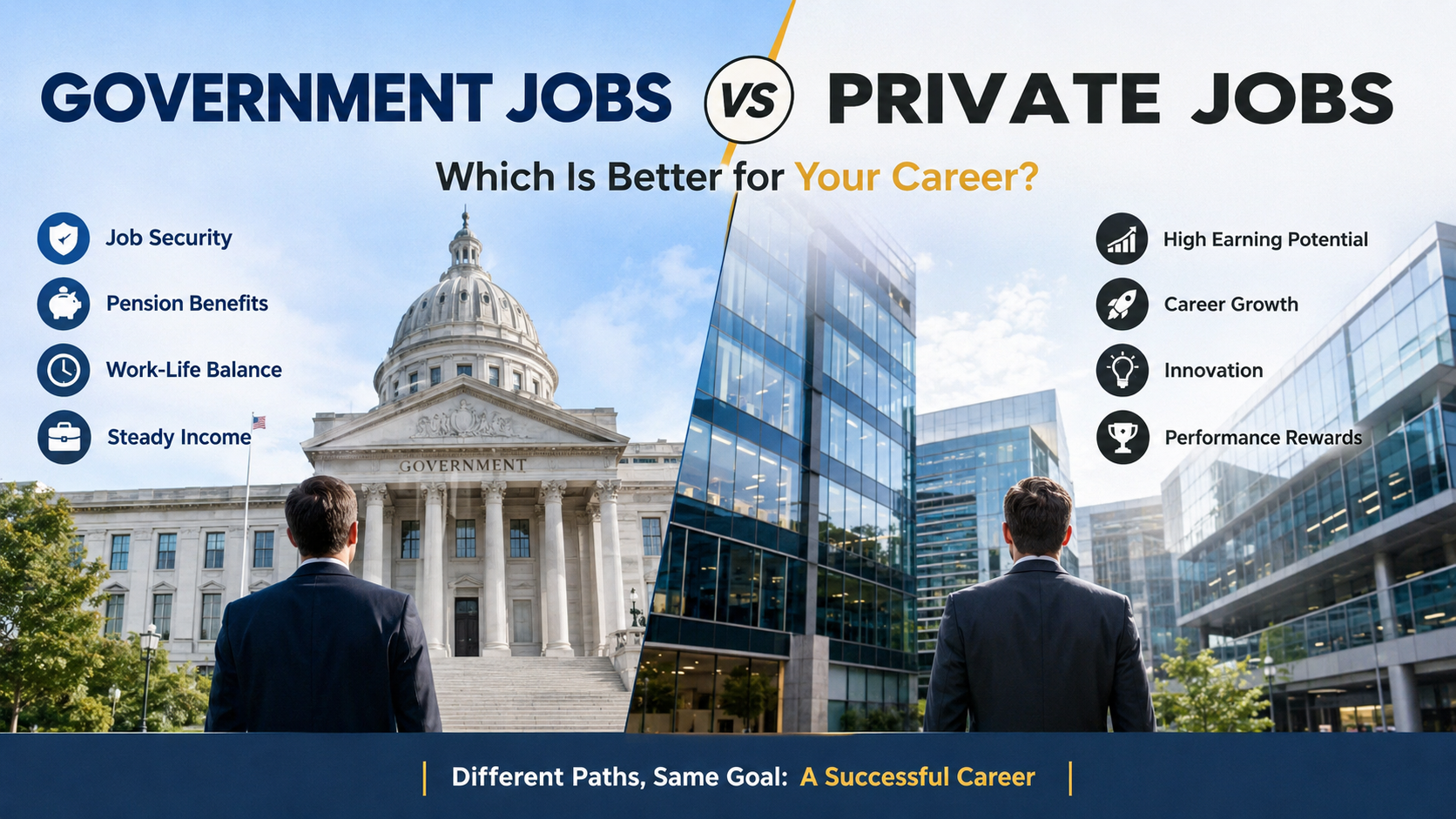
Choosing between a government job and a private job depends on your career goals, financial expectations, and preferred lifestyle. Government jobs are known for job security, fixed working hours, pension benefits in eligible roles, and stable career progression. These advantages make them attractive for people who value long-term stability and predictable employment. However, promotions may follow structured policies and can be slower than in the private sector.

Private jobs, on the other hand, offer faster career growth, higher earning potential, and opportunities to work with new technologies and global organizations. Promotions and salary increases are often based on performance, skills, and business results. When comparing government vs private jobs, neither option is universally better. If you prioritize stability and work-life balance, a government career may suit you better. If you prefer rapid growth, higher salaries, and dynamic work environments, the private sector may be the stronger choice.

Evaluating Personal Career Goals and Risk Tolerance

Before deciding between government and private jobs, assess your long-term career objectives and comfort with professional risk. Government jobs are ideal for individuals who prefer predictable careers, stable income, and lower employment uncertainty. They often appeal to those seeking long-term security and structured work environments.

Private-sector careers are better suited to professionals who enjoy challenges, continuous learning, and faster career progression. These roles often require adapting to changing technologies and business demands. Consider your financial goals, work preferences, and willingness to take risks before making a decision. Choosing a career that matches your personality and ambitions is more important than simply comparing salaries or job titles.

Which Life Is Better: Private or Government?

The lifestyle offered by government jobs and private jobs differs significantly. Government employees usually enjoy fixed working hours, public holidays, and a predictable schedule. This often creates better opportunities for maintaining a healthy work-life balance, spending time with family, and pursuing personal interests.

Private-sector employees may experience tighter deadlines, performance targets, and longer working hours, depending on their role and industry. However, they also benefit from modern workplaces, flexible work arrangements, international exposure, and continuous professional development. The better lifestyle depends on your priorities. If you value stability and routine, a government job may be the better fit. If you enjoy fast-paced work and career growth, private employment may provide greater satisfaction.

Managing Work-Life Balance and Daily Stress

Maintaining a healthy work-life balance is essential for long-term career success. Government jobs generally provide more predictable schedules, making it easier to manage personal responsibilities and reduce workplace stress. Regular working hours also contribute to a more balanced lifestyle.

Private jobs can be more demanding, especially in competitive industries. However, many companies now offer flexible schedules, remote work options, and employee wellness programs. Setting clear boundaries, managing time effectively, and maintaining healthy habits can help professionals succeed in either sector while avoiding burnout.

Whose Salary Is Higher: Government or Private?

In most industries, private jobs offer higher salary potential than government jobs, particularly for skilled professionals in technology, finance, healthcare, consulting, and engineering. Performance-based incentives, annual bonuses, stock options, and rapid promotions can significantly increase total earnings over time.

Government salaries are determined by standardized pay structures and periodic pay revisions. Although starting salaries may be lower than those in the private sector, government employees often receive additional benefits such as housing allowances, medical coverage, travel allowances, and retirement benefits. If maximizing income is your primary objective, the private sector generally provides greater earning potential. However, overall compensation should be evaluated alongside long-term benefits and job security.

Understanding Perks, Benefits, and Total Compensation

Salary alone does not determine the value of a job. Total compensation includes allowances, bonuses, retirement benefits, healthcare, insurance, paid leave, and career development opportunities. Comparing these benefits provides a more accurate picture of overall financial value.

Government jobs often include stable retirement benefits, medical facilities, and generous leave policies. Private companies may offer higher salaries, performance bonuses, learning programs, stock options, and flexible work arrangements. Evaluating the complete compensation package helps you choose the option that best supports your financial goals and lifestyle.

Which Is Better: A ₹40 LPA Private Job or an ₹8 LPA Government Job?

Choosing between a ₹40 LPA private job and an ₹8 LPA government job depends on your priorities rather than salary alone. A ₹40 LPA private role offers significantly higher income, allowing faster wealth creation through investments, property purchases, and long-term financial planning. Skilled professionals may also experience rapid career advancement and higher future earnings.

An ₹8 LPA government job provides exceptional job security, stable income, structured promotions, and valuable retirement benefits. While the salary is lower, the reduced risk of layoffs and predictable career progression appeal to many professionals. If your focus is maximizing earnings and long-term wealth, the private job generally offers greater financial potential. If stability, security, and predictable employment matter most, the government job may be the better choice.

Calculating Long-Term Wealth Versus Job Security

Comparing these career paths requires looking beyond annual salary. A higher private-sector income can generate substantial wealth through disciplined investing and career growth. However, it also comes with greater employment risk and changing market conditions.

Government jobs provide consistent income, long-term stability, and financial security during economic downturns. Consider your investment habits, financial responsibilities, career ambitions, and tolerance for uncertainty before making your decision. The best choice is the one that aligns with both your financial goals and your preferred lifestyle.


Frequently Asked Questions

Are government jobs completely immune to layoffs?

Government jobs offer strong job security and are far less likely to experience layoffs than private-sector positions. Permanent employees are protected by established employment rules and legal procedures. However, disciplinary action, misconduct, or poor performance can still result in dismissal in certain circumstances.

Can I switch from a private job to a government job later in life?

Yes, switching from a private job to a government job is possible if you meet the eligibility criteria. Most government recruitment requires candidates to satisfy age limits, educational qualifications, and competitive examination requirements. Some specialized government positions also recruit experienced professionals from the private sector.

Which sector offers better opportunities for rapid skill development?

The private sector generally provides faster skill development because businesses continuously adopt new technologies and processes. Employees often receive regular training and work on diverse projects. Government jobs also offer learning opportunities, but career development usually follows a more structured pace.

Do government jobs provide better retirement benefits than private jobs?

In many cases, government jobs provide stronger retirement benefits, including pension schemes for eligible employees, provident fund contributions, and healthcare benefits. Private companies also offer retirement plans and employee benefits, but these vary by employer and may not provide the same long-term financial security as traditional government benefits.


Conclusion: Making Your Decision

Comparing government vs private jobs reveals no universal perfect answer. Both distinct career paths offer exceptionally unique advantages. They cater to entirely different personal priorities and psychological preferences.

If you prioritize bulletproof job security, choose the public sector. It offers highly predictable hours and stress-free retirement benefits. Government service allows you to build a reliable, honorable career safely. For additional strategies and exam resources, you can explore this government job preparation guide.

If you seek rapid earning growth, choose the private sector. It provides immediate merit-based professional promotions and cutting-edge technology. Corporate careers beautifully empower ambitious professionals to dictate their advancement speed.

You must carefully assess your current life stage and needs. Define what true success means to you personally. Evaluate your personal tolerance for workplace volatility. Then, confidently choose the path that best supports your vision.


Leave a Reply

Your email address will not be published. Required fields are marked *