
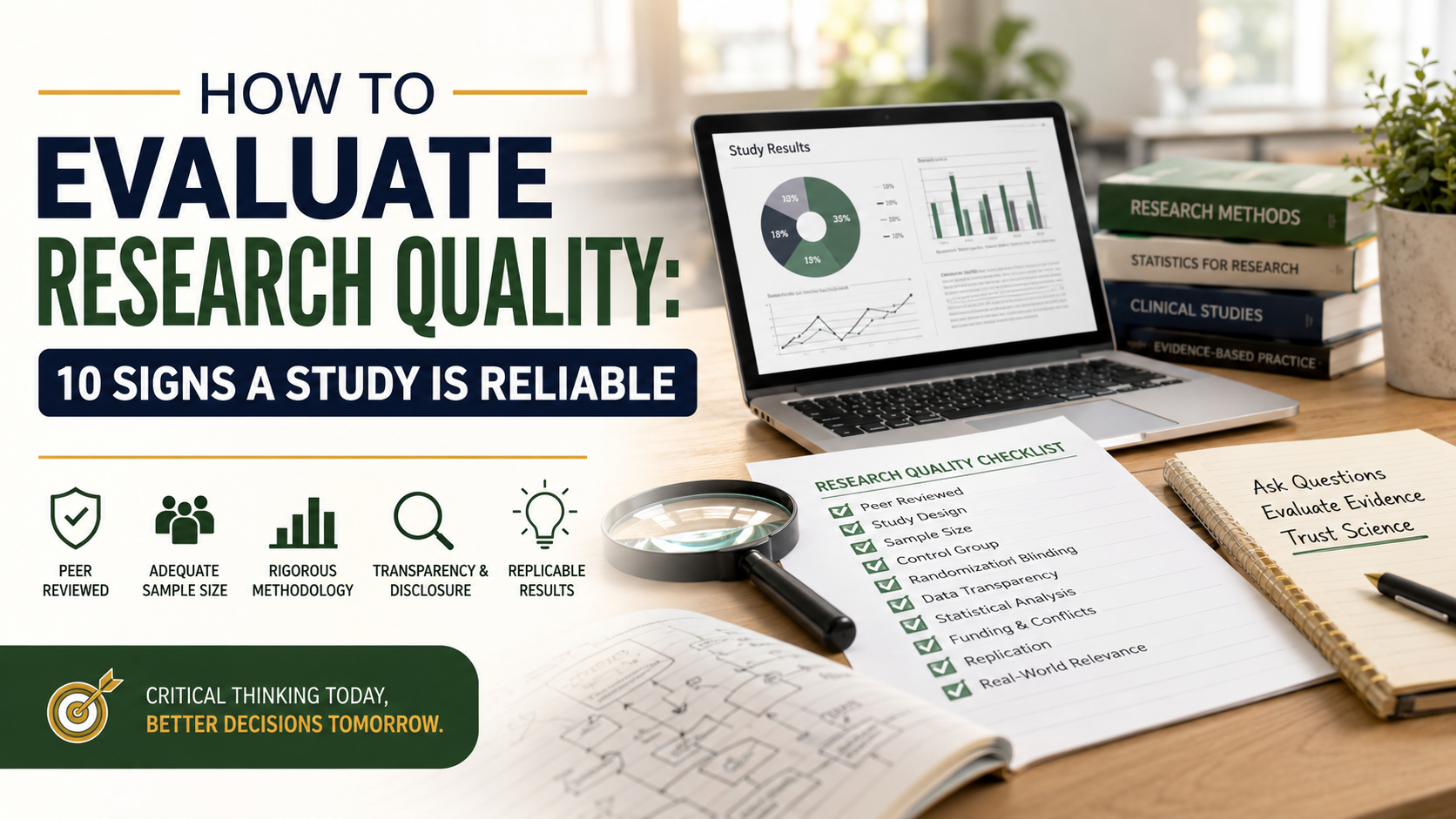
How to Evaluate Research Quality: 10 Signs a Study Is Reliable
Every single day, endless sensational headlines claim a brand-new miracle cure, a sudden dietary threat, or an immediate technological breakthrough. However, not all published information actually deserves your trust or attention. Learning how to evaluate research quality allows you to cut through this overwhelming noise, spot misleading claims, and identify truly credible evidence. To separate solid, reproducible science from flawed or hasty claims, professional researchers constantly rely on established reporting frameworks like those archived on the official National Institutes of Health databases. Understanding these core standards helps you make grounded, highly informed choices about your personal health, business strategy, and daily consumer habits.
Evaluating data properly requires looking past bold claims and dramatic promises. Bad science often relies on tiny sample sizes, missing control groups, selective reporting, or unstated commercial conflicts of interest. Conversely, trustworthy studies use rigorous methodologies, open statistical reporting, and rigorous peer review to ensure absolute accuracy. When you know exactly what signs to look for, you can quickly evaluate whether a scientific study holds up under genuine scrutiny or crumbles under pressure.
This comprehensive guide breaks down ten highly practical markers of dependable research. You will learn how sample sizes impact statistical validity, why peer review remains essential, and how to spot underlying bias before accepting claims as absolute fact.
What Makes a Scientific Study Trustworthy?
Reliable research builds on clear hypotheses, completely transparent methods, and replicable results across different environments. Scientists must design every experiment to test variables fairly without slanting the eventual outcome toward a preferred conclusion. Furthermore, dependable studies always publish their full methodology down to the finest detail. Transparent methods allow completely independent research teams across the globe to reproduce the exact experiment and verify the findings. Without this fundamental transparency, readers cannot assess whether positive results came from sound science, sloppy execution, or simple statistical luck. A trustworthy study embraces scrutiny rather than avoiding it.
In addition to transparency, trustworthy research demonstrates a clear understanding of its own limitations. No single study can answer every variable or account for every real-world scenario. High-quality papers explicitly discuss what the data cannot prove, framing results in context rather than making absolute, sweeping generalizations. They balance enthusiasm for new findings with healthy academic caution, ensuring that readers understand both the potential applications and the boundaries of the discovery. This objective, grounded perspective separates legitimate research from hype.
10 Critical Signs of High-Quality Research

1. Publication in a Reputable, Peer-Reviewed Journal
Peer review acts as the primary quality control filter in the world of academic publishing. Before a respected, reputable journal publishes a paper, independent domain experts thoroughly examine the experimental design, statistical analysis, and overall conclusions. They check for methodology errors, logical flaws, and unproven claims.
-
Look for journals indexed in major, established academic databases like PubMed, IEEE Xplore, or Web of Science.
-
Beware of predatory journals that skip rigorous peer review simply to collect publication fees from authors.
-
Check if the journal has a clear editorial board composed of active, recognized researchers in that field.
2. A Clear and Adequate Sample Size
Small sample sizes frequently generate misleading outliers that do not reflect reality. A study examining five people cannot possibly represent a diverse population of millions, as individual quirks will skew the entire dataset. Large sample sizes average out noise and provide a far clearer picture of genuine effects.
-
Large, representative samples dramatically reduce statistical noise and chance anomalies.
-
High-quality researchers calculate their required sample sizes before starting the experiment to ensure statistical power.
-
Ensure the sample demographic matches the group the study claims to inform or influence.
3. Use of Proper Control Groups
Control groups give scientists an essential baseline for comparison. Without a well-designed control group, you simply cannot prove that a specific treatment or intervention caused the observed result, as natural changes or placebo effects could be responsible.
-
Placebo controls prevent psychological expectations from altering results in human trials.
-
Matching control groups carefully for age, gender, and background improves the overall precision of the study.
-
Studies without control groups should generally be viewed as preliminary or exploratory observations rather than proof.
4. Randomization and Blinding Protocols
Randomization prevents researchers from accidentally or intentionally picking subjects that favor their starting hypothesis. Blinding ensures that participants and researchers remain unaware of who received the active treatment, removing subconscious bias from evaluation.
-
Single-blind: Participants do not know whether they are in the test group or the control group.
-
Double-blind: Neither the participants nor the researchers running the trial know who received the active treatment.
-
Double-blind protocols represent the gold standard in clinical and behavioral trial design.
5. Transparency About Funding and Conflicts of Interest
Financial backing can subtly or overtly influence study design, execution, and data interpretation. High-quality research papers disclose all funding sources, commercial partnerships, and author affiliations clearly near the beginning or end of the text.
-
Corporate funding does not automatically invalidate research, but it always warrants closer inspection of the methodology.
-
Independent grant funding from public institutes or nonprofit foundations generally carries a lower risk of commercial bias.
-
Look for clear statements confirming that sponsors had no say in the final decision to publish.
6. Sound Statistical Significance and Effect Size
Scientists use statistical tests to check whether their experimental results happened by random chance. However, statistical significance alone does not mean a result carries real-world value or practical importance.
-
Look for reasonable p-values (typically below 0.05) alongside clear confidence intervals to gauge precision.
-
Check the effect size to determine if the outcome actually offers meaningful real-world impact.
-
A result can be statistically significant while being too tiny to matter in daily life.
7. Replicable Methods and Open Data
A single, isolated study rarely provides a definitive answer to a complex scientific question. High-quality research provides detailed step-by-step protocols so other laboratories can repeat the exact steps and confirm the original findings.
-
Look for explicit statements confirming that raw datasets are publicly accessible for independent audit.
-
Check whether independent research teams have successfully reproduced the results in subsequent publications.
-
Beware of proprietary or secret methods that prevent external scientists from validating the claims.
8. Logical Conclusions That Match the Data
Sensational claims often far outstrip the actual findings presented in a study. Trustworthy authors keep their conclusions strictly grounded in the specific data they collected, avoiding exaggerated assertions.
-
Watch out for studies claiming direct causation when their design only proved a simple correlation.
-
Reliable authors explicitly discuss study limitations and potential confounding variables in the discussion section.
-
Extraordinary claims require extraordinary evidence; modest findings should yield modest, carefully framed conclusions.
9. Citation of Existing, High-Quality Literature
Solid research places its new findings directly within the broader context of existing science. Authors should cite relevant, peer-reviewed studies across the field rather than relying on isolated blogs, news pieces, or cherry-picked papers.
-
Careful citation demonstrates that the authors thoroughly understand the historical context of their discipline.
-
Over-reliance on self-citation or citing only friendly colleagues can indicate a narrow, biased perspective.
-
Check whether the literature cited comes from reputable, peer-reviewed sources in the same field.
10. Pre-Registration of the Trial Protocol
Pre-registration requires researchers to publicly state their primary hypothesis and statistical analysis plan before gathering any data. This critical step prevents scientists from changing their goals mid-way to hide negative results.
-
Pre-registration drastically reduces selective outcome reporting and hidden goalpost moving.
-
It protects against “p-hacking,” where datasets are repeatedly manipulated until a statistically significant pattern appears.
-
You can verify pre-registration on public registries like ClinicalTrials.gov or the Open Science Framework.
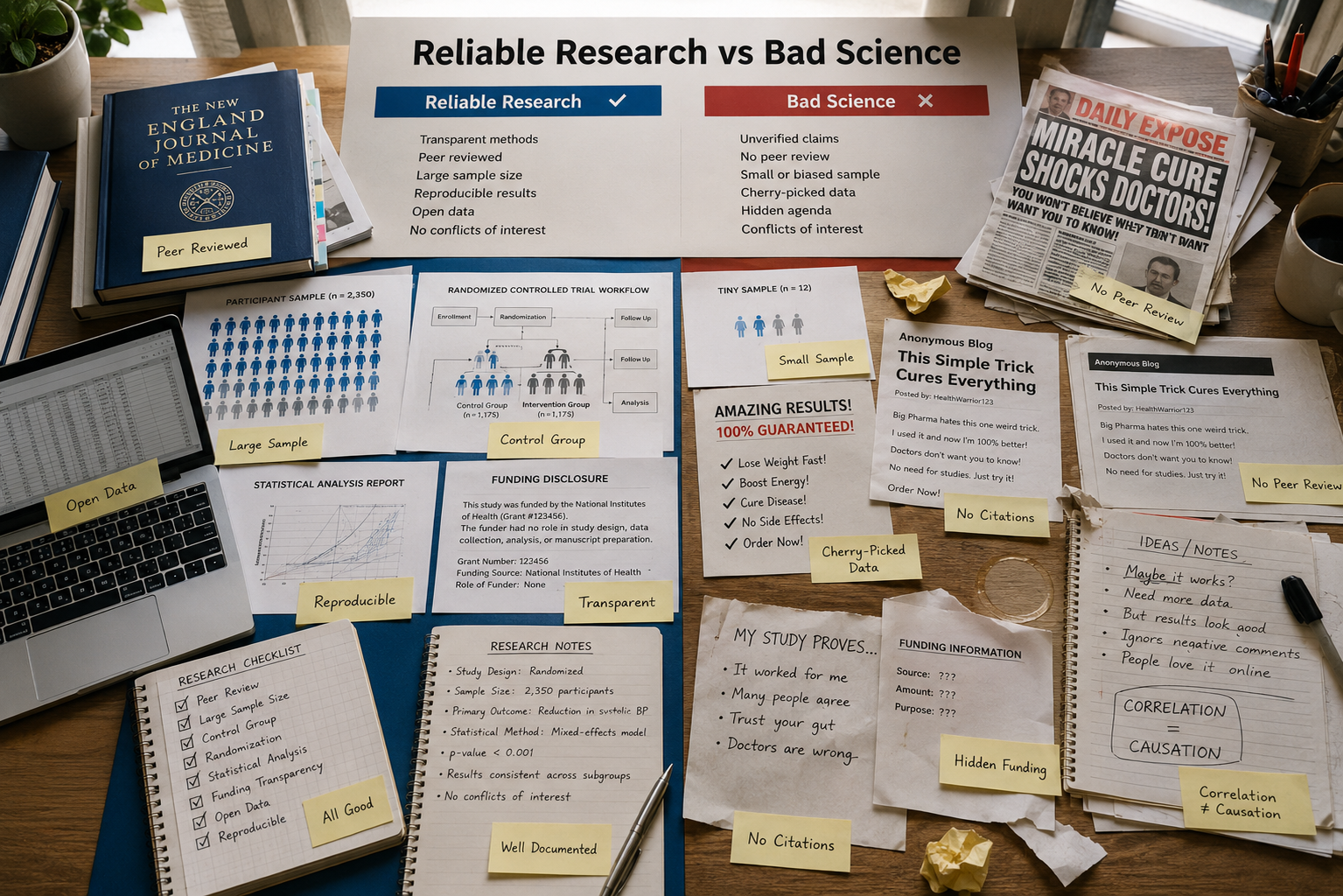
Red Flags: How to Evaluate Research Quality and Spot Bad Science
Knowing the warning signs of bad research is just as important as identifying good studies. When you learn how to evaluate research quality, you should approach claims with extreme caution whenever you spot common methodological red flags. Relying on poor data can lead to bad decision-making in personal health, finance, and career strategy.
One of the biggest red flags is an overreliance on personal anecdotes over systematic data collection. While individual stories sound compelling, they do not replace structured, controlled observation. Additionally, watch out for sensational headlines that use absolute terms like “miracle cure” or “overnight secret.” Real scientific progress is usually incremental and measured rather than sudden and miraculous.
-
Cherry-picked data: Authors intentionally ignore conflicting evidence to support their preconceived view.
-
Missing peer review: Studies published directly on commercial websites often lack independent scientific validation.
-
Confounding variables: The researchers failed to account for outside factors that influenced the final results.
Frequently Asked Questions
What is the fastest way to evaluate research quality?
The fastest way to evaluate research quality involves performing an immediate three-point check: review the publication journal, inspect the sample size, and examine the financial funding disclosures. First, verify whether the study appears in a peer-reviewed journal indexed within reputable databases like PubMed or Web of Science rather than a self-published website. Next, scan the methodology section to confirm the sample size is large and representative enough to support the conclusions being drawn. Finally, check the conflict of interest section to see who funded the work. While this quick appraisal does not replace a complete methodological audit, it instantly filters out low-quality marketing reports, press releases, and biased trials.
Why does peer review matter when judging a study?
Peer review matters because it serves as the scientific community’s primary line of defense against flawed methodology, unsupported claims, and poor logic. Before a paper reaches publication in a legitimate journal, independent domain experts meticulously critique the experimental design, statistical evaluations, and underlying conclusions. This rigorous review process catches hidden experimental errors, biased sampling, and unproven claims that non-experts might easily overlook. While peer review is not entirely foolproof, work published in a reputable peer-reviewed journal possesses far higher credibility and scientific weight than unverified white papers, commercial blog posts, or self-published reports that bypass expert validation altogether.
What is the difference between correlation and causation?
The critical difference between correlation and causation centers on whether one event directly brings about another. Correlation simply means that two variables change or move together in a recognizable pattern, whereas causation proves that one variable actively causes the other to occur. For example, ice cream consumption and sunburn rates both increase during summer months, demonstrating a strong statistical correlation. However, eating ice cream does not cause sunburns; increased exposure to sunlight causes both events simultaneously. High-quality research uses randomized control groups and rigorous statistical controls to isolate variables and prove genuine causation rather than highlighting accidental coincidences.
How does sample size affect study reliability?
Sample size directly determines how accurately a study reflects real-world populations and broad truths. Tiny sample sizes heavily amplify random chance, leading to false positives, distorted statistics, and exaggerated findings that fail when tested again. Conversely, large sample sizes minimize statistical noise, smooth out individual anomalies, and deliver far more accurate estimates of true real-world effects. A trial examining ten people might show a dramatic ninety-percent success rate purely due to random luck or specific subject selection. A study involving thousands of randomized participants provides a vastly more reliable foundation for drawing actionable conclusions.
Can a study funded by a company still be reliable?
Yes, a study funded by a commercial company can certainly remain valid, scientifically rigorous, and trustworthy. Major private investments drive crucial technological, medical, and industrial innovations every year. However, commercial funding inherently introduces a potential conflict of interest that requires readers to exercise heightened scrutiny. When evaluating corporate-backed research, inspect whether the experimental protocol was publicly pre-registered before data collection began, whether independent academic researchers led the investigation, and whether the authors made their raw data fully accessible for outside audit. Full methodological transparency remains the key to validating corporate-funded science.
Conclusion
Learning how to evaluate research quality is an essential skill in an age flooded with constant media noise and aggressive marketing. By systematically checking for rigorous peer review, representative sample sizes, proper control groups, and open datasets, you can confidently separate reliable evidence from weak claims. Always look beyond sensational headlines and scrutinize the underlying methodology before accepting new findings as absolute truth.
Developing a sharp, critical mindset takes continuous practice, but the long-term benefits are substantial. Understanding the difference between research-based and evidence-based information can also help you evaluate claims more effectively and make informed decisions. You will make vastly superior decisions regarding your health, investments, and professional strategy when you base them on dependable science. Use these ten critical signs as a practical checklist whenever you need to evaluate research quality in daily life.