
Entrepreneurship and Business Fundamentals: Master Success
Starting a new venture is an incredibly exhilarating journey, but relying solely on raw passion rarely guarantees long-term commercial success. To build a truly resilient enterprise, founders must thoroughly master entrepreneurship and business fundamentals before launching their products into a fiercely competitive marketplace. Understanding these core pillars transforms a fragile startup idea into a structured, highly scalable corporation. According to resources provided by the U.S. Small Business Administration, strategic planning, risk management, and foundational legal knowledge are critical early milestones that safeguard early-stage companies from premature failure.
This comprehensive guide pulls back the curtain on what it really takes to transition from an aspiring creator to a seasoned business owner. We will explore market validation, financial mechanics, operational frameworks, and modern customer acquisition strategies. Furthermore, this breakdown provides actionable frameworks designed to mitigate risk while maximizing your market share. Whether your goal is to launch a local service business or scale a global technology platform, mastering these basics will serve as your ultimate growth blueprint. Embracing these core principles helps you make data-driven decisions that foster lasting enterprise value.
The Essential Blueprint for Modern Business Growth
Market Validation: The Core of Entrepreneurship and Business Fundamentals
Every successful enterprise begins by solving a real, deeply painful problem for a specific group of people. Market validation is the systematic process of proving that a genuine demand exists for your proposed solution before you invest significant capital. Too many founders commit the fatal error of building a product based on assumptions rather than concrete data. To avoid this trap, you must engage directly with your target audience through surveys, focus groups, and structured interviews to gather honest feedback.
Proving your concept early saves thousands of dollars and months of wasted development time. It allows you to refine your value proposition so that it resonates deeply with buyers. During this phase, you should focus on creating a Minimum Viable Product (MVP), which is a basic version of your offering containing only the essential features. Testing an MVP in the real world provides immediate, actionable insights that guide your product roadmap. By listening to early adopters, you can safely pivot your strategy before scaling up.
Identifying Your Ideal Customer Profile
You cannot sell your product to everyone, and attempting to do so will quickly drain your marketing budget. Founders must explicitly define their target market through psychographics, buying behaviors, emotional pain points, and clear demographics. Creating highly detailed buyer personas allows you to tailor your product features and copywriting precisely to the people most likely to buy.
Understanding your customer journey ensures that your sales messaging hits the right notes at the right time. When you know their daily frustrations, you can position your product as the ultimate relief. This targeted approach dramatically improves your conversion rates and fosters long-term customer loyalty from day one.
Conducting Competitive Analysis
To stand out in a crowded marketplace, you must thoroughly evaluate your existing and indirect competitors. Identify their strengths, weaknesses, pricing strategies, customer service flaws, and overall market positioning. Discovering a clear gap in their service offers you a powerful competitive advantage that you can exploit immediately.
Analyze their customer reviews to see what users complain about most frequently. If their users struggle with poor customer support or outdated software interfaces, make those areas your core strengths. Continuous competitive analysis ensures you remain proactive rather than reactive, keeping your brand ahead of industry shifts.
[Identify Problem] ➔ [Define Target Market] ➔ [Analyze Competitors] ➔ [Test MVP]
Financial Literacy: Budgeting and Corporate Commercial Foundations
Cash flow is the undisputed lifeblood of any young enterprise, regardless of industry. A brilliant concept will quickly collapse if you run out of capital before reaching operational profitability. Founders must learn to read financial statements with confidence, treat budgeting as a daily discipline, and monitor their burn rate constantly. Managing expenses prudently while aggressively pursuing revenue opportunities creates financial runway for your team.
Understanding the difference between cash flow and net profit is vital for survival. A business can look highly profitable on paper while completely lacking the actual cash required to pay its immediate bills. By maintaining a healthy capital reserve, you protect your company from unexpected market downturns and sudden economic shifts. Sound financial habits build immense trust with banking institutions, vendors, and future investment partners.
-
The Big Three Statements: You must master the Balance Sheet, Income Statement, and Cash Flow Statement to accurately track your financial health over time.
-
Pricing Strategy: Set your prices based on customer value, production costs, and competitor benchmarks to protect your long-term profit margins.
-
Bootstrapping vs. Raising Capital: Decide early if you will self-fund your growth through revenue or pitch to venture capitalists and angel investors.
Operations Strategy: Establishing Solid Business Management Pillars
Operations represent the engine room of your company, dictating how efficiently inputs turn into valuable outputs. Streamlining your day-to-day workflows ensures that your business runs smoothly without requiring your constant, direct supervision. Documenting your standard operating procedures (SOPs) allows you to delegate critical tasks to your team members with complete confidence.
An efficient operational framework reduces waste, optimize resource allocation, and improves overall team productivity. As your customer base grows, your systems must scale seamlessly alongside it without causing service degradation. Focusing on operational excellence allows leadership to step away from daily firefighting and concentrate fully on long-term macro strategy.
Embracing Digital Transformation
Modern business requires the deliberate adoption of cloud-based infrastructure to maintain agility. Utilizing robust project management software, automated customer relationship management (CRM) platforms, and centralized communication tools eliminates costly operational friction. Automation saves valuable time and minimizes the risk of human error across all departments.
By integrating your software applications, you create a single source of truth for your corporate data. Employees can access information instantly, leading to faster decision-making and better internal collaboration. Embracing digital tools ensures your business remains nimble enough to adapt to rapidly evolving industry standards.
Supply Chain and Inventory Management
If your business sells physical products, managing your supply chain efficiently is absolutely non-negotiable. Establish strong, transparent relationships with multiple reliable vendors to avoid sudden production disruptions or unexpected material shortages. Implementing just-in-time inventory practices helps keep your overhead costs low while meeting customer demand promptly.
Regularly audit your fulfillment processes to find bottlenecks that slow down shipping times. Optimized logistics directly improve customer satisfaction and encourage repeat purchases. By protecting your supply chain from volatility, you secure a stable foundation for predictable business scaling.
Strategic Marketing: The Growth Engine of Entrepreneurship and Business Fundamentals
Great products fail every single day simply because nobody knows they exist in the market. Developing a scalable, predictable customer distribution engine is what separates market leaders from struggling startups. When applying entrepreneurship and business fundamentals, you must combine organic brand building with targeted outreach to capture attention, build deep trust, and convert casual prospects into brand advocates.
A diverse marketing mix protects your business from relying too heavily on a single traffic source. As algorithms change, having multiple acquisition channels ensures your pipeline remains full. Consistency in your messaging across all platforms establishes a strong brand identity that customers remember easily over time.
Content Marketing and Organic Search
Building long-term brand authority requires a consistent commitment to organic search growth. By publishing deeply educational, SEO-optimized content, you attract high-intent web visitors without paying for every single click. This strategy builds sustainable trust and positions your brand as an authoritative industry thought leader.
Organic content keeps working for your business long after it is originally published. It addresses customer questions, reduces the burden on your support team, and nurtures prospects through the sales funnel automatically. Over time, high search rankings turn your website into a powerful asset.
Paid Acquisition and Performance Marketing
When you need immediate traffic and fast data, paid channels like Google Ads and Meta campaigns offer rapid scalability. Carefully track your Customer Acquisition Cost (CAC) against your Customer Lifetime Value (LTV) to protect your bottom line. Your LTV must comfortably exceed your CAC to ensure profitable, sustainable long-term scaling.
Analyze your ad performance weekly to eliminate low-performing campaigns and scale winning creatives. Paid acquisition provides the immediate visibility required to test new offers and land early customers quickly. When balanced correctly with organic marketing, it creates a highly aggressive growth engine.
FAQ SECTION
What are the four pillars of entrepreneurship and business fundamentals?
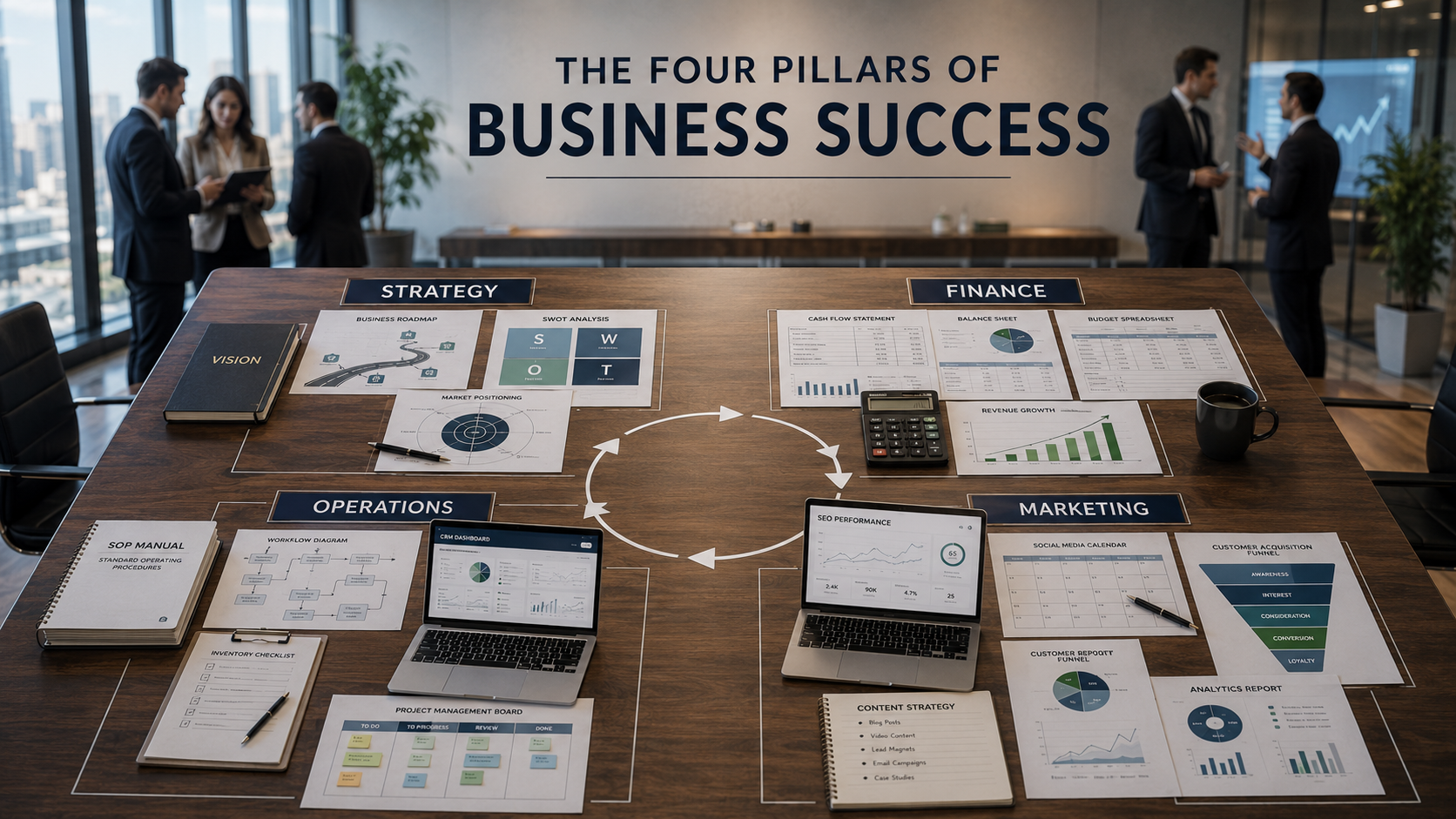
The four pillars encompass strategy, finance, operations, and marketing. Strategy focuses on defining your core value proposition, identifying market trends, and establishing a sustainable competitive position. Finance ensures you manage your cash flow, analyze profit margins, set correct pricing, and secure appropriate funding intelligently. Operations deal with building scalable internal systems, managing supply chains, maintaining legal compliance, and streamlining daily workflows. Finally, marketing governs how you attract, convert, and retain customers over time through targeted channels. Balancing these four distinct components creates a highly stable, resilient foundation for long-term growth. When a founder ignores any single pillar, the entire enterprise becomes vulnerable to market pressures. Therefore, developing a holistic understanding of all four disciplines is essential for anyone wishing to transition from a simple solopreneur to a successful chief executive officer who leads an enduring organization.
How do I write an effective business plan for a new startup venture?
An effective business plan outlines your company objectives, target market, financial projections, and operational strategy clearly and realistically. Keep it concise, professional, and entirely data-driven, avoiding overly optimistic assumptions that cannot be backed up by research. Start with a compelling executive summary that captures attention, followed by a detailed market analysis proving consumer demand. Include realistic financial forecasts, such as break-even analyses and cash flow projections for the next three to five years. Update this document regularly as your business pivots, gathers real-world market feedback, and adapts to economic shifts. A business plan should act as a living roadmap rather than a static document forgotten in a drawer. Investors look for clarity, risk mitigation strategies, and a deep understanding of milestones, making execution detail far more valuable than vague, idealistic prose.
Why do most early-stage startups fail within the first five years of operation?
Most startups fail due to a lack of market need, poor cash flow management, or wrong team alignment. Many passionate founders build products before validating actual customer demand, resulting in solutions looking for a problem. Others mismanage their working capital, burning through their seed funding before achieving true product-market fit or generating consistent revenue. Understanding foundational business principles mitigates these risks significantly by emphasizing rigorous market research, disciplined cash flow tracking, and agile execution strategies. Additionally, internal team conflicts and a lack of complementary skills often derail promising ventures before they can scale. By focusing on fundamental business health over vanity metrics, entrepreneurs can spot warning signs early, adjust their operations, and protect their capital reserves, thereby beating the statistical odds of early failure.
What is the difference between bootstrapping and venture capital funding for growth?
Bootstrapping means self-funding your company using personal savings, lean initial operations, and early customer revenue to fuel your growth. This approach allows you to retain full equity ownership and complete operational control, though your overall scaling speed might be significantly slower. Conversely, venture capital involves selling a percentage of corporate equity to professional investors in exchange for substantial, rapid growth funding. This accelerates your time-to-market and allows for aggressive customer acquisition, but it introduces heavy external pressure and dilutes your founder ownership. The right choice depends entirely on your personal goals, industry dynamics, and how fast your market moves. Bootstrapped founders answer only to their customers, whereas venture-backed founders must meet strict quarterly milestones set by a board of directors aiming for a massive exit.
How can a new entrepreneur successfully protect their corporate intellectual property?
Entrepreneurs protect their innovations through patents, trademarks, copyrights, and strict non-disclosure agreements (NDAs). Trademarks safeguard your unique brand name, logos, and slogans, while utility patents secure proprietary technologies, inventions, and mechanical processes. Use robust NDAs whenever you are discussing proprietary ideas or trade secrets with external partners, contractors, or overseas manufacturers. Consulting an experienced intellectual property attorney early in your journey safeguards your competitive advantage from future corporate infringement or theft. Failing to secure these legal rights early can lead to costly litigation or competitors copying your exact business model without legal consequences. View intellectual property protection as a mandatory insurance policy that builds long-term enterprise value and reassures institutional investors that your market position is fully defensible.
CONCLUSION
Building a thriving company requires a delicate, continuous balance between visionary thinking and strict operational discipline. By mastering entrepreneurship and business fundamentals, you equip yourself with the essential tools needed to navigate the volatile landscape of modern commerce. Remember that sustained business success is rarely a matter of luck; it is the predictable result of thorough market validation, sound financial stewardship, and relentless operational execution.
Do not rush the foundational process of setting up your venture. Take the necessary time to analyze your competitors, optimize your monthly cash flow, and build scalable systems that can support long-term growth. As you implement these core principles, focus on delivering consistent value to your target audience while continuously developing the essential skills needed to start an art business if you’re entering the creative industry. Now is the perfect time to audit your current business strategy, identify operational bottlenecks, and apply these fundamentals to build a sustainable, profitable enterprise. True leadership is about turning chaos into order, and by anchoring your business in proven fundamentals, you ensure your company is built to last.