

Driving Question Board: Make It More Than a Display
Transforming a static classroom wall into a dynamic driving question board can change how students engage with daily lessons. Instead of serving as decoration, the board becomes a central space for curiosity, inquiry, and critical thinking. Students actively post questions, organize ideas, and revisit their inquiries as they learn.
This interactive approach encourages learners to take ownership of their educational journey. It also supports student-centered teaching by connecting classroom activities with meaningful questions and real-world problems. Resources from Edutopia offer educators ideas for creating engaging, student-focused learning environments. Similarly, PBLWorks provides practical resources on project-based learning that can help teachers design meaningful, student-centered investigations.
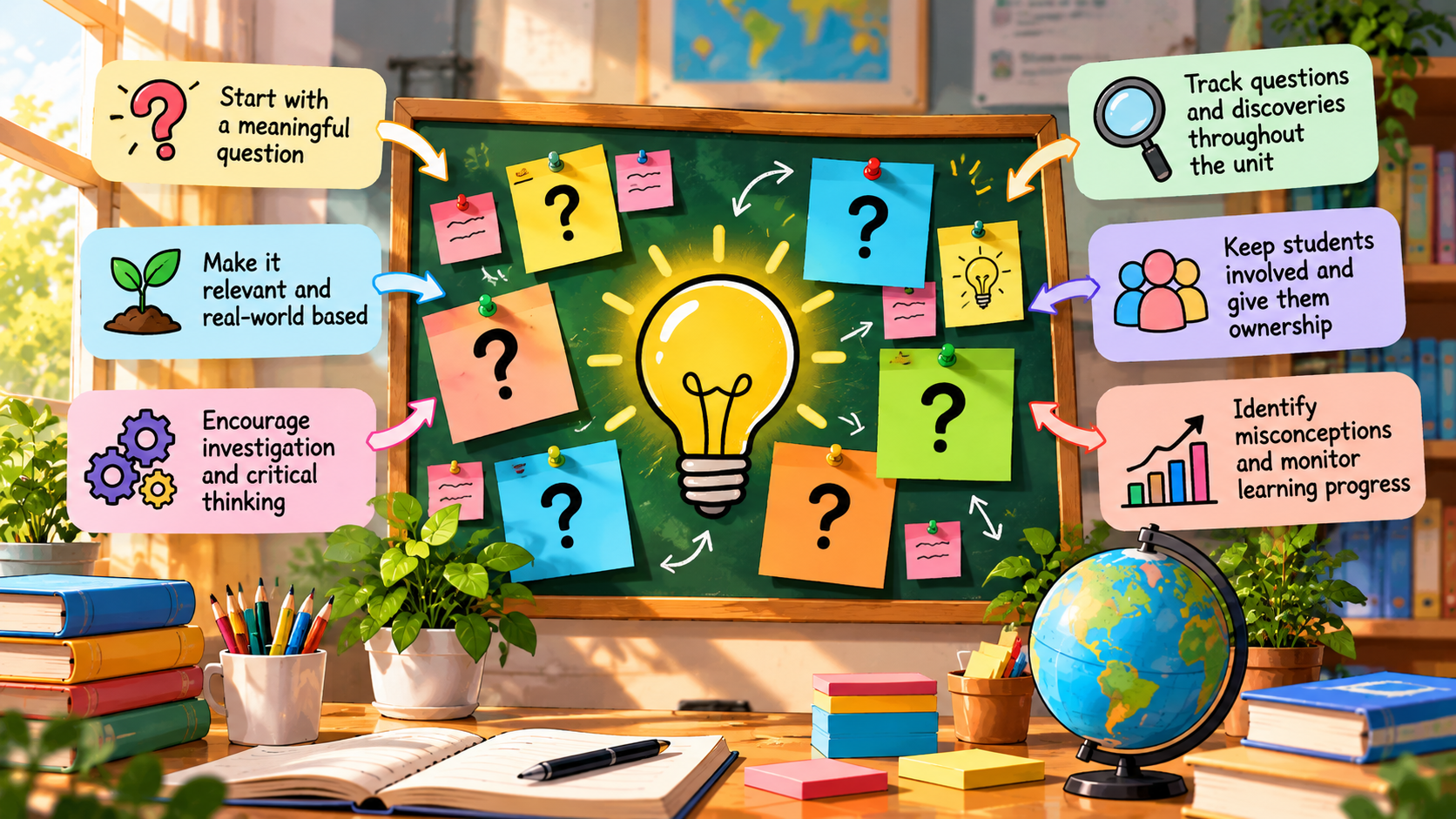
A well-designed driving question board does more than display questions. It helps teachers identify misconceptions, track learning progress, and connect lessons to students’ interests. This guide explains how to create effective driving questions, understand the role of DQBs in science, and design attractive classroom displays. You will also learn about different bulletin board types, their benefits, and practical ways to keep students involved throughout a learning unit.

How to make a driving question?
Creating an effective driving question starts with a meaningful problem, real-world phenomenon, or challenge that students can investigate. Avoid questions that require only a yes-or-no answer or a simple fact. Instead, encourage learners to explore possibilities, collect evidence, and develop explanations.
For example, rather than asking, “Does sunlight help plants grow?” consider, “How can we design a garden that helps plants grow with limited sunlight?” The second question encourages investigation, experimentation, and creative problem-solving.
Teachers can develop driving questions collaboratively with students at the beginning of a project. Ask learners what they notice, what surprises them, and what they want to understand. Then connect their interests to curriculum standards and learning objectives.
A strong question should be understandable, relevant, and challenging without feeling impossible. It must also guide several lessons rather than support only one classroom activity. Once the question is established, display it prominently on the driving question board. Students can then add related questions, suggest investigations, and revisit their ideas as new evidence emerges.
What is DQB in science?
In science education, DQB stands for Driving Question Board. It is a visual workspace where students record questions, explore ideas, and track discoveries throughout a learning unit. Teachers commonly use this approach in inquiry-based science instruction and phenomenon-driven learning.
The board usually begins with an engaging scientific phenomenon or central question. Students observe the phenomenon and write down what they wonder about it. Teachers display these questions on sticky notes, index cards, or digital boards.
As the investigation progresses, learners organize similar questions into categories. They identify misconceptions, connect evidence to their inquiries, and discuss which questions remain unanswered. For example, a lesson about changing weather might generate questions about clouds, temperature, rainfall, and wind patterns.
A driving question board also helps teachers plan investigations around students’ actual interests. Instead of treating lessons as disconnected activities, educators can connect experiments, readings, and discussions to the questions students have raised. This process makes scientific thinking visible and encourages collaboration, evidence-based reasoning, and deeper understanding.
Tracking Progress Through Investigation
A driving question board becomes more useful when students revisit it regularly. At the beginning of a unit, learners may record observations, predictions, and questions based on their initial understanding. As they investigate, they return to the board to examine how their thinking has changed.
Students can move sticky notes into categories, attach evidence, and identify questions that have been answered. They can also revise earlier explanations when experiments reveal unexpected results. These updates help learners recognize that scientific understanding develops through investigation rather than memorization. Understanding how peer-reviewed research works and why it matters can further help students appreciate the importance of evaluating evidence and scientific explanations.
Teachers can use this process to identify knowledge gaps and plan follow-up activities. If several students share the same unanswered question, it may indicate an opportunity for another experiment or classroom discussion.
To make progress visible, consider using simple labels such as “We Wonder,” “Investigating,” and “What We Discovered.” Keep the categories flexible enough to reflect the unit’s needs. Most importantly, give students regular opportunities to explain their discoveries and decide what they should investigate next.
What is a good driving question?
A good driving question encourages sustained investigation, critical thinking, and meaningful learning. It should be open-ended enough to support different explanations while remaining focused on a clear learning goal. Questions with straightforward factual answers rarely sustain an entire project because students can resolve them quickly.
For example, “What is renewable energy?” mainly asks students to recall information. In contrast, “How can our school reduce its energy use through renewable resources?” invites research, comparison, planning, and practical problem-solving. Teachers working with English language arts can also explore middle school writing prompts for English classes to find additional ways to encourage students to develop ideas and express their thinking.
An effective driving question also connects academic concepts with familiar experiences or real-world challenges. This connection helps students understand why the topic matters and encourages them to participate actively.
When evaluating a question, consider whether it:
- Encourages investigation rather than simple memorization.
- Connects with curriculum standards and learning objectives.
- Relates to students’ interests or real-world experiences.
- Supports multiple perspectives and evidence-based explanations.
- Provides opportunities for collaboration and creative thinking.
- Remains relevant across several lessons or project stages.
The question should challenge students without overwhelming them. Teachers can refine its wording after hearing students’ initial ideas. A carefully designed driving question gives the class a shared purpose and helps keep learning activities connected throughout the unit.
What are driving questions?
Driving questions are central inquiries that guide project-based learning, classroom investigations, and extended learning activities. They help students understand what they are exploring, why the topic matters, and how individual lessons contribute to a larger goal.
Unlike traditional questions that test memorization, driving questions require learners to investigate, evaluate information, and apply their knowledge. They often focus on real-world problems, scientific phenomena, community needs, or practical challenges.
For example, a geography project might explore, “How can our community prepare for extreme weather?” Students could research local risks, analyze available information, and develop recommendations. Each activity would contribute to answering the central question.
Driving questions also help teachers organize curriculum content into a coherent learning experience. Reading assignments, classroom discussions, experiments, and presentations can all connect to the same inquiry. This approach gives students a reason to engage with each activity rather than treating lessons as unrelated tasks.
When displayed on a driving question board, the central inquiry becomes a constant reference point. Students can compare new evidence with earlier ideas, identify unanswered questions, and reflect on their progress. The result is a more connected and purposeful learning experience.
What makes a bulletin board attractive to the learners?
An attractive bulletin board combines clear visual design with meaningful opportunities for student participation. Bright colors can capture attention, but excessive decoration may distract learners from the information that matters. A balanced layout, readable text, and clearly defined sections make the display easier to understand.
For a driving question board, organize content into simple areas such as the central question, student inquiries, ongoing investigations, and discoveries. Use consistent colors or labels to help students identify each section quickly. Keep frequently updated areas accessible so learners can add notes without disrupting the entire display.
Student contributions are particularly important. Displaying learners’ questions, drawings, observations, and explanations helps them recognize their role in the learning process. Movable sticky notes and reusable cards also make the board interactive rather than purely decorative.
Consider these practical design tips:
- Choose a clear title and readable lettering.
- Use a limited color palette for a consistent appearance.
- Leave enough space for new questions and discoveries.
- Arrange related information into easy-to-follow groups.
- Include student-created content to encourage ownership.
- Update the display as the investigation develops.
An effective board should evolve with classroom learning. Its success depends less on expensive materials and more on clarity, accessibility, and regular student involvement.
What are the disadvantages of using bulletin boards?
Although bulletin boards support classroom learning, they can create several practical challenges when not managed properly. The main disadvantages include:
-
Time-consuming maintenance: Updating a driving question board requires time to organize student contributions, remove outdated notes, and keep information readable.
-
Limited classroom space: Physical boards compete with other displays, reference materials, student artwork, and instructional resources.
-
Visual clutter: Too many sticky notes, questions, and decorations can make the board confusing and difficult to understand.
-
Limited accessibility: Some students may struggle to reach the board or participate because of the classroom layout.
-
Reduced student engagement: Students may lose interest when teachers display their questions but rarely discuss them or use them in lessons.
-
Ongoing organization: Teachers must group related questions, update information, and archive completed investigations regularly.
-
Dependence on technology: Digital bulletin boards can solve space problems, but they require suitable devices and reliable access.
Teachers can overcome these challenges by establishing regular updating routines, organizing questions into clear categories, and connecting the board to daily lessons. Reviewing student questions, discussing evidence, and celebrating discoveries helps keep the display useful and engaging.
What are the three types of bulletin boards?
Classroom bulletin boards generally fall into three main categories. Each type serves a different educational purpose and supports student learning in a specific way.
– Interactive bulletin boards: These displays encourage students to participate by adding questions, moving notes, organizing ideas, and tracking discoveries. A driving question board is an example because students actively contribute throughout a learning unit. These boards work well for inquiry-based and project-based learning.
– Informational bulletin boards: These displays provide reference materials that students can consult independently. Common examples include vocabulary lists, classroom rules, diagrams, formulas, and anchor charts. They usually require fewer updates than interactive boards.
– Celebratory or showcase bulletin boards: These displays highlight student achievements, completed projects, artwork, and other examples of learning. They recognize student effort, encourage creativity, and help build a positive classroom community.
Teachers can use all three types in the same classroom. For example, an interactive driving question board can support investigations, an informational board can display key vocabulary, and a showcase board can feature completed projects.
Choosing each display according to its purpose helps create an organized, engaging learning environment without overwhelming students with unnecessary visual information.
FAQ SECTION
How often should a driving question board be updated?
A driving question board should be updated continuously as your class progresses through a unit. Instructors should encourage students to add new insights, reorganize sticky notes, and check off answered queries at least two to three times a week. Keeping the display current ensures it remains a vital, active tool for learning rather than a forgotten static decoration.
Can driving question boards be used in digital classrooms?
Digital driving question boards work exceptionally well in online and hybrid learning environments using collaborative tools like Padlet, Miro, or Jamboard. These digital platforms offer infinite canvas space, easy color-coding, and seamless remote student contributions. Virtual boards also prevent physical space limitations and make it simple to save student progress across multiple school years.
How do you handle inappropriate or off-topic student questions?
Establish clear community guidelines and respectful discussion norms before students begin posting notes on the board. When off-topic ideas arise, gently redirect the student by discussing how their idea connects to a broader theme or suggesting a separate parking lot for curious tangents. This keeps the main board focused without discouraging student curiosity.
What subjects benefit the most from using inquiry boards?
While these displays originated primarily in science education, they work exceptionally well across history, English language arts, mathematics, and interdisciplinary STEM projects. Any subject that relies on deep investigation, problem-solving, and critical thinking can harness inquiry boards to anchor student learning and structure long-term thematic units successfully.
Conclusion
Implementing a dynamic driving question board elevates classroom instruction from routine memorization to authentic, student-centered inquiry. By carefully crafting open-ended prompts, designing interactive physical spaces, and regularly revisiting student ideas, educators cultivate a vibrant culture of curiosity. These displays do more than decorate walls—they make student thinking visible and give learners genuine autonomy over their academic progress. Applying these proven strategies will transform your classroom into an engaging hub of discovery. Start small, co-create your next inquiry with your students, and watch how a simple board redefines your entire learning environment.