
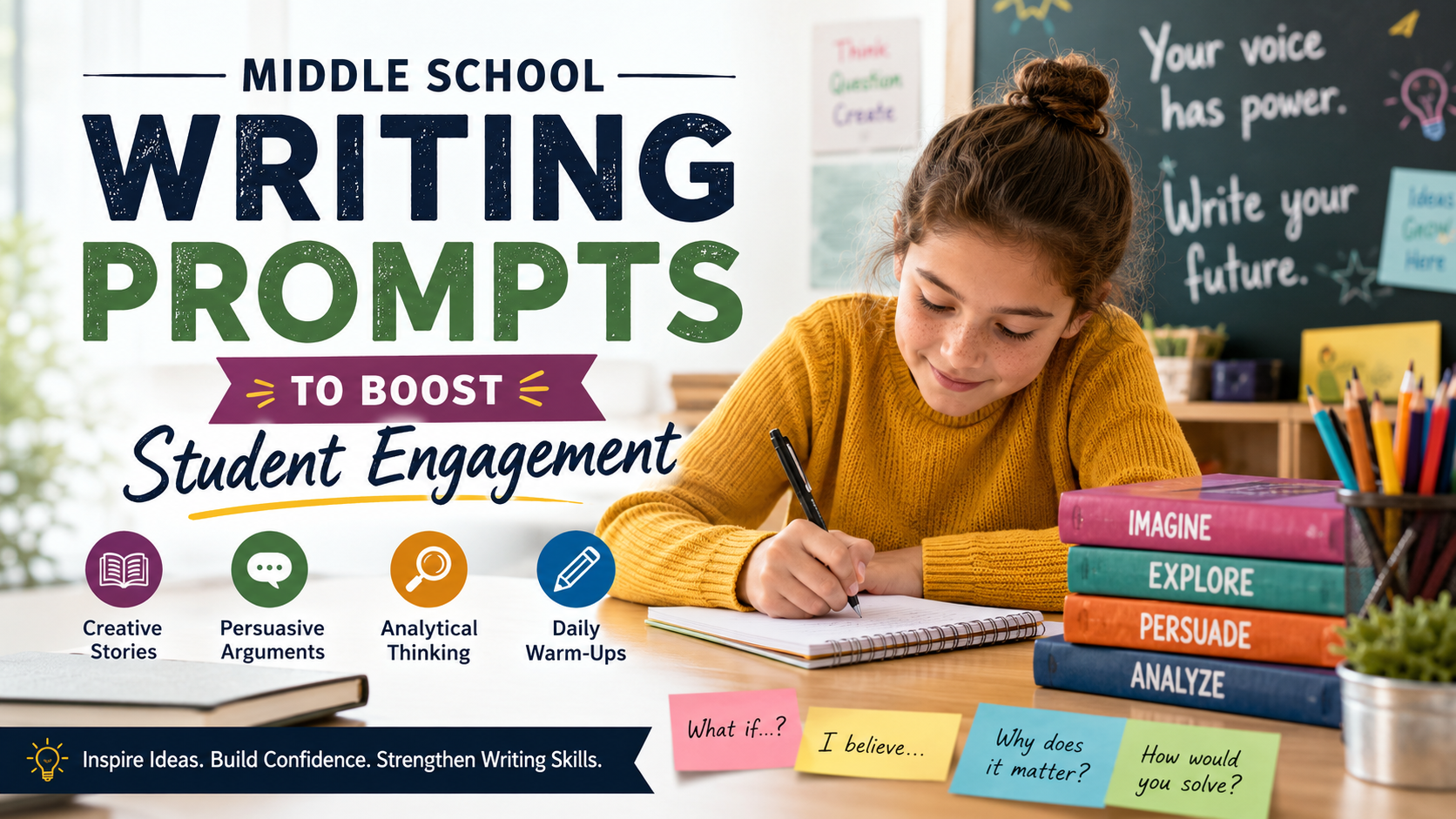
Middle School Writing Prompts to Boost Student Engagement
Finding effective middle school writing prompts can transform a quiet classroom into a vibrant space of active creation. Consequently, middle schoolers experience rapid cognitive growth while navigating academic expectations. However, they often face writer’s block when looking at a blank page. According to educational standards published by the National Council of Teachers of English, structured writing opportunities help young learners develop critical thinking. Furthermore, these targeted exercises build narrative mastery and analytical confidence over time. As a result, when students receive clear direction paired with expressive freedom, they transition seamlessly into motivated creators.
In addition, middle school educators know that student motivation fluctuates significantly from day to day. For instance, one morning, students might eagerly share detailed personal stories. Conversely, the very next day, they struggle to write a single sentence. Fortunately, engaging prompts bridge this gap effectively. Specifically, they offer low-stakes entry points into complex critical thinking skills. Therefore, by introducing diverse scenarios, you can help students find their authentic voice. Meanwhile, these activities simultaneously cover essential state curriculum standards.
Ultimately, this comprehensive guide provides an extensive collection of ELA journal cues. Moreover, we cover creative narrative, persuasive, analytical, and daily warm-up ideas specifically tailored for young adolescents. Additionally, we will explore actionable pedagogical strategies. Thus, these methods will help you implement these prompts seamlessly into your daily English language arts curriculum, ensuring every student receives the support needed to grow as a writer.
Engaging Middle School Writing Prompts and ELA Topic Ideas
First and foremost, middle school English teachers require diverse prompt collections. These dynamic resources must address various learning goals, writing modes, and skill levels. Because adolescent learners undergo significant intellectual shifts, they gradually move from concrete thinking toward abstract reasoning. Consequently, a single prompt style will not keep an entire class engaged throughout the academic year. Therefore, by building a diverse ELA toolkit, educators can target distinct literacy standards. In addition, these varied exercises keep daily classroom routines fresh and inspiring.
Indeed, the primary goal of using structured writing prompts is to overcome starting hesitation. Typically, the initial delay stems from a fear of making mistakes. Similarly, students simply do not know where to begin. Fortunately, thoughtfully designed cues eliminate this initial friction entirely. For example, they establish immediate context, boundary conditions, and purpose for the assignment. Therefore, when teachers provide compelling setups, students channel energy directly into drafting, organizing, and expressing ideas.
As listed below, the following curated middle school ELA prompts build student confidence. Furthermore, they sharpen reasoning abilities and cultivate authentic creative expression across key literacy strands.
Creative Narrative Exercises and Fiction Prompts to Fire Up Student Imagination
Above all, narrative writing allows middle school students to process real-world emotions safely. As a result, they explore complex social choices within imaginative contexts. In particular, creative scenarios build world-building abilities, spatial awareness, and descriptive vocabulary. Simultaneously, these prompts reinforce plot pacing, dialogue tag usage, and character development mechanics.
-
The Unopened Door: First, imagine you discover a hidden, ornate doorway located behind an old library bookshelf. Next, it opens into a room containing intact memories preserved from twenty years ago. Finally, describe what you see, hear, and feel as you cross the threshold into this forgotten space.
-
Role Reversal Perspective: Write a short story entirely from the perspective of an everyday classroom object. For instance, you could choose a dried-out whiteboard marker, an overworked pencil sharpener, or a worn-out backpack. Subsequently, detail your daily struggles, your interactions with students, and your ultimate dream for the school year.
-
The Glitch in Time: Every time you snap your fingers twice, time completely pauses for sixty seconds while you remain completely free to move. Therefore, how do you use this extraordinary ability to resolve a sudden, unexpected crisis during your school science fair?
-
An Unlikely Alliance: Two fierce academic rivals find themselves accidentally locked inside a museum during an overnight storm. Consequently, how do their contrasting personality traits and strengths help them solve a hidden riddle to escape safely?
When introducing these narrative exercises, encourage students to focus heavily on sensory details. In short, remind them to show readers what happens through actions and imagery. Furthermore, instruct them to avoid simply telling the audience what occurred.
Persuasive Topics, Argumentative Prompts, and Debate Ideas for Adolescents
Naturally, middle schoolers love to debate fairness, school rules, and daily routines. Because of this, argumentative writing prompts capitalize on this developmental trait effectively. In fact, they teach young writers how to organize logical claims efficiently. Furthermore, students learn to support assertions with verifiable evidence and address counterarguments respectfully.
-
School Schedule Reform: First, consider whether middle schools should shift their daily start times two hours later. Do later schedules align better with adolescent biological sleep cycles? Therefore, support your stance with clear logical reasoning, health facts, and relevant student experience examples.
-
Digital vs. Physical Textbooks: Construct a persuasive argument deciding between learning mediums. Specifically, do traditional printed paper textbooks or portable digital tablets provide a superior learning experience in modern middle school classrooms?
-
Cell Phone Usage Guidelines: Should middle school administrators permit students to utilize personal mobile devices during lunch breaks? Consequently, outline your arguments clearly while directly addressing potential safety and distraction concerns.
-
Mandatory Community Service Hours: Draft an opinion essay explaining community requirements. For example, should local school boards require eighth-grade students to complete twenty hours of community service before graduating to high school?
Ultimately, working through these persuasive topics teaches students that strong arguments rely on facts. Consequently, clear structure and evidence matter far more than pure emotion or loud assertions.
Analytical Essay Cues and Expository Journal Prompts
In contrast to creative stories, expository and analytical prompts encourage objective thinking, text-dependent analysis, and thoughtful personal reflection. As a result, these prompts bridge the gap between casual personal journaling and formal academic research papers.
-
Character Decision Analysis: First, select a prominent character from your current class novel. Next, evaluate one pivotal decision they made during the story and explain their underlying motivations clearly. Finally, detail how an alternate choice would have transformed the overall narrative outcome.
-
Personal Hero Definition Essay: Define what authentic courage means in contemporary society. In addition, identify a real-world figure or family member who embodies this definition. Thus, cite specific actions that prove their exemplary character.
-
Explaining a Technical Process: Describe a complex physical or technical skill you have mastered. For example, you might choose playing a musical instrument, solving a Rubik’s cube, or executing an athletic play. Therefore, write so clearly that a complete beginner could reproduce the steps easily.
In conclusion, developing analytical writing habits prepares middle school students for high school honors courses. Furthermore, these exercises build essential skills needed for standardized state assessments.
Daily Warm-Up Ideas and Bellringer Cues for Middle School Language Arts
Establishing a consistent daily warm-up routine transforms the first five to ten minutes of class. Educators often call these activities bellringers. Consequently, displaying a prompt on the board as students enter eliminates downtime completely. Furthermore, this routine signals that active learning begins immediately.
| Warm-Up Style | Time Allocation | Learning Focus |
| Quick-Write | 5 Minutes | Fluency & Continuous Drafting |
| Sentence Stem | 3-5 Minutes | Sentence Structure & Grammar |
| Image Response | 5 Minutes | Visual Literacy & Descriptive Tone |
In addition, daily warm-ups lower writing anxiety by framing drafting as a routine muscle exercise. Thus, students do not view it as a high-stakes performance test. When students write continuously every day without fearing harsh grading, their writing fluency improves naturally over time. Similarly, vocabulary recall and typing speed advance as well.
Implementing Low-Stakes Quick-Writes and Journal Warm-Ups Effectively
To maximize the impact of daily quick-writes, educators must keep these exercises explicitly low-stakes. Therefore, do not grade quick-write entries for minor spelling, mechanical, or punctuation errors. Because rigid correction during brainstorming stifles creative momentum, evaluate quick-writes based entirely on student engagement, continuous pen movement, and idea generation.
Indeed, when young authors realize they will not face point deductions for minor grammatical mistakes, their hesitation disappears. As a result, quick-writes serve as dynamic incubator spaces where raw thoughts take shape. Subsequently, they provide rich initial material that students can later revise, expand, and polish into formal assignments.
Using Visual Prompts, Imagery, and Multimodal Cues to Support Learners
Similarly, pairing written prompts with striking visual elements provides powerful support for diverse learners. In particular, visual thinkers and emerging English language learners benefit immensely from this practice. For instance, presenting a high-contrast photograph or artwork piece alongside a brief textual question gives students instant background context.
Furthermore, visual cues anchor abstract concepts, giving writers immediate concrete details to describe. For instance, displaying a picture of an abandoned, moss-covered train engine deep inside a forest gives students instant inspiration. Consequently, they immediately see setting, mood, and color imagery. Thus, this dual-modal approach reduces cognitive strain and helps reluctant writers construct meaningful opening paragraphs effortlessly.
How to Integrate Middle School Writing Tasks into Your Curriculum
Having a repository of excellent prompts is only the first step. In contrast, thoughtful curriculum integration determines long-term classroom success. Therefore, prompts should never feel like random busywork designed simply to pass time. Instead, weave middle school writing prompts intentionally into broader thematic units, novel studies, and grammar lessons.
For example, suppose your class studies a historical fiction novel set during the Great Depression. In that case, you should introduce persuasive and narrative prompts that reflect the dilemmas faced by the story’s characters. Because connecting prompt topics directly to active reading assignments deepens text comprehension, it simultaneously reinforces essential writing mechanics.
Furthermore, vary the format in which students respond. For example, mix traditional notebook assignments with digital blogging platforms, audio recordings, or collaborative group posters. Consequently, these varied mediums keep student enthusiasm consistently high across school terms.

Scaffolding ELA Writing Cues and Prompts for Diverse Classrooms
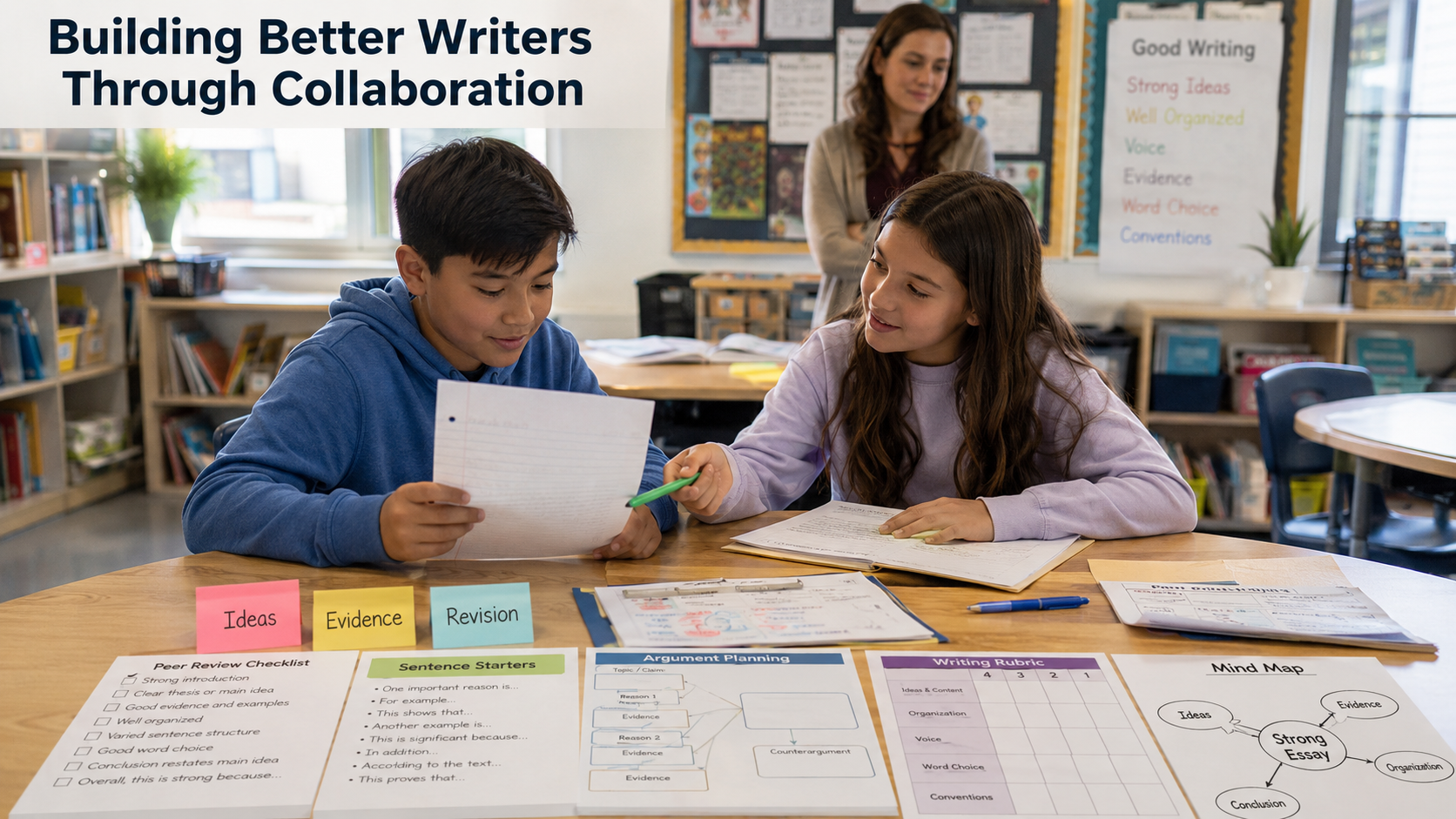
Furthermore, effective instructional differentiation ensures that every student accesses the writing task successfully. Proper scaffolding prevents students from feeling overwhelmed or under-challenged during writing blocks.
-
Provide Sentence Starters and Frames: First, supply structured opening phrases for students who experience executive function challenges, language delays, or emerging English proficiency.
-
Incorporate Visual Graphic Organizers: Second, pair open-ended prompt questions with structured mind maps, narrative arc diagrams, or claim-evidence-reasoning (CER) graphic organizers.
-
Offer Task Choice: Third, display three distinct prompt options on the board simultaneously. Consequently, granting students autonomy over their chosen topic significantly boosts intrinsic motivation and completion rates.
Ultimately, scaffolding transforms daunting, open-ended writing tasks into achievable, step-by-step learning experiences for all classroom participants.
Setting Up Student Peer Feedback and Review Systems
Once students complete a response to a prompt, organize quick, structured peer-review sessions. Partnering students allows them to read their work aloud. Consequently, it helps them practice active listening and give targeted, constructive feedback.
To keep feedback constructive, provide precise guidelines. For example, instruct students to highlight two vivid sensory details. Next, have them underline one strong logical claim. Finally, ask them to offer one polite question regarding a confusing plot point or sentence construction. Therefore, building a reliable peer feedback routine shifts classroom culture from teacher-centered evaluation to a collaborative writing community where students actively learn from one another.
FAQ SECTION
Why are middle school writing prompts important for ELA students?
First and foremost, writing prompts are essential tools for middle school English students because they eliminate the intimidation associated with an empty page. Furthermore, adolescents undergo significant cognitive transitions. Specifically, they move toward abstract reasoning while navigating social self-consciousness. Therefore, when handed an entirely open topic, many middle schoolers experience decision paralysis and anxiety. In contrast, a well-crafted prompt provides necessary structure, immediate focus, and clear contextual boundaries. This helpful setup allows students to skip the frustration of topic selection. Consequently, they jump directly into the drafting process. Furthermore, prompts allow teachers to target specific state standards. For instance, educators can focus on constructing textual claims, developing rich narrative settings, or utilizing sensory vocabulary. Over time, regular exposure to varied prompts builds crucial writing stamina. As a result, it expands active vocabulary and teaches young authors how to express complex personal opinions with clarity, structure, and confidence.
How often should middle school classes use writing prompts and daily journal topics?
Middle school English language arts classes should ideally incorporate writing prompts three to five times per week through short warm-ups or structured lesson openers. In fact, establishing a predictable daily writing cadence conditions students to view composition as a manageable habit. Therefore, writing becomes a routine rather than an overwhelming, sporadic chore. For example, brief five-minute quick-writes at the start of period help transition students mentally into the language arts space. Meanwhile, these exercises simultaneously reinforce essential mechanics like sentence variety and word choice. Consistently practicing quick writing exercises builds muscle memory. Additionally, it increases keyboard typing speed and improves overall drafting fluency. Because these daily warm-ups are brief and focused on creative expression rather than heavy grading, students experiment freely with new vocabulary. As a result, they practice new sentence structures without fear of immediate penalization.
How do I differentiate ELA writing prompts for struggling adolescent writers?
Differentiating writing prompts for struggling learners involves breaking complex prompts into manageable visual and structural components without reducing intellectual rigor. First, teachers can provide sentence frames, graphic organizers like story maps or claim-evidence tables, and targeted word banks alongside the main prompt. Consequently, these tools support students with processing delays or language barriers. Second, offering visual prompts—such as compelling photos or video clips—alongside text cues helps visual learners grasp settings and character emotions quickly. Additionally, offering tiered prompt options allows students to choose a complexity level that aligns with their confidence. Finally, educators can grant flexible output formats. For instance, they can permit struggling students to outline key thoughts using bullet points or dictation software before drafting full paragraphs, thereby ensuring every student actively engages with the core concept.
Can targeted ELA prompts help prepare middle schoolers for standardized testing?
Yes, using strategic writing prompts throughout the school year directly prepares middle school students for standardized state assessments. In fact, standardized exams regularly evaluate a student’s capacity to interpret complex written prompts. Specifically, tests require students to analyze informational passages, construct text-dependent claims, and produce structured responses within strict time limits. Therefore, by regularly exposing students to expository, persuasive, and narrative prompts that mimic assessment formats, you demystify the testing process and reduce test-related anxiety. Furthermore, routine prompt practice teaches students how to quickly unpack prompt requirements. As a result, they learn to formulate strong thesis statements, organize supporting evidence logically, and manage their writing time effectively under timed classroom conditions, ultimately translating to higher performance on formal end-of-year examinations.
How long should middle school students spend responding to a daily writing prompt?
The time allocated for responding to a writing prompt depends primarily on the pedagogical goal of the lesson. For instance, for routine bellringers, warm-ups, or quick-writes, students should spend approximately five to ten minutes writing continuously without worrying about perfection. Consequently, this short window encourages rapid brainstorming, boosts drafting fluency, and keeps classroom momentum moving swiftly into the core lesson. Conversely, when prompts are utilized for formal narrative development, argumentative essay drafting, or text-dependent literature analysis, the response period can span twenty to forty minutes. For these extended writing sessions, teachers should segment the allotted time into distinct operational stages: brainstorming, outlining, drafting, and brief peer revision, thereby teaching students how to manage longer academic assignments efficiently.
CONCLUSION
In conclusion, integrating creative middle school writing prompts is a proven strategy for driving student engagement and building lasting literacy skills. Whether you utilize imaginative world-building scenarios, lively argumentative debates, or reflective analytical exercises, structured prompts enable young adolescents to push past writer’s block. For educators who support diverse student populations, including those learning English as a second language with smart tips, these structured cues help students unlock their authentic voices effectively.
Furthermore, when educators pair compelling prompts with differentiated support structures, visual aids, and consistent peer review routines, writing shifts from an intimidating requirement into an enjoyable avenue for self-expression. Ultimately, take these prompts and strategies, adapt them to fit the unique needs of your student body, and foster a dynamic classroom environment where young writers thrive every day.