
Does Fast Charging Ruin Your Phone Battery?
Modern fast charging can feel like magic. You plug in a nearly dead phone, take a quick shower, and return to an 80% charge. That speed can also create concern. When your phone becomes warm during charging, you may wonder whether fast charging is damaging the battery.
The short answer is no. Fast charging does not destroy your phone battery under normal conditions. Modern smartphones, chargers, and power delivery systems include several layers of protection. They manage charging speed, voltage, current, and temperature. Apple’s guidance on charging and battery lifespan also highlights temperature and charging patterns as important factors in battery ageing. Apple Support: Charge and maintain your iPhone battery
However, fast charging is not completely free from battery stress. Heat, high voltage, and internal resistance can accelerate normal battery degradation. The effect becomes more important when the phone remains hot for long periods.
Understanding how fast charging works can help you charge more confidently. It can also help you develop simple habits that protect battery health without constantly watching the percentage.

Does Fast Charging Destroy Phone Batteries?
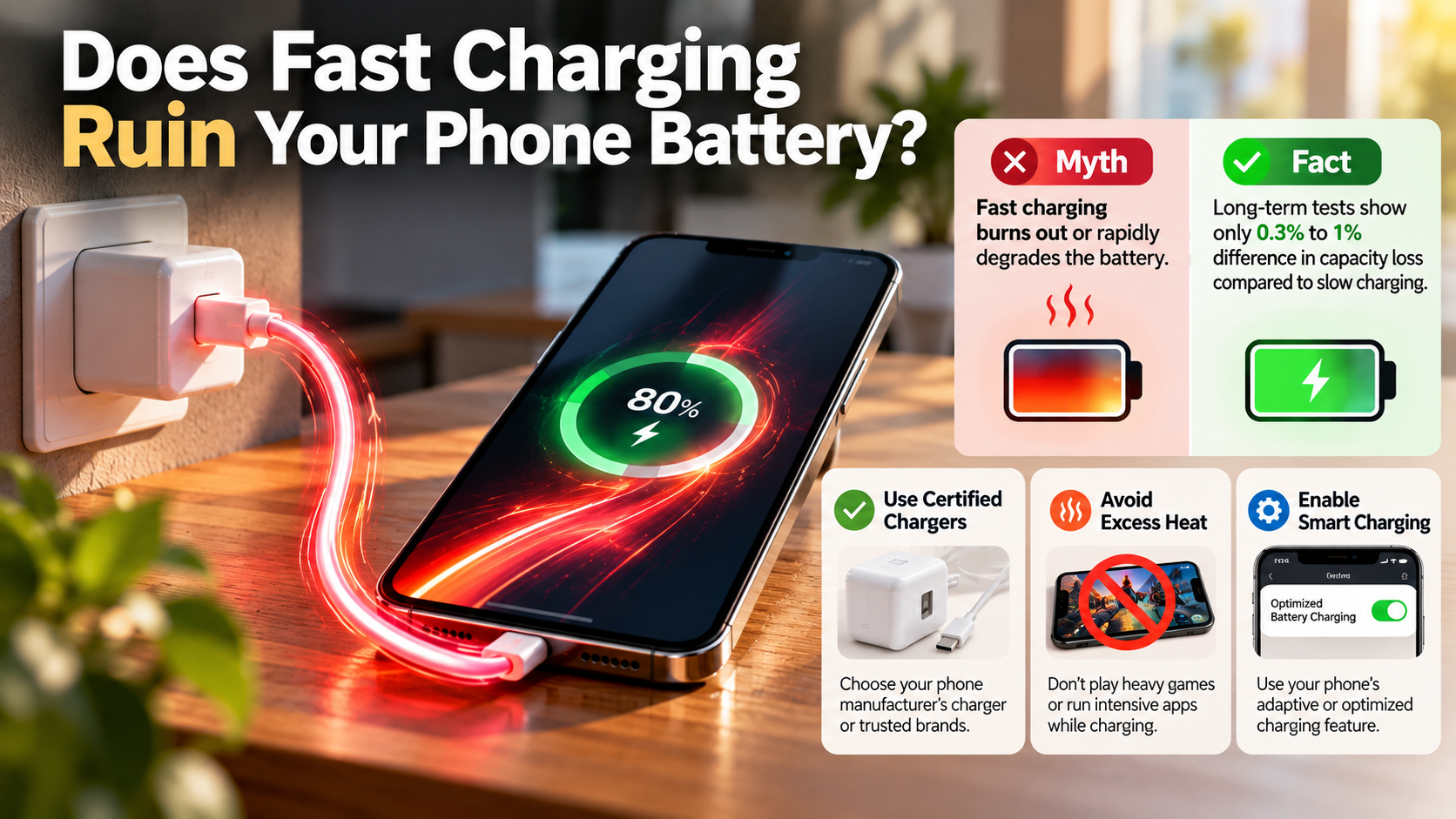
Fast charging does not normally destroy a phone battery. Modern lithium-ion and lithium-polymer batteries are designed to handle higher charging speeds within specific safety limits. Your phone does not simply receive maximum power until the battery reaches 100%. If you have heard conflicting advice about charging, it is also worth checking common phone charging myths before changing your habits.
Fast charging generally uses two stages:
- Constant Current Phase: When the battery is relatively empty, the charging system can deliver higher current. This allows the percentage to rise quickly while the battery can absorb energy efficiently.
- Constant Voltage Phase: As the battery becomes fuller, internal resistance increases. The charging system gradually reduces power to control voltage, heat, and chemical stress.
This is why the first part of a charge often feels much faster than the final portion. Your phone’s battery management system (BMS) continuously controls the charging process.
Standards such as USB Power Delivery and proprietary systems allow the phone and charger to negotiate suitable power levels. The phone therefore uses the power it is designed to handle rather than automatically accepting the charger’s maximum output.
The Real Culprit: Thermal and Chemical Stress
Fast charging itself is not automatically destructive. Excessive heat is the bigger concern. Electrical current passing through a battery creates heat because of internal resistance. Higher current can increase this heat, especially when the device is already warm.
Heat can accelerate chemical reactions inside lithium-ion batteries. Over time, this can contribute to electrolyte breakdown and changes in the protective SEI layer. These changes gradually reduce the battery’s ability to store and deliver energy.
Normal temperatures during charging are generally less concerning than sustained high temperatures. Problems become more likely when several heat sources occur together.
For example, avoid combining fast charging with:
- Direct sunlight or a very hot environment
- A thick case that traps heat
- Intensive gaming or demanding applications
- Poor ventilation while charging
- High-power wireless charging in a warm location
The practical lesson is simple: manage heat rather than fearing charging speed itself. If your phone remains reasonably cool during charging, fast charging does not automatically mean serious battery damage. Features such as bypass charging can also help reduce battery heat during demanding tasks like gaming.
Is the 20/80 Battery Rule True?
The 20/80 rule has a real basis in lithium-ion battery chemistry. It recommends keeping your phone between roughly 20% and 80% when convenient. The goal is to reduce the amount of time the battery spends in higher-stress conditions.
Lithium-ion batteries gradually degrade as their electrodes undergo chemical and physical changes during charging and discharging. Higher charge levels generally create more voltage stress, while extremely low levels can also place additional strain on the cell.
Charging above 80% is not automatically harmful. However, keeping a battery near its maximum voltage for long periods can increase chemical stress. Similarly, repeatedly allowing the battery to reach extremely low levels is less desirable than using moderate charge ranges.
A practical comparison looks like this:
| Charge Range | General Stress | Practical Consideration |
|---|---|---|
| 0%–100% | Higher | More complete cycling |
| 20%–80% | Lower | Useful range for battery longevity |
| 40%–60% | Lowest | Battery-friendly but inconvenient |
The key point is not to treat 20% and 80% as strict emergency boundaries. They are useful targets when battery longevity matters more than maximum daily capacity.
Is It Worth the Hassle?
The chemistry behind moderate charging ranges is useful, but constantly monitoring your battery is unnecessary. Modern smartphones already include software features that can reduce charging stress automatically.
Apple devices offer Optimized Battery Charging and, on supported models, an 80% charge limit. Optimized charging can delay the final part of charging based on your routine. This reduces the amount of time the battery remains fully charged.
Many Samsung and other Android devices also provide battery protection features. Depending on the model, these can limit the maximum charge to around 80% or 85%.
An 80% limit can be particularly useful if you plan to keep your phone for several years. It can help reduce prolonged high-voltage exposure without requiring manual monitoring. Understanding how different charging habits affect battery health can also help you avoid unnecessary concern about everyday charging.
However, convenience still matters. If you regularly need a full battery for work, travel, navigation, or long days, charging to 100% is reasonable.
The best approach is to use battery protection features when they fit your routine. Do not sacrifice practical battery capacity simply to follow a charging rule perfectly.
Is Fast Charging to 100% Bad?
Fast charging to 100% is not catastrophic. The bigger concern is leaving a fully charged battery at maximum voltage for many hours, especially in a warm environment.
Modern phones normally reduce charging power as the battery approaches full capacity. The phone does not continue receiving maximum fast-charging power all the way to 100%. Charging becomes progressively slower during the final portion.
This means the final percentage can take much longer than the earlier part of the charging process. The charging system is deliberately reducing power as the battery becomes fuller.
The main concern comes after the battery reaches full capacity. Two factors matter:
- Prolonged high-voltage exposure: A phone that reaches 100% before bedtime may remain near maximum charge for several hours.
- Repeated top-ups: A connected phone may periodically draw small amounts of power to maintain its charge.
If you charge to 100% and unplug the phone shortly afterward, the practical impact is limited. There is no need to avoid 100% completely.
The more useful habit is to avoid combining 100% charge, high temperature, and long periods of continuous charging whenever possible. If your phone supports optimized charging or a charge limit, those features can reduce unnecessary battery stress automatically.
Is 45W Too Much for a Phone?
No. A 45W charger is not automatically too powerful for a phone designed to support 45W charging. The important point is that the charger does not simply force its maximum wattage into the phone.
Power is requested by the phone, not blindly pushed into it. Charging systems communicate through protocols such as USB Power Delivery and PPS. The phone determines the voltage and current it can accept based on its charging design.
For example, a 45W or 65W charger can safely charge a phone rated for a lower power level. The phone can negotiate an appropriate charging level and avoid using the charger’s full capability. Understanding the difference between charging ratings such as 5V 1A and 5V 2A can also make charger specifications easier to understand.
A simplified example looks like this:
[65W Charger]  <── Power Negotiation ──>  [Phone]
Charger: "I can provide up to 65W."
Phone:   "I will request the power I support."
Result:  Charging occurs within the phone's limits.
The charger should still be compatible and meet appropriate safety standards. Using poor-quality accessories can create unnecessary electrical or thermal risks.
The key takeaway is simple: a higher-rated charger does not automatically damage a lower-rated phone. The phone’s charging hardware determines how much power it accepts.
How 45W+ Phones Handle the Load
Phones designed for 45W, 65W, or higher charging use additional engineering to manage the increased power. Manufacturers can use several approaches to control heat and improve charging efficiency.
One approach is dual-cell battery architecture. Some phones divide the battery into multiple cells, allowing charging power to be distributed across them rather than concentrating it in one cell.
Another approach involves advanced charging circuits. Efficient power-conversion hardware can reduce the amount of electrical energy that becomes unwanted heat inside the phone.
Some charging systems also move more voltage-conversion work into the charging adapter. This can reduce heat generated inside the handset.
These approaches help manufacturers deliver higher charging speeds while managing temperature and electrical stress.
However, higher wattage still requires proper thermal management. A phone designed for 65W charging is not equivalent to a phone designed for 20W charging.
For everyday use, follow the manufacturer’s charging specifications. Use compatible chargers and reliable cables, and avoid charging in excessively hot environments. Cable quality and construction can also matter when choosing accessories for modern high-speed charging systems.
The important distinction is between supported fast charging and forcing an unsupported setup. A properly designed 45W system is built to handle that power.
Is Charging 3 Times a Day Okay?
Yes. Charging your phone two or three times a day is generally fine. The number of times you connect the charger does not directly determine battery wear.
Battery degradation is more closely related to charge cycles and the conditions under which those cycles occur. One complete cycle represents using an amount of energy equivalent to 100% of the battery’s capacity. That use can happen across several smaller charging sessions.
For example:
- Using 100% of the battery’s capacity over time represents about one full cycle.
- Using 30% of the battery, charging it, and repeating that process three times represents about 0.9 of a cycle.
This means frequent top-ups are not automatically harmful. In some situations, shorter charging sessions can help you avoid extremely low battery levels and prolonged periods at maximum charge.
A practical routine might involve charging from 40% to 70% during the day and topping up again later when necessary.
The main exception is repeated heat exposure. Charging several times a day while gaming, using demanding applications, or charging in direct sunlight can increase thermal stress.
So, do not worry about plugging in your phone frequently. Focus instead on avoiding excessive heat and extreme battery levels when convenient.
Conclusion
Fast charging does not ruin your phone battery when the phone, charger, and charging system are designed to work together. Modern smartphones automatically adjust charging speed, voltage, and current to protect the battery as it fills.
The bigger concern is excessive heat and prolonged high charge levels, not fast charging itself. Charging to 100% occasionally is fine, and charging your phone several times a day does not automatically reduce battery life.
For better long-term battery health, avoid extreme heat, use reliable chargers and cables, and take advantage of battery protection features when available. Keeping your phone around 20% to 80% can also reduce battery stress when it is convenient.
Ultimately, you do not need to obsess over every charging percentage. Use fast charging when you need it, keep your phone cool, and let its built-in charging protections do the rest.