
Do Headphone Splitters Hurt Audio Quality?
Sharing a playlist or watching a movie with a friend often requires an audio splitter. However, many listeners wonder, do headphone splitters hurt audio quality when they share one output? The short answer is: sometimes, but not always.
A passive splitter connects two headphone loads to one audio output. This changes the electrical load that the source must drive. The result depends on headphone impedance, source power, cable quality, and splitter construction. High-fidelity audio requires consistent voltage and low interference, as documented by the Audio Engineering Society. When you route an analog audio stream into two paths, you change how that signal behaves.
With suitable equipment, a basic splitter can work without noticeable sound degradation. Problems become more likely when two headphones create a difficult load. You may then notice lower volume, distortion, or channel imbalance.
An active headphone amplifier can provide a better solution for demanding headphones. It gives each output a stronger and more controlled signal.
This guide explains how headphone splitters affect audio quality. It also covers 3.5mm adapters, RCA cables, aux splitters, impedance, crosstalk, and active amplifiers.

What are the disadvantages of audio splitters?
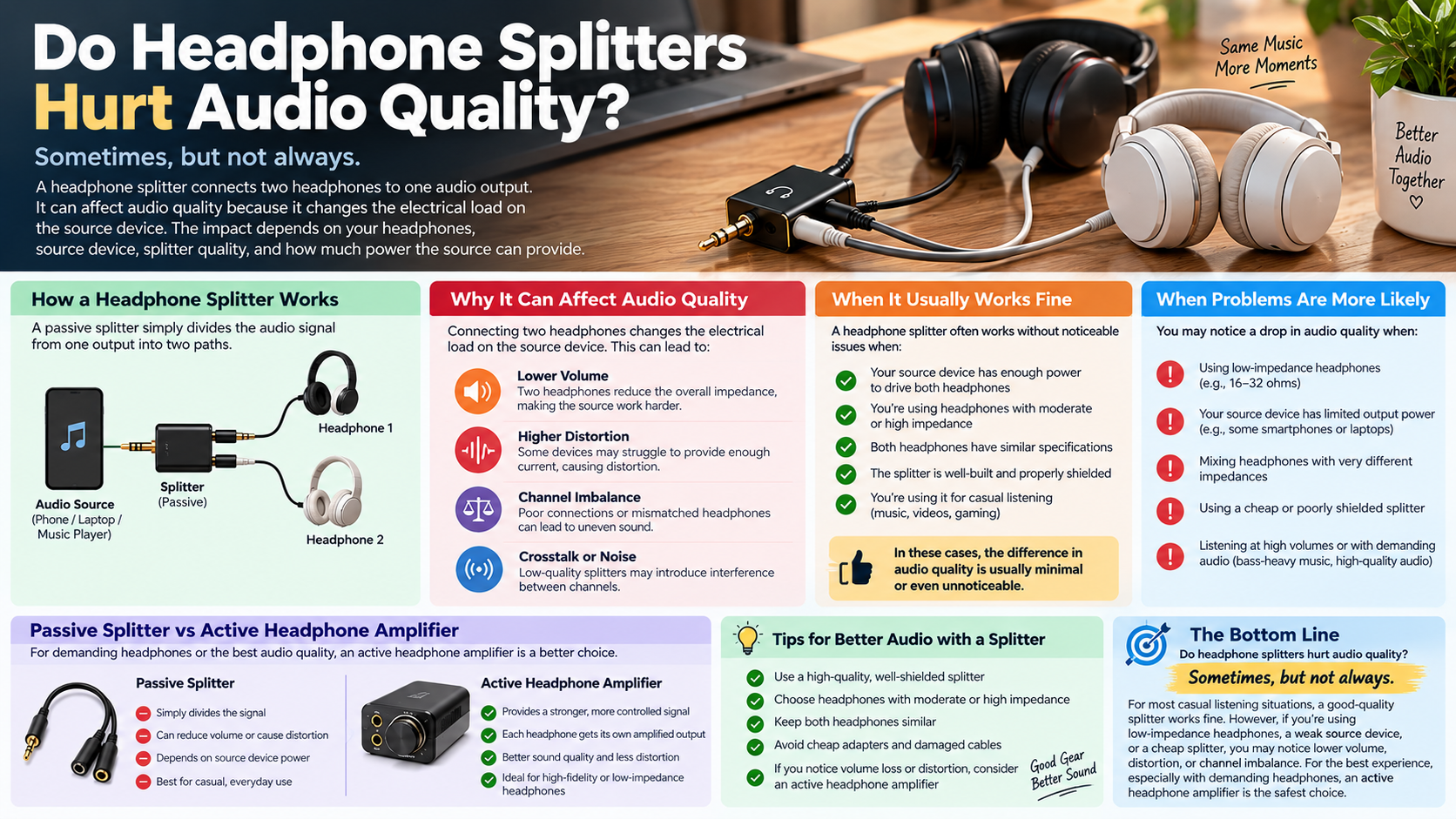
Passive audio splitters can create several electrical challenges. If you wonder, do headphone splitters hurt audio quality, the answer depends largely on the source and connected headphones. The biggest issue is the additional load placed on the source device.
Two headphones connected in parallel can reduce the overall impedance seen by the headphone amplifier. A lower impedance load may require more current. Some smartphones, laptops, and portable players can handle this easily. Others may produce lower volume or more distortion.
The effect also depends on the headphones themselves. Two similar low-impedance headphones may work well together. Mixing headphones with very different electrical characteristics can produce less predictable results.
Cheap splitters can introduce physical problems too. Poor connectors may cause crackling, intermittent sound, or channel dropouts. Weak shielding can also increase susceptibility to electrical noise.
Common disadvantages include:
- Lower available volume from a limited headphone output.
- Higher distortion when the source struggles with the load.
- Channel imbalance from poor connections or mismatched equipment.
- Crosstalk or noise from poorly designed cables and connectors.
For casual listening, these problems are often minor. A quality splitter should work well when the source can comfortably drive both headphones.
Signal Loss and Impedance Drops
Connecting two headphones to one output places their impedances in parallel. If both headphones have the same impedance, the combined load is roughly half the impedance of either pair alone.
For example, two 32-ohm headphones create an approximately 16-ohm load. That can demand substantially more current from the source. Whether this causes audible problems depends on the source amplifier and its output capability.
A strong headphone amplifier may handle the lower load without difficulty. A weaker portable device may reach its current limit sooner. This can reduce maximum volume or increase distortion.
It is important to avoid assuming that a splitter automatically causes a fixed volume loss. A passive splitter does not inherently reduce voltage by half. The actual change depends on the source output impedance and connected headphone loads.
If the source cannot comfortably drive both headphones, demanding passages may sound compressed or distorted. Bass performance can also suffer when the amplifier lacks sufficient control.
For demanding headphones, an active headphone amplifier is usually the safer choice. It provides greater current capability and better control over each output.
Do headphone jack adapters affect sound quality?
Basic headphone jack adapters usually have little effect on sound quality. A passive adapter simply changes the physical connector format. It does not normally process or alter the audio signal.
For example, a suitable 6.35mm-to-3.5mm adapter can connect compatible headphones to different output sizes. The adapter itself should not noticeably change frequency response when its contacts are clean and properly connected. If you are also comparing different connection types, wired vs wireless audio can help clarify the broader differences between the two approaches.
However, build quality still matters for reliability. Poorly manufactured adapters can create intermittent connections, crackling, or channel loss. Damaged contacts can also increase resistance or cause unstable connections.
Connector material is less important than many marketing claims suggest. Gold plating can help resist corrosion, but it does not automatically improve sound quality. Proper contact pressure, construction, and compatibility matter more.
A good adapter should provide:
- Secure electrical contact
- Correct TRS or TRRS wiring
- Durable mechanical construction
- Low contact resistance
- Good compatibility with the connected equipment
If an adapter causes audible buzzing or dropouts, replacing it can solve the problem. Under normal conditions, however, a correctly wired passive adapter should not noticeably color the sound.
How Dirt and Corrosion Degrade Jack Adapters
Dirt, oxidation, and pocket lint can interfere with headphone connections. These contaminants can prevent the plug from making consistent electrical contact with the jack.
A poor connection may produce crackling when the plug moves. It can also cause one channel to become intermittent or disappear completely. In some cases, the connection may create audible noise or distortion.
These problems are different from normal signal degradation. A clean, properly functioning connector does not normally reduce audio quality simply because it is an adapter.
Regular maintenance can help prevent connection problems. Keep headphone plugs clean and avoid storing exposed connectors in dusty environments. If a jack becomes dirty, use an appropriate electronics-safe cleaning method.
Avoid applying unsuitable household chemicals or excessive liquid. Some cleaners can damage plastics, coatings, or electronic components.
Gold-plated contacts can provide useful corrosion resistance. However, they do not guarantee better sound.
If you hear crackling or channel loss, check the physical connection first. Test the headphones directly with the source. Then test the adapter separately. This helps identify whether the adapter, headphone jack, or cable is responsible.
Does 3.5 mm to RCA lose quality?
A properly made passive 3.5mm-to-RCA cable does not inherently reduce audio quality. If you wonder, do headphone splitters hurt audio quality, the same principle applies here. A simple connector change does not automatically damage an analog audio signal.
Both connectors can carry the same two-channel analog audio signal. The cable simply routes the left and right channels to separate RCA connectors. The conversion itself does not compress or digitally alter the music.
Audio performance instead depends on the source, receiving equipment, cable construction, connection quality, and cable length. Long unbalanced cable runs can be more vulnerable to electromagnetic interference. Poor shielding can make this problem worse.
Ground-loop issues can also create audible hum between separate powered devices. Cable material is often overstated in consumer audio marketing. A properly designed copper cable with suitable shielding can provide excellent results.
For most home setups, focus on:
- Proper shielding
- Secure connectors
- Sensible cable length
- Correct wiring
- Compatible audio equipment
Potential problems are more likely when the cable is damaged, unusually long, poorly shielded, or exposed to interference. Therefore, do headphone splitters hurt audio quality is a different question from whether 3.5mm-to-RCA cables reduce fidelity. A properly made cable should remain transparent.
Choosing Shielded Cables for Pure Signal Transfer
Shielding becomes increasingly useful as an unbalanced audio cable gets longer. A shield helps reduce interference from nearby electrical equipment, power cables, and radio-frequency sources.
This matters because 3.5mm and RCA connections are generally unbalanced analog connections. They can be more susceptible to interference than balanced professional connections. However, a short, well-built cable usually performs very well in everyday systems.
You do not need an expensive audiophile cable to maintain good signal quality. If you are comparing cables while asking, do headphone splitters hurt audio quality, remember that cable shielding and splitter design address different issues.
When choosing a 3.5mm-to-RCA cable, look for:
- Adequate shielding
- Secure connectors
- Flexible but durable construction
- Correct left and right channel wiring
- A length suitable for your setup
Oxygen-free copper can be used in quality cables, but it does not automatically produce better sound. Connector quality and shielding are generally more relevant to reliability and noise performance.
Avoid unnecessarily long cables when a shorter option works. Keep audio cables away from power adapters and other potential noise sources where practical.
For studio or professional environments, balanced connections can offer better noise rejection over long distances. Good cable design matters more than expensive materials.
Can you split 3.5 mm?
Yes, you can split a 3.5mm audio connection with a passive Y-splitter. These adapters typically duplicate the stereo signal so two pairs of headphones can receive it.
A passive splitter requires no battery or external power. It is convenient for casual listening on compatible phones, laptops, tablets, and media players. For many users, this is the easiest way to share music or movie audio. However, if you are considering Bluetooth as an alternative to physical connections, 4 disadvantages of using Bluetooth for everything are worth understanding.
The main limitation is the source’s ability to drive both headphones. Connecting two headphones lowers the combined impedance presented to the output. If the source amplifier has limited current capability, volume and distortion can become issues.
The headphones themselves also matter. Two similar pairs with moderate impedance are often easier to drive together. Two demanding, high-impedance headphones may require more power than a portable device can provide.
If you are asking, do headphone splitters hurt audio quality, the answer depends on this electrical load. A suitable source may handle the splitter without noticeable changes.
For frequent sharing or professional use, an active headphone distribution amplifier is a better option. It can provide stronger output and separate volume controls.
Before buying a splitter, check whether your device uses TRS or TRRS connections. Headset microphone compatibility can require a different wiring arrangement.
Passive Adapters Versus Active Headphone Amplifiers
Passive Y-splitters are simple and affordable. They work well when the source can comfortably drive both connected headphones.
They do not amplify the signal. Instead, both headphones share the output of the same headphone amplifier. This means the source remains responsible for supplying the required voltage and current.
An active headphone amplifier uses powered electronics to drive the connected headphones. Distribution amplifiers may also provide separate outputs and individual volume controls.
This approach is useful when multiple headphones are difficult to drive. It can prevent the source from being overloaded and provide more consistent output.
A simple comparison looks like this:
| Feature | Passive Splitter | Active Amplifier |
|---|---|---|
| External power | Not required | Required |
| Amplification | No | Yes |
| Multiple outputs | Usually limited | Multiple options |
| Individual volume | Usually no | Often available |
| Demanding headphones | Less suitable | Better suited |
For casual movie sharing, a passive splitter is often enough. For high-impedance headphones, studio monitoring, or multiple users, an active amplifier provides greater flexibility. When choosing headphones for these setups, understanding how noise cancellation works can also help when evaluating the listening experience.
The best choice depends on the source and headphones.
Do aux splitters reduce quality?
Aux splitters do not automatically reduce audio fidelity. If you are asking, do headphone splitters hurt audio quality when used with an aux connection, the answer depends on the source and headphone load.
With two headphones connected in parallel, the source sees a lower combined impedance. A weak output stage may then struggle to provide enough current. This can reduce maximum volume or increase distortion.
It is not accurate to say that every passive splitter causes a fixed 3 dB loss. The actual level change depends on the source’s output impedance and the connected loads. With a low output impedance, voltage loss may be very small.
Problems can also arise from poor splitter construction. Weak connectors may create crackling or channel interruptions. Poor shielding can increase unwanted noise in some environments.
For better results, choose a splitter with:
- Secure, properly wired connectors
- Durable strain relief
- Adequate shielding
- Compatibility with your device
- Suitable impedance loads
If both headphones are easy to drive, you may hear little or no difference. If the source is already near its limits, an active amplifier can provide a cleaner solution.
Preventing Crosstalk in Budget Auxiliary Cables
Crosstalk occurs when part of one audio channel leaks into another. Poor cable design can increase this effect, although it is not always audible in ordinary consumer equipment.
Cheap auxiliary cables may use minimal shielding and less robust construction. However, cable thickness alone does not determine crosstalk or sound quality.
Good cable design separates and protects signal paths appropriately. Proper grounding and shielding can help maintain channel separation and reduce interference.
When choosing an aux splitter, consider the following:
- Reliable connector construction
- Proper stereo wiring
- Adequate shielding
- Strong strain relief
- A sensible cable length
Shorter cables can also reduce opportunities for external interference. Keep them away from power cables and noisy electronic equipment when possible.
If you hear noticeable channel bleed, buzzing, or static, test the headphones without the splitter. Then try another splitter or cable. This quickly identifies whether the accessory is causing the problem.
For normal consumer listening, a competent splitter should provide transparent performance. You generally do not need premium materials or exotic cable designs.
The key is correct wiring and solid construction, not marketing claims about expensive conductors.
Frequently Asked Questions
Will a headphone splitter drain my device battery faster?
Possibly. Two headphones can require more current than one, especially when their combined impedance is low. The additional power demand may increase battery consumption. The actual effect depends on the device, headphone sensitivity, volume level, and amplifier design.
Can I plug a microphone and headphones into one splitter?
A standard stereo splitter usually duplicates headphone output. It does not separate microphone input. For a headset with a microphone, use a compatible TRRS splitter designed to separate headphone and microphone connections.
Why does one side sound quieter on my splitter?
Check the headphones, plugs, and splitter first. A poor connection can cause one channel to become quieter. Different headphone sensitivities can also make two pairs appear uneven. Impedance differences alone do not necessarily explain a left-right imbalance within one headphone.
Do digital splitters perform better than analog splitters?
Digital distribution can avoid the analog loading problem when the signal remains digital. However, the system still depends on the splitter, digital interface, and downstream DACs. A digital splitter is not automatically higher quality, but it can preserve the digital data without sharing one analog headphone output.
Conclusion
So, do headphone splitters hurt audio quality? In most everyday situations, a good passive splitter will not dramatically degrade sound. The main concern is the additional electrical load placed on the source.
Two headphones connected in parallel can lower the combined impedance. A weak headphone output may then deliver less volume or produce more distortion. Poor connectors and cables can also cause noise, crackling, or channel dropouts.
For casual listening, a quality 3.5mm splitter is usually sufficient. Using two similar headphones can make the electrical load more predictable. Keep cables reasonably short and choose products with reliable connectors and proper shielding.
If you regularly drive demanding headphones, consider an active headphone amplifier or distribution amplifier. It can provide greater current capability and independent volume control.
Remember that expensive cables do not automatically improve sound. Proper compatibility, clean connections, sensible cable lengths, and adequate amplifier power matter more.
With the right equipment, you can share audio conveniently while maintaining clear, balanced, and enjoyable sound.