
Design Thinking Methodologies: Stages, Principles, and Frameworks
Great products rarely happen by accident. They emerge when teams move beyond guesswork and align solutions with real user needs. Applying structured design thinking methodologies gives teams a practical way to solve complex and ambiguous problems. These methods can support work across software, consumer products, services, and organizational processes. Institutions such as the Stanford d.school and major design firms have helped popularize this human-centered approach. Design thinking methodologies can make product development more iterative, collaborative, and evidence-based.
When teams use these frameworks, they can identify problems before investing heavily in development. They also uncover customer needs that traditional assumptions may overlook. Instead of immediately building a final solution, teams create experiments and gather feedback.
However, choosing the right process can feel difficult for new teams. This guide explains the main stages, principles, frameworks, and tools. It also covers the basic design process and visual design principles. For additional context on structured design processes, the British Design Council provides resources on approaches such as the Double Diamond.

What are the 5 stages of design thinking methodology?
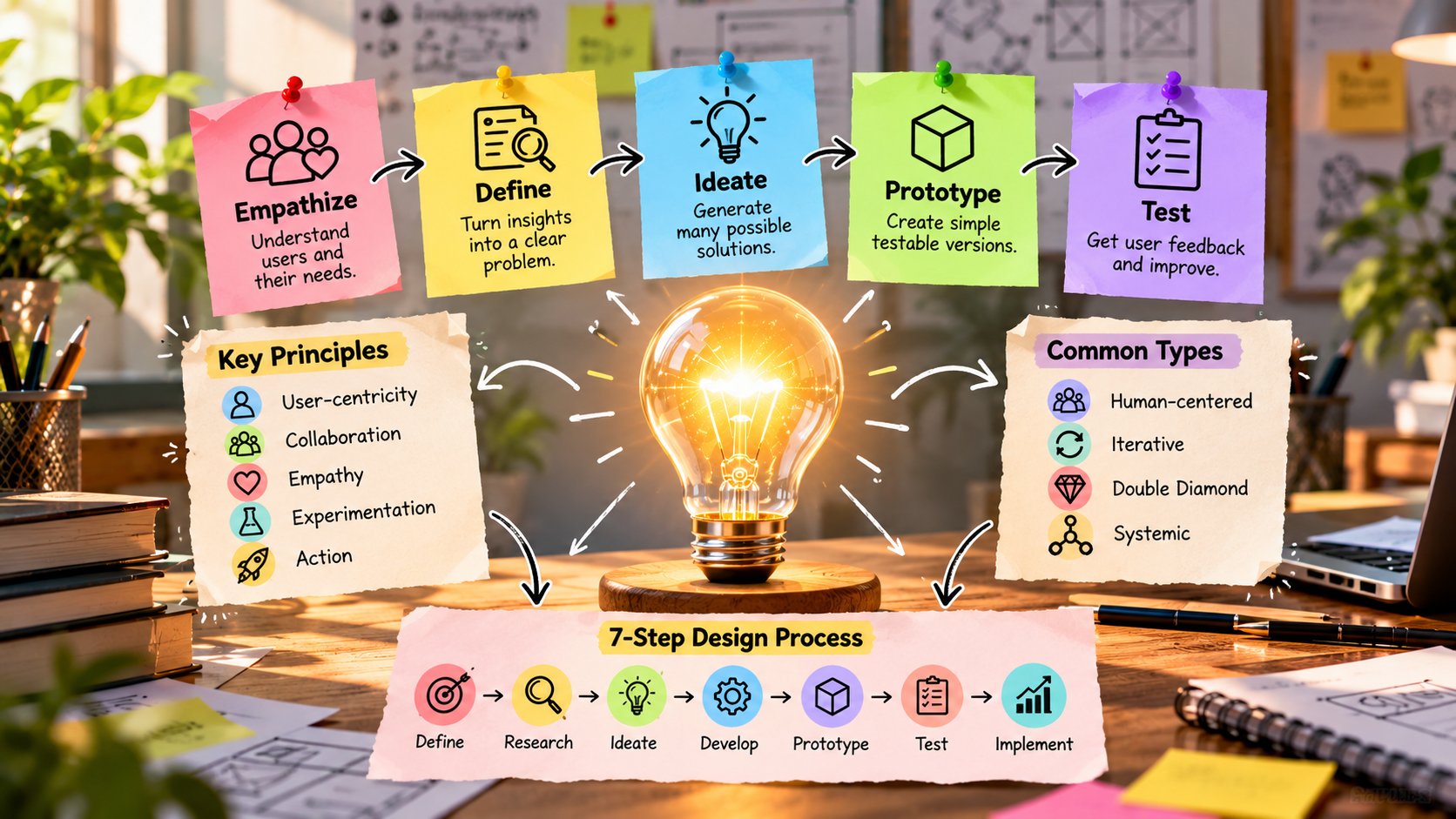
The five commonly recognized stages of design thinking methodology are Empathize, Define, Ideate, Prototype, and Test. These stages help teams understand users before developing solutions. However, they should not be treated as a strict, one-directional sequence.
During Empathize, researchers observe users and conduct interviews to understand their experiences. The Define stage then turns those findings into a focused problem statement. This helps teams address a specific need instead of solving an assumed problem.
Ideate encourages teams to generate many possible solutions before judging individual ideas. Prototype then turns promising concepts into simple, testable representations. These might include wireframes, storyboards, mockups, or physical models.
Finally, Test places prototypes in front of users to gather practical feedback. Teams can then return to earlier stages when testing reveals new information. This iterative approach makes design thinking methodologies useful for complex problems where the best solution is not immediately obvious.
What are the 5 principles of design thinking?
The five commonly associated principles of design thinking are user-centricity, collaboration, empathy, experimentation, and action. These principles help teams focus on real people rather than assumptions. They also encourage teams to learn through practical experimentation instead of relying only on planning.
User-centricity keeps customer needs at the center of important decisions. Collaboration brings people from different disciplines together. Engineers, marketers, researchers, and designers can contribute different perspectives to the same challenge. Effective collaboration also depends on improving workplace communication so teams can share ideas and understand different perspectives clearly.
Empathy requires teams to understand users without immediately judging their experiences. Researchers can use interviews, observation, surveys, and usability sessions to develop this understanding. Experimentation then allows teams to test ideas before making expensive commitments.
A bias toward action encourages teams to create something tangible. A simple prototype can reveal problems that remain invisible during discussions. These principles support design thinking methodologies by creating a working environment where teams can learn, adapt, and improve continuously.
What are the four types of design thinking?
There is no single universal classification of four design thinking types. However, organizations and educators often describe different approaches based on their purpose and scope. Commonly discussed variations include human-centered, iterative, Double Diamond, and systemic design thinking.
Human-centered approaches focus closely on the needs, behaviors, and experiences of people. Iterative approaches emphasize repeated cycles of prototyping, testing, learning, and refinement. This makes them useful for products that require continuous improvement.
The Double Diamond framework, developed by the British Design Council, organizes work around divergent and convergent thinking. Teams first explore a broad range of problems before narrowing their focus. They then expand possible solutions and eventually select an appropriate direction.
Systemic design thinking considers relationships between multiple people, organizations, services, and environments. It can help address complex challenges such as healthcare systems or urban mobility. The appropriate approach depends on the project’s goals, complexity, users, resources, and organizational context.
What are the 7 steps of design?
A commonly used seven-step design process includes define, research, ideate, develop, prototype, test, and implement. Unlike the five-stage design thinking model, this sequence places greater emphasis on implementation. Organizations may also adapt these steps depending on their industry and project requirements.
The first step defines the project brief, objectives, constraints, and expected outcomes. Research then combines relevant data, user insights, market information, and competitor observations. During ideation, teams generate multiple possible approaches rather than selecting the first idea. This is where design constraints can create better products by giving teams clear boundaries while encouraging focused problem-solving.
Development turns promising concepts into more detailed solutions. Prototyping creates realistic representations that can be reviewed and tested. Testing provides feedback from users, stakeholders, or other relevant audiences.
Implementation brings the validated solution into production or practical use. Teams may continue collecting feedback after launch and make further improvements. Therefore, design thinking methodologies and traditional design processes often overlap, especially when teams treat implementation as another opportunity to learn and refine the solution.
What are the 7 basic principles of design?
The seven commonly taught principles of visual design are balance, contrast, emphasis, movement, pattern, rhythm, and unity. These principles help designers organize visual elements and create clearer, more purposeful compositions. They can apply to websites, advertisements, presentations, interfaces, packaging, and other visual materials.
Balance distributes visual weight across a composition. It may be symmetrical or asymmetrical, depending on the desired effect. Contrast creates noticeable differences between elements, such as size, color, shape, or brightness.
Emphasis makes important elements stand out. Designers can use size, placement, contrast, or spacing to attract attention. Movement guides the viewer’s attention through a layout using visual direction and hierarchy, concepts explored further in visual hierarchy in graphic design.
Pattern uses repeated elements to create consistency. Rhythm creates a sense of visual pacing through repetition and spacing. Unity ensures that separate elements feel connected and belong to the same overall composition.
Understanding these principles strengthens design thinking methodologies by helping teams communicate ideas clearly through visual prototypes and final designs.
What tools are used in design thinking?
Modern design thinking methodologies use a combination of research, collaboration, visualization, prototyping, and testing tools. The appropriate tool depends on the project’s stage, team structure, and type of solution being developed. Designers can also explore free tools for aspiring designers when building their skills and experimenting with different workflows.
For user research, teams can use recorded interviews, contextual observation, surveys, customer journey maps, and usability sessions. These methods help researchers understand behaviors, frustrations, motivations, and unmet needs.
Digital whiteboard platforms such as Miro and Mural support brainstorming, affinity mapping, journey mapping, and remote workshops. They are particularly useful when team members work from different locations.
For interface design and digital prototypes, tools such as Figma, Sketch, and Adobe XD can help teams create and test interactive concepts. Physical product teams may use foam models, 3D printers, cardboard prototypes, or laser cutters.
Testing platforms such as UserTesting and Maze can help teams collect usability feedback from participants. Together, these tools make design thinking methodologies easier to apply across research, ideation, prototyping, and evaluation.
Collaborative Digital Whiteboards for Remote Synthesis
Digital whiteboards have changed how distributed teams organize and interpret customer research. Instead of keeping observations in separate documents, teams can place notes, quotes, images, and ideas on a shared visual canvas. This makes research findings easier to review and compare.
Teams can group similar observations into clusters and identify recurring themes. They can also create empathy maps, customer journey maps, and affinity diagrams during collaborative sessions. These activities help transform scattered research into clearer insights.
Remote collaboration is especially useful when designers, researchers, engineers, and marketers cannot meet in person. Everyone can contribute to the same workspace while maintaining a visible record of the discussion. This reduces information gaps and helps teams develop a shared understanding of the problem.
However, digital whiteboards do not replace good research. Poorly collected information can still produce weak conclusions. Their main value comes from making synthesis more organized, transparent, and collaborative. As part of design thinking methodologies, these tools help distributed teams move from raw observations toward clearer problems and potential solutions.
Frequently Asked Questions
How does design thinking differ from traditional business strategy?
Traditional business strategy leans heavily on historical data, market sizing, and linear forecasting. It often assumes customer needs remain static. In contrast, design thinking tackles ambiguous challenges through active qualitative observation, rapid prototyping, and repeated user testing. By prioritizing continuous experimentation over static market reports, teams discover breakthrough innovations that spreadsheets alone rarely reveal.
Can non-designers participate in design thinking workshops?
Yes, multi-disciplinary participation is essential for effective workshops. Including software engineers, customer support representatives, financial analysts, and marketing leads ensures the team analyzes user friction from diverse angles. Non-designers contribute practical operational insights that challenge conventional assumptions, resulting in more robust and feasible business solutions.
How long does a standard design sprint take?
A standard design sprint typically runs for five consecutive days. Popularized by Google Ventures, this structured format moves a cross-functional team from an open challenge on Monday to testing a realistic prototype with target customers on Friday. Highly focused teams compress months of development debate into a single, high-intensity work week.
What is an empathy map in design thinking?
An empathy map is a collaborative visualization tool used to understand user behavior and emotional states. It organizes qualitative research into four distinct quadrants: what the user says, thinks, does, and feels. Product teams use empathy maps during early discovery phases to build genuine alignment around authentic customer frustrations.
Conclusion
Adopting modern design thinking methodologies allows forward-thinking organizations to solve difficult operational problems while keeping real human needs at the center of innovation. By navigating the five iterative stages—Empathize, Define, Ideate, Prototype, and Test—teams eliminate internal guesswork and avoid investing resources into poorly validated features.
Coupled with foundational principles like radical collaboration and an unyielding bias toward action, these structured frameworks provide a repeatable path toward sustainable product success. Whether your group is sketching preliminary low-fidelity wireframes or coordinating cross-functional discovery workshops, disciplined design execution bridges the gap between technical feasibility and customer delight.
Begin by integrating these human-centered practices into your upcoming product cycle. Run brief user interviews, build rough tactile prototypes, and embrace the constructive feedback that follows. When your team commits to iterative validation, you replace subjective opinions with verified insights, ensuring every release delivers measurable value to your market.