

Competency-Based Learning: The Complete Modern Guide
Traditional education often measures learning through classroom attendance and time spent studying. In contrast, competency-based learning measures success through demonstrated knowledge and practical abilities. Students must show that they have mastered specific skills before progressing to more advanced concepts. This student-centered approach ensures that educational achievements reflect actual capabilities rather than attendance records.
Educational institutions worldwide are exploring competency-based education to address changing workforce requirements and persistent skills gaps. Curriculum frameworks increasingly emphasize practical knowledge, critical thinking, and real-world applications. Organizations such as UNESCO’s International Bureau of Education also support curriculum development that connects learning outcomes with relevant knowledge, skills, and competencies.
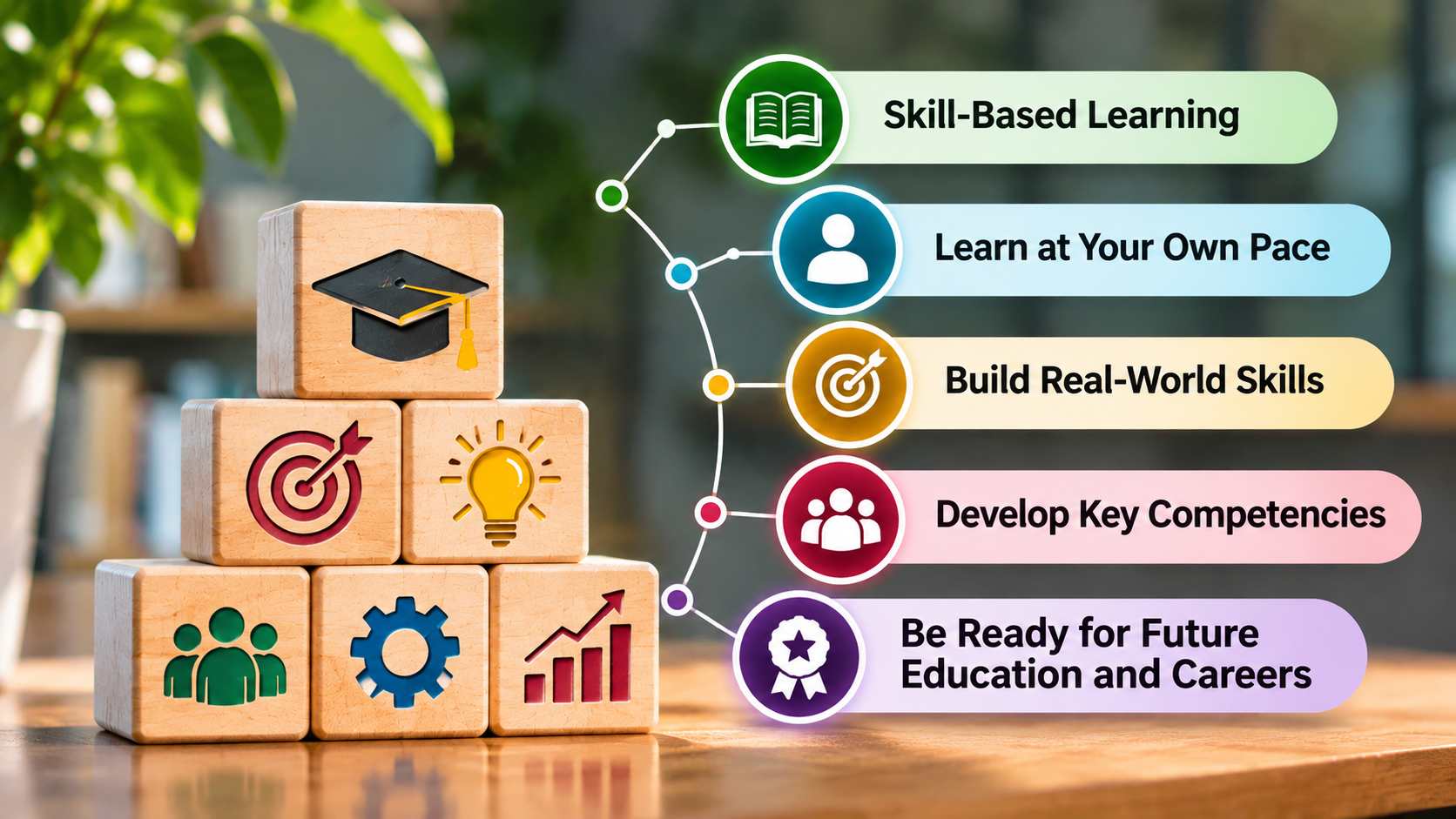
By moving away from rigid classroom schedules, students gain greater control over their learning experiences. They can develop essential competencies at their own pace and receive additional support when learning gaps appear. Meanwhile, educators become facilitators who encourage independent thinking, active participation, and continuous improvement.
Whether you are an educational administrator restructuring a curriculum or a teacher improving classroom instruction, understanding this approach is essential. This guide explores the fundamental principles behind competency-based education. It covers curriculum frameworks, teaching competencies, learning outcomes, and practical implementation strategies. These insights can help create flexible, inclusive, and skills-focused learning environments.

What are the 7 competencies of CBC?
The Competency-Based Curriculum (CBC), particularly the framework used in Kenya, identifies seven core competencies that support students’ academic, personal, and social development. These competencies prepare learners to apply their knowledge in everyday situations rather than simply memorize information.
The seven competencies include:
- Communication and collaboration: Develops effective communication, teamwork, active listening, and the ability to exchange ideas.
- Critical thinking and problem-solving: Encourages learners to analyze information, evaluate evidence, and find practical solutions.
- Imagination and creativity: Helps students develop original ideas and approach challenges from different perspectives.
- Citizenship: Promotes responsibility, respect, ethical behavior, and active participation in society.
- Digital literacy: Builds the ability to use digital technologies safely, effectively, and responsibly.
- Learning to learn: Encourages curiosity, independent learning, and continuous personal development.
- Self-efficacy: Develops confidence, resilience, and belief in one’s ability to achieve goals.
Together, these competencies create a balanced educational experience. They connect classroom learning with practical life skills and prepare students for further education, employment, and responsible citizenship.
What are the five C’s of competency?
The five C’s of competency provide a framework for developing well-rounded individuals. They are Character, Competence, Connection, Confidence, and Contribution. This framework is particularly associated with positive youth development. It highlights the importance of combining practical abilities with personal values and social responsibility.
Each component supports a different aspect of individual growth:
- Character: Encourages honesty, integrity, ethical decision-making, and respect for others.
- Competence: Develops the knowledge, practical skills, and abilities required to perform tasks effectively.
- Connection: Builds meaningful relationships through communication, teamwork, and mutual respect.
- Confidence: Strengthens self-belief, independence, and the ability to overcome challenges.
- Contribution: Encourages individuals to use their abilities to support communities and create positive change.
These five elements work together to support personal and professional development. Competence alone does not guarantee responsible behavior or effective collaboration. Individuals also need strong values, healthy relationships, and confidence.
When educators incorporate these qualities into competency-based learning, students develop more than academic knowledge. They gain the personal and interpersonal abilities needed to participate meaningfully in society.
What are the 10 principles of competency-based learning?
Competency-based learning follows several principles that prioritize demonstrated mastery, personalized instruction, and student development. Although different educational frameworks organize these principles differently, ten commonly emphasized ideas help explain how this approach works. These principles also connect with personalized learning in education, which focuses on adapting educational experiences to individual student needs.
These principles include:
- Student agency: Gives learners greater responsibility for their educational progress.
- Purposeful transparency: Makes learning expectations and assessment criteria clear.
- Clear learning definitions: Establishes specific knowledge and skills students must demonstrate.
- Personalized pacing: Allows students to progress according to their individual learning needs.
- Rigorous mastery criteria: Requires learners to meet clearly defined performance standards.
- Authentic assessment: Uses practical tasks to evaluate real understanding and application.
- Continuous feedback: Provides actionable guidance throughout the learning process.
- Timely support: Addresses learning difficulties before they become larger problems.
- Collaborative culture: Encourages teamwork, participation, and shared responsibility.
- Systemic equity: Provides appropriate opportunities and support for every learner.
Together, these principles create a flexible learning environment. Students understand their goals, receive meaningful feedback, and demonstrate progress through measurable outcomes. Teachers can also identify learning gaps and adjust instructional strategies through daily formative assessment strategies. The result is an educational approach that values individual progress without compromising academic standards.
What is competency-based teaching?
Competency-based teaching is an instructional approach that organizes classroom activities around specific, measurable learning outcomes. Instead of following fixed textbook timelines, educators focus on helping students demonstrate particular knowledge and skills. The main objective is to ensure that learners understand concepts and can apply them effectively.
In this approach, teachers act as learning facilitators rather than relying entirely on traditional lectures. They identify individual learning needs, provide suitable resources, and assess student progress regularly. Learning activities may include practical exercises, group discussions, projects, presentations, and problem-solving tasks.
Time becomes flexible, but learning expectations remain consistent. Students can receive additional guidance when necessary and move forward after demonstrating the required competencies. This approach also encourages independent learning and active classroom participation.
Competency-based teaching supports different learning abilities and reduces dependence on one-size-fits-all instruction. It helps educators identify knowledge gaps and provide targeted assistance. When implemented effectively, it creates more engaging classrooms and connects academic learning with real-world situations.
Transitioning to Facilitated Learning
Transitioning to facilitated learning requires teachers to change how they organize classroom activities. Instead of delivering information through continuous lectures, educators guide students through structured learning experiences. Their role involves supporting independent thinking, encouraging collaboration, and helping learners achieve specific competencies.
Teachers can introduce this approach through several classroom practices, including project-based learning activities that connect academic concepts with practical challenges:
- Small-group workshops: Encourage teamwork, discussion, and collaborative problem-solving.
- Individual learning activities: Allow students to practice skills according to their current abilities.
- Diagnostic assessments: Help identify knowledge gaps before introducing advanced concepts.
- Practical projects: Connect classroom concepts with real-world challenges.
- Regular feedback sessions: Help students understand their progress and identify areas for improvement.
This teaching model also requires careful planning. Educators must establish clear learning objectives and select appropriate assessment methods. They should monitor individual progress rather than relying exclusively on class-wide performance.
As a result, students become more involved in their education. They develop accountability, confidence, and the ability to manage their learning independently.
What are 10 key teaching competencies?
Effective teaching requires more than strong subject knowledge. Modern educators need a combination of instructional, interpersonal, technological, and analytical abilities. These competencies help teachers create supportive learning environments and respond to different student needs.
Ten important teaching competencies include:
- Subject knowledge: Demonstrates a strong understanding of the subjects being taught.
- Pedagogical knowledge: Helps teachers select effective instructional methods.
- Classroom management: Maintains an organized, respectful, and productive learning environment.
- Assessment literacy: Enables educators to evaluate student understanding and learning outcomes.
- Technological proficiency: Supports the effective use of digital tools and educational platforms.
- Cultural responsiveness: Recognizes and respects students’ different backgrounds and experiences.
- Differentiated instruction: Adapts teaching strategies to individual learning requirements.
- Data analysis: Uses assessment results to identify progress and learning gaps.
- Communication skills: Encourages clear explanations, active listening, and meaningful discussions.
- Reflective practice: Helps teachers evaluate their methods and improve their professional skills.
Together, these competencies strengthen instructional quality and student engagement. They also help educators implement competency-based learning more effectively. By continuously developing these abilities, teachers can create inclusive classrooms where students receive appropriate guidance and opportunities to demonstrate their capabilities.
What are the three types of obe?
Outcome-Based Education (OBE) is an educational approach that focuses on clearly defined learning outcomes. It identifies what students should know, understand, and demonstrate by the end of an educational program. Rather than measuring success through completed lessons alone, OBE emphasizes measurable achievements and demonstrated competencies.
A commonly discussed classification identifies three approaches: Traditional OBE, Transitional OBE, and Transformational OBE.
- Traditional OBE: Focuses primarily on subject knowledge and academic achievement within established curriculum structures. Assessment generally measures how well students understand specific course content.
- Transitional OBE: Expands learning beyond individual subjects. It emphasizes transferable abilities such as communication, critical thinking, collaboration, and interdisciplinary problem-solving.
- Transformational OBE: Takes a broader approach by preparing students for complex professional, social, and global responsibilities. It emphasizes adaptability, leadership, ethical decision-making, and lifelong learning.
These approaches represent different levels of educational transformation rather than three universally prescribed OBE models. Their implementation can vary across institutions and educational systems.
When combined with competency-based learning, outcome-based education helps institutions connect curriculum design, teaching activities, and assessment methods with clearly defined educational goals. This makes learning more purposeful, measurable, and relevant to future opportunities.
Frequently Asked Questions
How does competency-based learning differ from traditional grading?
Traditional grading averages test scores, homework, and classroom behavior into a single letter grade, often hiding severe skill gaps. In contrast, capability-oriented evaluation measures specific learning standards independently. Students receive detailed feedback on individual competencies and earn credit only after demonstrating thorough mastery of each standard, ensuring authentic academic achievement.
Can competency-based learning work in remote or online learning?
Yes, capability-driven instruction naturally thrives in digital environments because digital platforms easily accommodate asynchronous, self-paced learning. Students review instructional modules online, complete virtual labs, and submit digital portfolios whenever they feel ready. Automated diagnostic assessments and responsive digital dashboards help remote instructors track individual mastery and intervene promptly.
How does mastery-focused education support neurodivergent students?
This model supports neurodivergent learners by decoupling mastery from rigid time limits. Students who process information differently can spend extra time revisiting challenging modules without facing academic penalties or social stigma. Conversely, they can move quickly through areas where they excel, resulting in a low-stress, highly accommodating educational experience.
What is the biggest challenge when implementing competency-based models?
The greatest challenge is shifting institutional mindsets away from traditional seat-time compliance toward flexible, mastery-focused progression. Implementing this transition requires restructuring scheduling systems, providing intensive teacher development, updating grading software, and clearly communicating the pedagogical benefits to skeptical parents accustomed to conventional GPA rank models.
Conclusion
Adopting competency-based learning represents a critical, long-overdue evolution in educational design. By moving past outdated seat-time models, this framework ensures that credentials represent genuine, verifiable capability rather than mere classroom attendance. Throughout this guide, we explored how the seven CBC competencies, the five C’s, and the ten foundational principles establish an equitable ecosystem centered entirely on individual mastery. We also examined how modern teaching competencies and outcome-based education models equip educators to navigate this structural transition successfully.
Shifting toward dynamic, capability-based environments requires patient collaboration among administrators, teachers, and learners. When schools implement transparent assessment rubrics, personalized learning timelines, and timely interventions, student achievement rises predictably. Educators transition from traditional lecturers into proactive mentors who inspire intellectual curiosity and self-direction. As you update your own pedagogical practices or organizational curricula, focus on designing clear learning pathways that prioritize mastery above all else. Embrace these principles today to build an enduring educational environment where every student has the tools and time needed to succeed.