
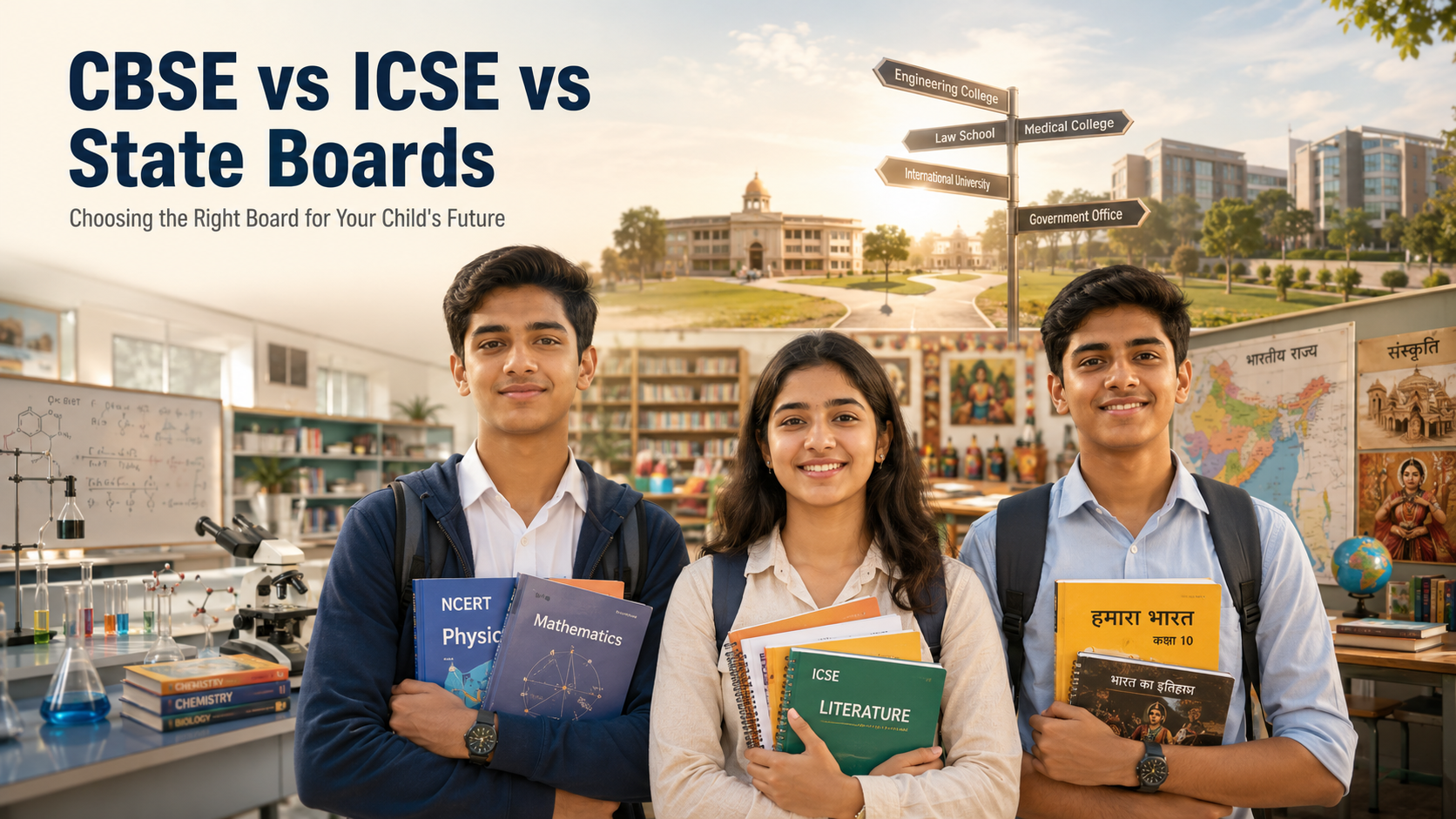
CBSE ICSE and State Boards: How They Actually Differ
Choosing the right educational board for your child is one of the most critical decisions a parent can make in India. The major choices—namely CBSE ICSE and State Boards—each offer a fundamentally different approach to learning, assessment, and future career preparation. Navigating these systems can feel overwhelming, especially with conflicting advice from well-meaning relatives and peers. Understanding these core differences directly impacts how students grasp concepts and perform in competitive environments. To get a foundational look at national education policy standards, parents can review guidelines from the Ministry of Education to see how national frameworks align with local schooling.
This article provides an honest, in-depth comparison of CBSE, ICSE and State Boards. We go beyond school marketing claims to examine syllabus depth, exam patterns, teaching methods, and the practical advantages of each board. Whether your goal is engineering entrance exams, international university admissions, or an affordable local education, this guide will help you make an informed decision. If you are also planning ahead, explore our guide on career options after high school to understand how your board choice can influence future academic and professional opportunities. By the end of this guide, you will know which board best matches your child’s learning style, career goals, and long-term aspirations.
Understanding the Core Identity of CBSE ICSE and State Boards
Before comparing specific subjects, we must understand why these boards exist. The Central Board of Secondary Education (CBSE) is a national board operating under the Indian Union Government. Its primary mission is to provide a uniform education across the country, making it highly preferred by families with transferable jobs. This structural uniformity ensures that a student moving from Delhi to Bangalore can transition between schools smoothly without facing gaps in their ongoing curriculum.
In contrast, the Indian Certificate of Secondary Education (ICSE), managed by the CISCE council, focuses on a comprehensive, world-class curriculum. It treats science, arts, and humanities with equal weight, avoiding the early specialization seen in other systems. Meanwhile, State Boards are managed by individual state governments. They focus heavily on regional language, local culture, and state-level administrative realities, offering an education that is deeply contextualized to the immediate geographical area.
Syllabus Depth and Curriculum Focus
The Science and Math Angle: CBSE’s Core Strength
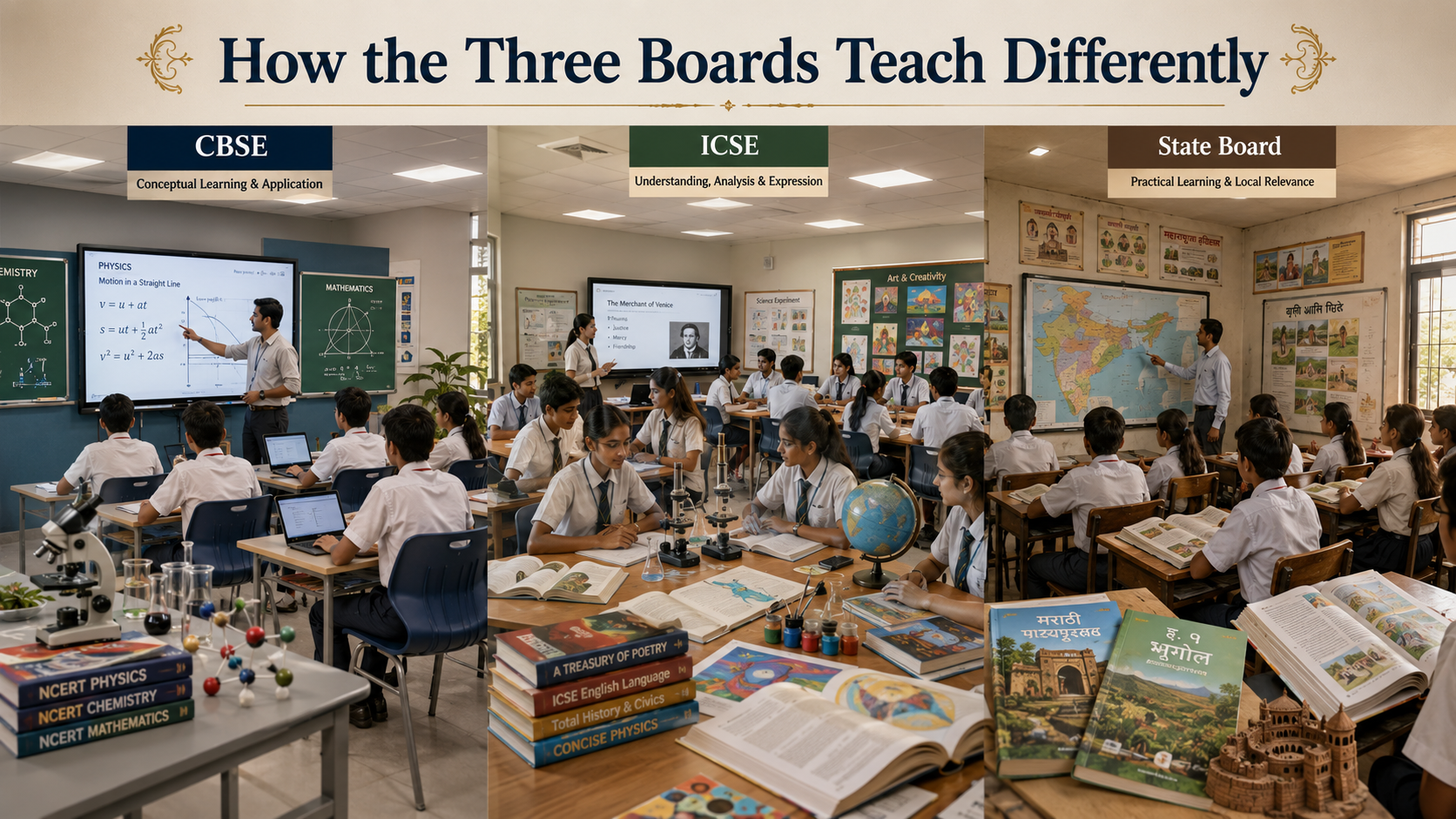
CBSE aligns its curriculum strictly with the National Council of Educational Research and Training (NCERT) guidelines. This national alignment makes it highly structured, concise, and focused on core concepts. The syllabus prioritizes logical reasoning, mathematical proofing, and scientific problem-solving, which heavily favors students targeting national competitive setups.
Because the central government updates these guidelines regularly to reflect shifting educational trends, the material remains lean and optimized. It avoids unnecessary trivia and instead concentrates heavily on building strong foundational concepts in physics, chemistry, biology, and advanced mathematics. This specific focus makes it a powerhouse for scientific preparation.
The Holistic Approach: ICSE’s Breadth
ICSE approaches education with an extensive, detailed syllabus that goes far beyond the boundaries of standard textbooks. It requires heavy reading and deep conceptual application across all subjects, treating non-science fields with extreme seriousness. Unlike other boards, ICSE tests students on vast theoretical knowledge, ensuring strong analytical skills through rigorous internal assignments and extensive lab work.
Students are expected to write comprehensive essays, perform detailed literary analyses, and explore historical contexts deeply. This balanced focus ensures that a student’s artistic or administrative intellect develops at the exact same pace as their scientific comprehension, providing a uniquely broad intellectual foundation.
The Localized Lens: State Board Specialization
State Boards design their curriculum to cater directly to local needs, ensuring that state-specific content is prioritized. While they cover foundational sciences to keep pace with national standards, they dedicate significant space to regional history, local political structures, and native geography. The depth can vary significantly from one state to another, as each board operates independently.
For instance, a state board in a coastal region might place higher emphasis on marine biology or local trade history. This system ensures that students graduate with an intimate understanding of their immediate environment, making it incredibly relevant for local socio-economic participation and native administrative careers.
Medium of Instruction and Language Proficiency
Language policies create a huge dividing line between these educational systems. ICSE permits only English as the medium of instruction across all its affiliated institutions. Consequently, it places immense emphasis on English literature and grammar, helping students excel in international language tests like TOEFL or IELTS. The curriculum demands high levels of verbal fluency, reading comprehension, and structured writing right from primary school.
| Board | Medium of Instruction | Language Focus |
|---|---|---|
| CBSE | English & Hindi | Balanced national and regional language approach |
| ICSE | English only | Strong emphasis on advanced English language, literature, and communication skills |
| State Board | Regional language & English (varies by state) | High priority on the state’s native language while also offering English education |
CBSE allows both English and Hindi mediums, offering a flexible national approach that accommodates diverse demographic backgrounds across different territories. State Boards, however, prioritize the regional language of that specific state as a primary tool for learning. This regional focus is incredibly beneficial for students who intend to live, work, or take state government civil service exams in their home state, as local governance is conducted entirely in the native tongue.
Preparing for National Competitive Exams vs. Global Studies
Your choice of board can shape your child’s academic path. If your child plans to crack JEE or NEET, CBSE offers a clear advantage. National testing agencies design these exams around the NCERT syllabus. As a result, CBSE students often find the transition to competitive exam preparation much easier. They also avoid studying from multiple sets of books.
ICSE students often perform well in management, humanities, law, and international study programs. The board emphasizes internal assessments, project work, and English language skills. These strengths match the expectations of many foreign universities and international standardized tests.
State Boards are often well suited for state-level engineering, medical, and government entrance exams. Some states also reserve institutional quotas or provide admission advantages for students from their own state boards.
Grading Systems and Assessment Methods
The way a board measures success changes how students study on a day-to-day basis. CBSE utilizes a structured grading system that reduces absolute marks pressure, focusing on cumulative grade points to assess a student’s overall performance. Their evaluation tests application-based knowledge through a balanced mix of objective questions, case studies, and short-answer questions.
ICSE relies heavily on a comprehensive evaluation model where internal assessments, laboratory practicals, and detailed project work contribute up to 20% of the final grade across subjects. This design forces students to maintain consistent academic effort throughout the year rather than cramming at the last minute. State Boards traditionally lean toward memory-based evaluation, relying on final written board examinations with less emphasis on day-to-day project work. This method rewards strong retention skills and precise adherence to prescribed textbook answers during the final exam cycles.
FAQ SECTION
Which board is best for cracking JEE and NEET exams?
CBSE is widely considered the best board for national competitive exams like JEE and NEET. This advantage exists because the National Testing Agency (NTA) designs these competitive entrance papers based almost entirely on the NCERT curriculum. CBSE students study this exact syllabus daily in school. Therefore, they do not face a major gap between their school exams and competitive entrance preparation, saving time and reducing stress. They can utilize their regular school hours to reinforce the exact concepts, definitions, and numerical problems that will appear on their highly competitive national entrance exams later on.
Is ICSE harder than the CBSE board curriculum?
ICSE is generally considered more demanding because of its broader and more detailed syllabus. CBSE focuses mainly on the practical application of math and science. In contrast, ICSE requires in-depth study across all subjects. This includes detailed English literature, arts, and humanities. The reading workload is also much heavier. However, whether ICSE is harder depends on the student. Those who prefer concise, formula-based learning often do well in CBSE. Students who enjoy reading and writing may find ICSE a better fit. ICSE also requires students to remember historical facts and literary analysis. This demands discipline, consistent study, and strong language skills throughout the academic year.
Can a State Board student clear national level competitive exams?
Yes, State Board students absolutely clear national exams every year. However, they must often put in extra effort to study NCERT books independently to match the specific testing patterns of central exams. Because many State Boards have updated their science curriculums to match national standards, the gap is narrowing rapidly. Success ultimately depends on the student’s dedication and access to proper reference materials rather than just the school board label. With supplemental coaching or self-study, a determined State Board student can easily bridge any content differences and compete effectively at the highest levels.
Why do parents choose ICSE over other educational boards?
Parents choose ICSE primarily to build strong global communication skills, analytical thinking, and a well-rounded personality. The mandatory English-medium rule and deep focus on world literature create highly articulate students. Additionally, the heavy emphasis on mandatory project work teaches practical research application early in life. This makes ICSE graduates highly competitive for corporate careers, management paths, civil services, and direct admissions into universities abroad. The board trains minds to handle large amounts of data and complex assignments, which mimics the workload students face in higher professional education and global corporate environments.
How do schooling costs differ across CBSE, ICSE and State Boards?
Schooling costs vary significantly across CBSE, ICSE and State Boards. State Boards are usually the most affordable option. Government and government-aided schools charge low fees, making them accessible to families from different income groups.
CBSE schools generally fall into the mid-to-high fee range. They often provide standardized infrastructure, digital learning tools, and consistent academic resources across the country.
ICSE schools are usually the most expensive. Most are private institutions that invest in specialized facilities, experienced teachers, and a broader curriculum. These factors often increase the overall cost of education.
When comparing CBSE, ICSE and State Boards, parents should look beyond tuition fees. They should also consider the quality of education, facilities, extracurricular opportunities, and their child’s long-term academic goals.
CONCLUSION
In summary, choosing between CBSE ICSE and State Boards requires looking closely at your child’s unique learning style and future aspirations. No single board is universally superior; instead, each serves a different strategic purpose in the Indian educational landscape. CBSE offers excellent national mobility and clear advantages for engineering and medical careers due to its close alignment with national testing standards. ICSE provides unparalleled language mastery, deep analytical skills, and a well-rounded foundation for global education and management fields. State Boards offer deeply affordable, culturally rooted learning that sets up students perfectly for local opportunities and state government roles.
Take time to evaluate where you see your child in the next decade. If national competitive tracks are the primary goal, lean toward the structured framework of CBSE. If international exposure, advanced communication, or corporate leadership appeals more, explore the rigorous depth of ICSE. Evaluate your local schools carefully, look beyond the brand name to inspect physical facilities, speak with experienced educators, and choose the environment where your child will truly thrive.