
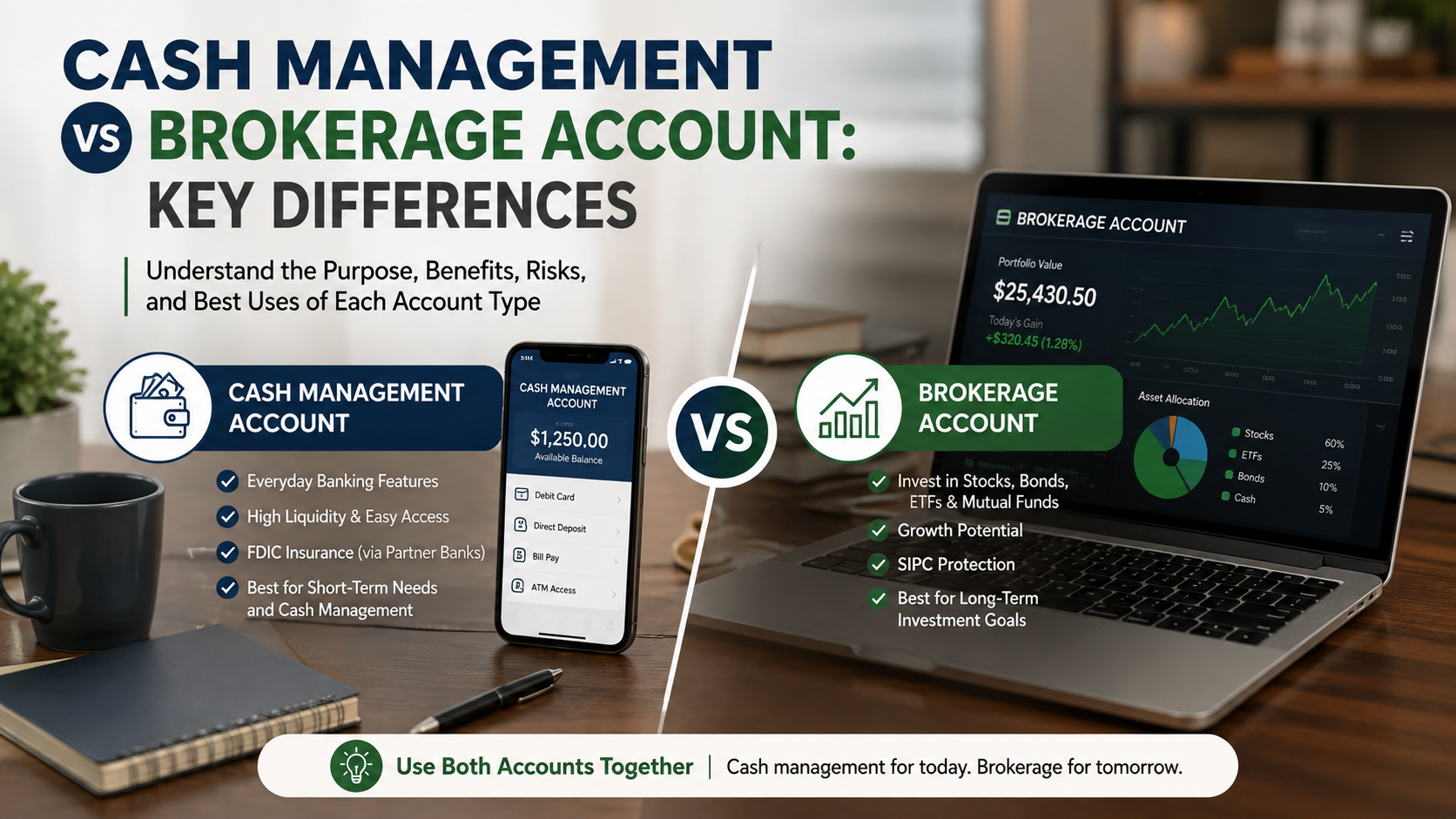
Cash Management vs Brokerage Account: Key Differences
Managing personal finances effectively starts with choosing the right financial tools for each goal. When comparing cash management vs brokerage accounts, many savers wonder where to keep everyday cash and where to invest for long-term growth. Both account types can play an important role, but they serve different purposes within a personal financial plan.
Cash management accounts are commonly offered by fintech companies, brokerages, and other non-bank financial platforms. They are designed for short-term liquidity, spending, and cash storage. Brokerage accounts, meanwhile, provide access to investments such as stocks, bonds, mutual funds, and exchange-traded funds (ETFs).
The U.S. Securities and Exchange Commission oversees securities markets and many aspects of brokerage activity. Cash management accounts may rely on partner banks for deposit services and FDIC insurance.
Choosing between these accounts does not have to be an either-or decision. Many people use both. A cash management account can handle short-term needs, while a brokerage account supports long-term investing. Understanding the differences can help you build a more organized financial system.

What is the difference between a brokerage account and a cash management account?
The biggest difference between these accounts is their primary purpose. A standard brokerage account is designed for investing. It allows you to buy and sell assets such as stocks, bonds, mutual funds, and ETFs. The value of those investments can rise or fall with market conditions.
A cash management account focuses instead on liquidity and everyday cash management. It can provide features commonly associated with checking and savings accounts. Depending on the provider, these features may include debit cards, direct deposits, bill payment, ATM access, and mobile check deposits.
Cash management accounts are often offered by brokerages or fintech companies. Some providers place customer cash into partner banks through sweep arrangements. Eligible deposits held at those banks may receive FDIC insurance, subject to applicable limits and program rules.
The distinction becomes clearer when considering your financial objective. A brokerage account is generally better suited to money you want to invest for future growth. A cash management account is better suited to money you expect to spend or need to access soon, which makes short-term vs. long-term savings goals an important consideration.
Core Distinctions in Insurance and Liquidity
Insurance and liquidity are two important areas where these accounts differ. Brokerage accounts may provide SIPC protection for eligible securities and cash if the brokerage firm fails. SIPC protection does not protect you from investment losses caused by falling stock or bond prices. It also does not guarantee investment performance.
Cash management accounts can work differently. When a provider uses a bank sweep program, your uninvested cash may be distributed among participating banks. Eligible deposits can receive FDIC insurance at each participating institution, subject to the applicable insurance limits and program terms.
Liquidity can also vary by account. Cash management accounts are generally built for routine transactions. Depending on the provider, you may receive a debit card, ACH transfers, direct deposit, ATM access, or bill-pay features.
Brokerage accounts primarily support investing rather than everyday spending. You may need to sell an investment and wait for the trade to settle before withdrawing the proceeds. Settlement timing and withdrawal rules can vary by investment and brokerage.
The key distinction is simple: cash management emphasizes access to cash, while brokerage accounts emphasize investment access and growth.
What are the disadvantages of a cash management account?
Cash management accounts can be convenient, but they are not a perfect replacement for every banking service. One major limitation is the lack of traditional branch access. Many providers operate entirely online, so customers may not have a local branch for cash deposits, face-to-face support, or other in-person services.
Another potential disadvantage is that the interest rate can change. Providers often adjust yields based on market conditions and their own pricing decisions. A competitive rate today may therefore become less attractive later.
Some accounts also have transaction restrictions. Depending on the provider, customers may face ATM withdrawal limits, transfer restrictions, foreign transaction fees, or other account-specific charges. These details matter if you expect to use the account frequently.
Cash management accounts may also depend on partner banks or sweep programs. The exact structure varies by provider. Customers should understand where their money is held, how FDIC coverage applies, and whether any portion of their balance is not covered.
For people who frequently handle physical cash, need specialized banking services, or prefer local support, a traditional bank or credit union may offer greater convenience.
Operational Complexities and Sweep Delays
Sweep arrangements can introduce additional complexity because the provider may distribute deposits among several participating banks. Customers usually see one combined balance, while the underlying funds may be held at multiple institutions.
This structure can make deposit insurance more complicated to understand. FDIC coverage depends on how the program is structured, the banks involved, ownership categories, and the amount of eligible deposits already held at those institutions. Customers should review the provider’s sweep-program disclosures rather than assuming that every dollar automatically receives additional coverage.
Transfers can also take time. Moving money between a cash management account, an external bank, and an investment account may involve processing periods. The exact timing depends on the provider, transfer method, weekends, holidays, and other factors.
These issues do not necessarily make sweep programs unsafe or impractical. However, they mean users should understand how their account operates before relying on it for urgent payments.
A useful approach is to check the provider’s information about FDIC coverage, partner banks, transfer timing, ATM access, and transaction limits. Knowing these details reduces surprises and helps you decide whether the account fits your financial routine.
What are the advantages of a cash management account?
The biggest advantage of a cash management account is convenience. Instead of separating everyday spending, short-term savings, and uninvested cash across several platforms, you may be able to manage much of it from one digital account.
Many cash management accounts offer competitive yields on eligible balances. Some also avoid monthly maintenance fees, although terms vary between providers. Customers may receive additional features such as debit cards, direct deposit, bill pay, ACH transfers, ATM access, and mobile check deposits.
Another benefit is the connection between cash management and investing. Brokerage firms that offer cash management services may allow users to move money between spending and investment accounts within the same platform. This can make it easier to keep short-term cash separate from long-term investments.
Some providers also use bank sweep programs. These arrangements may spread eligible deposits across multiple participating banks. As a result, customers may qualify for more aggregate FDIC insurance than the standard limit at one bank, depending on the program’s structure and applicable rules.
The strongest benefit is therefore convenience rather than guaranteed returns. A well-designed account can simplify daily money management while keeping excess cash productive.
Enhanced Deposit Safety Through Multi-Bank Sweeps
Multi-bank sweep programs can provide an important benefit for customers holding substantial cash balances. Instead of keeping eligible deposits at one participating bank, a program may allocate funds across several banks. This can increase the amount of cash that may qualify for FDIC insurance.
However, the phrase multi-million-dollar FDIC insurance should not be interpreted as unlimited protection. Coverage depends on the number of participating institutions, ownership categories, existing deposits, and the program’s specific terms. The FDIC generally applies its insurance limits at each insured bank based on ownership category.
This structure can be especially useful for people who maintain large cash reserves. It may reduce the need to open and manage numerous individual bank accounts simply to distribute deposits.
The arrangement can also make administration easier. Instead of logging into several banks, customers may manage the sweep program through one platform.
Still, users should review the provider’s current disclosures before relying on the coverage. Confirm which banks participate and understand how the provider handles deposits when one institution reaches the applicable insurance limit.
The main benefit is potentially broader deposit insurance with centralized management, not protection against every type of financial loss.
Is a cash management account worth it?
Whether a cash management account is worth it depends on how you use your money. It can be valuable for people who want a single digital platform for spending, short-term savings, and uninvested cash. The combination of competitive yields and payment features can reduce the need to manage multiple accounts.
These accounts can also work well for investors. Keeping short-term cash near an investment account can make transfers more convenient when you need to fund a purchase or rebalance your finances. However, convenience should not be confused with higher investment returns. Cash management accounts are designed for cash, not market-based growth.
A traditional bank or credit union may be a better option if you regularly deposit physical cash. Local branches can also be valuable when you need in-person assistance or specialized banking services.
Before opening an account, compare the interest rate, fees, ATM access, transfer limits, FDIC structure, and customer support. Also consider whether the provider allows the payment features you actually use and fits your good financial habits.
For many people, the best solution is not choosing between cash management and brokerage accounts. Using both can create a clear separation between money needed soon and money intended for long-term investment.
Ideal User Profiles for Cash Management
Cash management accounts are particularly useful for people who prefer digital financial services. They can suit remote workers, frequent online users, and investors who want spending and investing tools under one platform.
They may also work well for people who want to earn interest on money that would otherwise sit in a low-yield checking account. Depending on the provider, users can combine cash storage with direct deposit, debit-card spending, electronic transfers, and bill payments.
Another suitable group is investors who keep a meaningful amount of uninvested cash. A cash management feature can provide a convenient place for short-term reserves, particularly when building an emergency fund, without requiring a separate banking relationship.
However, the account is less suitable for everyone. People who frequently handle physical cash may prefer a bank with nearby branches. Users who need specialized banking products should also compare the available services before switching.
The right choice depends on your financial habits rather than the account’s feature list alone. Consider how often you spend, save, transfer, deposit cash, and invest.
If your priority is convenient access to liquid funds, a cash management account may fit well. If your priority is long-term market growth, a brokerage account is usually the more relevant tool.
What are the three types of brokerage accounts?
The three broad categories discussed here are taxable brokerage accounts, retirement accounts, and custodial accounts. Each serves a different financial purpose and has different tax and withdrawal rules.
A standard taxable brokerage account offers substantial flexibility. You can generally invest without an annual contribution limit and withdraw funds when needed. However, investment income and realized capital gains can create tax obligations.
Retirement accounts, including Traditional and Roth IRAs, are designed for long-term retirement savings. Traditional IRAs can provide tax benefits on eligible contributions, while Roth IRAs generally use after-tax contributions and may allow tax-free qualified withdrawals. Contribution limits and eligibility requirements apply.
Custodial accounts, such as UGMA and UTMA accounts, allow an adult custodian to manage assets for a minor. The child generally receives control of the account when the applicable legal age is reached. Rules vary by state and account type.
These categories are not interchangeable. A taxable account may suit flexible investing, an IRA may suit retirement planning, and a custodial account may support investing for a child.
The best structure depends on your goal, time horizon, tax situation, and need for access to the money, all of which are important when considering modern asset allocation strategies.
Matching Account Structures to Financial Goals
Choosing a brokerage account should start with the purpose of the money. A taxable brokerage account can be useful when you need investment flexibility and may want access to funds before retirement. It does not provide the same tax advantages as many retirement accounts, but it generally offers fewer restrictions.
An IRA is more focused on retirement. Traditional and Roth IRAs can provide valuable tax treatment, but each has contribution rules and withdrawal considerations. They are therefore less suitable for money you expect to need for routine expenses.
Custodial accounts address a different goal. They allow an adult to invest assets for a minor, but the funds ultimately benefit the child. This makes them different from simply holding investments in the parent’s name.
Your timeline should also influence the decision. Short-term money generally should not depend heavily on stock-market performance. Long-term money may have more capacity to tolerate market fluctuations, making risk vs. return in investing an important part of the decision.
A practical framework is to match each account to its job:
- Cash management: everyday spending and short-term reserves.
- Taxable brokerage: flexible, long-term investing.
- Retirement account: retirement-focused investing with tax advantages.
- Custodial account: investments intended for a minor.
This separation can make your financial system easier to manage and reduce the risk of using the wrong account for a specific goal, while helping you distinguish between assets and liabilities as your finances become more complex.
Frequently Asked Questions
Can I lose money in a cash management account?
You generally have a low risk of losing eligible deposited cash in a cash management account when funds are held at FDIC-insured partner banks and remain within applicable insurance limits. However, cash management vs brokerage accounts have different risks. FDIC insurance can protect eligible bank deposits if a participating bank fails, but it does not cover every fee, transaction issue, or investment-related loss. Always review the provider’s sweep structure and insurance terms before depositing large amounts.
Can a cash management account fully replace a traditional bank?
A cash management account can replace many traditional checking or savings functions, especially for people who primarily manage money online. In the cash management vs brokerage comparison, a cash management account is better suited to everyday spending and liquid savings. Depending on the provider, you may get debit cards, direct deposit, bill pay, and electronic transfers. However, traditional banks may still be better for physical cash deposits, branch services, safe deposit boxes, or specialized banking needs.
Do cash management accounts charge monthly maintenance fees?
Many cash management accounts from online brokerages and fintech providers do not charge monthly maintenance fees or require minimum balances. This can make them attractive when comparing cash management vs brokerage options for everyday cash. However, fee structures vary by provider. You should check for charges related to out-of-network ATM withdrawals, wire transfers, foreign transactions, expedited services, or other optional features. A no-monthly-fee account can still have other transaction-based costs.
How do taxes work on cash management versus brokerage accounts?
Taxes are another important consideration when comparing cash management vs brokerage accounts. Cash management accounts generally generate interest that you report as ordinary taxable income. Taxable brokerage accounts can generate dividends, interest, and capital gains when you sell investments for a profit. Some long-term capital gains and qualified dividends may receive preferential tax treatment. Your actual tax liability depends on your account type, investments, income, and applicable federal and state tax rules.
Conclusion
Understanding cash management vs brokerage accounts helps you assign each dollar to the right financial purpose. Cash management accounts generally suit spending and short-term reserves, while brokerage accounts support long-term investing. Using both can create a clearer separation between liquid cash and investments, while helping you manage taxes, risk, and financial goals more effectively.