Can a Laser Pointer Start a Fire?
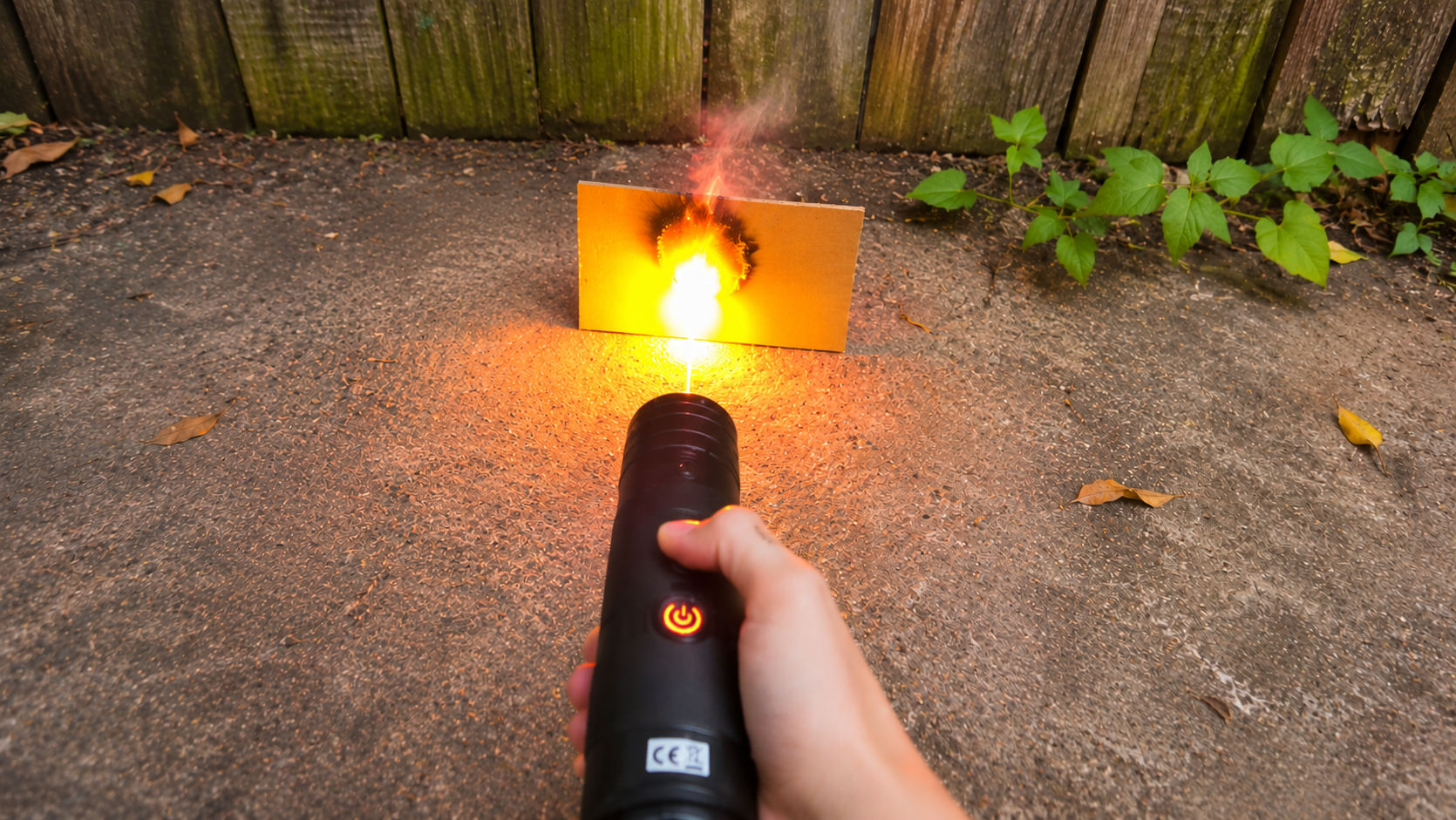
Many people wonder: can a laser pointer start a fire, or is it simply an internet myth? The answer depends on the laser’s power and classification. Standard classroom pointers generally lack enough energy to ignite ordinary materials. However, certain high-powered lasers can create serious thermal hazards.
According to the U.S. Food and Drug Administration (FDA), laser pointers intended for pointing and demonstration purposes are limited to 5 milliwatts (mW) in the visible wavelength range. More powerful devices present additional safety concerns.
Understanding concentrated light is important for everyday safety. High-powered laser beams can damage sensitive electronics, cause permanent eye injuries, and create fire hazards. Their risks extend beyond the person operating the device.
In this guide, we explore whether a laser pointer can start a fire, burn objects, or damage CCTV cameras. We also explain laser safety classifications and the legal restrictions surrounding high-powered devices.
Can a Laser Pointer Burn Things?
Yes, certain high-powered lasers can burn materials, but ordinary presentation pointers generally cannot. Most consumer laser pointers operate at relatively low power. Their primary purpose is highlighting objects during presentations, not producing significant heat.
The difference comes down to laser output, wavelength, exposure time, and material properties. Powerful lasers concentrate substantial optical energy into a small area. Depending on the target, this energy can cause discoloration, melting, scorching, or other thermal damage.
However, not every laser above 5 mW automatically burns objects. Actual results depend on several physical conditions. Surface reflectivity, beam characteristics, and material composition all influence the outcome.
It is also important to understand that a laser capable of damaging materials can seriously injure human eyes. High-powered laser devices should never be treated as toys or household tools.
How Power Output Determines Burning Capability
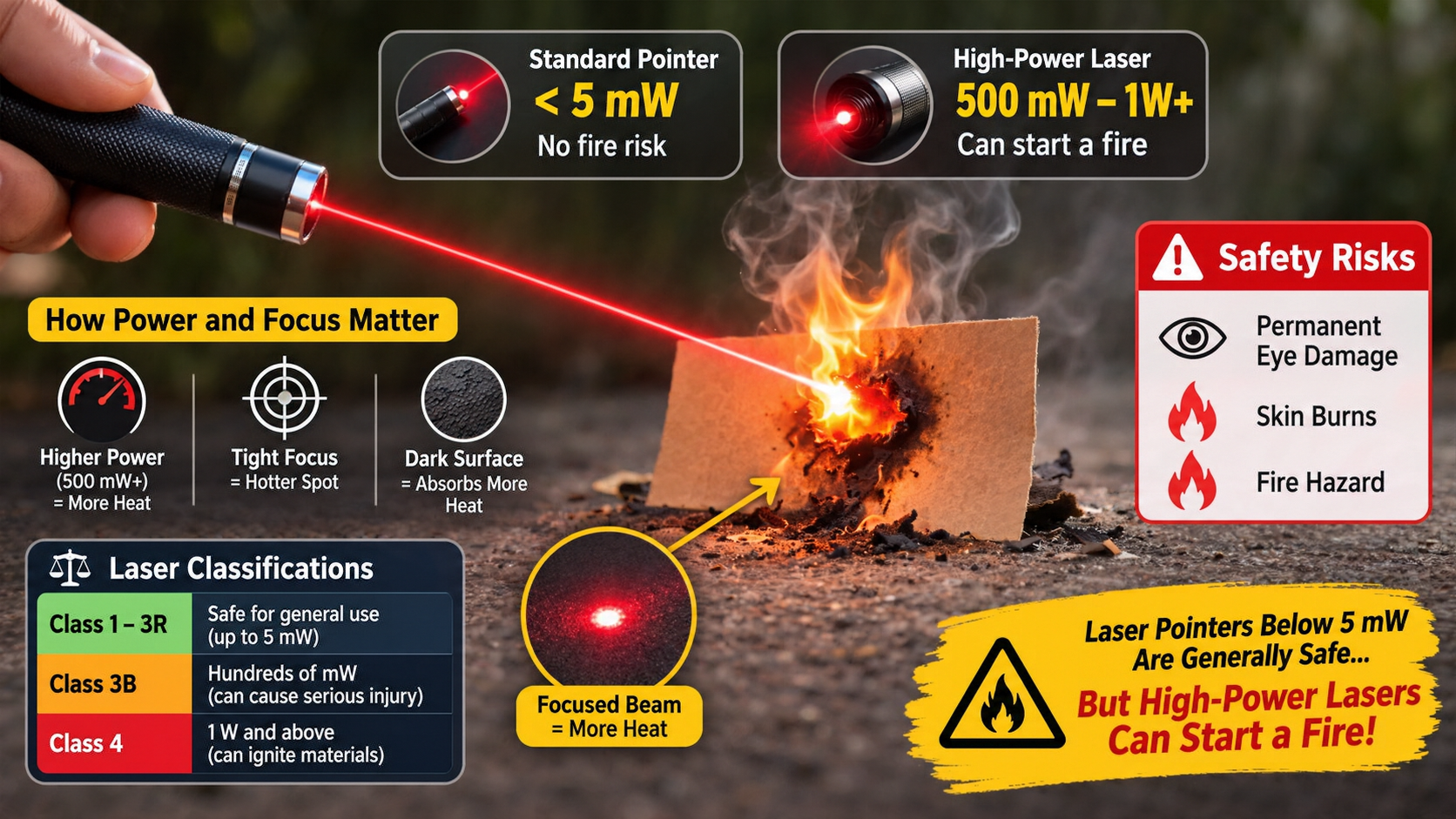
Laser output is measured in milliwatts (mW) or watts (W). These measurements describe the amount of optical power a laser produces. Higher output generally increases the potential for thermal damage, although power alone does not determine the result.
The FDA recognizes several laser hazard classifications. Their power ranges help distinguish ordinary pointers from more hazardous equipment.
- Class 3R: Generally up to 5 mW for visible laser pointers. Direct eye exposure can still present risks.
- Class 3B: Approximately 5–500 mW. Direct exposure can cause serious eye injuries.
- Class 4: Above 500 mW. These lasers can cause serious eye injuries, skin burns, and fire hazards.
Importantly, these classifications describe potential hazards rather than guaranteed burning performance. A laser’s wavelength, beam characteristics, and exposure conditions also matter.
Never assume that a laser is safe because its advertised output appears relatively low. Product labels and verified specifications are essential.
Can Laser Light Destroy a CCTV Camera?
Yes, sufficiently powerful laser exposure can permanently damage a CCTV camera’s image sensor. Similar damage can affect smartphone cameras, too. Learn what a laser does to your phone’s camera and understand the potential risks. However, the outcome depends on the laser’s characteristics, exposure conditions, and camera design.
Most modern surveillance cameras use CMOS image sensors. Some older models use CCD technology. These components detect incoming light and convert it into electronic signals.
A sufficiently intense laser beam entering the camera lens can overload or physically damage sensitive sensor components. Depending on the exposure, the resulting damage may appear as persistent image defects or complete sensor failure.
However, not every laser exposure destroys a camera. Ordinary low-power pointers do not automatically cause permanent damage. The risk increases with more powerful laser sources and unfavorable exposure conditions.
Camera damage can also result from other electrical or environmental problems. Therefore, unusual footage alone does not confirm laser damage.
Signs of Laser Sensor Damage on Security Cameras
Laser-related sensor damage can create visible problems in surveillance footage. The appearance depends on the affected sensor components and the extent of the damage.
Some common warning signs include:
- Permanent bright spots: Certain pixels may remain unusually bright across multiple recordings.
- Colored lines: Persistent purple, green, or other colored streaks may appear.
- Dark patches: Damaged sensor areas may produce black or discolored sections.
- Distorted images: Parts of the footage may display unusual patterns or brightness inconsistencies.
- Complete image failure: Severe damage may prevent the camera from producing a usable picture.
These symptoms are not exclusive to laser exposure. Faulty sensors, damaged connections, and other electronic problems can produce similar results.
Restarting a camera or cleaning its lens will not repair physically damaged sensor components. A professional inspection can help identify the actual cause and determine whether replacement is necessary.
Can Lasers Start Fires?
Yes, sufficiently powerful lasers can start fires under certain conditions. This is one reason high-powered laser devices require careful handling.
If you are asking can a laser pointer start a fire in real-world conditions, the answer depends on its ability to transfer enough energy into a material. A sufficiently intense beam can heat an absorbing surface. If the temperature reaches the material’s ignition point, combustion may occur.
However, the outcome depends on several factors. Laser output, wavelength, exposure conditions, and material properties all influence the potential fire risk.
Standard classroom pointers generally lack the necessary output to create ordinary fire hazards. Class 4 lasers present significantly greater risks because they can produce dangerous thermal effects.
This distinction is important when evaluating claims about laser pointers. Not every handheld laser can ignite materials, and not every powerful laser produces identical results.
For household safety, keep high-powered lasers away from combustible materials. You should also follow practical precautions to make your home fireproof and reduce everyday fire risks. Never experiment with laser-based ignition because accidental exposure can cause permanent eye injuries and unexpected fires.
Why Dark Surfaces Ignite Faster Under Laser Beams
Surface color and composition influence how materials interact with laser light. Dark surfaces often absorb more visible light than lighter surfaces. However, color alone does not determine whether a material will ignite.
Light absorption describes how much incoming optical energy a material takes in rather than reflects or transmits. Absorbed energy can increase the material’s temperature.
Other characteristics also influence this process:
- Surface reflectivity: Highly reflective surfaces may redirect some incoming light.
- Material composition: Different materials respond differently to concentrated optical energy.
- Thermal properties: Some materials distribute heat more effectively than others.
- Environmental conditions: Surrounding conditions can influence whether combustion occurs.
This explains why two materials exposed to similar lighting conditions may respond differently.
Importantly, dark surfaces are not automatically flammable, and lighter surfaces are not automatically fireproof. The potential for ignition depends on several interacting factors.
Never use household materials to test a laser’s burning capability. Such experiments can create uncontrolled fire hazards and dangerous eye exposure.
Are Laser Pointers Safe?
Low-power laser pointers are generally suitable for everyday presentations when users follow basic safety precautions. However, this does not mean every laser pointer is completely harmless.
The human eye is particularly vulnerable to concentrated laser light. The eye’s optical system focuses incoming light onto the retina. Consequently, direct exposure can damage sensitive retinal tissue.
Higher-powered lasers create more serious hazards. Depending on their classification, they can cause permanent vision loss, skin injuries, and accidental fires.
Even reflected laser light can present risks with sufficiently powerful devices. This makes mirrors, polished metal, glass, and other reflective surfaces important safety considerations. In professional environments, appropriate protective equipment is essential. Understanding chemistry lab safety equipment can also help users recognize important protective measures when working with potentially hazardous equipment.
Follow these precautions when handling laser pointers:
- Never aim a laser at people, animals, or aircraft.
- Avoid looking directly into a laser beam.
- Keep laser devices away from children.
- Never point lasers toward reflective surfaces.
- Check the manufacturer’s safety labels and power specifications.
- Use appropriate wavelength-specific protective equipment in professional laser environments.
Responsible handling reduces unnecessary exposure and helps prevent avoidable accidents.
Understanding FDA Laser Hazard Classifications
The FDA classifies laser products according to their potential hazards. These classifications help users understand the risks associated with different devices.
The major classifications include:
| Laser Class | General Characteristics |
|---|---|
| Class 1 | Generally considered safe during normal operation. |
| Class 2 | Visible lasers with limited output and potential risks from prolonged direct viewing. |
| Class 3R | Lower-powered lasers that can still present eye hazards. |
| Class 3B | Higher-powered lasers that can cause immediate eye injuries from direct exposure. |
| Class 4 | Powerful lasers that can cause eye injuries, skin burns, and fire hazards. |
The FDA also recognizes Class IIIa and IIIb terminology, which broadly corresponds to modern IEC Class 3R and 3B classifications.
Importantly, the natural blinking reflex does not guarantee protection from laser injuries. Some exposures can cause damage before a person reacts.
For detailed classification guidance, consult the FDA’s laser safety information.
Why Are Some Laser Pointers Illegal?
Some high-powered laser pointers face strict legal restrictions because they can cause serious injuries and threaten public safety.
In the United States, the FDA limits laser products promoted for pointing and demonstration purposes to Class IIIa or equivalent Class 3R output. For visible wavelengths, this generally means a maximum output of 5 mW.
Products exceeding these limits cannot legally be promoted as ordinary laser pointers or demonstration devices. More powerful lasers may still be permitted for legitimate professional, industrial, research, or entertainment applications under applicable requirements.
Importation and distribution also involve federal regulatory requirements. The FDA can take action against noncompliant laser products entering the United States.
Another major concern involves aviation safety. Aiming a laser at an aircraft can distract or temporarily impair pilots during critical flight operations.
Legal requirements differ between countries and jurisdictions. Therefore, a device legally available in one location may be restricted elsewhere. Always check local regulations before purchasing or using a high-powered laser.
Legal Penalties for Misusing Handheld Lasers
Misusing a laser pointer can result in serious legal consequences, particularly when aircraft or public safety are involved.
In the United States, 18 U.S.C. § 39A makes knowingly aiming a laser pointer at an aircraft or its flight path a federal crime.
Possible consequences include:
- Federal imprisonment: Offenders can face up to five years in prison.
- Criminal fines: Courts may impose criminal fines under applicable federal law.
- FAA civil penalties: The Federal Aviation Administration can impose substantial civil penalties for laser-related violations.
- Additional legal action: State and local authorities may pursue separate charges when applicable.
The FAA also warns that laser strikes can temporarily blind or distract pilots. These incidents create risks for passengers, flight crews, and people on the ground.
Remember that laser regulations vary internationally. Always follow the laws applicable to your location and never aim a laser toward an aircraft.
Conclusion
So, can a laser pointer start a fire? Yes, but it depends on the laser’s power, classification, and exposure conditions. Ordinary classroom pointers generally cannot ignite materials, while high-powered lasers can generate enough heat to cause burns, damage objects, and create fire hazards.
Laser safety also extends beyond fire risks. Powerful beams can permanently damage human eyes, harm sensitive camera sensors, and create dangerous situations around aircraft. Even relatively low-powered devices require responsible handling.
Before purchasing or using a laser pointer, check its verified power rating, safety classification, and local regulations. Never aim a laser at people, animals, vehicles, or aircraft. Understanding these risks helps prevent serious injuries, property damage, and avoidable accidents.