

Best Science Project Ideas for Class 10 Students
Best Science Project Ideas for Class 10 Students help learners understand scientific concepts through practical, hands-on experiments and models. These science projects improve creativity, problem-solving skills, and presentation ability. Choosing the right science project ideas for Class 10 students can significantly improve exam performance, confidence, and school exhibition results.
In this guide, you will explore simple, practical, and high-scoring project ideas suitable for Class 10 students.
For official syllabus support, refer to NCERT: https://ncert.nic.in
How to Choose Class 10 Science Projects
Selecting the right Class 10 Science Projects is important for scoring well in school assessments. Avoid overly complex topics and focus on clarity and relevance.
- Match your project with your syllabus (Physics, Chemistry, Biology)
- Choose something you are interested in
- Ensure easy availability of materials
- Prefer real-life applications
👉 Good planning always leads to better results.
Best Class 10 Science Projects
⚡ Solar Energy Model (Renewable Electricity)
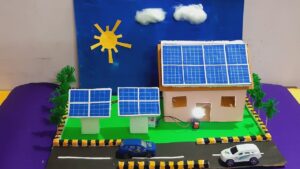
This project demonstrates how sunlight can be converted into electrical energy using a solar panel. It is one of the best models for science exhibitions because it is simple and highly practical.
To make it, you need a small solar panel, LED bulb, connecting wires, switch, and a cardboard base. First, fix the solar panel on a cardboard sheet so it can directly face sunlight. Then connect the positive and negative terminals of the solar panel to the LED bulb using wires. You can also add a switch in between for control. When sunlight falls on the panel, electricity is generated and the LED glows.
This project helps you understand renewable energy, solar power conversion, and real-life applications like solar street lights and solar calculators.
💧 2. Water Purification System (Filtration Model)
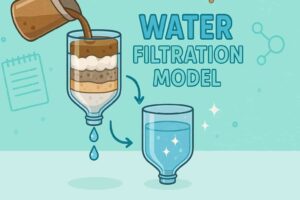
This project explains how dirty water can be cleaned using natural filtering materials. It is very useful to understand how clean drinking water is produced.
To build it, take a plastic bottle and cut it into two halves. Place the upper half upside down like a funnel. Add layers inside: cotton at the bottom, then charcoal, sand, and gravel at the top. Now pour dirty water from the top slowly. The water will pass through all layers and come out cleaner at the bottom container.
Each layer has a role: gravel removes large particles, sand removes smaller impurities, and charcoal removes smell and color. This project teaches water purification techniques used in real water treatment plants and helps understand the importance of clean water.
🌧️ 3. Rainwater Harvesting Model
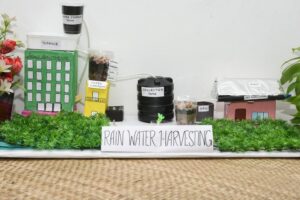
This model shows how rainwater can be collected, stored, and reused instead of wasting it. It is very important for saving water resources.
To make it, create a small house model using cardboard. Attach small pipes or straws from the roof to act as rainwater channels. Under the pipe, place a container to collect water. You can also add a simple filter system using cotton and sand before water enters the tank. Pour water on the roof to simulate rainfall and observe how it flows into the storage tank.
This project teaches water conservation, groundwater recharge, and sustainable living. It also explains how cities use rainwater harvesting systems to prevent water shortage.
🌬️ 4. Wind Energy Model (Wind Turbine)
This project shows how wind energy is converted into electrical energy using a turbine. It is an important renewable energy source.
To make it, use cardboard or plastic to create 3–4 blades. Attach them to a small DC motor. Fix the motor on a stand made of cardboard or wood. Connect wires from the motor to an LED bulb. Now, when you blow air or use a fan, the blades rotate and the LED glows due to electricity generation.
This model explains how wind turbines work in wind farms. It teaches energy conversion, mechanical motion, and green energy concepts that are used to produce electricity without pollution.
🌱 5. Plant Growth Experiment (Effect of Sunlight)
This experiment shows how sunlight affects plant growth and explains the process of photosynthesis in a simple way.
To perform it, take two identical plants in pots. Keep one plant in direct sunlight and the other in a shaded area. Water both plants equally every day and observe them for 1–2 weeks. You will notice that the plant in sunlight grows faster, greener, and healthier, while the shaded plant becomes weak and pale.
This project helps you understand how plants need sunlight to prepare food through photosynthesis. It also teaches the importance of environmental conditions for plant growth and agriculture.
❓ Frequently Asked Questions (FAQs)
1. What are the easiest best science project ideas for Class 10 students?
The easiest science project ideas include solar energy models, water filtration systems, and pH indicator experiments. Moreover, these projects require simple and easily available materials. In addition, they are very easy to build, explain, and demonstrate in front of teachers. Therefore, they are highly recommended for school exhibitions.
2. How much time does a science project take?
Usually, simple science projects take around 3–7 days to complete. However, the exact time may vary depending on the design and level of detail. Furthermore, if the project is more complex or includes working circuits, it may take a little longer. As a result, proper planning is very important to complete it on time.
3. Can I use internet ideas for my project?
Yes, you can definitely take inspiration from the internet. However, it is important that you understand the concept clearly instead of copying it directly. In addition, you should try to modify or improve the idea in your own way. Therefore, your project will look more original and impressive to teachers.
4. Which subject is best for science projects?
Physics, chemistry, and biology all offer excellent project ideas. Therefore, students should choose the subject they understand the most. Moreover, selecting a familiar topic makes it easier to explain during viva. Consequently, it increases the chances of scoring higher marks.
Final Thoughts
The best science project ideas for Class 10 students are simple, practical, and highly creative. Therefore, students should mainly focus on understanding the scientific concepts instead of building overly complex models. In addition, they should try to keep their project neat, organized, and easy to explain, because presentation plays a very important role in scoring good marks.
Moreover, when students connect science with real-life applications, learning becomes much more meaningful and interesting. As a result, they not only perform better in exams but also develop a stronger understanding of how science works in everyday life.
Furthermore, teachers often appreciate projects that show clarity, effort, and creativity rather than difficulty alone. Consequently, even a simple model can earn high marks if it is explained well.
Finally, if you want even more creative options, you can explore additional ideas in this guide on 15 best science projects for students, which includes more detailed explanations and project suggestions for school exhibitions.