How to Avoid Misinformation While Studying Online
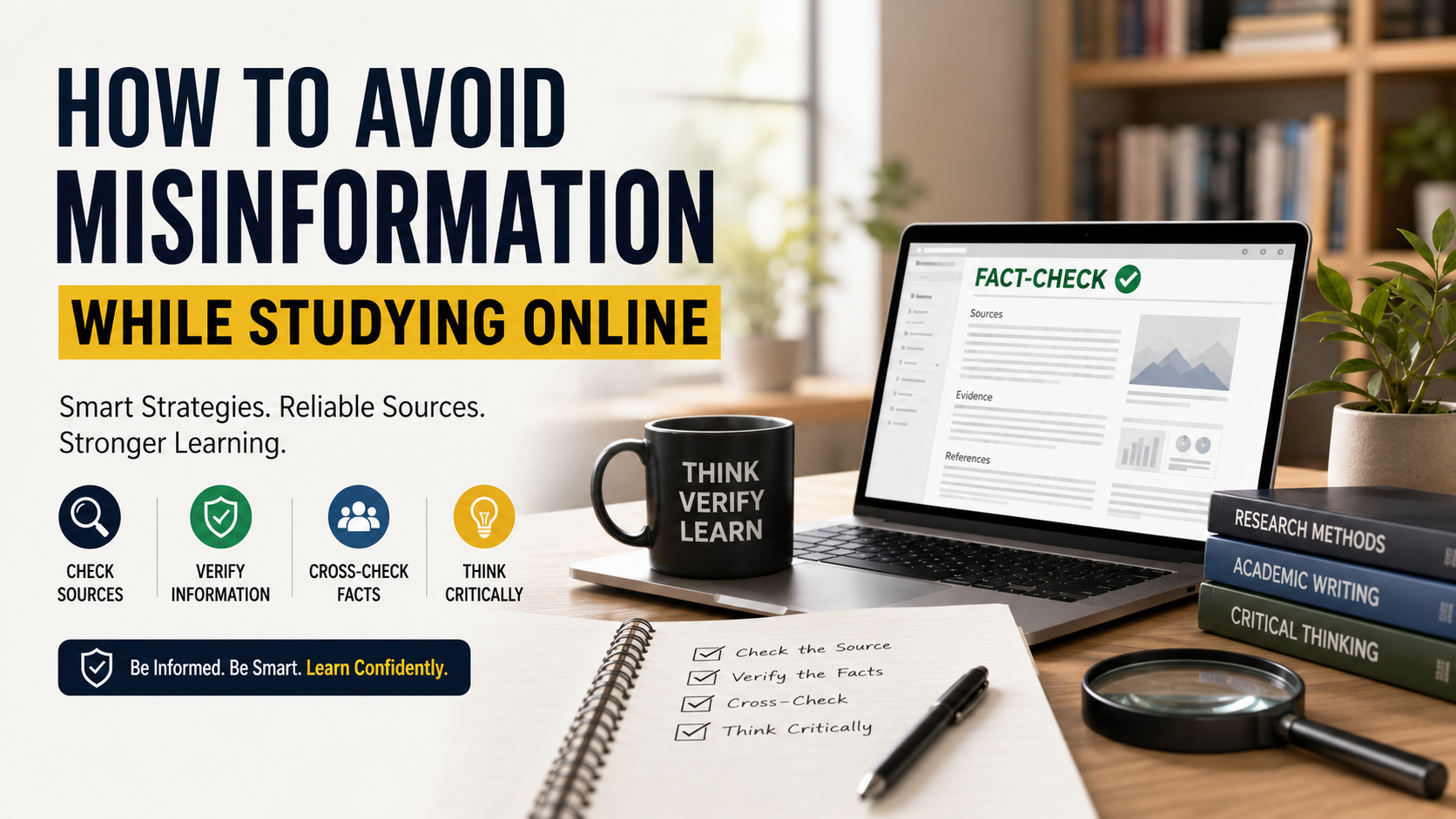
The internet has democratized education. It makes learning any skill from home incredibly easy. However, this open access means anyone can publish content. This reality leads to a massive influx of unverified data. If you want to maintain the quality of your education, learning how to avoid misinformation while studying online is critical. It is one of the most important skills you can develop today.
Academic success relies heavily on the integrity of your research material. According to the Stanford History Education Group, many digital learners struggle to evaluate sources. They cannot easily distinguish between credible journalism, sponsored content, and outright fabrications.
When you rely on inaccurate data, you risk sabotaging your grades. You adopt flawed perspectives and waste valuable time. The digital ecosystem is packed with blogs and social media threads. It contains unverified wikis that mimic legitimate academic papers.
This guide provides a comprehensive framework for safe navigation. We will explore how to identify deepfakes and verify digital assertions. You will learn to leverage peer-reviewed databases and cultivate a healthy skeptical mindset. By mastering these digital literacy strategies, you will protect your academic integrity. You will ensure your study hours truly yield accurate knowledge.
The Growing Challenge of Digital Learning
Online education offers unmatched flexibility. However, it also forces students to act as their own gatekeepers. Traditional textbooks undergo rigorous editorial reviews before publication. In contrast, online articles can be uploaded instantly. They often lack any factual verification. This lack of quality control means incorrect data spreads fast. Falsehoods frequently travel faster than verified facts.
The algorithms driving modern platforms compound this issue heavily. They serve content that provokes a strong emotional reaction. They do this regardless of the underlying truth. Furthermore, search engine algorithms prioritize user engagement over strict factual accuracy. A sensationalized blog post might rank higher than a dry study. It wins simply because it gets more clicks.
As a remote student, you must actively filter out this background noise. This filter helps you find genuine, evidence-based academic materials. Relying blindly on the first page of search results is dangerous. It can introduce subtle inaccuracies into your core understanding. Developing an active filtering system is not just an extra step. It is a fundamental prerequisite for successful self-directed learning today.
Smart Strategies to Avoid Misinformation While Studying Online
Building a robust verification process protects your mind from inaccurate assertions. You do not need to be a professional researcher to spot flaws. Implementing a few systemic checks will immediately elevate your study materials. These habits insulate your coursework from deceptive trends.
You must treat online reading as an active evaluation process. Do not treat it as passive absorption. This mindset helps you spot inconsistencies early. You catch them before they find their way into your assignments. To protect your education, you must commit to filtering your daily digital intake thoroughly.
Check the Author’s Credentials and Intent
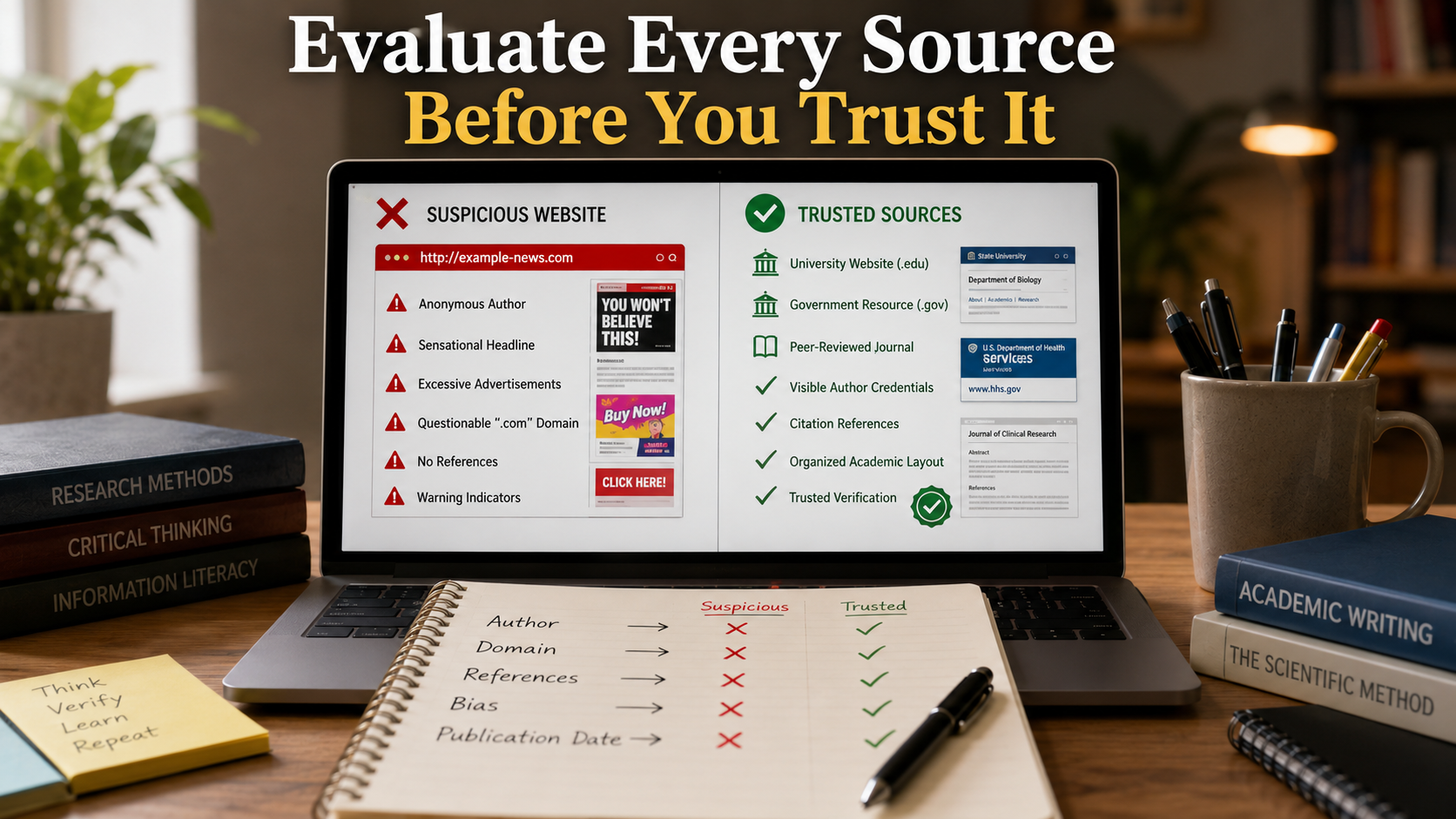
Always investigate who wrote the material you are reading. A reliable author explicitly displays their academic degrees. They show their professional history or organizational affiliations directly on the page. If an article lacks a clear author profile, treat it with caution. The same applies if it masks the creator’s background.
Experienced researchers look for institutional backing. They verify if the author currently teaches at an accredited university. They check if the writer works within a recognized scientific field.
Additionally, evaluate the author’s underlying motivation. Are they trying to educate you, or are they selling a product? They might also be promoting a narrow political agenda. Factual data should remain objective. It must present multiple viewpoints where appropriate.
If the tone feels overly emotional, sensational, or heavily biased, beware. The content may be designed to persuade rather than inform. That tone makes it an unreliable foundation for your academic coursework.
Analyze the URL and Domain Extensions
The structure of a website link reveals its trustworthiness. Educational institutions and government agencies provide the most reliable online learning resources. They face strict internal content guidelines. When assessing a site, carefully review the suffix of the domain name. This suffix determines who supports the platform.
Look for these specific domain extensions when conducting research:
-
.edu: Reserved exclusively for accredited higher education institutions.
-
.gov: Managed strictly by government entities and official departments.
-
.org: Used by non-profit organizations, though these require extra verification for bias.
-
.com / .net: Commercial spaces that require thorough independent verification due to financial motives.
Utilize the Lateral Reading Method
Instead of reading an unfamiliar article from top to bottom, practice lateral reading. This method requires leaving the website almost immediately. You open multiple browser tabs to research the organization or author. You check the claims from external perspectives.
See what independent experts say about the source. Check fact-checking platforms and historical records before you trust the text. If other reputable institutions do not back up the claim, move on. You can discard the source quickly if it has a history of publishing unverified rumors.
Professional fact-checkers use this technique to evaluate unfamiliar sites within seconds. It prevents you from being manipulated by clean web designs. It stops you from trusting official-looking logos that hide deceitful content.
Evaluating Academic Sources for Digital Fact Verification
When writing essays or prepping for exams, basic web searches often fall short. You need to leverage specialized databases. These platforms filter out informal commentary, personal anecdotes, and commercialized content.
Learning how to properly navigate academic infrastructure is vital. It ensures that the notes you take are accurate. It makes your work highly resilient against academic scrutiny. If you want to avoid misinformation while studying online, you must upgrade your source selection. You cannot rely on basic search engines alone for complex topics.
Rely on Peer-Reviewed Journals
Peer-reviewed papers represent the absolute gold standard of academic research. Before publication, independent experts thoroughly critique these studies. They verify their methodologies, mathematical calculations, and logical conclusions.
Utilizing platforms like Google Scholar or JSTOR ensures you access validated data. Your online university library offers the same benefit. These platforms present data that has already survived intense expert examination.
While these documents can feel dense initially, they provide excellent evidence. Reading the abstract and conclusion sections first can help you parse the main arguments. This approach prevents you from getting bogged down in complex statistical data. Relying on peer-reviewed content significantly upgrades the authoritative weight of your own bibliography.
Cross-Reference Multiple Independent Outlets
Never rely on a single blog post or video. A single source cannot form your complete understanding of a complex topic. Cross-check core facts across multiple independent platforms. Ensure these outlets have no financial or institutional connections to one another.
When three or more distinct, reputable sources confirm the exact same data point, act with confidence. You can use that information knowing it is highly secure. If you notice that one source makes a radical claim, be careful. Treat that outlier as potential misinformation if no other sources mention it.
Cross-referencing forces you to synthesize different perspectives. This process naturally deepens your memory retention over time. This investigative habit ensures you construct a well-rounded viewpoint. It grounds your mind in a broad consensus rather than a singular, potentially flawed perspective.
Spotting Advanced Visual Fabrications in Digital Learning
Misinformation has evolved far beyond simple text typos and amateur blogs. Modern digital deception includes highly sophisticated visual manipulations. These tactics can easily trick unsuspecting students who skim through content quickly.
Staying ahead of these technical fabrications requires a sharp eye. You need an awareness of modern digital alteration tools. To avoid misinformation while studying online, you must evaluate media assets as carefully as text. Visual elements require the same rigorous verification process.
Identifying Deepfakes and Edited Media
Artificial intelligence now allows creators to synthesize realistic video and audio clips. They can do this with minimal effort. A historical figure or modern scientist can easily be made to say things. They speak words they never actually uttered in reality.
This fabric can confuse students who use video platforms for learning. To spot these deepfakes, you must look closely for physical anomalies. Look for unnatural blinking patterns and mismatched audio syncing. Watch for blurry edges around the mouth.
Check for unusual lighting artifacts around the speaker’s face. Furthermore, check the original source of the video. Ensure it was uploaded by a verified news agency or educational institution. If a historical speech sounds incredibly controversial, pause. Search for the official transcript to verify its authenticity before citing it.
Reverse-Image Searching for Context
Misleading educational articles often use real, unaltered images out of context. They use them to support completely false narratives. For example, a photo of an old disaster might be reused. A writer might use it to illustrate a different modern event.
If a photo looks suspicious or overly dramatic, perform a reverse-image search. Upload the image to a search engine tool. This check helps you discover its original publication date.
You find the photographer’s identity and the true context behind the visual asset. This quick check prevents you from absorbing false historical timelines. It keeps you from recording incorrect geographic data. Visual literacy is just as important as textual literacy. You need both to maintain accurate records during your online study sessions.
Protecting Your Education from Unverified Digital Claims
Your educational journey requires a clean stream of data. If you expose your mind to unverified claims, your skill development suffers. You must build a digital firewall around your study environment.
This step requires discipline and the right tools. To avoid misinformation while studying online, you must treat information gathering as a science. You cannot treat it as a casual hobby. Every source must earn its place in your notes.
Establish a Trusted Source Directory
Create a personal folder of bookmarks containing verified platforms. Include direct links to national statistics libraries, government archives, and open-access academic repositories. When a new topic arises, search these trusted sites first.
Starting your research within a safe ecosystem saves time. It reduces the risk of encountering manufactured facts on open search engines. This proactive strategy keeps your initial brainstorming sessions grounded in objective truth. It establishes a high baseline of quality for your entire project.
Document Your Verification Steps
When you find a critical fact online, note where it came from. Write down the author’s name and the hosting institution next to the data point. If you cannot find these details, flag the information as unverified.
This documentation habit protects your final papers from errors. It allows you to re-verify claims quickly if a professor questions your sources. It also builds strong academic discipline. This structure will serve you well throughout your collegiate and professional career.
FAQ SECTION
How can I quickly tell if an online study source is reliable?
You can quickly assess reliability by checking the domain extension and looking for clear author credentials. Trustworthy sources generally end in .edu or .gov. They openly display the author’s academic qualifications, degrees, and institutional affiliations. Additionally, look for a robust reference list or bibliography at the end of the page. If the article contains no citations, features excessive pop-up ads, or lacks an author profile, be careful.
You should cross-check its claims elsewhere before using it. Reliable platforms want you to verify their work. For this reason, they make their sources transparent. If a site makes it difficult to track down its information, avoid it. It is best to find a more transparent alternative for your research. This care helps you avoid misinformation while studying online.
What is lateral reading and how does it help students?
Lateral reading is the practice of leaving a webpage to research the credibility of the site. You investigate its authors on other external platforms. Instead of reading the original article sequentially from top to bottom, you open new browser tabs. You use these tabs to search for independent reviews, critiques, or biographical data about the organization.
This technique helps online students spot hidden biases, corporate funding, or a history of publishing inaccurate data. You catch these red flags before wasting time reading the actual text. It prevents you from being misled by professional website designs and official-looking logos. These elements frequently disguise deceptive or unverified content. By moving horizontally across the web to verify a source’s reputation, you gain a truthful perspective. You learn quickly whether the information is worth studying.
Can I use Wikipedia when I am studying for exams?
Wikipedia is excellent for gaining a broad, rapid overview of an unfamiliar topic. However, you should not cite it as a primary source for your academic work. Anyone can edit Wikipedia pages. Because of this open structure, errors, biases, and vandalism can情 persist temporarily.
Community editors eventually correct them, but mistakes happen. Instead of citing the wiki page directly, scroll down to the bottom of the article. Review the “References” and “External Links” sections carefully. Follow those original links to read the primary source material.
Verify the facts yourself and use those authoritative sources for your studies. This habit allows you to use Wikipedia as a stepping stone. You use it to find peer-reviewed papers, government data, and expert analyses. This approach ensures your study notes remain perfectly accurate and academically sound for exam preparation.
How do I handle conflicting information from two different websites?
When you encounter conflicting information, evaluate the hierarchy and authority of the two sources. A peer-reviewed study, an academic textbook, or a government report is best. These options always outrank a corporate blog post, a personal forum discussion, or a social media thread. Look closely at the publication dates.
Newer scientific data often corrects older, outdated theories. If both sources seem equally authoritative, search for a third and fourth independent source. This extra research helps you determine where the academic consensus lies.
Understanding why the conflict exists is highly valuable. It could stem from evolving research, different testing methodologies, or regional variations. This insight can actually deepen your overall comprehension of the subject matter. It turns a confusing contradiction into a valuable learning experience that enhances your education.
What should I do if my online teacher shares outdated information?
If you discover your instructor shared outdated data, approach the situation politely and professionally. Wait until their scheduled office hours or send a respectful email. Highlight the newer research you found during your study sessions. Frame your message as a curious academic question.
Do not frame it as an aggressive, direct correction. For instance, you could say, “I was reading a recent study from an official research publication. I noticed it differs slightly from the lecture notes. Could you help me understand this transition?”
This approach shows immense academic initiative. It protects the student-teacher relationship perfectly. Furthermore, it allows the instructor to clarify the concepts or update the course materials easily. They can update the information for the entire class without feeling attacked or publicly embarrassed.
CONCLUSION
Navigating the internet requires a delicate balance of curiosity and skepticism. As digital learning environments continue to expand, challenges grow too. Learning how to avoid misinformation while studying online will protect your academic journey from costly errors. You do not have to double-check every single sentence you read. However, developing a systematic approach to verifying major claims will yield massive benefits over time.
Always check author credentials before taking extensive notes. Lean heavily on peer-reviewed journals, analyze domain extensions, and use lateral reading to spot hidden biases. If you want to optimize your academic performance, learning how to stay motivated while studying alongside these verification skills will ensure consistent progress.
As you continue your online studies, keep these defensive evaluation tools sharp. Treat verification as a natural part of your study routine. Your academic integrity, your grades, and your long-term professional expertise depend on your choices. They rely heavily on the quality of the sources you choose to trust today. Commit to high-quality research, and your educational foundation will remain unshakeable through the years.