
Are AirPods More Likely To Damage Your Hearing Than Wired Headphones?
Slip into a crowded train or step into a gym, and you will see wireless earbuds everywhere. Their convenience makes them easy to use throughout the day. Yet many people still ask: Are AirPods more likely to damage your hearing than wired headphones?
The answer depends less on the connection type and more on volume, listening time, and your environment. Bluetooth itself does not make AirPods more harmful to your ears than wired headphones.
The World Health Organization warns that unsafe listening practices can put more than one billion young people at risk of hearing loss. This makes safe listening habits important for anyone who regularly uses personal audio devices.
This guide compares AirPods with wired earphones, explains how noise cancellation affects listening habits, and examines the commonly cited 60/60 rule. You will also learn what hearing professionals generally recommend and which headphone features can make safer listening easier.

Are AirPods worse for you than wired earphones?
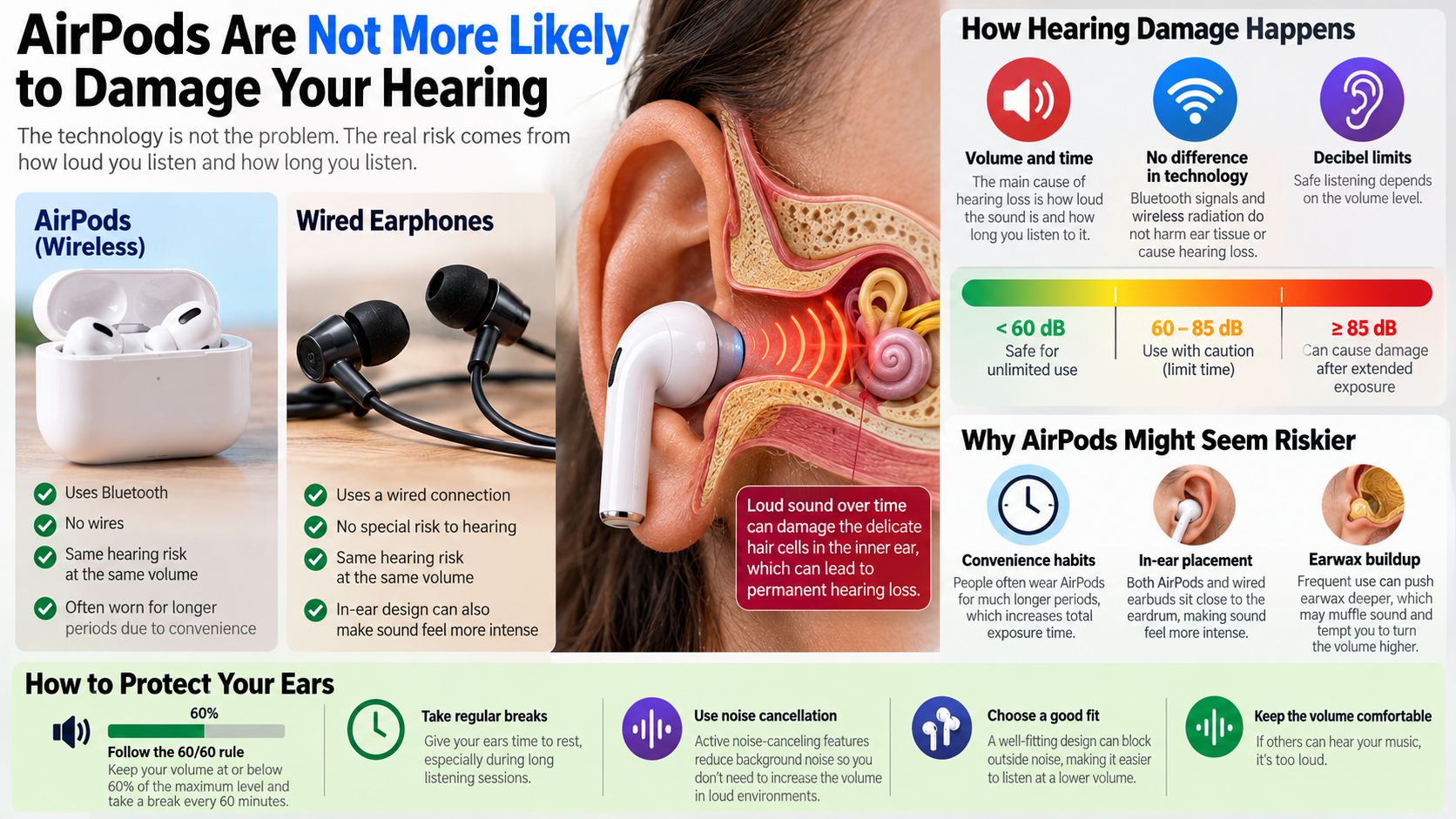
AirPods are not inherently worse for your hearing than wired earphones. Both can deliver sound directly into the ear canal, and excessive sound exposure can damage the sensitive structures involved in hearing.
The main factors are how loud you listen and how long you listen. Bluetooth technology does not create a special hearing risk simply because the connection is wireless.
The bigger issue can be your surroundings. Standard open-fit AirPods allow more outside sound to enter than many sealed earphones. In a noisy environment, you may increase the volume without realizing how loud the audio has become.
The Problem of Environmental Masking
Background noise can make safe listening more difficult. On a busy street, train, or airplane, you may raise your volume to hear music or podcasts clearly.
A better approach is to reduce the amount of background noise when possible. Noise-cancelling headphones or well-fitting earphones can make audio easier to hear without requiring excessive volume. Choosing the right noise-cancelling headphones can also make a noticeable difference in comfort and everyday listening.
However, noise isolation does not make loud listening safe. You can still expose your ears to harmful sound levels if you turn the volume up too far.
The key difference is therefore not AirPods versus wired headphones. It is your total sound exposure. For a broader comparison of the two formats, see wired vs. wireless audio and how each option fits different listening needs.
If two headphones produce the same sound level at your ears for the same amount of time, their wired or wireless connection does not make one automatically safer.
For safer listening, keep the volume comfortable and take regular breaks. Avoid increasing the volume simply to overpower nearby noise.
Which is safer, AirPods or wired earphones?
There is no universal winner between AirPods and wired earphones for hearing safety. Both can be used safely when you control volume and listening duration.
The design can still influence your habits. A well-fitting pair that blocks outside noise may make it easier to listen at a lower volume. This can be useful on trains, airplanes, and busy streets.
AirPods Pro and similar wireless earbuds also offer active noise cancellation (ANC). ANC reduces certain external sounds, particularly steady low-frequency noise. This can make music easier to hear without increasing the volume as much.
However, ANC should not be treated as hearing protection. It does not make unlimited listening safe. High-volume audio can still expose your ears to excessive sound.
Your choice should therefore focus on fit, comfort, and your ability to maintain a reasonable listening level.
How Active Noise Cancellation Can Help
Active noise cancellation can indirectly support safer listening habits. It reduces some surrounding sounds before they reach your ears. You may then need less volume to hear your music clearly.
This can be particularly useful in noisy environments. You might notice that your normal listening level remains comfortable even when a train or airplane becomes louder.
However, ANC does not prevent noise-induced hearing loss by itself. It is still possible to listen too loudly for too long.
Passive noise isolation can provide a similar benefit. Earphones with a suitable seal can reduce outside noise without using electronic cancellation.
The important point is simple: noise cancellation can help you avoid turning up the volume. It does not give you permission to listen at high levels for extended periods.
When choosing between AirPods and wired headphones, consider whether the design helps you maintain a comfortable volume. Also consider comfort, fit, and how long you typically wear them.
What is the 60/60 rule for using AirPods?
The 60/60 rule is a popular listening guideline. It generally means keeping your device volume around 60% or lower and limiting continuous listening to about 60 minutes before taking a break. You can also learn more about the 60-60 rule for headphones and how this listening guideline is commonly applied.
It is useful as a simple starting point, but it should not be treated as a precise medical safety threshold. A device’s 60% volume setting does not represent the same sound level across every phone, headphone, recording, or listening environment.
Actual exposure depends on the sound level reaching your ears and the length of exposure. For this reason, lower volume is preferable when possible.
The WHO recommends keeping personal audio device volume below 60% of maximum and using well-fitted, noise-cancelling headphones when appropriate. It also emphasizes managing both sound level and listening time.
Give Your Ears Regular Listening Breaks
Your inner ear contains tiny sensory cells that help convert sound vibrations into signals for the brain. Excessive noise exposure can damage these structures, and significant damage may be permanent.
Regular breaks can reduce your overall exposure. They also give you an opportunity to notice warning signs, such as ringing or muffled hearing.
You do not need to wait until your ears hurt before reducing the volume. Hearing damage can occur without obvious pain.
For everyday listening, consider these habits:
- Keep the volume at a comfortable level.
- Take regular breaks during long listening sessions.
- Avoid increasing volume to overpower background noise.
- Give your ears additional rest after loud events.
- Pay attention to ringing or muffled hearing after listening.
The goal is not to follow one perfect number. It is to reduce your overall exposure to excessively loud sound.
Do doctors recommend earbuds?
Doctors and hearing professionals do not generally consider earbuds automatically unsafe. The concern is how they are used, particularly when listening is loud or prolonged.
Earbuds sit close to the ear canal, so excessive volume can expose the ears to high sound levels. Wearing them for long periods can also contribute to discomfort or irritation.
Earwax is another consideration. Earbuds can interfere with the natural movement of earwax and may push wax deeper into the canal in some people. Poorly cleaned earbuds can also collect dirt and microorganisms.
That does not mean you should avoid earbuds completely. Instead, use a comfortable fit, keep the earbuds clean, and avoid inserting them deeply into your ears.
If you regularly experience ringing, muffled hearing, ear pain, discharge, or reduced hearing, stop using the earbuds and seek medical advice. Persistent symptoms should be evaluated by a healthcare professional.
Preventing Earwax Problems and Ear Infections
Earbuds can contribute to earwax problems when they are worn frequently or inserted too deeply. They may interfere with the ear’s normal ability to move wax outward.
Cleaning your earbuds can help maintain better hygiene. Follow the manufacturer’s cleaning instructions and avoid putting liquid directly into the device. For more detailed maintenance advice, learn how to clean and maintain your headphones without damaging them.
You should also avoid using cotton swabs deep inside the ear canal. They can push wax farther inward and irritate the delicate skin.
A few simple habits can reduce unnecessary problems:
- Keep earbud surfaces clean.
- Avoid sharing earbuds with other people.
- Choose a comfortable fit rather than forcing earbuds deeper.
- Give your ears breaks during long listening sessions.
- Seek medical advice for persistent pain, discharge, or hearing changes.
Earbuds themselves are not automatically responsible for ear infections or hearing loss. Problems are more likely to arise from factors such as excessive sound exposure, irritation, moisture, poor hygiene, or underlying ear conditions.
What headphones are healthiest for your ears?
There is no single headphone type that is automatically the healthiest for your ears. Over-ear headphones, wired earphones, AirPods, and other earbuds can all be used safely when sound exposure is kept within reasonable limits.
Over-ear headphones can be comfortable because their speakers sit outside the ear canal. They may also provide useful passive isolation, depending on their design.
Noise-cancelling over-ear headphones can make listening easier in noisy environments. This may reduce the temptation to increase the volume.
Bone-conduction headphones leave the ear canals relatively open. However, they are not immune to hearing risks. Excessive sound levels can still affect hearing because the device transmits vibrations to the inner ear.
The most useful choice is therefore the one that lets you hear clearly at a comfortable volume without needing to compensate for surrounding noise.
Why Volume and Listening Time Matter Most
The distance between a headphone speaker and your eardrum is not the main factor determining hearing damage. What matters more is the sound level reaching your ears and how long you are exposed to it.
Over-ear headphones do not automatically protect your hearing. If you listen at excessive volume for extended periods, they can still contribute to noise-induced hearing loss.
Likewise, AirPods do not automatically damage your ears simply because they sit inside the ear canal.
For safer everyday listening, focus on practical habits:
- Keep the volume at a comfortable level.
- Use noise cancellation or isolation when it helps you avoid raising the volume.
- Take regular breaks during long sessions.
- Avoid listening loudly in already noisy environments.
- Pay attention to ringing or muffled hearing after listening.
Ultimately, AirPods are not inherently more damaging than wired headphones. Your listening volume, exposure time, environment, and habits have a much greater influence on hearing risk.
Conclusion
Are AirPods more likely to damage your hearing than wired headphones? Not necessarily. The main risk comes from listening to sound that is too loud for too long, rather than from whether your headphones use Bluetooth or a cable.
So, are AirPods more likely to damage your hearing? When used at a comfortable volume with regular breaks, AirPods can be part of safe listening habits. Noise cancellation can also help you avoid increasing the volume in busy environments.
The type of headphones you choose matters less than how you use them. Keep the volume at a comfortable level, take regular breaks, and avoid using high volume to block out background noise. These simple habits can reduce unnecessary exposure to loud sounds.
Finally, pay attention to how your ears feel after listening. Temporary ringing or muffled hearing can be a warning that the sound was too loud. If these symptoms persist or you notice a change in your hearing, stop using the headphones and speak with a healthcare professional.