
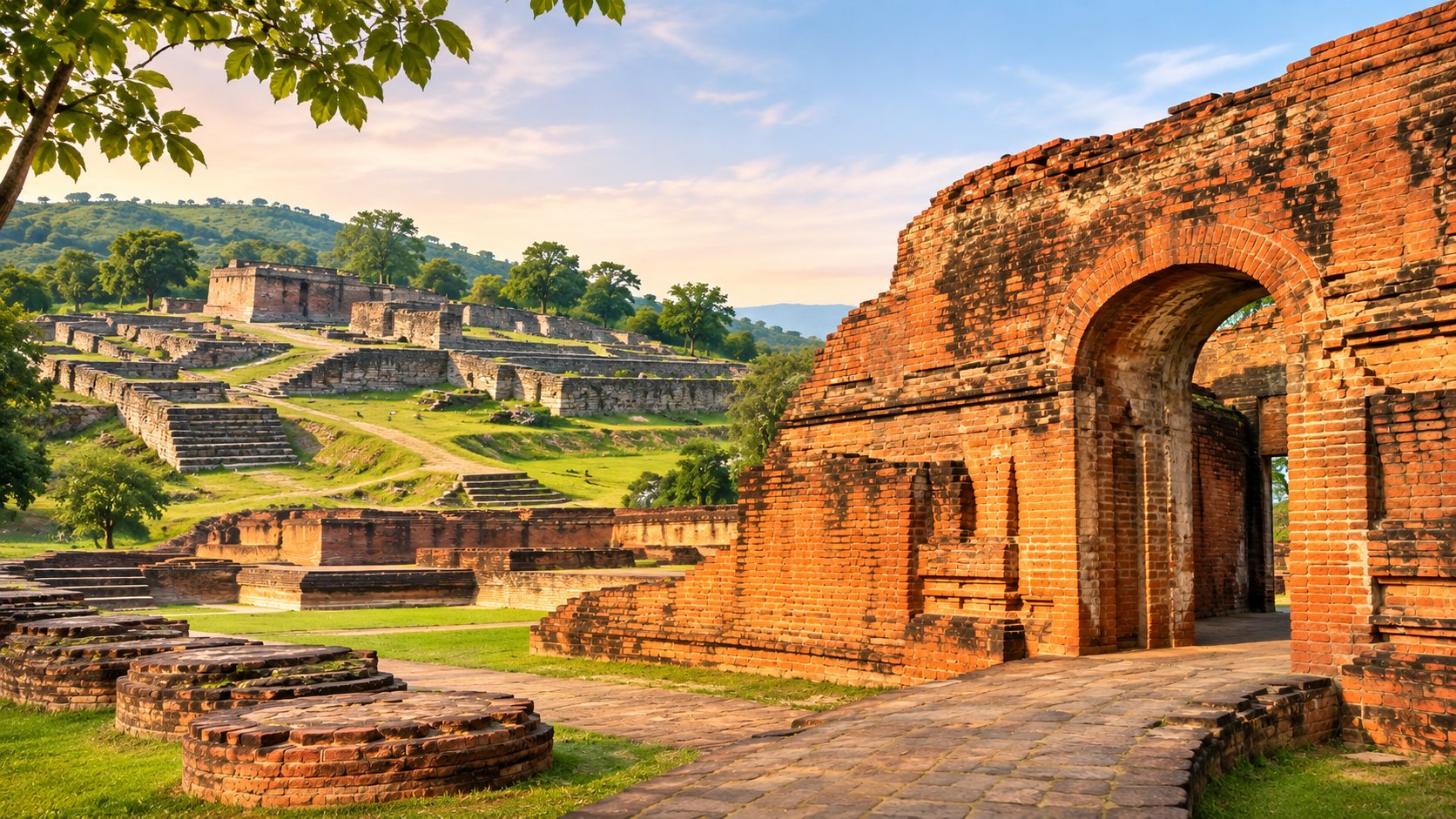
Ancient Indian Universities: Nalanda and Takshashila
Long before modern universities emerged in Europe, Nalanda and Takshashila became renowned centres of higher education. These ancient institutions attracted scholars and students from China, Tibet, Greece, and Central Asia. According to the UNESCO World Heritage Centre, Nalanda maintained an organized system of education for approximately 800 years. These learning centres played an important role in shaping philosophy, medicine, mathematics, astronomy, and Buddhist studies across Asia.
Understanding these academic centres offers valuable insight into India’s early education system. Both institutions became associated with influential scholars, including Chanakya, Panini, and Aryabhata. However, their timelines, teaching methods, organizational structures, and historical developments were quite different. Anyone interested in exploring this subject further can learn more about studying ancient history effectively.
In this guide, we answer seven important questions about these historic learning centres. You will discover which institution came first, who established them, and how they differed. We also explore ten ancient Indian universities, Nalanda’s original name, and the historical events surrounding their decline. Let’s explore the remarkable history of India’s earliest centres of higher learning.

Which university is older, Takshashila or Nalanda?
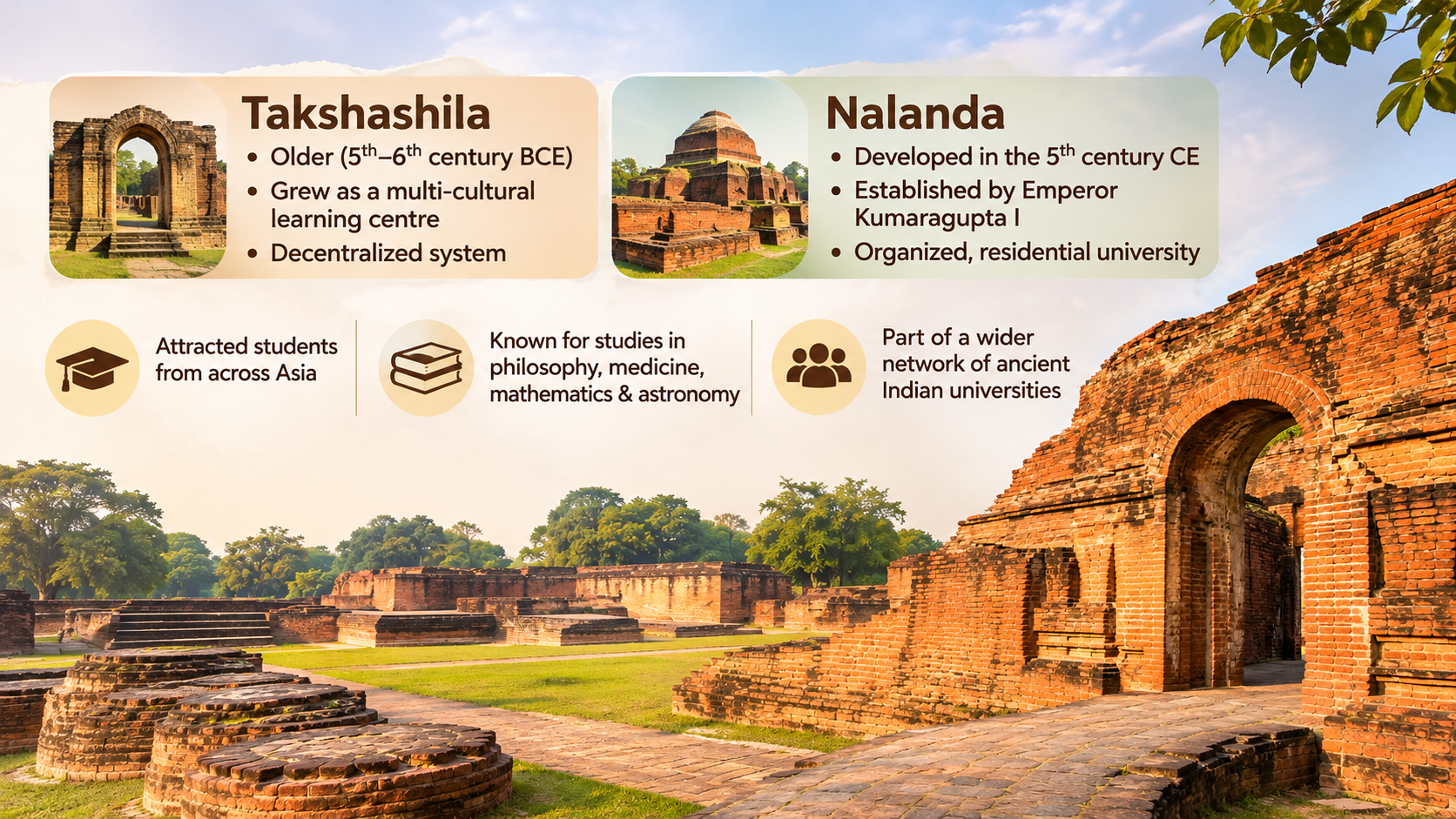
Takshashila is considerably older than Nalanda. Historians generally associate Takshashila with an established centre of learning from around the 5th or 6th century BCE. Some traditions suggest an even earlier origin, although archaeological evidence does not confirm every traditional date. In comparison, Nalanda developed into a major residential educational institution during the 5th century CE under the Gupta Empire.
This means Takshashila’s educational traditions existed several centuries before Nalanda became prominent. Takshashila flourished during the period of ancient Gandhara and later experienced the influence of Persian, Greek, and Central Asian cultures. Nalanda, meanwhile, became an important centre of Buddhist scholarship during India’s Gupta and subsequent Pala periods. To understand these developments in a broader historical context, explore the different ages of human history.
Both institutions represent important stages in the development of Nalanda and Takshashila as internationally recognized learning centres. Their histories demonstrate India’s long-standing contribution to education and intellectual exchange.
Archaeological Evidence of Their Timelines
Archaeological discoveries provide important evidence about the historical development of both institutions. Excavations at Taxila uncovered ancient settlements, Buddhist monasteries, and educational remains. UNESCO identifies Taxila as an important Buddhist learning centre between the 5th century BCE and 2nd century CE. These findings support its early historical significance. Researchers can also explore the best references for ancient history to understand how historical information is verified.
Nalanda’s archaeological remains reveal a different timeline. Excavations uncovered monasteries, temples, inscriptions, and educational buildings associated with its development. UNESCO identifies its major monastic and scholastic establishment with the period between the 5th and 13th centuries CE.
These discoveries establish Takshashila’s earlier prominence as a learning centre. However, they do not prove the exact founding dates of either institution. Archaeological evidence, historical inscriptions, and written accounts together help researchers understand their development.
Who established Nalanda and Takshashila University?
Different rulers, scholars, and historical communities contributed to the development of these ancient institutions. Nalanda’s establishment is traditionally associated with Emperor Kumaragupta I of the Gupta dynasty during the 5th century CE. Historical accounts identify him with Sakraditya, the ruler associated with its early foundation. Later Gupta rulers, Harshavardhana, and the Pala kings supported its expansion through financial contributions and royal patronage.
Takshashila followed a different pattern of development. Unlike Nalanda, it did not have one clearly documented royal founder or a centralized university administration. Instead, it gradually developed into an important intellectual centre in the ancient Gandhara region.
Its location along major trade routes encouraged cultural exchange and attracted scholars from different regions. Local rulers, wealthy merchants, and independent teachers contributed to its growth. Over generations, renowned teachers established their own learning traditions and attracted students seeking advanced education. This decentralized structure distinguished Takshashila from Nalanda’s organized residential system.
What are 10 ancient universities in India?
Ancient India had several important centres of education beyond Nalanda and Takshashila. These institutions attracted scholars, supported intellectual exchange, and preserved knowledge across different disciplines. Historical records, archaeological discoveries, and accounts from foreign travellers help researchers understand their importance.
Here are ten notable ancient Indian learning centres:
- Takshashila (modern-day Pakistan)
- Nalanda (Bihar, India)
- Vikramashila (Bihar, India)
- Valabhi (Gujarat, India)
- Odantapuri (Bihar, India)
- Somapura (modern-day Bangladesh)
- Pushpagiri (Odisha, India)
- Jagaddala (modern-day Bangladesh)
- Sharada Peeth (historical Kashmir region)
- Kanthalloor Sala (Kerala, India)
These centres supported different branches of knowledge. Their subjects included Buddhist philosophy, Sanskrit literature, grammar, mathematics, astronomy, medicine, logic, and religious studies.
However, not all these institutions operated like modern universities. Some functioned as monasteries, residential learning centres, or specialized educational establishments. Together, they demonstrate the diversity and reach of ancient South Asian education.
What is the difference between Nalanda University and Takshila university?
The main difference between Nalanda and Takshashila involved their educational structures and teaching arrangements. Nalanda Mahavihara operated as an organized residential institution with established administration, academic facilities, and a structured learning environment. Students and monks lived within its extensive campus. They attended lectures, participated in debates, and studied under experienced scholars. Historical accounts also describe competitive admission requirements.
Takshashila followed a more decentralized teaching system. It consisted of independent teachers and learning communities rather than one centralized university campus. Students approached respected teachers to study particular subjects. These included medicine, grammar, philosophy, politics, and military training.
Another important difference involved institutional organization. Nalanda maintained residential facilities, libraries, and a more unified academic environment. Takshashila relied heavily on individual teachers and their teaching traditions. Neither institution should be understood entirely through modern university standards. Nevertheless, both played influential roles in ancient education and intellectual development.
What is the old name of Nalanda University?
The historical name associated with Nalanda’s famous educational institution is Nalanda Mahavihara. The Sanskrit term Mahavihara means “great monastery” and reflects its Buddhist educational and residential character. Archaeological discoveries at Nalanda include seals carrying the inscription Sri-Nalanda-Mahavihara-Arya-Bhikshu-Sanghasya. This inscription connects the site with its monastic community.
The name Nalanda also has several traditional interpretations. One popular explanation connects it with the Sanskrit expression Na-alam-da, commonly interpreted as “insatiable in giving.” This interpretation reflects the institution’s association with generosity and knowledge sharing.
Chinese Buddhist pilgrim Xuanzang also recorded traditions explaining the origin of the name. One account connects Nalanda with a serpent deity associated with the region.
These historical and traditional explanations offer different perspectives on the name. However, Nalanda Mahavihara remains the most recognized historical designation for the ancient educational institution. Its name continues to represent India’s contribution to Buddhist scholarship and international education.
Who destroyed Takshila and Nalanda University?
The decline of Takshashila and Nalanda occurred during different historical periods. Takshashila experienced repeated political changes and invasions. Its importance gradually declined following the rise of new powers in the northwestern region. The invasions associated with the White Huns, particularly during the 5th century CE, contributed to the destruction of several settlements and Buddhist establishments. However, its decline resulted from multiple historical developments rather than one clearly documented attack.
Nalanda continued as an important educational centre for several centuries afterward. Its institutional activities weakened during the political and economic changes of the later medieval period. Around the late 12th and early 13th centuries, Buddhist institutions in Bihar experienced major disruption.
Bakhtiyar Khilji’s military campaigns around 1193–1200 CE are frequently associated with the destruction of major Buddhist establishments in Bihar. However, historians continue to debate the precise circumstances surrounding Nalanda’s destruction. The exact responsibility for the burning of its famous library remains uncertain.
The Loss of Priceless Manuscripts
Nalanda’s historical importance extended beyond its buildings and residential facilities. Its libraries preserved valuable manuscripts covering Buddhist philosophy, Sanskrit literature, medicine, mathematics, astronomy, and other subjects. Traditional accounts describe three major library buildings known as Ratnasagara, Ratnodadhi, and Ratnaranjaka. These collections represented centuries of scholarly activity and intellectual exchange.
The destruction of Nalanda’s library is often associated with Bakhtiyar Khilji’s military campaigns. However, surviving historical accounts do not conclusively establish that he personally burned the entire library. Researchers have also examined Tibetan historical traditions and archaeological evidence to understand the institution’s final years.
The loss of manuscripts represents an important cultural tragedy. Many ancient works disappeared, while other texts survived through copies preserved in Tibet and other parts of Asia. Today, Nalanda’s archaeological remains help historians reconstruct its educational legacy. UNESCO recognizes the site as an important example of early organized higher education.
Who was the founder of Takshashila University?
Takshashila does not have one historically confirmed founder in the way many modern universities do. Instead, traditional accounts connect the city’s foundation with Bharata, the younger brother of Lord Rama. According to the Ramayana, Bharata established a city in the Gandhara region and named it after his son, Taksha. This story forms part of the traditional explanation behind the city’s name.
Historical evidence presents a more gradual picture of Takshashila’s development. The city became an important centre of learning because of its strategic position along major trade routes. Its connections with different kingdoms encouraged cultural exchange and attracted scholars from distant regions.
Independent teachers established their own educational traditions and accepted students interested in specialized subjects. Over generations, these teaching communities strengthened Takshashila’s academic reputation.
Therefore, it is more historically accurate to describe Takshashila as a learning centre that developed over time rather than an institution founded by one confirmed individual. Its educational legacy remains an important part of ancient Indian history.
Frequently Asked Questions
What subjects were taught at Nalanda and Takshashila?
Both universities offered broad curricula covering religious and secular subjects. Students studied logic, grammar, philosophy, astronomy, mathematics, and medicine. Takshashila also taught practical skills like archery, hunting, military strategy, and law. Nalanda focused heavily on Mahayana Buddhism, Sanskrit literature, metaphysics, and logic.
Did foreign students study at these ancient universities?
Yes, thousands of international students traveled to India to study at both institutions. Chinese scholars like Xuanzang and I-Tsing spent years studying and copying texts at Nalanda. Takshashila welcomed students from Greece, Persia, Babylon, and Central Asia, creating truly multicultural classrooms.
How were students admitted to Takshashila?
Takshashila had no centralized entrance exam or formal admissions board. Students traveled to the city around age sixteen after completing their basic education at home. They approached individual teachers directly, and each master decided whether to accept the student based on personal interviews.
Does Nalanda University still exist today?
The ancient Nalanda Mahavihara remains a protected UNESCO World Heritage archaeological ruin in Bihar. However, the Government of India established a modern international Nalanda University near the ancient site in 2010. This modern institution revives the historic spirit of global Asian scholarship.
Conclusion
Exploring the history of Nalanda and Takshashila reveals how deeply ancient India valued critical thinking, debate, and global knowledge exchange. Takshashila pioneered flexible, master-led education in the 6th century BCE, while Nalanda perfected the organized residential university model in the 5th century CE. Together, these institutions shaped brilliant minds across Asia and laid foundational stones for modern higher education.
Understanding their rise and tragic destruction reminds us how fragile human knowledge can be. Even though invasions reduced their physical libraries to ashes, their intellectual legacy survives through surviving texts, archaeological ruins, and modern academic institutions.
If you want to experience this rich heritage firsthand, consider visiting the UNESCO-listed Nalanda ruins in Bihar or exploring the Taxila museum collections. Sharing these stories keeps India’s remarkable educational legacy alive for future generations.