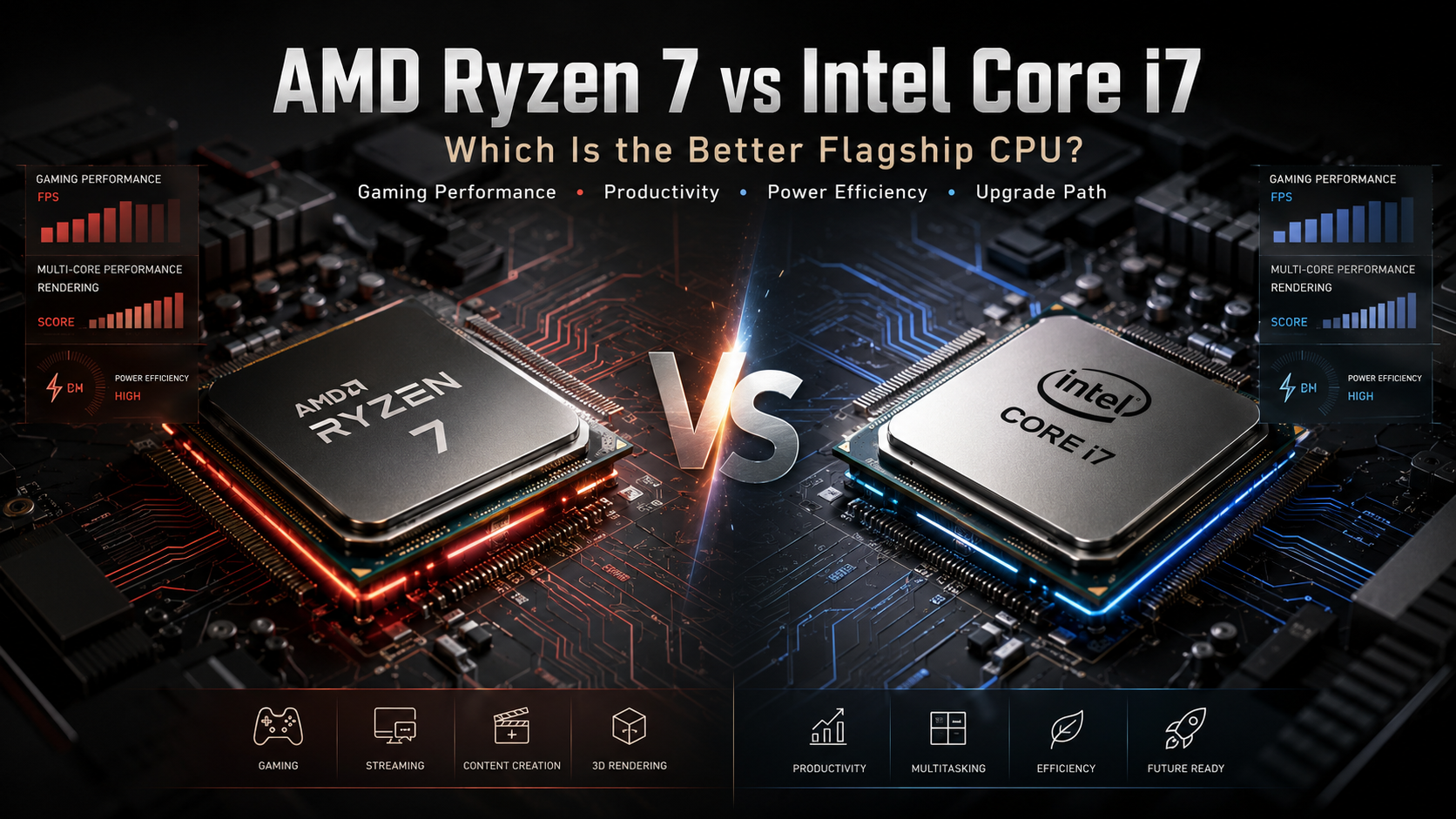
AMD Ryzen 7 vs Intel Core i7: Which Is The Better Flagship CPU?
Choosing the right processor is the most critical decision when building or buying a high-performance PC. For years, the fiercest battle in the hardware world has been AMD Ryzen 7 vs Intel Core i7, a matchup that defines the sweet spot for premium gaming and heavy productivity. Both CPU lineups offer incredible speed, but they approach performance differently. To find the absolute best option for your needs, you can look at the official specifications on the AMD website and the Intel product pages to see how their architectures have diverged.
This guide breaks down the core differences between these powerhouse chips. We will analyze gaming performance, multi-threaded productivity, power efficiency, and overall platform longevity. Whether you want to maximize frame rates or render complex 3D projects, this breakdown will help you choose the ideal processor.
Architecture Differences: Zen vs Hybrid Design
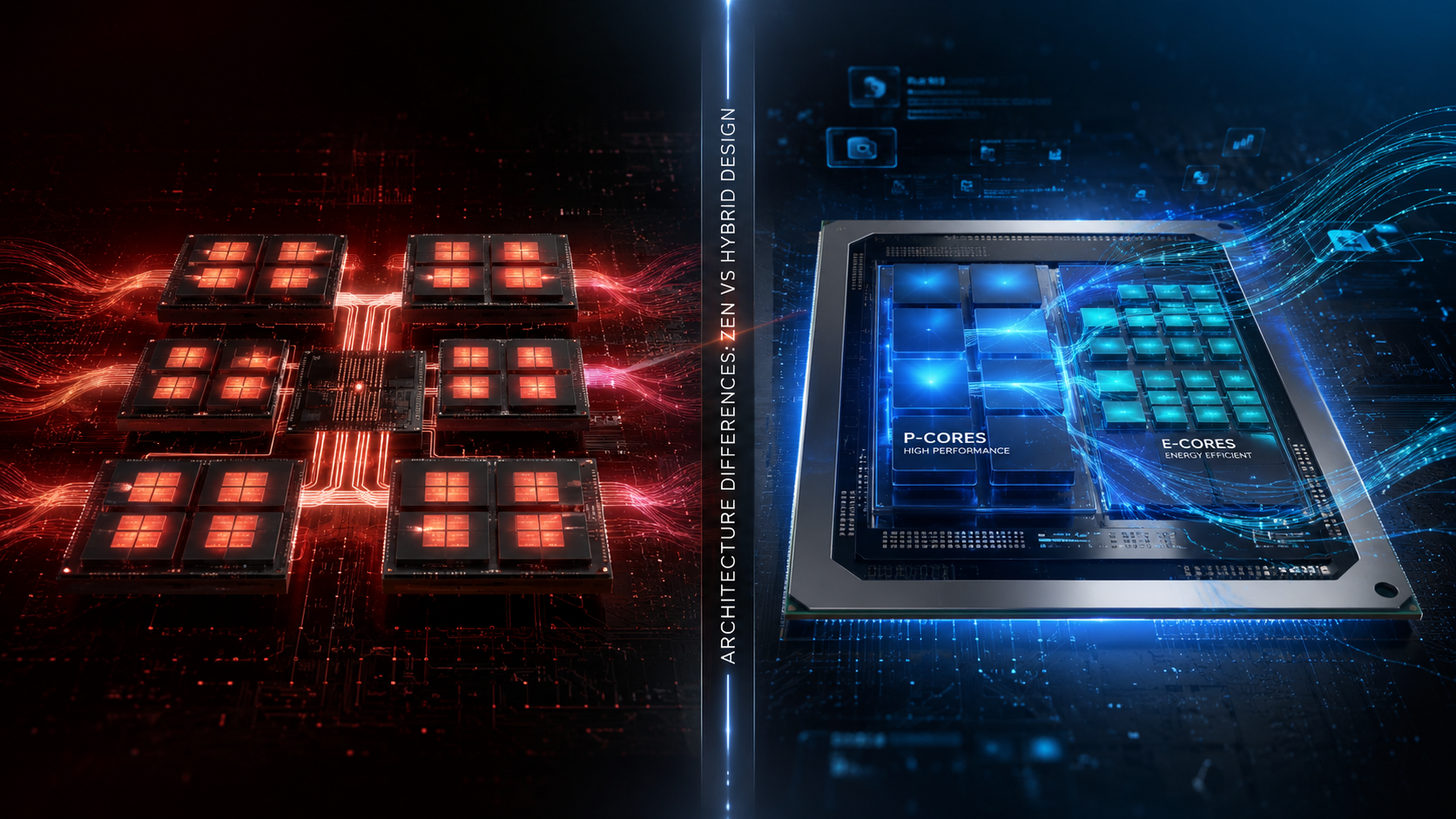
At the core of the AMD Ryzen 7 vs Intel Core i7 comparison is their completely different CPU architecture strategies. AMD relies on its Zen-based chiplet design, while Intel uses a hybrid architecture combining performance and efficiency cores. These design choices directly influence speed, power consumption, and multitasking ability.
AMD’s approach emphasizes consistency, where every core is equally powerful and capable of handling heavy workloads. Intel, on the other hand, divides responsibilities between specialized cores to maximize performance per task. This difference affects everything from gaming frame rates to video rendering speed. Understanding these architectural differences is key to knowing why each processor performs better in specific scenarios.
AMD Ryzen 7: Zen Architecture and Chiplet Efficiency
AMD Ryzen 7 processors are built on the Zen architecture, which uses a chiplet-based design. Instead of relying on a single large die, AMD splits components into smaller chiplets connected through high-speed interconnects. This improves manufacturing efficiency and reduces cost while maintaining strong performance.
A major advantage of Ryzen 7 CPUs is that every core is a full-performance core with simultaneous multithreading support. This ensures consistent performance across gaming, productivity, and multitasking workloads. Additionally, AMD often includes large L3 cache sizes, especially in 3D V-Cache models, which significantly improves gaming performance by reducing data access latency. This architecture is also known for better power efficiency, making Ryzen 7 CPUs cooler and quieter under load compared to many Intel counterparts.
Intel Core i7: Hybrid Core Technology Explained
Intel Core i7 processors use a hybrid architecture that combines Performance-cores (P-cores) and Efficient-cores (E-cores). The P-cores handle demanding tasks like gaming and rendering, while E-cores manage background processes and multitasking. This division allows Intel CPUs to achieve very high core counts and strong multi-threaded performance.
Intel also uses an advanced thread scheduler that dynamically assigns tasks to the most suitable cores. This results in excellent responsiveness in productivity applications and strong peak gaming performance due to high clock speeds. However, this design often leads to higher power consumption and heat output, especially under sustained heavy workloads. Despite this, Intel Core i7 processors remain highly competitive due to their raw speed and strong optimization in creative software.
Gaming Performance: Which CPU Wins FPS Battles?
When it comes to gaming, the AMD Ryzen 7 vs Intel Core i7 comparison becomes extremely close, but the winner often depends on the game type and resolution. Modern gaming performance is influenced by cache size, clock speed, and architecture efficiency.
AMD Ryzen 7 processors with 3D V-Cache technology often lead in gaming benchmarks. The massive cache reduces memory latency and improves frame pacing, which is especially beneficial in open-world, strategy, and simulation games. This results in smoother gameplay and higher minimum frame rates.
Intel Core i7 CPUs, however, rely on higher boost clock speeds and strong single-core performance. This makes them particularly effective in esports titles and older game engines that rely heavily on raw frequency. At higher resolutions like 1440p and 4K, the difference between the two becomes smaller since the GPU becomes the limiting factor. Overall, AMD often wins in pure gaming efficiency, while Intel remains a strong contender for high-FPS competitive gaming.
Productivity Performance: Editing, Rendering, and Multitasking
In productivity workloads, the AMD Ryzen 7 vs Intel Core i7 competition shifts toward multi-threading capability and software optimization. Tasks like video editing, 3D rendering, programming, and heavy multitasking benefit greatly from core count and architecture efficiency.
Intel Core i7 processors generally perform very well in rendering and encoding tasks due to their hybrid core setup. The combination of P-cores and E-cores allows them to handle large workloads efficiently, reducing render times in many professional applications. Intel also benefits from technologies like Quick Sync, which accelerates video encoding in supported software.
AMD Ryzen 7 CPUs, however, offer consistent performance across all cores, making them excellent for sustained workloads. They excel in tasks that require stability over long durations, such as scientific simulations and large-scale data processing. While Intel may edge ahead in some rendering scenarios, AMD provides a more balanced and efficient workflow experience.
Power Efficiency and Thermal Performance
Power efficiency plays a major role in the AMD Ryzen 7 vs Intel Core i7 comparison, especially for users concerned about heat, noise, and electricity consumption. AMD has a clear advantage in performance-per-watt efficiency.
Ryzen 7 processors are built using advanced manufacturing processes that allow them to deliver high performance while consuming less power. This results in lower temperatures and quieter cooling requirements, even under heavy workloads. Users can often pair Ryzen CPUs with mid-range air coolers without thermal issues.
Intel Core i7 processors, while extremely powerful, tend to consume significantly more power under load. Their high boost clocks and hybrid architecture demand more energy, which leads to increased heat output. As a result, Intel systems often require stronger cooling solutions such as high-end air coolers or liquid cooling systems to maintain peak performance.
Platform Longevity and Upgrade Path
Another important factor in the AMD Ryzen 7 vs Intel Core i7 debate is upgrade flexibility. This determines how long your motherboard and system can remain relevant before needing a full rebuild.
AMD has built a reputation for long-term socket support. Ryzen platforms often support multiple CPU generations, allowing users to upgrade their processor without replacing the motherboard. This makes AMD a cost-effective choice for long-term PC builds.
Intel, in contrast, changes motherboard sockets more frequently. While this allows them to introduce new technologies faster, it often means that upgrading to a newer CPU requires a new motherboard. For users who upgrade frequently, this can increase long-term costs significantly.
FAQ Section
Which processor is better for pure gaming, the Ryzen 7 or the Core i7?
For pure gaming performance, the answer in the AMD Ryzen 7 vs Intel Core i7 comparison often depends on the exact models being compared, but AMD Ryzen 7 chips with 3D V-Cache technology generally hold a consistent advantage. The large L3 cache reduces memory latency and allows the CPU to access frequently used game data much faster. This improvement translates into higher average frame rates, better 1% lows, and smoother overall gameplay, especially in modern AAA titles, open-world environments, and simulation-heavy games.
Intel Core i7 processors still deliver excellent gaming performance thanks to their high boost clock speeds and strong single-core efficiency. They perform particularly well in esports titles and older game engines that rely heavily on frequency rather than cache size. However, these gains often come with higher power consumption and increased heat output. Overall, for maximum gaming FPS and efficiency, Ryzen 7 with 3D V-Cache is usually the stronger choice.
Does the Intel Core i7 beat the Ryzen 7 in video editing?
In the AMD Ryzen 7 vs Intel Core i7 comparison for video editing, Intel Core i7 processors often have a slight advantage, but it is not absolute across all workflows. Intel’s hybrid architecture, which combines high-performance cores with efficiency cores, allows it to handle heavy rendering, exporting, and multitasking more effectively in many professional applications. This structure helps distribute workloads efficiently during tasks like 4K video editing, color grading, and complex timeline rendering.
Another key advantage is Intel Quick Sync technology, which accelerates video encoding and decoding directly through dedicated hardware. This results in smoother playback, faster exports, and improved responsiveness in software like Adobe Premiere Pro and DaVinci Resolve. However, AMD Ryzen 7 processors still perform strongly, especially in sustained workloads due to their consistent full-performance cores and efficient power usage. In real-world use, Intel often leads in speed, while AMD provides better thermal efficiency and stability.
Are AMD Ryzen 7 processors more power-efficient than Intel Core i7?
In the AMD Ryzen 7 vs Intel Core i7 comparison, AMD Ryzen 7 processors are generally more power-efficient, especially when running sustained heavy workloads. AMD achieves this advantage through its Zen architecture and chiplet-based design, which focuses on delivering strong performance per watt rather than simply pushing higher power limits. As a result, Ryzen 7 CPUs often complete demanding tasks like rendering, encoding, and simulation work while consuming less electricity compared to many Intel Core i7 processors in the same performance range.
This improved efficiency also translates into lower heat output, which helps maintain more stable performance over long sessions. Users can often pair Ryzen 7 chips with mid-range air coolers while still achieving excellent thermal control. In contrast, Intel Core i7 processors typically draw more power under load due to their high boost frequencies and hybrid core design, which can lead to increased temperatures and a greater need for robust cooling solutions.
Can I upgrade my CPU in the future on both platforms?
In the AMD Ryzen 7 vs Intel Core i7 comparison, both platforms allow CPU upgrades, but they differ significantly in long-term flexibility. AMD is generally known for better platform longevity, meaning its motherboard sockets tend to be supported across multiple CPU generations. This allows users to upgrade from one Ryzen 7 processor to a newer Ryzen generation without necessarily replacing the motherboard, as long as the chipset and BIOS support it. This approach makes AMD a more cost-effective option for users who plan gradual upgrades over time.
Intel, on the other hand, typically changes its socket design more frequently, often within one to two generations. This means that upgrading to a newer Core i7 or higher-tier CPU may require a new motherboard, and sometimes even new supporting components like RAM depending on the platform shift. While Intel focuses on introducing new technologies faster, AMD generally provides a longer and more stable upgrade path for budget-conscious upgraders.
Do these processors require different types of RAM?
In the AMD Ryzen 7 vs Intel Core i7 comparison, both platforms now commonly support modern DDR5 RAM, but compatibility depends more on the specific generation and motherboard than the CPU alone. AMD’s newer Ryzen 7 platforms are fully focused on DDR5 memory, meaning users building or upgrading to a modern AMD system will typically need to purchase DDR5 RAM. This shift is aimed at maximizing bandwidth and overall system performance, especially in gaming and productivity workloads.
Intel Core i7 systems offer slightly more flexibility because some motherboard chipsets still support DDR4 alongside DDR5. This allows users to reuse existing DDR4 memory, which can significantly reduce the cost of a new build. However, newer Intel platforms are also moving toward DDR5-only support over time. In practical terms, both CPUs work best with DDR5 for maximum performance, but Intel may offer a more budget-friendly upgrade path depending on the motherboard you choose.
Conclusion
The debate between the AMD Ryzen 7 vs Intel Core i7 ultimately comes down to your daily computing habits. Neither processor will disappoint you, but they excel in entirely different environments.
Choose the AMD Ryzen 7 if your primary focus is high-frame-rate gaming, long-term upgrade options, and excellent power efficiency. The chiplet architecture runs cool, keeps your power bills low, and provides an easy upgrade path for future component releases. It is the definitive choice for pure gamers and efficiency enthusiasts.
Opt for the Intel Core i7 if you are a heavy multitasker, content creator, or video editor who needs maximum multi-threaded horsepower. The hybrid core design handles intensive rendering pipelines with ease, and the raw clock speeds deliver snappy performance across professional applications. Just ensure you pair it with a robust cooling solution to manage the thermal output effectively.
For a deeper understanding of how memory choice impacts CPU performance and overall system speed, read this our guide on DDR4 vs DDR5 in 2026.