
Which AMD CPU Is Best for Gaming in 2026?
Building or upgrading a gaming PC requires a balance of performance, power efficiency, and long-term value. Choosing the best AMD CPU in 2026 can improve frame rates, reduce performance dips, and help your graphics card reach its potential. Modern games benefit from fast cores, large caches, and efficient communication between processor components.
AMD’s 3D V-Cache technology has made its Ryzen X3D processors leading options for gaming. However, the fastest processor is not always the best purchase for every build. Your budget, graphics card, monitor resolution, and other workloads all influence the right choice.
This guide compares AMD’s leading gaming processors and explains which models suit different budgets. It also covers CPU upgrades, cooling requirements, upcoming processor developments, and AMD versus Intel. By understanding these factors, you can choose a gaming processor that delivers the performance you need without overspending.
What Is the Best AMD CPU in 2026?
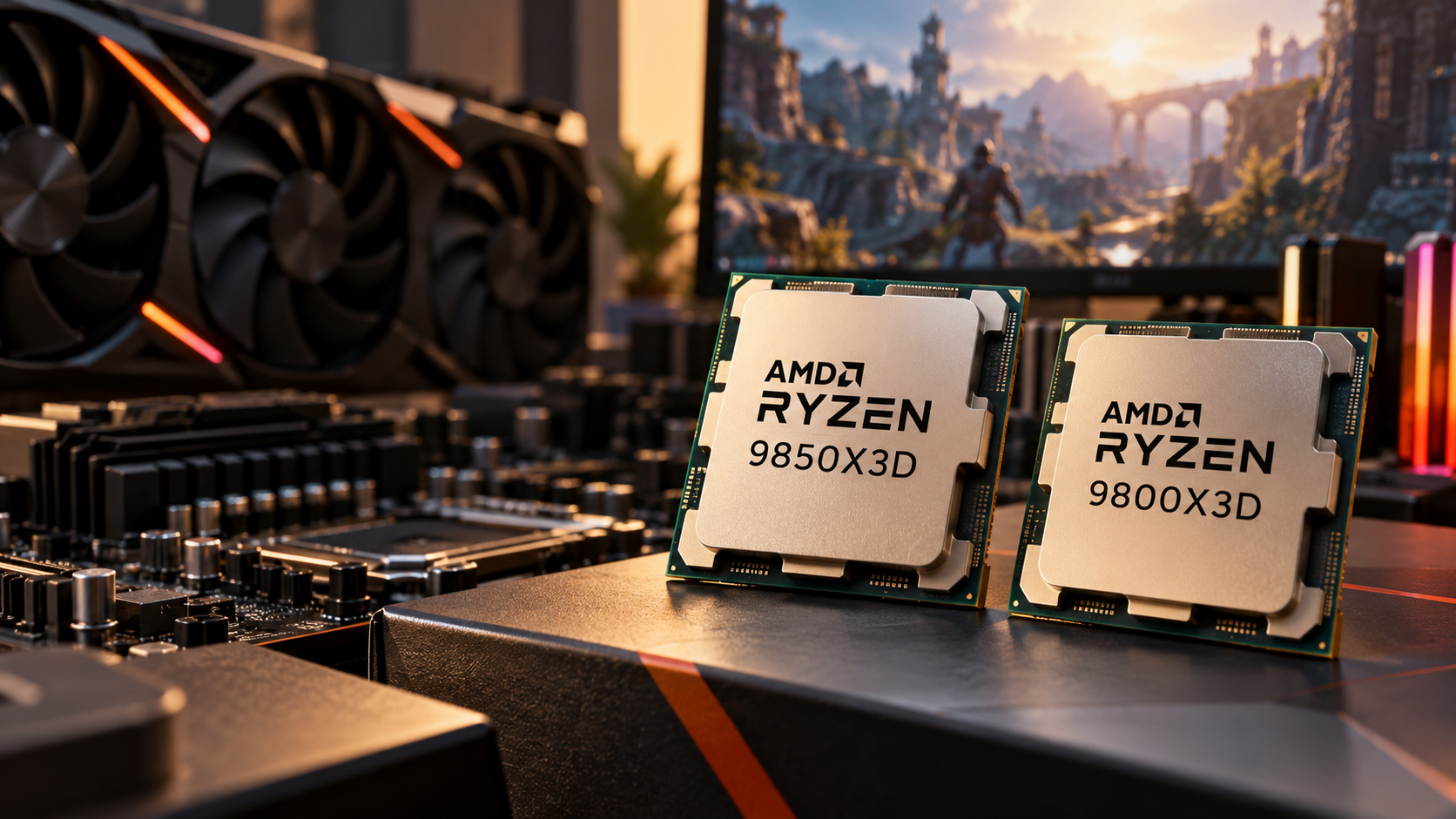
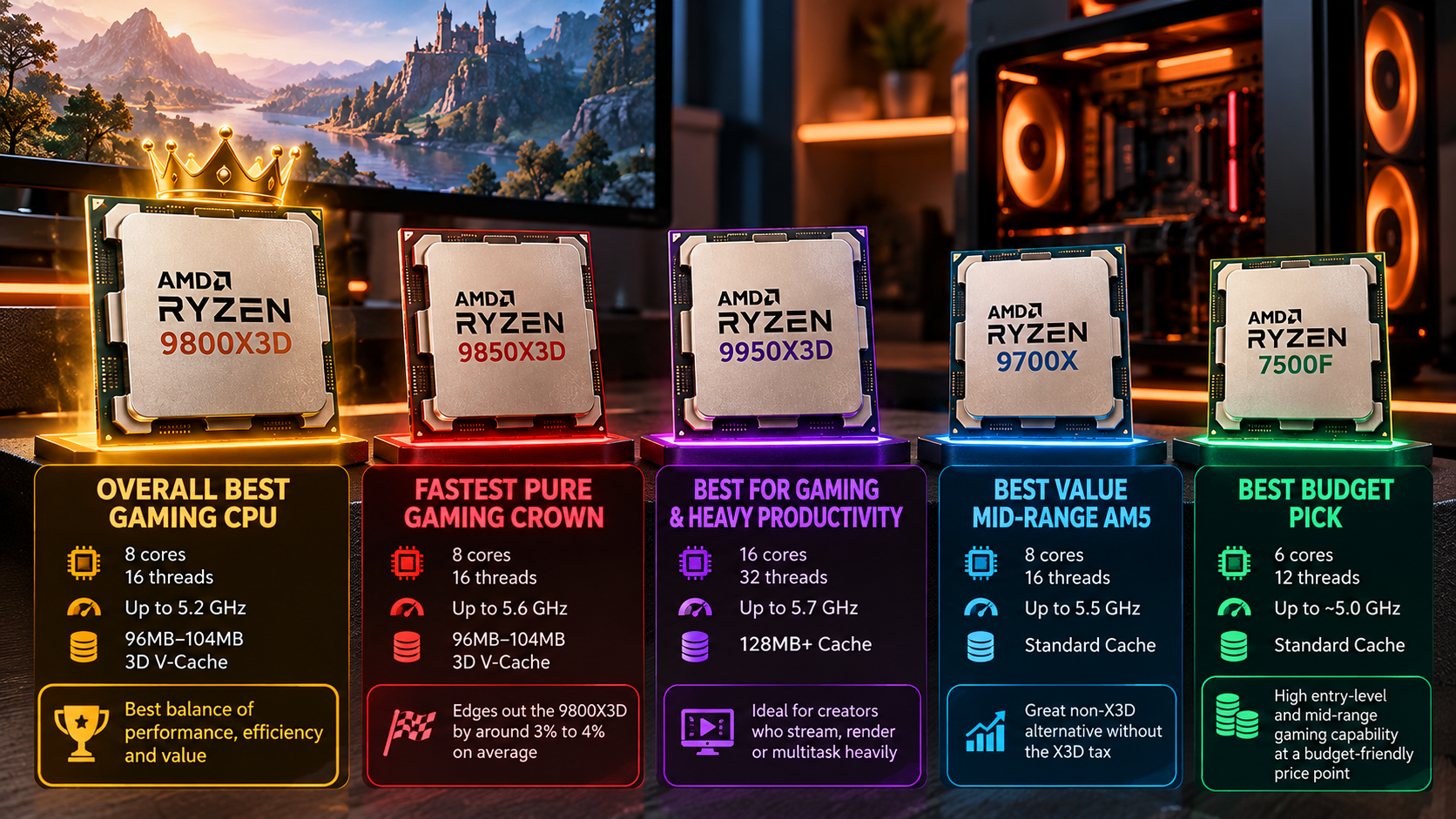
The AMD Ryzen 7 9850X3D is a leading choice for maximum gaming performance in 2026. It edges out the Ryzen 7 9800X3D in many gaming benchmarks, although the difference varies by game and system configuration. The 9800X3D remains an excellent alternative when its lower price makes it better value. Both processors feature eight cores, 16 threads, and 96 MB of L3 cache.
AMD’s second-generation 3D V-Cache places the additional cache beneath the processor’s core complex. This arrangement improves thermal transfer and supports higher clock speeds than the previous generation’s design. Games that frequently access large amounts of data can benefit from the reduced memory latency.
Before buying, compare current prices and independent gaming benchmarks. Also consider your graphics card, cooling solution, and motherboard compatibility. For official specifications, consult AMD’s Ryzen 7 9800X3D product page.
Next-Level Thermal Headroom and Overclocking
The Ryzen 7 9800X3D supports CPU overclocking, Precision Boost Overdrive, and Curve Optimizer adjustments. Its revised cache layout improves thermal management compared with earlier X3D designs. However, actual temperatures depend on the cooler, case airflow, ambient temperature, and workload. Before changing processor settings, review how to overclock your CPU safely to understand the risks and stability checks involved.
You do not need extreme overclocking to enjoy strong gaming performance. Start with default settings, enable a compatible memory profile, and monitor stability before changing advanced settings. DDR5-6000 can be a practical target for many AM5 gaming builds, but the ideal memory configuration depends on the processor and motherboard.
Choose a capable air cooler or liquid cooler based on your case and noise preferences. Check the manufacturer’s cooling guidance before purchasing. Remember that overclocking results vary, and higher voltages or aggressive settings can increase heat and reduce stability.
Which Processor Is Best for Gaming in 2026?
For gamers seeking the highest frame rates, an eight-core Ryzen X3D processor is an excellent starting point. The Ryzen 7 9850X3D targets maximum gaming performance, while the Ryzen 7 9800X3D offers a closely related experience. Both combine eight cores and 16 threads with 96 MB of L3 cache.
However, eight cores are not a universal requirement for every game. Many titles run well on six-core processors, particularly when paired with a suitable graphics card. Strategy games, simulations, and competitive titles can benefit significantly from fast cores and additional cache. Meanwhile, streaming, video editing, and demanding productivity workloads may benefit from more cores.
A processor with 12 or 16 cores is not automatically slower in games. Performance depends on architecture, clock speeds, cache, scheduling, and the specific game. Some multi-CCD processors can experience additional communication latency, but the impact varies by design.
Compare benchmarks for the games you actually play. That approach is more useful than choosing a CPU based only on core count.
The 1% Low Metric That Determines Real Playability
Average frame rates show overall performance, but they do not tell the whole story. 1% low frame rates help reveal how smoothly a game performs during its slower moments. Higher results generally indicate fewer severe frame-rate drops.
Large caches can improve these results in games that repeatedly access CPU-related data. This can make gameplay feel more consistent during busy scenes, complex simulations, or rapid changes in the environment. However, cache does not eliminate every stutter. Shader compilation, storage activity, memory limitations, drivers, and game optimization can also affect smoothness.
When comparing gaming processors, review average FPS and 1% lows together. Use benchmarks that test similar graphics settings and hardware. A CPU that delivers slightly higher average FPS may still provide less consistent frame pacing in some titles. Your monitor also affects the experience, so consult this guide on choosing the perfect gaming monitor to match its resolution and refresh rate to your system.
For competitive gaming, prioritize responsiveness and stable performance. For visually demanding games, balance CPU performance against the graphics card’s capabilities.
What CPU Should I Buy in 2026?
The best AMD CPU for your PC depends on your budget, gaming resolution, and graphics card. If you want maximum frame rates at 1080p or 1440p, consider the Ryzen 7 9850X3D or Ryzen 7 9800X3D. These processors are particularly useful when a powerful GPU can produce very high frame rates. If you are unsure whether your processor limits gaming performance, learn how to tell if your CPU is bottlenecking before spending more on an upgrade.
For a more balanced mid-range build, the Ryzen 5 9600X offers six cores and 12 threads. The Ryzen 7 9700X is another option if you want eight cores for gaming and additional workloads. Both use the AM5 platform and DDR5 memory.
At 4K resolution, the graphics card often becomes the main performance limit. A less expensive CPU may therefore deliver similar frame rates in GPU-bound games. The Ryzen 5 7600 can also remain attractive for budget-conscious builders, depending on its local price and the cost of a complete AM5 build.
Before deciding, compare total platform costs. Include the motherboard, memory, cooler, and power supply, rather than evaluating the processor price alone.
Platform Costs and Component Synergy
A gaming processor performs best when paired with compatible, balanced components. For most new AM5 builds, a suitable B650 or B850 motherboard can provide the features needed for gaming without requiring a premium chipset. Check the board’s supported processors and BIOS version before ordering. If you are planning a complete gaming setup, compare the costs and benefits of building your own PC before deciding where to spend your budget.
AM5 processors use DDR5 memory, so existing DDR4 memory cannot be reused on this platform. A two-module memory kit is generally a practical choice for a typical gaming system. Check the motherboard’s memory support list and enable the appropriate memory profile after installation.
Your graphics card deserves equal attention. Spending more on a CPU while using a much slower GPU may deliver less gaming improvement than upgrading the graphics card. Conversely, a powerful GPU benefits from a fast processor when targeting high refresh rates.
Budget for sufficient cooling, reliable power delivery, and adequate case airflow. These components help maintain consistent performance and reduce unnecessary noise. A balanced build usually provides better value than purchasing the most expensive part in every category.
Is AMD Releasing New CPUs in 2026?
AMD’s processor lineup continues to evolve, with newer models and product updates expanding the available choices. The Ryzen 7 9850X3D is one example of how AMD continues refining its gaming-focused desktop processors. Buyers should check official announcements and current reviews before assuming an unannounced architecture or release date.
New processors can offer higher clock speeds, architectural improvements, or better performance per watt. However, a newer name does not guarantee a worthwhile upgrade. The actual benefit depends on gaming benchmarks, pricing, power requirements, and the performance of your current CPU.
If you are building a PC now, compare available processors rather than delaying a purchase for unspecified future products. Waiting may make sense when an announced launch is close and your current system meets your needs. Otherwise, choose hardware based on verified performance and value.
For the latest specifications and announcements, use AMD’s official Ryzen processor information. Review release details carefully, as availability and pricing can differ between markets.
Should I Buy AMD or Intel in 2026?
AMD is a strong choice for dedicated gaming PCs, particularly if you want the high frame rates offered by Ryzen X3D processors. Models such as the Ryzen 7 9850X3D and Ryzen 7 9800X3D perform especially well in many CPU-limited games. However, AMD is not automatically the best choice for every buyer.
Intel processors can offer competitive gaming performance and strong productivity results at certain price points. The better option depends on the specific CPUs, applications, motherboard costs, and available discounts. Hybrid core designs can affect scheduling in some workloads, but they do not make every Intel processor slower in games.
Platform longevity also matters. AMD has committed to supporting AM5 through 2029, giving buyers a clearer stated upgrade horizon. Intel buyers should check the compatibility and expected upgrade options of their chosen platform rather than relying on general assumptions about socket changes.
Compare current independent benchmarks and complete build costs before deciding. If gaming is your priority, start with gaming results. If you also render video, compile code, or run demanding applications, consider those workloads before choosing a processor.
Power Efficiency and Everyday Cooling Demands
Power consumption affects temperatures, fan noise, and the cooling required for a gaming PC. AMD’s Ryzen processors offer several efficient options, but power use varies by model and workload. Do not assume that every AMD CPU consumes less electricity than every competing Intel processor.
The Ryzen 7 9800X3D has a default thermal design power (TDP) rating of 120 W. TDP is not the same as measured electricity consumption during gaming. Actual power draw depends on the game, processor settings, motherboard configuration, and workload intensity.
For a quieter PC, select an appropriate cooler and case with good airflow. A well-designed enclosure can support effective air or liquid cooling, depending on your components and layout. Use reasonable fan curves and avoid unnecessary voltage increases. These steps can help control noise without sacrificing much performance.
If electricity costs matter, compare measured gaming power consumption rather than relying on TDP alone. A processor that delivers strong frame rates at moderate power can be an excellent choice for everyday gaming. Your graphics card will also contribute substantially to the system’s total energy use.
Conclusion
Choosing the best AMD CPU in 2026 depends on your gaming goals, budget, and overall PC setup. The Ryzen 7 9850X3D is a strong option for gamers seeking maximum frame rates, while the Ryzen 7 9800X3D delivers excellent gaming performance. For budget-conscious builders, the Ryzen 5 9600X and Ryzen 5 7600 offer practical alternatives. Before buying, compare gaming benchmarks, current prices, cooling requirements, and motherboard compatibility. Ultimately, the right processor is not necessarily the most expensive one. It is the CPU that delivers the performance you need while leaving enough budget for a balanced gaming PC.