What Is the Average Lifespan of a Portable Battery Bank?
The average lifespan of a portable battery bank depends on its cells, charging habits, heat exposure, and usage pattern. Most modern power banks use lithium-ion or lithium-polymer batteries. These batteries gradually lose capacity because of normal chemical aging.
There is no single number that applies to every power bank. Some packs may remain useful for several years, while heavily used or poorly stored units can degrade sooner. Battery age also matters even when the pack is rarely used.
Battery University notes that lithium-ion battery life changes with factors such as depth of discharge, temperature, charge level, and current. Smaller discharge cycles generally place less stress on the cells.
Capacity also affects how often you need to recharge the bank. A 20,000mAh model may require fewer cycles than a 10,000mAh model for the same workload.
This guide explains how long portable battery banks can last. It also covers 10,000mAh, 20,000mAh, and 50,000mAh models. You will learn how capacity affects daily use and how to store your power bank safely.
How long do portable battery banks last?
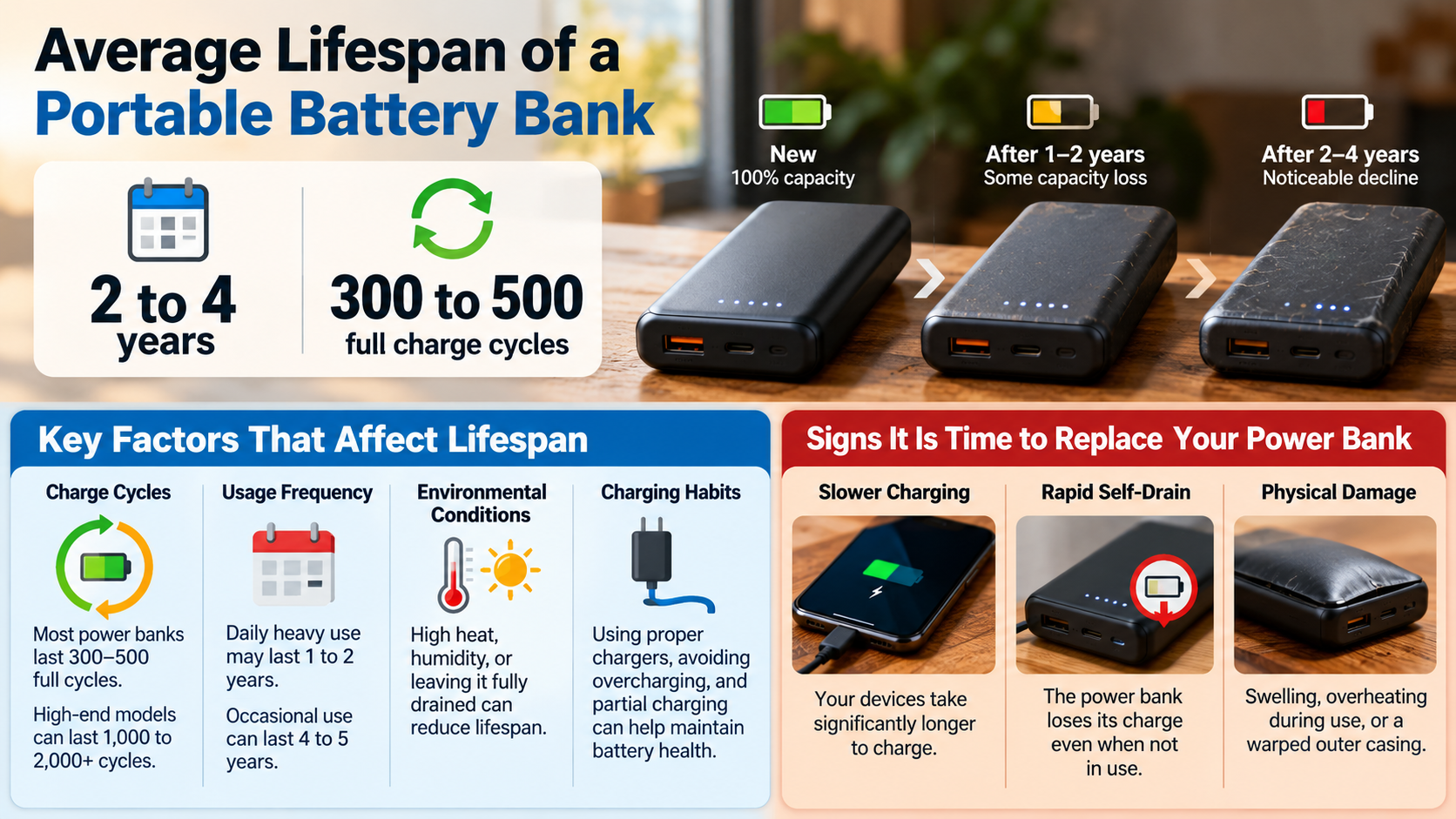
A portable battery bank can remain useful for several years, but its exact lifespan varies widely. There is no universal two-to-four-year limit for every lithium power bank. Battery chemistry, cell quality, temperature, charging behavior, and usage all affect degradation.
Cycle life is also more complicated than simply counting full charges. One full cycle represents cumulative discharge equal to the battery’s full capacity. Several partial discharges can therefore add up to one cycle. For a deeper look at how these measurements relate to battery longevity, see battery health vs. cycle count.
Battery University shows that shallower discharge cycles can provide substantially more cycles than repeated deep discharges. Heat and prolonged high charge levels can also accelerate capacity loss.
For everyday use, follow these habits:
- Avoid unnecessary deep discharges.
- Keep the battery away from excessive heat.
- Use a compatible charger and cable.
- Avoid storing the pack completely empty.
- Do not leave a damaged or swollen pack in service.
A power bank is usually nearing the end of its useful life when capacity has dropped noticeably or charging performance becomes unreliable.
Maximizing Daily Cycle Durability
You cannot stop lithium batteries from aging, but you can reduce unnecessary stress. One of the simplest methods is avoiding repeated full discharges when you do not need them.
A battery does not need to reach zero before you recharge it. Partial charging and partial discharging can reduce stress compared with repeatedly using the entire battery range. Battery University specifically identifies depth of discharge as an important factor in lithium-ion cycle life. Similar charging habits can also affect the batteries in your everyday devices, as explained in our guide to smartphone mistakes that reduce battery life.
Temperature is equally important. High temperatures can accelerate permanent capacity loss, especially when a battery remains highly charged. Storage around moderate room temperature is generally preferable to hot cars, direct sunlight, or other extreme environments.
For better long-term battery health:
- Recharge before the pack stays empty for long periods.
- Avoid unnecessary exposure to high heat.
- Do not use a damaged charging cable.
- Follow the manufacturer’s charging instructions.
- Store an unused pack at a moderate charge level.
These habits cannot guarantee a specific lifespan. They can, however, reduce avoidable battery stress.
How long will a 20000mAh power bank last?
A 20,000mAh power bank stores substantially more energy than a 10,000mAh model. However, the printed mAh figure does not represent the exact amount delivered to your devices.
A typical 20,000mAh lithium power bank stores about 74Wh when its cells are rated around 3.7V. The power bank must then convert that energy to the voltage required by your phone, tablet, or laptop. Conversion losses reduce the energy available at the output.
Real-world charging counts depend on the device. A modern smartphone may receive several charges, while a laptop may receive only a partial charge. Your device’s battery size, charging efficiency, cable, and power-bank output all affect the result.
For lifespan, capacity alone does not determine durability. A 20,000mAh pack used lightly may experience fewer cycles than a smaller pack used every day.
Store it in a cool, dry location and avoid leaving it fully discharged for extended periods.
How long will a 10000mAh battery pack last?
A 10,000mAh battery pack is a common choice for everyday phone charging. Its smaller size makes it easier to carry than higher-capacity models.
Its actual output is lower than the number printed on the case. A 10,000mAh pack rated around 3.7V stores roughly 37Wh. After voltage conversion and other losses, the usable output can be considerably lower.
In practical use, many 10,000mAh power banks can provide around one or two smartphone charges. The exact number depends on your phone’s battery size and charging efficiency. A larger phone battery will naturally require more energy.
Its lifespan also depends on usage rather than capacity alone. Someone who recharges the pack every day can accumulate cycles faster than someone who uses it only during occasional trips.
The best approach is simple: avoid unnecessary deep discharges, limit heat exposure, and store the battery correctly between uses.
How long will a 50000mAh power bank last?
A 50,000mAh power bank stores much more energy than typical pocket-sized models. At a nominal cell voltage of about 3.7V, 50,000mAh corresponds to roughly 185Wh of stored energy before conversion losses.
That capacity can support several device recharges, but the exact number depends on the device and power bank. A phone with a smaller battery will receive more charges than a laptop with a larger battery.
A large power bank may also experience fewer full cycles if you use it for occasional trips. That can reduce cycle accumulation compared with a smaller bank used every day. However, calendar aging still occurs even when the device is rarely used.
Storage becomes particularly important for large packs. Do not leave one completely discharged for long periods. For extended storage, follow the manufacturer’s recommended charge level and temperature range.
Also consider transportation rules. A 50,000mAh pack can be around 185Wh at 3.7V, which exceeds the 100Wh threshold commonly used for passenger-aircraft power-bank limits. Always check the airline’s current rules before traveling with a high-capacity pack.
Frequently Asked Questions
Can a power bank explode if it gets too old?
Catastrophic failures are rare in reputable models, but aging lithium batteries can swell, emit odor, or overheat when internal components degrade. Modern power banks incorporate safety chips to prevent overcharging and short circuits. If you notice your battery case bulging, stop using it immediately, avoid charging it, and take it to an approved electronics recycling center.
Does fast charging degrade a battery bank faster?
Yes, continuous high-wattage fast charging generates additional heat, which accelerates chemical degradation inside the lithium cells. While modern Power Delivery protocols actively regulate wattage to preserve safety, routine charging at cooler, moderate speeds preserves total cycle life. The same concern applies to smartphones, so you can also learn more about whether fast charging ruins your phone battery. Reserve high-wattage fast charging for situations when you genuinely need rapid power on the road.
How should I store a power bank when not in use?
Store your power bank in a temperature-controlled environment away from moisture and direct sunlight. Charge the battery to approximately 50 to 60 percent before putting it away, rather than leaving it completely full or totally depleted. Similar concerns apply to leaving rechargeable devices connected for long periods, so it is worth understanding whether overnight charging ruins your smartphone battery.
Why does my battery bank lose power without being used?
All lithium battery packs suffer from natural self-discharge, alongside tiny power draws from internal monitoring and management circuits. High-quality power banks typically lose around 2 to 5 percent of their stored capacity each month. Storing batteries in warm rooms speeds up this parasitic discharge, so keep your backup gear in cool storage areas.
Conclusion
The average lifespan of a portable battery bank cannot be reduced to one guaranteed number. Many power banks can remain useful for several years, but actual service life depends on battery chemistry, usage, heat, charging habits, and storage conditions.
Capacity also changes how frequently you need to recharge the device. A 10,000mAh power bank may suit everyday phone backup, while a 20,000mAh model provides more stored energy for longer trips. A 50,000mAh model offers substantially more capacity but is much larger and may face additional travel restrictions.
For longer battery life, focus on simple habits:
- Avoid unnecessary deep discharges.
- Keep the battery away from excessive heat.
- Follow the manufacturer’s charging instructions.
- Store unused batteries at a moderate charge level.
- Inspect the power bank for swelling or physical damage.
Do not rely on a generic cycle count as a guarantee. Lithium-ion battery life varies significantly with operating conditions and battery design. For more detailed information about lithium battery aging, charging, and storage, see this Battery University guide to prolonging lithium-based batteries.
With sensible charging, storage, and handling, you can reduce avoidable battery stress and get more useful years from your portable power bank.